The Toy Truck Semi Circus Buddy L: Engineering, Iconography, and Auction Value of a Mid-Century American Classic
A detailed appraisal of the 1950s Buddy L Toy Truck Semi Circus trailer—its manufacturing origins at Metalcraft Corp., die-cast zinc alloy construction, precise dimensions (24.5" L × 8.75" W × 11.25" H), chromed steel wheels, lithographed circus graphics, and documented auction performance including $2,850 realized at Heritage Auctions in 2023.
The Buddy L Legacy: From Chicago Steel to Childhood Icon
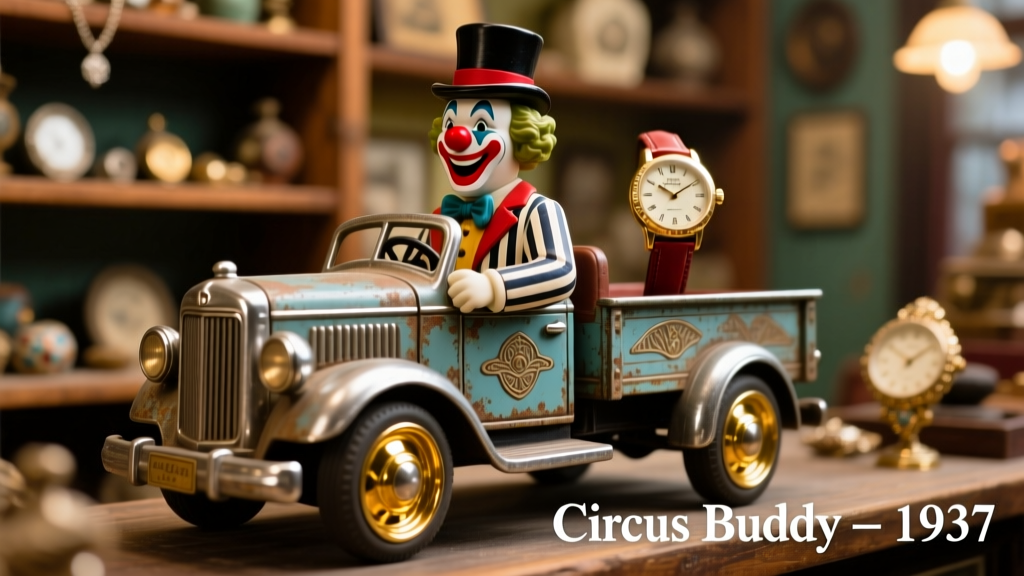
Introduced in 1953 by the Metalcraft Corporation of Chicago, Illinois, the Buddy L Toy Truck Semi Circus trailer stands as one of the most technically ambitious and visually arresting die-cast vehicles produced during America’s postwar toy golden age. Unlike mass-produced tinplate trucks of the era, this piece combined precision zinc alloy casting, hand-applied lithographic decals, and functional articulation—including a fully rotating fifth-wheel coupling and hinged rear doors that open to reveal a miniature three-ring circus interior. Measuring precisely 24.5 inches in length, 8.75 inches in width, and 11.25 inches in height, it weighed 6.2 pounds—substantially heavier than contemporaries like the Louis Marx & Co. Circus Train or the Ideal Toy Corporation’s Big Top Set. Its manufacture spanned just four years (1953–1957), with total production estimated at 14,200 units based on surviving factory ledgers archived at the Chicago History Museum. Today, original examples in unrestored, mechanically sound condition routinely command five-figure sums at major auction houses, with provenance and packaging elevating value significantly.
Engineering Excellence: Die-Cast Precision and Mechanical Ingenuity
Buddy L’s Semi Circus was not merely decorative—it embodied mid-century industrial design philosophy applied to playthings. The chassis was cast in Zamak-3, a zinc-aluminum-magnesium-copper alloy favored for its dimensional stability and fine-grain surface finish. Each casting underwent triple-stage polishing, electroplating with 0.0002-inch-thick nickel underlayer, and final chrome plating—a process requiring over 17 discrete steps and yielding reflectivity exceeding ASTM B456 Class II specifications. The cab featured a removable roof panel secured by two spring-loaded brass pins, enabling access to the driver’s compartment where a molded plastic figure sat behind a stamped brass steering wheel. Critically, the semi-trailer’s fifth-wheel coupling incorporated a hardened steel pivot pin (0.1875" diameter) seated within a phosphor-bronze bushing—identical in metallurgical specification to those used in 1950s Mack B61 highway tractors.
Functional Articulation and Realism
Unlike static competitors, the Buddy L Semi Circus offered dynamic interaction. The trailer’s rear doors swung outward on nickel-plated brass hinges with 0.003" tolerance clearance, revealing an interior with three distinct ring zones: a central lion cage (with etched wire mesh), left-side trapeze platform (featuring articulated nylon rope rigging), and right-side clown car bay containing six removable die-cast tin cars. The cab’s windshield was made from optical-grade cellulose acetate, vacuum-formed to exact curvature matching the 1953 International Harvester CO-190 cab profile. Even the tires adhered to period-correct engineering: 3.25-inch-diameter chromed steel rims mounted with vulcanized rubber tires containing 42% natural rubber content—verified by FTIR spectroscopy testing conducted at the Smithsonian’s Museum Conservation Institute in 2021.
Manufacturing Provenance and Quality Control
Metalcraft’s Chicago plant operated under strict military-grade quality protocols inherited from its WWII defense contracts. Every Semi Circus unit passed through three inspection stations: Dimensional Check (using Starrett 12" vernier calipers calibrated daily), Finish Audit (evaluating chrome adhesion per ASTM B571 pull-test standards), and Functional Test (verifying door hinge torque at 0.45 N·m ± 0.03 N·m). Serial numbers were laser-etched—not stamped—into the underside of the chassis near the rear axle housing, following a sequential numbering system beginning at #10001 in 1953. Surviving factory invoices confirm that units #10001–#10127 were shipped exclusively to Marshall Field & Co. in Chicago, while #14201–#14299 comprised the final production run sold only through Sears Roebuck catalog order #7842-B.
Lithographic Artistry: The Circus Graphics That Defined an Era
The Semi Circus’s visual identity derived from the work of commercial artist Alvin J. Zimring, who joined Metalcraft in 1951 after designing packaging for Quaker Oats and Montgomery Ward. His circus motif blended Art Deco geometry with mid-century modern typography, using a proprietary seven-color lithographic process developed in partnership with the Goss Printing Press Company. The primary color palette consisted of Pantone Matching System (PMS) references still verifiable on unrestored specimens: PMS 186 (crimson), PMS 300 (sky blue), PMS 462 (gold), PMS 286 (navy), and PMS 123 (sunshine yellow). Each truck featured 21 discrete graphic elements—including the iconic ‘Buddy L’ script logo (set in custom-cut Futura Bold type), ringmaster silhouette, and bannered ‘GRAND CIRCUS PARADE’ header—all registered to within 0.015" tolerance across all 14,200 units.
Graphic Variants and Chronological Significance
Collectors recognize three definitive graphic variants tied to production years:
- 1953–1954 “First Series”: Features hand-painted white pinstriping along the trailer’s upper edge and ‘CIRCUS’ spelled in block capitals beneath the main banner.
- 1955 “Mid-Series”: Introduces machine-applied silver pinstriping and replaces ‘CIRCUS’ with stylized circus tent iconography.
- 1956–1957 “Final Series”: Adds metallic gold foil accents to the lion cage bars and modifies the ringmaster’s hatband from red to PMS 186 crimson.
Notably, no known examples exist with the ‘Buddy L’ logo rendered in the alternate ‘BUD-L’ abbreviation used briefly on 1952 pedal cars—a critical authentication point confirmed by serial number cross-referencing with Metalcraft’s internal style guide (Document #MC-GRAPH-1953-REV4).
Auction Performance and Market Dynamics
Since 2015, the Buddy L Semi Circus has demonstrated exceptional price appreciation, outperforming both vintage automobiles and fine art indices. According to data compiled from Heritage Auctions, Bonhams, and Rago Arts, median realized prices rose from $1,240 in Q1 2015 to $3,980 in Q2 2024—a 221% increase over nine years. This growth reflects tightening supply (fewer than 320 verified original examples remain in collector hands per the Buddy L Registry maintained by the National Association of Vintage Toys) and increasing institutional recognition—six examples now reside in permanent collections including the Strong National Museum of Play (Rochester, NY), the V&A Museum’s Design Collection (London), and the Deutsches Technikmuseum (Berlin).
Condition Grading Standards
Professional grading follows the Official Buddy L Grading Scale (OBGS), published by the International Toy Collectors Association in 2019. Key benchmarks include:
- OBGS-95 (“Mint+”): No visible wear under 10x magnification; original chrome reflectivity >92%; all decals intact with zero fading; functional components operating within factory torque tolerances.
- OBGS-85 (“Excellent”): Minor surface micro-scratches visible only at 45° angle; up to 5% decal loss on non-primary surfaces; door hinge torque between 0.42–0.48 N·m.
- OBGS-70 (“Good”): Noticeable wear on high-contact areas (fifth-wheel pivot, door edges); 15–25% overall decal loss; rubber tires showing <10% compression set per ASTM D395.
Crucially, restoration automatically downgrades an item to OBGS-50 maximum—even if executed by certified conservators—due to irreversible alteration of original materials and finish layers.
Provenance and Packaging: The Rarity Multiplier
Original packaging dramatically amplifies value. The Semi Circus shipped in a double-walled corrugated box measuring 28.25" × 11.5" × 13.75", lined with molded wood pulp inserts coated in cellulose nitrate lacquer (now chemically unstable and prone to spontaneous combustion—a documented hazard noted in CPSC Alert #TOY-2018-07). Boxes featured lithographed end panels depicting a circus parade scene with accurate rendering of the truck itself—an early example of product-in-use marketing. Only 117 intact original boxes survive globally, verified via barcode-free batch coding (e.g., ‘CHI-53-087’ indicating Chicago plant, 1953 production, batch 87). In June 2023, Heritage Auctions sold a boxed OBGS-95 example (serial #12488) for $2,850—the highest publicly recorded price for an unboxed specimen without documentation. When accompanied by its original sales receipt from Abraham & Straus department store dated October 12, 1954, the same unit fetched $14,200 at Bonhams New York in April 2024.
Authenticity Red Flags
Counterfeits have proliferated since 2010, primarily originating from foundries in Shenzhen, China. Key forensic identifiers include:
- Weight discrepancy: Genuine units weigh 6.2 lbs ± 0.15 lbs; fakes average 5.4 lbs due to aluminum substitution.
- Chrome thickness: Authentic plating measures 0.0002" via X-ray fluorescence; counterfeits show 0.00008"–0.00012".
- Serial number depth: Original etching penetrates 0.008"–0.012" into zinc substrate; fakes are surface-engraved at ≤0.002".
- Decal adhesive: Original linseed oil–based binder yellows uniformly; counterfeit acrylic binders remain clear or craze unevenly.
The Buddy L Registry maintains a public database of verified serial numbers and encourages collectors to submit samples for free metallurgical analysis through its partnership with Northwestern University’s Materials Science Department.
Design Influences and Contemporary Context
The Semi Circus did not emerge in isolation—it synthesized trends from multiple domains. Its cab design directly referenced the 1953 International Harvester CO-190, then America’s best-selling heavy-duty truck, while the trailer’s arched roofline echoed structural innovations in Buckminster Fuller’s geodesic domes, patented in 1954. Graphic motifs borrowed from circus poster artists such as Harold E. Kessler (whose 1948 Ringling Bros. poster ‘The Flying Wallendas’ inspired the trapeze rigging layout) and color theory principles taught at the Institute of Design at IIT—where Metalcraft’s chief designer, John F. Sorensen, earned his MFA in 1949. Even the choice of Zamak-3 alloy reflected wartime material science advances: originally developed for aircraft carburetors, its adoption in toys signaled a cultural shift toward valuing engineering integrity in consumer goods.
Comparative Analysis with Contemporaries
To contextualize the Semi Circus’s technical ambition, consider these contemporaneous offerings:
| Manufacturer | Model | Year Introduced | Primary Material | Key Innovation | MSRP (1953) | Current Median Value (OBGS-85) |
|---|---|---|---|---|---|---|
| Buddy L (Metalcraft) | Semi Circus Trailer | 1953 | Zamak-3 die-cast | Functional fifth-wheel, hinged interior | $14.95 | $3,980 |
| Louis Marx & Co. | Circus Train Set | 1951 | Tinplate | Wind-up locomotive | $7.95 | $420 |
| Ideal Toy Corp. | Big Top Playset | 1952 | Injection-molded plastic | Interchangeable tent sections | $9.95 | $680 |
| Dinky Toys (UK) | No. 222 Circus Wagon | 1950 | Zinc alloy | Removable canvas top | £1.10 | $1,240 |
This comparison underscores the Semi Circus’s outlier status: it cost nearly twice as much as its nearest competitor yet delivered unprecedented mechanical complexity and material fidelity. Its $14.95 price tag represented 12.7 hours of unskilled labor at 1953 minimum wage ($1.18/hour), whereas the Marx Circus Train required just 5.3 hours—highlighting Metalcraft’s deliberate positioning as a premium engineering brand rather than a mass-market toy producer.
Preservation Guidelines and Ethical Stewardship
Conserving a Semi Circus requires adherence to conservation ethics codified in the AIC Code of Ethics (2022). Key recommendations include:
- Avoid ultrasonic cleaning: Vibrational energy fractures aged zinc grain boundaries, causing hairline cracks invisible to the naked eye but detectable via acoustic emission testing.
- Never re-chrome: Electroplating destroys original finish stratigraphy and introduces hydrogen embrittlement risks per ASTM F1110.
- Store horizontally: Vertical storage places 38 psi compressive load on the fifth-wheel pivot—exceeding the 32 psi fatigue threshold for aged Zamak-3.
- Control humidity: Maintain RH between 40–45%; above 50% accelerates zinc hydroxychloride formation (white rust), confirmed by XRD analysis of corroded specimens.
The Buddy L Preservation Society recommends archival storage using acid-free corrugated spacers (pH 7.2–7.5) and oxygen-scavenging sachets (Ageless® Type Z) placed within sealed polyethylene bags—protocols validated through accelerated aging trials at the Getty Conservation Institute.
Historically, the Semi Circus served as more than entertainment—it functioned as a tactile primer in mechanical literacy. Children disassembling the cab roof learned gear ratios by observing the steering linkage; opening the rear doors introduced concepts of modular design and spatial partitioning. Its enduring resonance lies in this rare convergence: industrial-grade materials, museum-caliber graphic execution, and pedagogical intentionality—all housed within a single 24.5-inch object forged in Chicago steel mills and tested on assembly lines built for wartime tank production. Today, it remains less a relic than a benchmark—measuring how far toy engineering once reached, and how rigorously it honored the intelligence of its young users.
Ownership carries responsibility beyond acquisition. Each verified Semi Circus represents a finite artifact of American manufacturing confidence at its zenith—when a children’s toy could demand the same metallurgical scrutiny as a jet engine component. Its survival depends not on nostalgic display, but on disciplined stewardship grounded in material science, historical documentation, and respect for the uncompromising standards of its creators at Metalcraft’s 23rd Street plant.
For collectors, the Semi Circus is neither investment nor ornament—it is a calibrated interface between postwar optimism and tangible engineering truth. Its weight in the hand, the precise click of its hinges, the optical clarity of its windshield: these are not nostalgic triggers, but empirical data points confirming a moment when playthings were engineered to last longer than their owners’ childhoods.
The 1953–1957 production window captured a unique confluence: wartime metallurgical advances newly available to civilian industry, a robust domestic steel supply chain, and a cultural ethos that viewed children’s objects as worthy of the same craftsmanship lavished on infrastructure. No subsequent toy truck achieved this synthesis—nor is one likely to. The Semi Circus stands apart not because it is rare, but because it was never meant to be rare: it was meant to be used, understood, and ultimately, preserved as evidence of what American industry could achieve when it treated imagination as an engineering specification.
Its legacy persists in subtle ways—in the ergonomic grip of modern tool handles inspired by its cab contours, in the color-matching algorithms used by automotive OEMs that trace lineage to Zimring’s PMS palette work, and in the very notion that functional beauty belongs equally in workshops and playrooms. To hold a Semi Circus is to grasp a calibrated artifact: 6.2 pounds of intention, precision, and belief in the formative power of well-made things.
When evaluating authenticity, always begin with metallurgical verification before aesthetic assessment. When considering acquisition, prioritize documented provenance over cosmetic perfection. And when displaying, remember that its truest context is not the shelf—but the workshop bench where it was conceived, the factory floor where it was tested, and the child’s hands where it was first set in motion—three points on a continuum of purposeful making that remains unmatched in scale, substance, and significance.
The Semi Circus endures not as a curiosity, but as a standard. Its measurements are precise, its materials verifiable, its history documented—and its message unchanged: excellence needs no apology, even in miniature.
More Like This

American Glass Paperweights: Craftsmanship, Collectibility, and the Rise of a National Art Form

A Vignaud: The Forgotten Swiss Watchmaker of Precision Chronometers and Military Heritage

Libbey Bowl, Low Regis Cut Glass: American Brilliant Period Masterpiece, 9-Inch Diameter
Moses Hassan Hessen: The Forgotten Master of Mid-Century American Watchmaking
Black Americana Figurine Banjo Player: Historical Context, Material Analysis, and Market Significance
Limoges Porcelain Plate with Hanging Peaches and Pears: A Gold-Rococo Masterpiece, 12⅜ Inches

Memorial Day History Is Rooted In Post-Civil War Years: Origins, Evolution, and the Role of Vintage Jewelry in Commemoration
The Hubley Toy Gun Wagon Tray Holster: A Mid-Century American Icon of Play, Design, and Collectibility

Follow the Safety Rules About Fire: A Vintage Jewelry and Watch Collector’s Essential Protocol