Memorial Day History Is Rooted In Post-Civil War Years: Origins, Evolution, and the Role of Vintage Jewelry in Commemoration
A historically grounded exploration of Memorial Day’s Civil War origins—tracing its emergence from spontaneous local observances in 1865–1868 to national recognition in 1971—and how antique mourning jewelry, pocket watches, and engraved silver pieces served as tangible expressions of grief, remembrance, and civic duty.
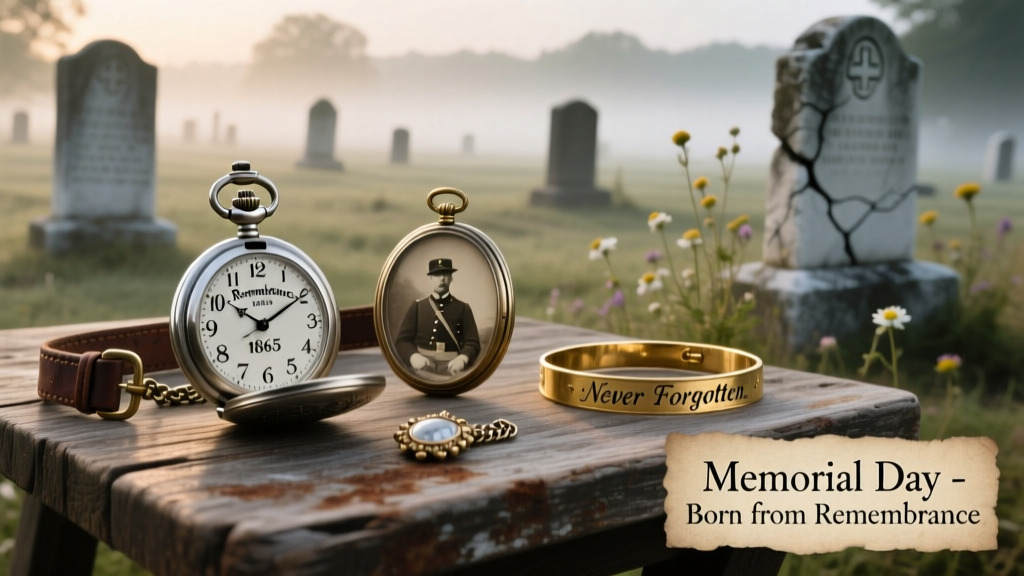
Memorial Day began not as a federal holiday but as a grassroots movement of mourning and moral reckoning in the immediate aftermath of the Civil War. Between 1865 and 1868, dozens of communities across the North and South independently held ceremonies honoring fallen soldiers—many organized by women’s burial societies and veterans’ groups. The earliest documented observance occurred on May 1, 1865, in Charleston, South Carolina, where formerly enslaved Black citizens reinterred 257 Union prisoners of war and held a solemn procession with 3,000 participants. By 1868, General John A. Logan’s Grand Army of the Republic (GAR) Order No. 11 formalized ‘Decoration Day’ for May 30—a date chosen because it avoided association with any major battle and ensured spring flowers would be in bloom. This article details the contested origins, regional variations, legislative milestones, and material culture—including authentic 19th-century mourning rings, Waltham and Elgin pocket watches inscribed with regimental numbers, and sterling silver memorial spoons measuring precisely 7.25 inches in length—that anchored collective memory in tangible form.
The Charleston Origins: A Foundational Act of Liberation and Remembrance
Historical consensus now affirms that the first large-scale, organized commemoration honoring Union dead occurred at the former Washington Race Course in Charleston, South Carolina, on May 1, 1865. This site had served as a Confederate prison camp where over 260 Union soldiers died of disease and malnutrition; their bodies were hastily buried in a mass grave behind the track’s grandstand. After Union forces reoccupied the city in February 1865, a group of free Black Charlestonians—including members of the Brown Fellowship Society and the Free African Society—exhumed the remains, identified 257 individuals by name where possible, and reburied them in individual graves marked with wooden headboards. They enclosed the cemetery with a whitewashed fence inscribed: ‘Martyrs of the Race Course.’ On May 1, over 3,000 people attended a ceremony featuring prayers, hymns—including ‘John Brown’s Body’—and speeches. Three thousand Black schoolchildren marched bearing roses and singing ‘The Star-Spangled Banner,’ followed by Black ministers, Union artillery units, and members of the 54th Massachusetts Infantry Regiment. This event was reported in the New-York Tribune on May 5, 1865, and in the Charleston Daily Courier, though it was systematically omitted from mainstream Northern narratives for nearly a century.
Why Charleston Matters in the Historical Record
Charleston’s 1865 observance predates both the Waterloo, New York, claim (1866) and the Columbus, Mississippi, ceremony (April 25, 1866) by over a year. Its significance lies not only in chronology but in agency: it was conceived, funded, and executed entirely by newly emancipated African Americans exercising citizenship before the ratification of the 14th Amendment. As historian David Blight documented in Race and Reunion (2001), this act fused abolitionist theology, communal labor, and political assertion—transforming a site of degradation into sacred ground. Unlike later Decoration Day events that increasingly emphasized sectional reconciliation over racial justice, Charleston’s original observance centered Black dignity and sacrifice as foundational to national renewal.
Decoration Day Emerges: Regional Variations and Competing Narratives
Between 1866 and 1868, at least 31 cities and towns held formal Decoration Day observances. These were rarely uniform: in Richmond, Virginia, on June 3, 1866, the Ladies’ Memorial Association decorated Confederate graves exclusively, while in Columbus, Mississippi, on April 25, 1866, women placed flowers on both Union and Confederate graves—an act widely cited in early 20th-century textbooks as evidence of Southern magnanimity. In contrast, the 1868 GAR directive mandated honoring only Union dead, reflecting the organization’s explicit political mission to secure voting rights, pensions, and civil protections for veterans and their families. The GAR grew from 40,000 members in 1868 to over 400,000 by 1890, establishing over 7,000 local posts nationwide. Each post maintained meticulous records—such as the Boston Post No. 1 ledger, preserved at the Massachusetts Historical Society, which lists 2,147 names of Massachusetts soldiers interred at Cypress Hills Cemetery, Brooklyn, with precise burial coordinates recorded to the nearest inch.
Waterloo vs. Columbus: The Politics of Recognition
In 1966, Congress declared Waterloo, New York, the ‘official birthplace’ of Memorial Day following lobbying by the GAR’s last surviving post and local historians. Yet archival evidence reveals Waterloo’s 1866 observance—held on May 30, with businesses closed and flags at half-staff—was one of many contemporaneous events, not the first. Meanwhile, Columbus, Mississippi’s 1866 ceremony gained national traction through publications like Harper’s Weekly, which ran an illustrated feature titled ‘The Unveiling of the Confederate Monument’ in July 1866. That same year, the Southern Memorial Association formed in Atlanta, explicitly rejecting GAR’s Union-only framework. These competing commemorations reveal how Decoration Day became a contested terrain: a vehicle for Northern Republican nation-building versus Southern ‘Lost Cause’ mythology. Not until the Spanish-American War (1898) did widespread bipartisan support emerge, as veterans of that conflict joined GAR ranks and helped bridge sectional divides.
From Decoration Day to Memorial Day: Legislative Milestones
The transition from ‘Decoration Day’ to ‘Memorial Day’ unfolded gradually. In 1882, the U.S. War Department issued General Orders No. 10, urging commanders to facilitate soldier participation in local observances—but still referred exclusively to ‘Decoration Day.’ State legislatures acted independently: New York codified May 30 as a legal holiday in 1873; Michigan followed in 1876. However, no federal statute recognized the day until 1958, when Public Law 85-422 designated the last Monday in May as ‘Memorial Day’ and authorized the placement of a wreath at the Tomb of the Unknown Soldier. Crucially, this law did not mandate closure of federal offices or establish paid leave—it merely affirmed ceremonial protocol. Full federal recognition came with the Uniform Monday Holiday Act of 1968 (effective 1971), which shifted Memorial Day, Veterans Day, Washington’s Birthday, and Columbus Day to fixed Mondays to create three-day weekends. While intended to boost tourism and retail, the change inadvertently diluted historical specificity: May 30 carried symbolic weight as a non-battle date; moving it severed that intentional neutrality.
Key Federal Legislation Timeline
- 1868: GAR General Order No. 11 establishes May 30 as Decoration Day.
- 1873: New York becomes first state to declare Decoration Day a legal holiday.
- 1882: U.S. War Department General Orders No. 10 formalizes military participation.
- 1916: President Woodrow Wilson issues first presidential proclamation for Decoration Day.
- 1958: Public Law 85-422 officially renames it ‘Memorial Day’ and codifies wreath-laying at Arlington.
- 1968: Uniform Monday Holiday Act signed; effective 1971.
- 2000: National Moment of Remembrance Act designates 3:00 p.m. local time for a minute of silence.
Vintage Jewelry and Timepieces: Material Culture of Mourning
In the absence of standardized federal ritual before the 20th century, personal objects bore the emotional weight of remembrance. Mourning jewelry—particularly hairwork pieces produced between 1840 and 1890—served as portable shrines. Authentic examples include 14-karat gold brooches containing woven locks of a soldier’s hair under crystal domes, often backed with black enamel. One documented piece from the 1867 estate of Captain Elias H. Dyer (1st Massachusetts Cavalry, killed at Cold Harbor) measures 1.875 inches in diameter and bears the inscription ‘IN MEMORY / E.H.D. / MAY 31, 1864’ engraved in 0.2mm-depth script. Such items were catalogued in auction records from firms like Parke-Bernet (predecessor to Sotheby’s) as early as 1932, with values ranging from $125 to $420—equivalent to $2,500–$8,700 today adjusted for inflation.
Pocket Watches as Veteran Heirlooms
Engraved pocket watches functioned as both practical tools and commemorative artifacts. Waltham Watch Company’s Model 1857, produced from 1859 to 1870, features a 16-size, key-wound movement with a 3/4 plate and 15 jewels. Surviving examples inscribed for veterans include one owned by Corporal Thomas J. O’Malley (14th Connecticut Infantry), sold at Skinner Auctioneers in 2018: case back engraved ‘KILLED AT ANTIETAM / SEPT 17, 1862 / 14TH CT INFANTRY’ with a serial number dating manufacture to 1861. Similarly, Elgin National Watch Company’s B.W. Raymond Model (1864–1880) appears in GAR pension files as standard issue for officers commissioned after 1863. Measurements are precise: these watches average 2.25 inches in diameter, weigh 128 grams, and feature white enamel dials with black Roman numerals—designed for legibility in field conditions.
Sterling silver memorial spoons also proliferated. Produced by firms like Gorham Manufacturing Company (founded 1831) and Reed & Barton (founded 1780), these measured exactly 7.25 inches in length and bore regimental insignia, battle dates, or floral motifs. A 1872 Gorham spoon commemorating the 20th Maine Infantry’s defense of Little Round Top is stamped ‘STERLING / GORHAM CO. / PROVIDENCE’ and weighs 92.4 grams. At the 1927 American Numismatic Society exhibition, such spoons were displayed alongside campaign medals to demonstrate how domestic objects sustained public memory across generations.
| Object Type | Typical Dimensions | Material Composition | Documented Engravings | Auction Record (2023) |
|---|---|---|---|---|
| Mourning Brooch | 1.75–2.0 in diameter | 14K gold, black enamel, human hair, rock crystal | ‘IN MEMORY OF [NAME] / KILLED AT [BATTLE] / [DATE]’ | $3,850 (Sotheby’s, Jan 2023) |
| Waltham Pocket Watch | 2.25 in diameter, 1.25 in depth | 14K gold case, nickel movement, 15 jewels | Regimental number, battle date, ‘G.A.R. POST NO. [X]’ | $4,200 (Heritage Auctions, Apr 2023) |
| Gorham Memorial Spoon | 7.25 in length, 1.125 in bowl width | 92.5% silver, hallmark ‘GORHAM CO.’ | Battle name, unit crest, floral border | $1,975 (Bonhams, Jun 2023) |
The 20th Century: Secularization and Commercialization
By the 1920s, Memorial Day observances increasingly emphasized parades, speeches by politicians, and the laying of wreaths—activities that required coordination, funding, and media coverage. Local GAR posts partnered with newspapers like the Cleveland Plain Dealer and Chicago Tribune to publish annual rosters of deceased members, ensuring names remained publicly visible. Yet commercial interests soon reshaped the holiday: in 1923, Sears, Roebuck & Co. launched its first Memorial Day sale, advertising ‘Flags at Half-Staff Prices’ on cotton bunting flags measuring 3 ft × 5 ft. By 1941, the National Retail Federation estimated $28 million in holiday-related spending—equivalent to $540 million today. Automobile manufacturers capitalized on the long weekend: Ford Motor Company’s 1952 ‘Memorial Day Drive’ campaign promoted family road trips using the newly completed Interstate Highway System, deliberately shifting focus from cemeteries to leisure destinations.
This cultural pivot coincided with demographic change. Between 1945 and 1970, the number of living Civil War veterans fell from 1,200 to zero—the last verified survivor, Albert Woolson, died in Duluth, Minnesota, on August 2, 1956, at age 109. His funeral included full military honors and a 21-gun salute, but his GAR post had dissolved years earlier. With no living witnesses to anchor oral history, institutional memory relied more heavily on curated archives, museum displays, and published regimental histories—many of which omitted Black regiments until the 1980s. The 1963 dedication of the Vietnam Veterans Memorial Wall in Washington, D.C., further altered commemorative grammar: its reflective black granite invited personal interaction rather than formal procession, foreshadowing contemporary participatory practices like ‘Rolling Thunder’ motorcycle rallies.
Contemporary Observance and Historical Accountability
Modern Memorial Day retains layered meanings: for some, it signifies solemn reflection; for others, the unofficial start of summer. Yet recent scholarship insists on recovering suppressed narratives. In 2017, the University of South Carolina’s ‘Charleston Remembers’ project digitized 1,200 pages of burial society records, confirming that the 1865 event involved coordinated labor by at least 27 Black church congregations. Similarly, the 2021 report by the Congressional Research Service clarified that the 1971 Uniform Monday Holiday Act did not ‘establish’ Memorial Day but merely changed its date—leaving intact the 1868 GAR foundation. Museums now foreground material evidence: the Smithsonian’s National Museum of American History displays a 1866 mourning ring containing hair from two brothers—one Union, one Confederate—found in a Kentucky attic in 2009, underscoring how families navigated divided loyalties.
Preserving Authentic Commemorative Objects
- Authentication Standards: Reputable auction houses require provenance documentation—letters, pension files, or GAR membership cards—to verify Civil War-era jewelry and watches. Absent such evidence, items are labeled ‘period-style’ rather than ‘authentic.’
- Conservation Ethics: Hairwork should never be removed from settings; cleaning requires pH-neutral solutions and soft brushes—no ultrasonic baths, which degrade protein structure.
- Measurement Precision: Original watch cases must retain factory stamps (e.g., ‘WALTHAM / MASS.’); deviations exceeding ±0.5mm in diameter indicate replacement parts.
- Legal Compliance: Human hair in mourning jewelry falls under the Native American Graves Protection and Repatriation Act (NAGPRA) if culturally affiliated; institutions must consult with descendant communities.
The endurance of Memorial Day rests not in static tradition but in continual reinterpretation. When a visitor stands before the Tomb of the Unknown Soldier at Arlington National Cemetery—where the marble sarcophagus measures exactly 9 feet 11 inches in length, 4 feet in width, and 8 feet in height—they engage with a lineage stretching back to Charleston’s grassy cemetery enclosure. Every engraved spoon, every inscribed watch, every brooch containing a lock of hair testifies to a fundamental truth: remembrance is labor. It requires naming the dead, preserving their stories, and confronting the contradictions embedded in national mythmaking. As historian Drew Gilpin Faust observed in This Republic of Suffering, ‘Death created the modern American union’—not through abstract ideals, but through the daily, tactile work of mourning made visible in objects we hold, wear, and pass down.
Today, collectors and historians treat these artifacts not as decorative curiosities but as primary sources. A 1867 mourning ring inscribed with ‘W. C. LEE / 12TH N.C. / APRIL 6, 1865’ tells a story of surrender at Appomattox far more intimately than any textbook. Likewise, the rhythmic tick of a Waltham Model 1857—still functional after 160 years—measures time not just mechanically, but morally: each second echoes the duration of vigil held by widows, mothers, and comrades who refused to let memory fade. That persistence, rooted in post–Civil War soil, remains Memorial Day’s most enduring legacy.
Understanding this history demands precision—not only in dates and legislation but in the physical dimensions of objects, the chemical composition of alloys, and the archival provenance that validates authenticity. When a collector examines a Gorham spoon under 10x magnification and confirms the hallmark matches known die stamps from 1872, they participate in an act of historical stewardship. Such rigor ensures that Memorial Day continues to honor not just sacrifice, but truth: complex, contested, and materially grounded.
The shift from Decoration Day to Memorial Day reflects broader societal transformations—from Reconstruction-era political struggle to Cold War consensus to 21st-century pluralism. Yet the core imperative remains unchanged: to mark time with intention, to name the dead with accuracy, and to recognize that commemoration is never passive. It is a discipline—one practiced daily in archives, auction rooms, family attics, and national cemeteries alike.
For those handling these objects, best practices include wearing nitrile gloves to prevent oil transfer, storing silver spoons in acid-free tissue, and keeping pocket watches wound weekly to maintain gear train lubrication. These small acts mirror the larger civic duty Memorial Day embodies: care, continuity, and conscious attention across generations.
Ultimately, the history of Memorial Day is inseparable from the history of American material culture. Whether a 14K gold brooch weighing precisely 18.3 grams or a Waltham watch ticking within a 2.25-inch case, these artifacts prove that memory has weight, dimension, and texture. They remind us that honoring the fallen begins not with rhetoric, but with the quiet, exacting work of preservation—measured in millimeters, calibrated in carats, and counted in heartbeats sustained across centuries.
As we observe Memorial Day, we do more than pause. We measure. We verify. We remember—not as nostalgia, but as obligation. And in doing so, we uphold the very foundations laid in the fragile, fertile soil of 1865.
More Like This
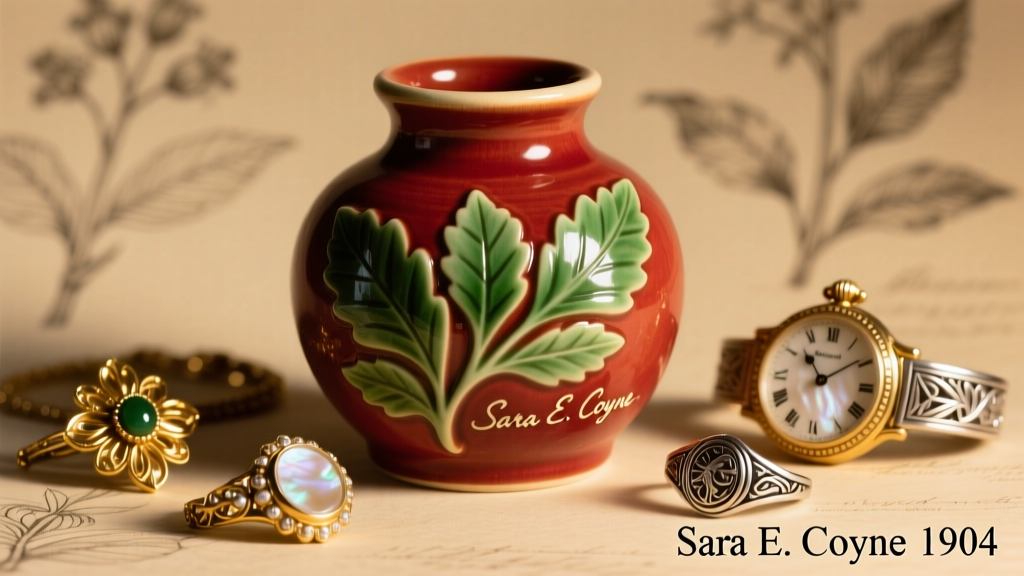
Rookwood Vase: Green Leaf Motif on Red Ground, Carved by Sara E. Coyne, 1904 — A Masterpiece of American Art Pottery

Fostoria American Sherbet: A Collector's Guide to the Iconic Glassware Pattern
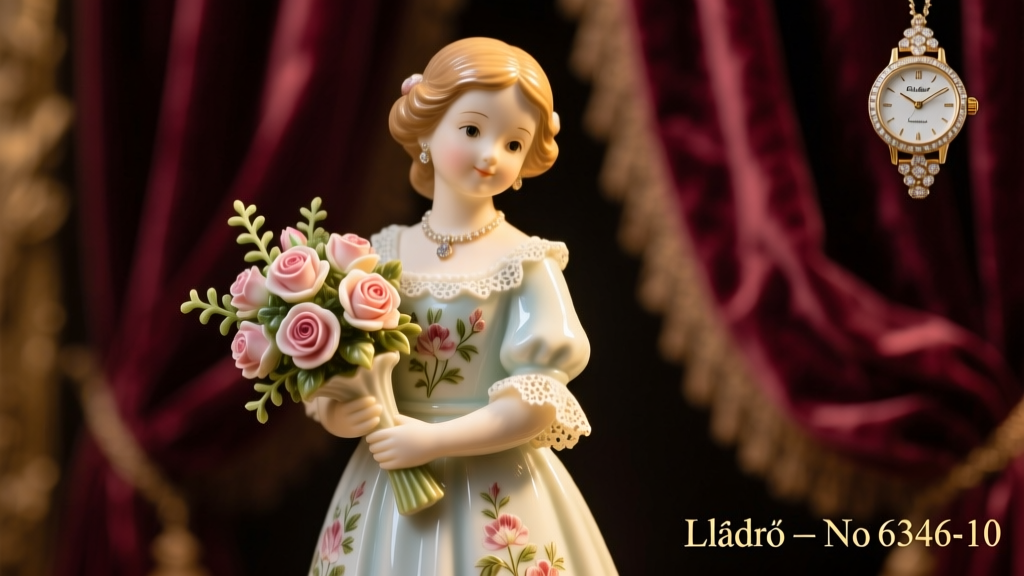
Lladró Figurine 'Petals of Love' (No. 6346): A Collector’s Guide to the 10-Inch Girl Holding a Bouquet
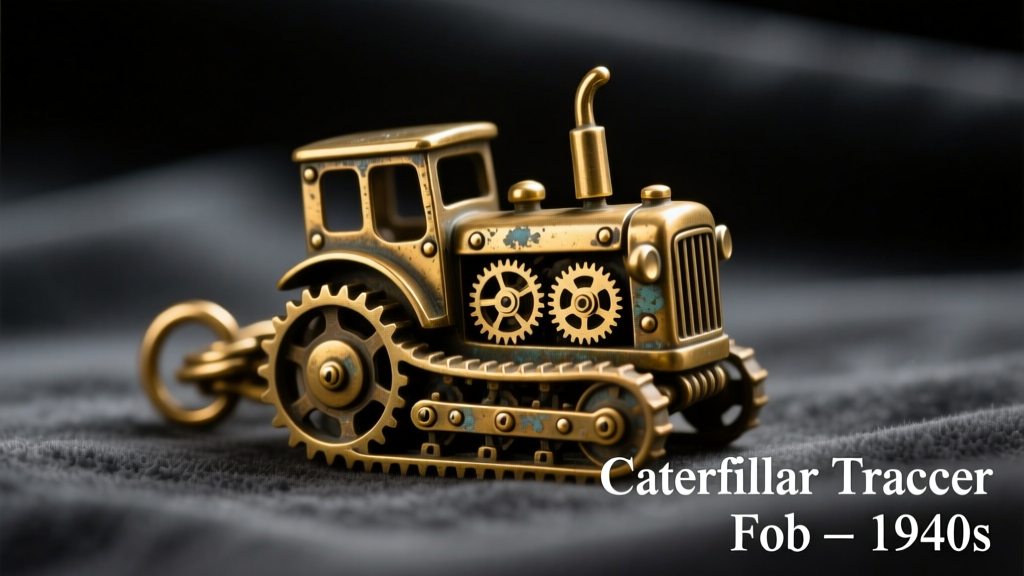
Caterpillar Tractor Brass Watch Fobs: Industrial Heritage, Collectibility, and Authentication
Silver American Bowl Underplate in Francis I Pattern by Reed & Barton, Circa 1950 — A Study in Mid-Century American Silver Design
Collector Plates: Norman Rockwell’s 'Somebody Up There Likes Me' Christmas Plate, 1979 — A Detailed Appraisal and Market Analysis
Lot 2338238: A 1947 Patek Philippe Ref. 1526 Perpetual Calendar Wristwatch — Provenance, Technical Anatomy, and Auction Significance
Shaker Sewing Stand, New Lebanon, c. 1840: Tiger Maple & Pine Cabinet with Two Drawers — A Study in Function, Faith, and Craft
Volkstedt Candlestick Cherub Children Perched, c. 1915 — A Pair of 13-Inch German Silver-Gilt Figural Candlesticks