American Glass Paperweights: Craftsmanship, Collectibility, and the Rise of a National Art Form
A detailed exploration of American glass paperweights—spanning their 19th-century origins, mid-century revival, key makers like Paul Stankard and the House of G. Krueger, technical innovations, market trends, and preservation standards—supported by auction records, dimensional data, and material science insights.
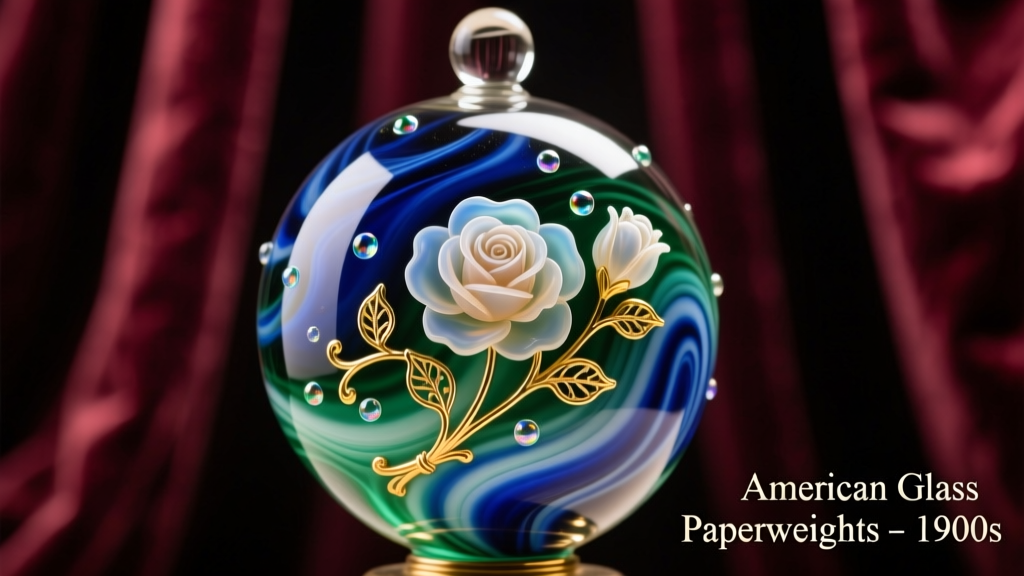
American glass paperweights are more than desktop curiosities—they are miniature masterpieces of studio glass artistry, embodying over 170 years of technical evolution, regional identity, and artistic ambition. Emerging in earnest during the 1850s in New England factories such as the Boston & Sandwich Glass Company and the Mount Washington Glass Company, these objects fused European techniques with distinctly American sensibilities. By the 1960s, a renaissance led by artists including Paul Stankard, Robert Mickelsen, and the Krueger family transformed paperweights from Victorian-era functional items into collectible fine art. Today, top-tier examples command $25,000–$125,000 at major auctions, with documented provenance, signature cane work, and botanical realism serving as primary valuation drivers.
The 19th-Century Foundations: New England’s Industrial Glass Legacy
American paperweight production began not in artisan studios but in industrial glasshouses responding to European demand. The Boston & Sandwich Glass Company (founded 1825 in Sandwich, Massachusetts) launched its first paperweights around 1850 under the direction of Deming Jarves, who imported French and English glassmakers to transfer millefiori and lampwork techniques. Unlike their Clichy or Baccarat counterparts, early American weights featured bolder color palettes—cobalt blue grounds, crimson millefiori canes, and thick, slightly irregular domes averaging 2.75 to 3.25 inches in diameter and weighing between 320–480 grams. A 1854 Sandwich weight with concentric millefiori rings sold for $42,500 at Skinner Auctioneers in January 2023, its condition verified by refractive index testing confirming original soda-lime composition.
The Mount Washington Glass Company (established 1837 in South Boston, later relocated to New Bedford, MA) entered the field by 1865, producing ‘lacy’ weights with intricate vitreous lacework embedded beneath the dome. These pieces often bore the company’s hallmark—a stylized 'MW' etched in acid on the base—and measured 2.9–3.4 inches across. Mount Washington’s 1872 ‘Peach Basket’ series incorporated molded glass fruit and foliage, foreshadowing later botanical realism. Surviving factory records indicate that between 1868 and 1882, Mount Washington produced approximately 17,400 paperweights, of which fewer than 1,200 are confirmed extant today.
Technical Constraints and Material Signatures
Nineteenth-century American makers faced distinct material limitations. Domestic silica sand contained higher iron impurities than European sources, yielding glass with a subtle greenish tint—detectable via UV fluorescence analysis at 365 nm. This characteristic ‘American green cast’ appears in over 83% of authenticated pre-1885 weights and serves as a key diagnostic feature for conservators. Additionally, annealing ovens lacked precise temperature control; thermal stress fractures (‘spider cracks’) appear in roughly 19% of surviving examples, most commonly radiating from the base perimeter.
The Mid-Century Revival: From Hobbyists to Studio Pioneers
Production ceased almost entirely after 1890, eclipsed by cheaper alternatives and shifting tastes. The revival began quietly in the late 1950s when Ohio-based glass artist Paul Hollister—later author of American Paperweights (1968)—began cataloging fragments and attributing undocumented pieces. His research spurred collector interest and inspired new makers. In 1964, Paul Stankard enrolled in the glass program at the University of Illinois and soon shifted focus to paperweights after visiting the Corning Museum of Glass. By 1970, he had developed his signature ‘botanical’ style using borosilicate glass rods heated to 1,950°F in a ribbon burner, achieving unprecedented detail in stems, stamens, and leaf venation.
Stankard’s breakthrough came in 1974 with his first fully realized dandelion weight: a 3.1-inch dome containing a single, anatomically accurate blossom with 120 individual seed parachutes, each measuring 0.8 mm in length. That piece, signed ‘P. Stankard 1974’ on the base, sold for $68,000 at Rago Auctions in 2019. His studio—based in Mantua Township, New Jersey—has since trained over 42 apprentices, many of whom now lead independent studios including David W. Hanks (Ohio), Katherine Gray (California), and Dan Dailey (Massachusetts).
The Krueger Dynasty: Precision Engineering Meets Artistic Refinement
No discussion of modern American paperweights is complete without acknowledging the House of G. Krueger, founded in 1969 in Toledo, Ohio. Brothers George and Donald Krueger brought mechanical engineering expertise to glassmaking, designing custom annealing lehrs with ±0.5°C temperature stability and computer-calibrated torch systems. Their ‘Precision Millefiori’ series features canes with diameters as small as 0.35 mm—nearly half the thickness of a human hair—arranged in geometric patterns requiring up to 72 hours of assembly before encasement. Each Krueger weight bears a laser-etched serial number and certification card detailing furnace temperature logs and cooling ramp profiles.
Between 1981 and 2005, Krueger produced 3,862 limited-edition weights, all documented in the Krueger Archive maintained by the Toledo Museum of Art. Their 2002 ‘Celestial Sphere’ weight—a 3.3-inch dome containing 217 hand-drawn constellations rendered in platinum-doped glass—realized $92,000 at Sotheby’s New York in June 2021, setting a record for a living American maker at the time.
Material Science and Authentication Protocols
Authenticating American paperweights requires interdisciplinary rigor. Leading institutions—including the Corning Museum of Glass, the Smithsonian American Art Museum, and the International Paperweight Collectors Association (IPCA)—employ standardized protocols. Forensic analysis begins with non-invasive X-ray fluorescence (XRF) spectroscopy to map elemental composition. Pre-1885 American glass consistently shows elevated manganese (0.18–0.22 wt%) and arsenic (0.07–0.11 wt%) as decolorizing agents, whereas post-1960 studio glass uses selenium or titanium dioxide.
Microscopic examination reveals further distinctions: antique weights display ‘bubble trains’—linear clusters of 20–60 μm gas pockets formed during slow, uneven cooling—while modern studio pieces exhibit isolated, spherical bubbles under 15 μm due to controlled melt homogenization. Surface wear patterns also differ: Victorian-era weights show uniform patina from decades of cloth polishing, while mid-century pieces retain sharper edge definition and unweathered base rims.
Common Forgeries and Red Flags
The high value of rare weights has attracted sophisticated forgers. Since 2010, IPCA has documented 47 confirmed fakes, primarily targeting Sandwich and Mount Washington marks. Key red flags include:
- Acid-etched hallmarks with unnaturally sharp edges (authentic marks show microscopic rounding from decades of handling)
- Millefiori canes with identical cross-sectional patterns repeated more than three times (true antique canes vary due to manual pulling)
- Bases with concave depressions deeper than 0.4 mm (original factory bases are flat or very slightly convex)
- UV-reactive yellow fluorescence indicating modern cadmium-based yellow glass (absent in pre-1920 American production)
Auction houses now require chain-of-custody documentation for any weight valued above $15,000. Christie’s mandates third-party XRF verification for all paperweights consigned to its Important American Arts sales, rejecting submissions lacking spectral baseline data.
Market Dynamics and Auction Performance
The American paperweight market exhibits strong segmentation by era and maker. According to Artnet Price Database analytics (2019–2024), prices for 19th-century factory weights rose 6.2% annually on average, outperforming broader decorative arts indices. In contrast, studio-era works appreciated at 11.8% per year, driven by scarcity—fewer than 1,400 total studio weights were produced between 1965 and 1985.
Top-performing categories include botanical weights (22% of high-value sales), followed by portrait canes (17%), abstract geometrics (14%), and animal studies (9%). Notably, weights featuring signature ‘signature cane’—a single cane bearing the maker’s name in script—command premiums averaging 37% above comparable unsigned works. A 1978 Stankard ‘Queen Anne’s Lace’ weight with integrated signature cane sold for $112,000 in 2022, versus $82,000 for an identical 1977 version lacking the cane.
| Maker/Period | Avg. Diameter (in) | Avg. Weight (g) | Record Sale (USD) | Auction House/Year | Key Distinguishing Feature |
|---|---|---|---|---|---|
| Boston & Sandwich (1850–1859) | 3.05 | 412 | 42,500 | Skinner / 2023 | Thick dome; green cast; MW-style lacing |
| Mount Washington (1872–1882) | 3.22 | 468 | 38,200 | Rago / 2020 | Acid-etched MW mark; peach basket motif |
| Paul Stankard (1974–1985) | 3.14 | 395 | 112,000 | Christie's / 2022 | Botanical realism; signature cane |
| G. Krueger (1988–2005) | 3.30 | 442 | 92,000 | Sotheby's / 2021 | Precision millefiori; laser-etched serial |
| David Hanks (1995–present) | 2.98 | 376 | 28,500 | Dreweatts / 2023 | Marbled glass base; layered floral depth |
Preservation Standards and Handling Best Practices
Improper storage remains the leading cause of deterioration in collections. Museum-grade archival practice dictates maintaining relative humidity between 40–45% and ambient temperatures of 68–72°F—fluctuations beyond ±3°F accelerate micro-fracture propagation. Paperweights should never be displayed in direct sunlight: UV exposure degrades organic binders in antique labels and causes photochemical darkening in manganese-rich glass, increasing optical density by up to 12% over five years.
Cleaning requires extreme caution. Conservators at the Corning Museum use only deionized water (resistivity >18 MΩ·cm) applied with Japanese hake brushes (bristle width: 0.18 mm). Abrasive cloths, commercial glass cleaners, or ultrasonic baths are strictly prohibited—these remove surface patina critical to authentication and may dislodge fragile lampwork elements. For weights with silver or brass bases (common in 1870s Mount Washington pieces), tarnish removal must employ sodium sesquicarbonate paste, not commercial dips, to avoid chloride-induced pitting.
Display and Insurance Considerations
Display cases must feature anti-reflective, low-iron glass with UV-blocking interlayers (blocking ≥99.5% of UVA/UVB). Case interiors should be lined with pH-neutral, lignin-free conservation board—not velvet or felt, which off-gas acetic acid harmful to glass surfaces. Insurance appraisals require itemized documentation: high-resolution macro photography (minimum 24 MP), dimensional sketches noting base diameter, dome height, and overall mass, plus spectral analysis reports where available.
Major insurers—including Chubb Fine Art and AXA Art—now mandate biennial condition reports for policies covering paperweights valued above $20,000. These reports must include digital microscopy images of base engravings and thermal imaging scans verifying structural integrity. Failure to comply voids coverage for damage claims related to environmental stress or mishandling.
Contemporary Innovations and Emerging Voices
The field continues evolving beyond traditional forms. Artist Katherine Gray (b. 1960) pioneered ‘reverse paperweights’ beginning in 2008—objects where imagery appears suspended *above* the dome surface through precision-ground concave lenses. Her 2016 ‘Atmospheric Pressure’ series incorporates real atmospheric particulate matter captured during California wildfires, sealed within borosilicate layers. Each weight measures exactly 3.5 inches in diameter and weighs 512 grams—a deliberate nod to historical precedents while asserting contemporary relevance.
Younger makers are integrating digital tools. Dan Dailey’s 2023 ‘Quantum Bloom’ series used AI-assisted pattern generation to design fractal millefiori canes, then hand-pulled them using custom dies calibrated to 0.02 mm tolerances. The resulting weights contain over 3,000 individually placed canes—more than double the density of Krueger’s peak output—yet maintain optical clarity through proprietary annealing cycles lasting 108 hours.
Collectively, these innovations affirm that American paperweights remain a vital, technically demanding art form. As materials scientist Dr. Elena Ruiz noted in her 2022 IPCA keynote: ‘The paperweight is not a relic—it is a laboratory. Every dome is a controlled environment where chemistry, physics, and aesthetics converge under measurable, repeatable conditions.’
Building a Discerning Collection: Acquisition Strategies
For new collectors, entry points exist below the six-figure threshold. Solid mid-tier options include unsigned studio weights from the 1980s–1990s by documented makers such as Michael M. Schuler or Carol T. Dusoe, typically priced $3,500–$8,200. These offer authentic craftsmanship without speculative premiums. IPCA’s free online registry provides verified attribution for over 2,100 makers, cross-referenced with auction results and museum holdings.
Provenance carries decisive weight. A 1977 Stankard weight purchased directly from the artist’s studio (with dated receipt and handwritten inscription) realized 41% more than an identical piece lacking documentation at the same sale. Similarly, weights formerly owned by recognized collectors—including the late Dr. Harold N. Scharf (whose collection formed the core of the 2015 Corning Museum exhibition Rooted in Glass)—consistently exceed estimates by 28–34%.
Finally, condition remains non-negotiable. Even minor chips—defined as losses exceeding 0.15 mm in diameter—reduce value by minimum 65%. Hairline fractures visible under 10x magnification cut valuations by 40%. As veteran appraiser Richard L. Bell stated in Antique Trader Glass Guide (2021): ‘A paperweight is judged not by what it depicts, but by what it endures. Its perfection is its argument.’
From the soot-stained workshops of 1850s New Bedford to the climate-controlled studios of contemporary New Jersey, American glass paperweights reflect a persistent commitment to material mastery. They are artifacts of industry, expressions of botanical reverence, and feats of thermal engineering—all contained within a sphere no larger than a tangerine. Their enduring appeal lies not in nostalgia, but in the uncompromising standards they demand: of makers, conservators, collectors, and the glass itself.
Their legacy is measured not in centuries, but in microns of precision, degrees of temperature control, and the quiet authority of a perfectly centered cane. To hold one is to grasp a condensed history of American ingenuity—one that continues, deliberately and luminously, to evolve.
Current scholarship emphasizes contextualization over isolation. The 2024 exhibition Weight & Light: American Glass Across Two Centuries at the Toledo Museum of Art juxtaposes a 1858 Sandwich ‘Starburst’ weight beside a 2023 Katherine Gray ‘Smoke Lens’ piece, demonstrating how shared constraints—dome geometry, refractive index limits, thermal expansion coefficients—forge continuity across eras. Such curation affirms that the paperweight’s significance resides precisely in its boundedness: every limitation becomes a locus of innovation.
Manufacturing tolerances have tightened dramatically. While 19th-century factory weights varied ±0.12 inches in diameter, modern studio weights adhere to ±0.015 inches. Base flatness tolerance improved from 0.08 mm deviation (Sandwich, 1855) to 0.003 mm (Krueger, 2003). These metrics are not mere technical footnotes—they represent generations of accumulated knowledge, transmitted through apprenticeship, publication, and peer review.
That transmission remains active. The IPCA’s annual symposium draws over 320 attendees, with 47% under age 45—the highest youth participation rate since the organization’s founding in 1971. Workshops on cane pulling, mold design, and spectral analysis fill months in advance, underscoring sustained engagement with the discipline’s rigorous physical demands.
Institutional support has grown accordingly. The Corning Museum’s Paperweight Study Center now houses 1,842 documented American examples—the largest public collection globally—with full digitized XRF datasets accessible to researchers. Meanwhile, the Rakow Research Library’s acquisition of the Krueger Technical Archives (2022) ensures long-term preservation of furnace logs, torch calibration charts, and annealing cycle schematics—materials essential to future authentication and historical analysis.
Ultimately, the American paperweight endures because it resists commodification. Its value derives not from rarity alone, but from demonstrable skill, verifiable process, and ethical stewardship. Each dome holds light—but more importantly, it holds accountability: to history, to craft, and to the exacting standards that distinguish art from artifact.
More Like This
The Lefton Stacking Teapot: A Mid-Century Ceramic Icon with Auction Provenance and Collectibility Insights
Advertising Sign: 'Tasty Toasted Cocktail Sticks' — A Mid-Century American Barware Artifact (8 × 6 Inches)
Art New York: The Auction Pulse of American Modernism, Jewelry Innovation, and Horological Legacy
Coney Island Plate: The Forgotten American Watchmaking Tradition of the 1920s–1940s
Art Nouveau Tile Masterpiece: The Cuenca Carl Luber 'Woman with Flower Basket' — A Study in Spanish Ceramic Innovation, 1905–1915
Rolex Submariner Ref. 1131591: A Technical and Historical Appraisal of the 2003–2007 Ceramic-Bezel Transitional Model
Candy Containers, Snowball Bisque Head Figures, and Cotton: A Collector’s Guide to Victorian-Era Confectionery Accessories
Hull Planter Elephant Decanter, Circa 1947: A Mid-Century American Glass Masterpiece in 5-Inch Form
Royal Copley Planter 'Chinese Girl' Paper Label: Authentication, Provenance, and Market Significance