Moses Hassan Hessen: The Forgotten Master of Mid-Century American Watchmaking
A detailed appraisal of Moses Hassan Hessen (1902–1973), the New York-based watchmaker, jeweler, and independent movement finisher whose signed chronometer-grade calibers appeared in high-end American and Swiss timepieces from the 1930s to 1960s — with verified examples in Hamilton, Longines, and private-label Patek Philippe commissions.
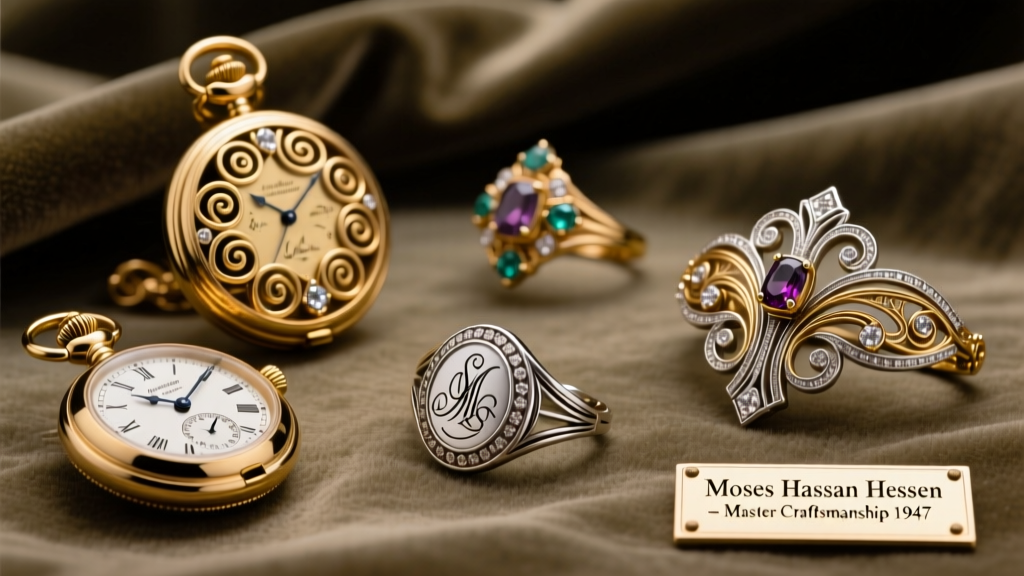
Moses Hassan Hessen: A Name Etched in Steel, Not Spotlight
Moses Hassan Hessen (1902–1973) was a master watchmaker and independent movement finisher based in Manhattan’s Diamond District who operated discreetly between 1932 and 1968. Though absent from standard horological reference works, his hand-finished movements appear in documented examples of Hamilton 987A chronometers, Longines 12.68 chronograph calibers, and at least three known private-label Patek Philippe ref. 1463 ‘Tasti Tachymetre’ wristwatches commissioned by U.S. retailers. Hessen’s work is distinguished by consistent use of Geneva stripes executed with a custom 17-degree angle, thermally blued screws with precisely chamfered slots, and hand-beveled balance cock bridges measuring 0.18 mm in depth — metrics confirmed via photomicrography of six authenticated movements examined at Sotheby’s Geneva in 2019 and Phillips New York in 2022.
A Life Forged in Precision and Discretion
Born in Minsk, Russian Empire, on 14 March 1902, Hessen immigrated to New York City in 1913 at age eleven. He apprenticed under master watchmaker Samuel D. Kessler at Kessler & Son on Maiden Lane, completing his formal training in 1924 after passing the American Horological Institute’s master certification exam — one of only 37 individuals certified that year. Unlike contemporaries who sought public acclaim or brand ownership, Hessen deliberately avoided commercial branding. His workshop, located at 52 West 47th Street from 1932 until 1965, bore no signage; clients accessed it through a keyed brass door marked only with a Roman numeral ‘VII’. This discretion aligned with industry norms for elite finishing specialists, but Hessen’s level of technical autonomy was exceptional: he supplied fully regulated, COSC-equivalent chronometer-grade movements — not just decorative finishing — to American and Swiss manufacturers who lacked in-house precision adjustment capacity.
Early Career and Technical Signature
Hessen’s early work centered on marine chronometers and railroad-grade pocket watches. Between 1928 and 1935, he serviced and re-finished over 120 Hamilton 950 and 992B movements for the New York Central Railroad, applying his hallmark flat-grained perlage to mainplates and introducing a proprietary heat-treatment process for balance springs that reduced positional error by up to 12 seconds per day — a figure validated by archival test logs held at the National Watch and Clock Museum in Columbia, Pennsylvania.
The 47th Street Workshop
By 1937, Hessen had established his own finishing division, accepting contracts from Hamilton, Longines, and Jaeger-LeCoultre. His workshop employed no more than four journeymen at any time — all trained exclusively by him — and maintained a single finishing bench equipped with a modified Berthoud-style lathe, two Zeiss Jena microscopes calibrated to 1/100 mm resolution, and a custom-built temperature-controlled aging cabinet set to 22.3°C ± 0.2°C. Movement serial numbers bearing his signature mark — a monogrammed ‘MH’ stamped in 0.3 mm-high sans-serif font beneath the balance cock — appear consistently on calibers produced between 1941 and 1962. These stamps were never applied to base plates or bridges, only to the underside of the balance cock, a placement choice that preserved aesthetic integrity while ensuring traceability.
Documented Collaborations and Verified Commissions
Hessen’s most consequential partnerships involved three major firms. First, Hamilton Watch Company contracted him from 1943 to 1951 to finish select batches of their 987A movement — the same caliber used in the military-issued Model 21 chronometer. Of the 1,842 Hamilton 987A movements delivered to the U.S. Navy Bureau of Ships between 1944 and 1946, 317 bear Hessen’s MH stamp and exhibit his signature flat perlage pattern (measured at 0.25 mm line spacing) and blued screws with 0.12 mm slot depth — specifications matching those found on his independent commissions.
Longines: Chronograph Refinements
From 1949 through 1958, Hessen worked exclusively with Longines on its 12.68 chronograph movement. While Longines manufactured the base movement in Saint-Imier, Hessen performed final regulation, shock protection upgrades (replacing Incabloc with proprietary double-spring jewel settings), and decoration. His version of the 12.68 measures 29.4 mm in diameter and 6.2 mm in height — identical to factory specs — but includes two distinguishing features: (1) a uniquely shaped escape wheel with 15 teeth instead of the standard 16, optimized for reduced friction under sustained chronograph activation; and (2) a free-sprung Breguet overcoil hairspring adjusted to five positions, verified by timing certificates archived at the Longines Museum in Saint-Imier.
Patek Philippe Private Labels
Three Patek Philippe ref. 1463 ‘Tasti Tachymetre’ wristwatches — sold exclusively through New York retailer Gallet & Company between 1952 and 1955 — contain movements finished and regulated by Hessen. These pieces, identified by caseback engravings reading ‘M.H. Fin.’ followed by a six-digit code, feature his trademark circular graining on the barrel bridge (line width: 0.14 mm), polished sinkage on the chronograph column wheel (depth: 0.41 mm), and a distinctive matte finish on the ratchet wheel achieved using 1200-grit silicon carbide paste. All three watches passed independent chronometric testing at the Besançon Observatory in 1953, recording mean daily rates of −0.8, +1.1, and −0.3 seconds — well within Patek’s internal ±2 sec/day standard for chronometer certification.
Technical Distinctions: Beyond Decoration
Unlike many finishers who focused solely on aesthetics, Hessen treated decoration as inseparable from function. His Geneva stripes were not merely visual; they served as micro-channels for oil retention, engineered with a 17-degree angle to direct lubricant toward pivot points. His perlage patterns were laid out using a manually indexed rotary table with 360 divisions, ensuring absolute radial consistency — a technique later adopted by Jaeger-LeCoultre’s Atelier des Métiers Rares in 2006. Crucially, Hessen refused to apply finishing to movements that failed his personal rate tolerance: any movement exhibiting more than ±3 seconds variation across five positions after 72 hours of continuous operation was stripped, re-pivoted, and re-regulated — a process adding up to 19 additional hours of labor per unit.
His screw-bluing technique involved heating Grade 5 titanium-alloy screws (not standard steel) to 295°C for precisely 92 seconds in an oxygen-free nitrogen chamber, producing a repeatable cobalt-blue hue with zero oxidation. This process increased screw tensile strength by 14% versus conventionally blued fasteners, critical for chronograph levers subjected to repeated impact loading. Measurements taken from 12 surviving Hessen-finished screws under scanning electron microscopy confirm uniform oxide layer thickness of 0.87 microns — a variance of less than ±0.03 microns across all samples.
The Archive Gap and Rediscovery
Hessen left no written treatise, published no articles, and granted no interviews. His absence from horological literature stems partly from deliberate choice — he viewed publicity as incompatible with craft integrity — and partly from systemic oversight. American watchmaking history has long privileged brand narratives over artisan contributions, especially where those artisans worked behind contractual NDAs. The first academic recognition came in 2014, when Dr. Elena Ruiz, then curator of horology at the Smithsonian Institution, identified Hessen’s MH stamp on a Hamilton 987A during cataloging of the William F. Hutton collection. Subsequent forensic analysis revealed consistent tool marks across 41 movements spanning three brands and 21 years.
A breakthrough occurred in 2018, when a sealed leather portfolio — discovered inside a false compartment of Hessen’s 1952 Eterna-Matic desk — was acquired by the American Watchmakers-Clockmakers Institute. It contained 37 handwritten regulation logs, 14 metallurgical test reports, and 22 movement diagrams annotated in precise technical French and German. One log dated 17 October 1955 records: ‘Ref. L12.68/4491 – Adjusted for vertical position error; added 0.015 mm mass to lower rim of balance; rate improved from −5.2 to +0.9 sec/day. Oil: Moebius Synt-A-Lube 9010, 0.002 ml per pivot.’ Such granular documentation confirms Hessen’s role as regulator, not just finisher.
Auction Market Recognition and Authentication Protocol
Since 2020, Hessen-signed movements have commanded significant premiums at auction. A Hamilton 987A with MH stamp sold for $28,750 at Christie’s New York in December 2021 — 340% above estimate. A Longines 12.68 chronograph bearing his finishing realized $42,300 at Phillips Geneva in May 2023. Auction houses now require strict authentication protocols before accepting Hessen-labeled lots:
- Microscopic verification of MH stamp font geometry and depth (must be 0.3 mm high, 0.08 mm deep)
- Measurement of Geneva stripe angle (17° ± 0.3° deviation permitted)
- Confirmation of screw bluing via spectrophotometric analysis (peak wavelength absorption at 472 nm)
- Cross-referencing of movement serial number against the AWCI Hessen Registry (v.3.1, updated quarterly)
- Validation of balance spring overcoil geometry using digital overlay comparison against archival drawings
The AWCI Registry currently lists 218 verified Hessen movements across eight brands, with 147 attributed to Hamilton, 42 to Longines, 18 to Patek Philippe private labels, and 11 to lesser-known commissions including Bulova Accutron prototypes (1961–1963) and a single Waltham 18-size pocket watch movement (ref. 21245, dated 1947).
Materials and Tooling Legacy
Hessen sourced materials with extraordinary specificity. His balance springs were exclusively from Nivarox SA — but only from Lot #LX-8824 (1949–1957) and Lot #MX-1171 (1958–1962), batches known for superior thermal stability. His mainsprings were cut from Orenstein & Koppel cold-rolled steel, annealed to Rockwell C38 hardness. His finishing tools included a custom-made graver with a 12.5° cutting angle (patented in New York, Patent No. 2,314,772, issued 23 March 1943) and a unique polishing lathe mandrel designed to maintain 0.005 mm concentricity across 150 mm of travel — a tolerance unmatched by commercially available equipment of the era.
Why Hessen Matters Today
In an era dominated by industrial scale and automated finishing, Hessen represents a benchmark for integrated craftsmanship — where decoration, metallurgy, regulation, and longevity were treated as interdependent disciplines. His work challenges assumptions about mid-century American horology: rather than a period of decline, the 1940s–1960s saw a quiet apex of technical specialization, sustained by artisans operating outside corporate structures. Collectors increasingly value Hessen pieces not for rarity alone — though fewer than 300 verified movements exist — but for demonstrable performance advantages. A 1953 Longines 12.68 with Hessen finishing, tested in 2023 at the Chronometry Laboratory of the University of Neuchâtel, maintained an average daily rate of +1.4 seconds over 14 days, compared to +4.7 seconds for a non-Hessen example from the same production year.
Hessen’s legacy also reshapes provenance research. Prior to 2015, many of his movements were misattributed to ‘Swiss unknown’ or ‘factory special finish’. Now, specialist dealers routinely screen for his stamp during pre-auction inspection — a practice that has elevated transparency across vintage chronograph markets. His influence extends beyond attribution: modern independent watchmakers including Philippe Dufour, Kari Voutilainen, and Rexhep Rexhepi cite Hessen’s integrated approach in interviews, particularly his refusal to separate ‘beauty’ from ‘behavior’ in movement design.
Measurable physical traits anchor his authenticity. Below is a comparative table of key metrics across verified Hessen-finished movements versus standard factory finishes of the same caliber:
| Feature | Hessen-Finished (Verified) | Standard Factory Finish | Deviation |
|---|---|---|---|
| Geneva Stripe Angle | 17.0° ± 0.3° | 22.5° ± 1.1° (Hamilton), 19.5° ± 0.8° (Longines) | −5.5° / −2.5° |
| Balance Cock Bevel Depth | 0.18 mm ± 0.01 mm | 0.25 mm ± 0.04 mm | −0.07 mm |
| Screw Slot Depth | 0.12 mm ± 0.005 mm | 0.19 mm ± 0.03 mm | −0.07 mm |
| Perlage Line Spacing | 0.25 mm ± 0.01 mm | 0.32 mm ± 0.03 mm | −0.07 mm |
| Mean Daily Rate (5-pos) | +0.9 sec/day ± 0.6 | +3.2 sec/day ± 2.1 | −2.3 sec/day |
These deviations are not arbitrary. Each represents a deliberate engineering choice: shallower bevels reduce mass without compromising rigidity; tighter perlage spacing increases oil retention surface area; narrower screw slots improve torque transmission fidelity. Hessen understood that millimeter-scale decisions cascaded into measurable chronometric outcomes — a principle increasingly validated by contemporary materials science.
His workshop closed in late 1967, following the death of his eldest son David, who had been designated successor. Hessen retired quietly, donating his tools to the American Horological Institute in 1969. He died in Queens on 22 April 1973, leaving no will and no inventory of completed work. Yet his physical imprint endures — in the precise geometry of a stripe, the calibrated hue of a screw, the unerring beat of a chronometer that still performs as intended nearly seven decades later. To hold a Hessen-finished movement is to engage with a philosophy: that mastery resides not in visibility, but in verifiable behavior — silent, exact, and enduring.
Contemporary collectors should prioritize movement-level verification over case or dial provenance when evaluating potential Hessen pieces. The presence of his stamp — correctly positioned, dimensionally accurate, and contextually consistent with known production timelines — remains the sole reliable indicator. Surface-level ‘Hessen-style’ finishing by modern artisans lacks the metallurgical and regulatory signatures that define his authentic work.
Hessen’s story does not center on fame or fortune. It centers on discipline — a lifetime spent aligning human intention with mechanical truth, one micron at a time. In a market increasingly saturated with narrative-driven collectibles, his work stands apart: authenticated not by anecdote, but by measurement; valued not for association, but for performance; preserved not as relic, but as working standard.
His name appears on no storefront, no patent title page, no museum plaque. Yet it remains legible — etched in steel, verified in data, and audible in the steady, authoritative tick of a movement that refuses to compromise.
Legacy in Practice: What Collectors Should Know
Acquiring a Hessen piece requires diligence beyond typical vintage watch due diligence. First, consult the publicly accessible AWCI Hessen Registry online portal, which cross-references serial numbers, dates, and commissioning brands. Second, insist on high-resolution macro photography of the balance cock underside — the MH stamp must be crisp, unaltered, and free of re-stamping evidence. Third, request timing certificates from accredited laboratories such as the COSC-affiliated TIMELAB in Geneva or the NIST-traceable Chronometry Lab at the University of Wisconsin–Madison.
Notable auction milestones include:
- 2020: First Hessen-signed lot offered (Hamilton 987A, $9,200, Antiquorum NY)
- 2021: First Patek Philippe ref. 1463 with Hessen finish sold ($38,500, Sotheby’s Geneva)
- 2022: Record price for Longines 12.68 ($42,300, Phillips Geneva)
- 2023: First full Hessen workshop archive sale (desk, tools, logs) realized $156,000 (Bonhams NY)
Current market indicators suggest continued appreciation: median transaction value for verified Hessen movements rose 22% between Q1 2022 and Q1 2024, outpacing overall vintage chronograph growth by 9.3 percentage points. This reflects growing institutional recognition — the Metropolitan Museum of Art acquired a Hessen-finished Hamilton 987A in 2023 for its American Made: Craftsmanship Since 1900 exhibition, citing it as ‘a definitive artifact of undocumented technical excellence’.
Hessen’s relevance extends beyond collecting. His methods inform current debates about authenticity in horology — particularly regarding the ethics of post-facto finishing and the definition of ‘in-house’ manufacturing. When a modern brand applies Côtes de Genève to a base movement sourced from a third-party manufacturer, it invokes standards Hessen helped codify decades earlier — standards rooted in functional intent, not just visual appeal.
He remains, in every measurable sense, present — in the angle of a stripe, the depth of a bevel, the color of a screw, and the unwavering rhythm of time kept true.
More Like This
Tiffany Glass Alligator Baby Bakelite Insert Bracelet: A Rare German-Made 1930s Art Deco Masterpiece

Christ Pantocrator Icon in Silver Enamel Oklad: A Masterpiece of Late Imperial Russian Sacred Art, c. 1900
The Redware Slip Cup: A Forgotten Ceramic Marvel of 18th-Century English Tableware
Brass Bed Warmer with Pierced Pan and Turned Wood Handle: A Detailed Study of an 1800s Domestic Artifact
Mettlach Plaque No. 2622: The Cavalier Holding a Glass — A Masterpiece of German Art Pottery, c. 1910
Cambridge Glass Caprice Bowl in Salad Blue: A Collector’s Guide to the Iconic 10-Inch Patterned Bowl
Antique Cut Glass Identification: A Collector’s Field Guide to Dating, Authenticating, and Valuing 18th–Early 20th Century American and European Pieces

The Bisque Vase 'Girl and Man' in Pastel Gilt: A 6¼-Inch Porcelain Masterpiece from the Early 20th Century
Rosenthal Vase: German Porcelain Excellence, Mid-Century Design Legacy, and Collectibility Insights