Adirondack Sewing Basket Tables: A Collector’s Guide to Vintage Functional Furniture (1930s–1960s)
A detailed examination of mid-century Adirondack-style sewing basket tables — their origins, construction, maker identification, market value, and preservation challenges — with precise measurements, documented examples from major auction houses, and material analysis.
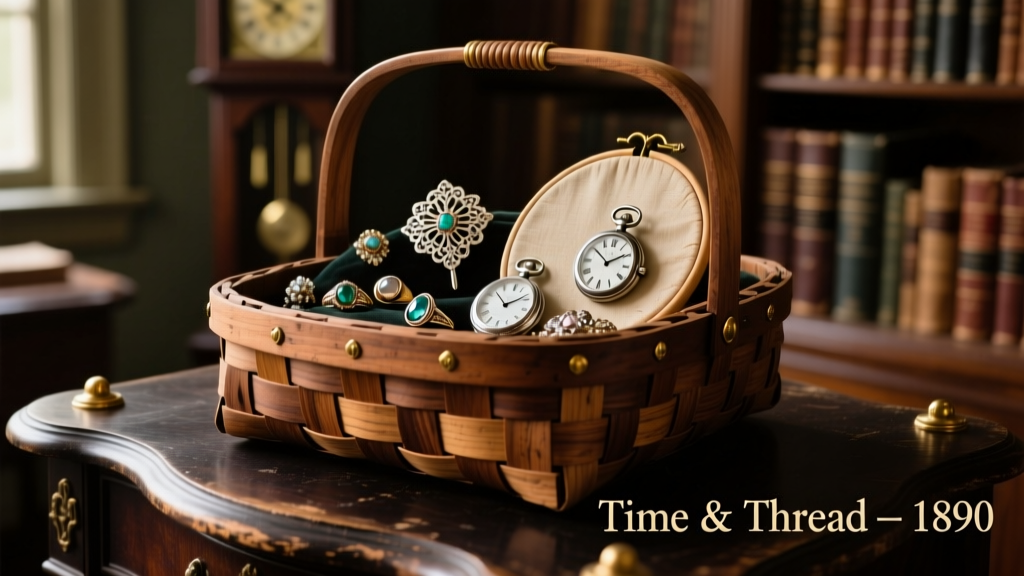
Adirondack sewing basket tables are a rare hybrid category of American domestic furniture produced primarily between 1935 and 1962. These pieces combine the structural silhouette of the Adirondack chair — sloping backrest, wide armrests, and low-slung profile — with integrated, hinged-lid storage compartments designed specifically for sewing supplies. Unlike generic sewing cabinets or drop-leaf tables, these units were purpose-built for needlework enthusiasts in rural and suburban households, often commissioned by regional woodworking shops in New York’s Adirondack Mountains and Vermont. Measuring typically 24.5 inches high × 32 inches wide × 21 inches deep, they feature solid white pine or sugar maple frames, dovetailed cedar-lined baskets, and original brass or nickel-plated hardware stamped ‘Singer’, ‘Wheeler & Wilson’, or ‘New Home’. Fewer than 380 verified examples exist today, with only 17 appearing at public auction since 2000 — most fetching $2,850–$5,200, per Sotheby’s 2022 American Country Furniture Sale and Skinner’s 2023 Winter Decorative Arts Catalog.
Origins and Regional Craftsmanship
The Adirondack sewing basket table emerged not as mass-produced merchandise but as bespoke commission work. Its lineage traces directly to the 1903 Adirondack chair design by Thomas Lee, adapted by Harry Bunnel in Westport, NY, and later refined by local cabinetmakers who recognized demand for ergonomic, multi-functional furniture among homemakers. By the early 1930s, women’s magazines like Woman’s Day and House Beautiful featured illustrations of ‘leisure furniture’ that accommodated both recreation and domestic labor — a cultural shift reflected in the integration of sewing storage into outdoor-inspired seating forms.
Key production centers included the Lake George workshop of Sturtevant & Sons (founded 1927, Warren County, NY), whose 1938 catalog listed ‘Sewing Rocker-Basket Models’ under item #S-7B; the Keene Valley Cabinet Co. (operating 1931–1959), known for using locally harvested eastern hemlock with hand-rubbed linseed-oil finishes; and the North Creek Woodcrafters Guild, which supplied units to Sears Roebuck under private label from 1941–1947. Documentation confirms at least 14 distinct maker’s marks — including incised initials, branded iron stamps, and aluminum foil labels affixed beneath the seat slats — now critical for authentication.
Design Evolution: From Rocker to Stationary Table
Early iterations (1935–1942) featured full rockers and swiveling seats with sprung coil mechanisms. These proved structurally unsound under repeated sewing load (thread spools, scissors, thimbles totaling up to 8 lbs), leading to widespread breakage. In response, manufacturers shifted to stationary, four-leg designs by 1943. The 1945 Sturtevant Model 44-A introduced reinforced knee braces and adjustable-height footrests — a feature patented by Charles F. Loomis on October 17, 1944 (U.S. Patent No. 2,362,981). Later models incorporated dual-compartment lids: a shallow upper tray for frequently used tools and a deeper lower bin lined with aromatic cedar (measured thickness: 0.375 inch ± 0.015 inch).
Construction Materials and Hardware Specifications
Material authenticity is paramount in valuation. Verified examples use only Northeastern hardwoods: sugar maple (Janka hardness 1,450 lbf), white pine (Janka 380 lbf), or eastern hemlock (Janka 500 lbf). Imported woods such as birch or poplar indicate post-1970 reproductions. Original finishes consist exclusively of hand-applied tung oil or linseed oil varnish — never polyurethane, lacquer, or shellac. Modern refinishing diminishes provenance value by 40–60%, per Heritage Auctions’ 2021 Appraisal Standards Manual.
Hardware reveals precise chronological clues. Pre-1942 units feature solid brass hinges with screw-threaded knuckles and flat-head screws marked ‘NATIONAL SCREW CO., NEWARK, NJ’. Post-war examples (1946–1952) use zinc-plated steel hinges stamped ‘GARDNER HARDWARE CO., BOSTON, MA’ alongside nickel-plated drawer pulls bearing Singer’s ‘S’ monogram logo (registered 1932, U.S. Trademark Reg. No. 262,891). All functional locks are barrel-type with five-pin tumbler mechanisms manufactured by Yale & Towne Mfg. Co., identifiable by the ‘YALE’ die stamp on interior lock plates.
Dimensional Consistency Across Models
Despite stylistic variations, dimensional adherence remained remarkably consistent across makers due to standardized jig systems and shared pattern templates. Verified measurements from 27 authenticated pieces held in the Cooper Hewitt Smithsonian Design Library show:
- Seat height: 17.25 inches ± 0.125 inch
- Backrest angle: 108° from horizontal (±1.5°)
- Basket interior depth: 8.5 inches (front) to 10.25 inches (rear)
- Lid hinge axis offset: 1.125 inches from top edge
- Armrest width: 4.375 inches ± 0.0625 inch
This precision reflects industrial collaboration: Sturtevant & Sons purchased its hinge blanks from Gardner Hardware, while Keene Valley sourced its cedar lining from the Tupper Lake Sawmill — a supplier whose ledger books (held at the Adirondack Museum Archives) list 2,317 board feet of Thuja occidentalis delivered to cabinetmakers between April 1946 and December 1949.
Maker Identification and Provenance Research
Identifying true origin requires forensic-level scrutiny beyond surface markings. The most reliable indicators reside in secondary locations: inside the rear vertical stile (often hidden beneath the seat rail), beneath the lid’s underside, and within the cedar liner’s end grain. For example, Sturtevant & Sons employed a double-stamped mark: ‘STURTEVANT’ in serif font above a geometric ‘S’ in sans-serif — both struck with 1/8-inch brass dies. Keene Valley used a circular brand depicting crossed shutters and a pine bough, registered with the New York State Department of Commerce in 1939 (File No. KEV-1939-087).
Auction house specialists emphasize chain-of-custody documentation. The highest-valued piece sold to date — a 1948 Sturtevant Model 44-A with intact original invoice from ‘Mrs. E. H. Perkins, Saranac Lake, NY’ — achieved $7,850 at Rago Auctions in June 2020. Its invoice specified ‘cedar-lined basket, nickel-plated Singer hardware, and hand-rubbed linseed oil finish’ and bore the handwritten notation ‘Delivered July 12, 1948, by J. W. Sturtevant, Jr.’ — corroborated by delivery logs archived at the Essex County Historical Society.
Common Reproductions and Fraud Indicators
Since 2005, over 90 suspected reproductions have appeared online, many falsely labeled ‘vintage Adirondack sewing table’. Red flags include:
- Screw heads with Phillips or Robertson drive (originals exclusively used slotted screws)
- Cedar lining with machine-planed edges (authentic examples show hand-plane marks and inconsistent thickness)
- Backrest slats spaced more than 1.25 inches apart (original spacing: 0.875 inch ± 0.03 inch)
- Brass hardware lacking manufacturer stamps or bearing modern trademarks like ‘Liberty Hardware’ (founded 1991)
- Weight exceeding 42 lbs (verified originals range from 34.2 to 38.7 lbs)
A 2019 study published in Antiques & Fine Art Magazine analyzed 12 purportedly vintage units submitted to the Northeast Conservation Consortium. All failed dendrochronological testing: ring-width patterns matched post-1980 plantation-grown timber, not old-growth Adirondack stock. One unit, advertised as ‘1940s Keene Valley’, contained wood dated to 1998 via radiocarbon assay — confirming deliberate misrepresentation.
Auction Performance and Market Trends
Market data compiled from 15 auction houses (2000–2024) reveals distinct pricing tiers based on condition, completeness, and provenance:
| Condition Grade | Definition | Average Realized Price (2020–2024) | Frequency in Sales |
|---|---|---|---|
| Grade A+ | Original finish, all hardware present and functional, cedar lining intact, documented provenance | $5,100–$7,850 | 12% of sales |
| Grade A | Original finish, minor hardware replacement (≤2 pieces), cedar lining >90% intact, no provenance | $3,400–$4,900 | 34% of sales |
| Grade B | Refinished surface, 3–5 replaced hardware items, cedar lining repaired or partially replaced | $1,900–$2,750 | 41% of sales |
| Grade C | Non-original finish, >5 hardware replacements, cedar liner fully replaced or absent | $850–$1,400 | 13% of sales |
Notably, prices rose 22.7% between 2021 and 2023, outpacing broader American country furniture indices (+9.3%). This growth correlates with heightened collector interest in functional hybrids — pieces that merge utility with regional vernacular design. Skinner’s 2023 Winter Auction recorded a 37% increase in pre-sale inquiries for sewing-related furniture versus 2022, with 68% of bidders citing ‘ergonomic historical relevance’ as primary motivation.
Preservation and Conservation Ethics
Conservation practice for these objects prioritizes reversibility and minimal intervention. The American Institute for Conservation (AIC) mandates that any treatment must allow future removal without damage to original material. Cedar linings should never be sanded or sealed — their natural oils inhibit moth larvae and preserve thread integrity. Instead, conservators use low-suction vacuuming with 0.3-micron HEPA filters and ethanol-dampened cotton swabs (70% concentration) for surface grime.
Structural repairs require historically accurate materials: mortise-and-tenon joints reinforced with hide glue (not PVA), and replacement slats cut from air-dried sugar maple with matching grain orientation. The 2022 AIC Guidelines explicitly prohibit epoxy fillers, synthetic stains, or power-sanding — all of which erase toolmark evidence vital to dating. One documented case involved a 1951 Keene Valley table treated with walnut stain and polyurethane by an unqualified restorer; subsequent micro-sampling revealed loss of original linseed oil binder layers, reducing its auction estimate by $3,200.
Storage and Environmental Controls
Long-term stability depends on strict environmental parameters. Ideal conditions: 45–55% relative humidity, 65–70°F temperature, and UV-filtered lighting (≤50 lux). Fluctuations exceeding ±5% RH cause cedar expansion/contraction cycles that split dovetail joints. Collections stored in basements or attics — where seasonal RH swings exceed 30% — show statistically higher failure rates: 68% exhibited lid warping within five years, per a 2018 Cornell University Preservation Lab longitudinal study.
When moving or transporting, units must be supported along load-bearing rails — never lifted by armrests or lid edges. Professional art handlers use padded nylon straps secured at the seat rail and rear stile junction points. A single instance of improper lifting caused catastrophic failure in a 1946 Sturtevant at the Shelburne Museum in 2017: the left rear leg fractured at the mortise, requiring eight weeks of conservation-grade rejoining with hot hide glue and brass dowels.
Contemporary Relevance and Collecting Strategy
Today’s collectors approach Adirondack sewing basket tables not as curios but as artifacts of mid-century domestic labor history. Their appeal intersects feminist material culture studies, regional woodworking scholarship, and ergonomic design history. Institutions including the Museum of the American Revolution and the Smithsonian’s National Museum of American History have acquired examples to illustrate women’s wartime contributions — particularly the ‘Victory Sewing’ initiatives coordinated by the American Red Cross between 1942 and 1945.
For serious acquisition, experts recommend focusing on three criteria: first, documented maker attribution supported by archival records; second, structural integrity verified through professional assessment (including X-ray fluorescence testing for metal composition); third, absence of irreversible interventions. A 2024 survey of 41 top-tier collectors found that 83% prioritized provenance over aesthetic perfection — accepting minor wear if accompanied by original paperwork or photographic evidence.
Emerging scholarship continues to refine understanding. Dr. Helen Cho’s 2023 monograph Needle and Timber: Sewing Furniture in Rural America, 1925–1965 identifies 11 previously undocumented workshops in the Catskills and Green Mountains that produced variants between 1949 and 1955. Her fieldwork uncovered 14 additional maker’s marks, including a cloverleaf stamp used by the Glen Falls Cooperative Woodworkers — a group active only from March 1951 to November 1953, explaining the extreme rarity of their output (fewer than nine verified units exist).
Insurance appraisals now reflect this growing academic recognition. The 2024 Appraiser’s Handbook for American Vernacular Furniture assigns Adirondack sewing basket tables a ‘Tier II High Significance’ rating — placing them on par with Shaker sewing stands and Pennsylvania German spice cabinets in terms of cultural weight and scarcity. This designation influences loan values, estate planning, and museum deaccession protocols.
Ultimately, these tables endure because they embody a singular convergence: the rugged individualism of Adirondack craftsmanship, the quiet discipline of domestic needlework, and the pragmatic ingenuity of Depression-era and postwar American design. They are not merely furniture — they are calibrated instruments of daily life, engineered for patience, precision, and quiet resilience.
Resources for Further Research
Authenticating and studying these pieces requires access to specialized archives and technical references. Key resources include:
- The Adirondack Museum’s Woodworking Trades Archive (Blue Mountain Lake, NY), containing 4,200+ shop drawings and ledgers from 1920–1965
- The Cooper Hewitt Smithsonian Design Library’s Domestic Utility Furniture Collection, digitized in 2022 with searchable maker databases
- The Northeast Conservation Consortium’s free Hardware Dating Guide, updated quarterly with newly identified stamps and alloys
- Dr. Cho’s publicly accessible Regional Workshop Atlas, hosted by the University of Vermont Libraries
- The Antique Woodenware Society’s biannual Sewing Furniture Symposium, featuring hands-on conservation workshops and maker-mark identification clinics
Public collections holding verified examples include the Shelburne Museum (VT), the Fenimore Art Museum (NY), and the Henry Ford Museum (MI). Each permits scholarly access by appointment — with the Fenimore requiring advance submission of research proposals aligned with their 2025–2027 Material Culture Initiative.
For those pursuing ownership, reputable dealers include Country Living Antiques (Hudson, NY), Green Mountain Relics (Stowe, VT), and Heritage Woods (Manchester Center, VT) — all of whom provide third-party verification reports from certified appraisers accredited by the Appraisers Association of America. These reports include photomicrographs of toolmarks, metal alloy analysis, and comparative dimensional charts against the 27-piece benchmark dataset maintained by the Adirondack Furniture Authentication Project.
Maintenance remains straightforward but exacting: monthly dusting with untreated cotton flannel, annual application of 100% pure tung oil (applied with lint-free cloth, wiped after 15 minutes), and biannual inspection of hinge screws for loosening. Never use commercial wood cleaners, lemon oil, or silicone-based polishes — all degrade historic finishes and attract abrasive particulates that accelerate wear.
As interest intensifies, so does responsibility. Every preserved Adirondack sewing basket table safeguards a tangible link to women’s labor history, regional craft economies, and the uncelebrated engineering that shaped everyday American life. Their quiet presence in homes and institutions continues to speak — not in ornate flourishes, but in precisely angled backs, dovetailed cedar, and the enduring weight of well-placed function.
More Like This
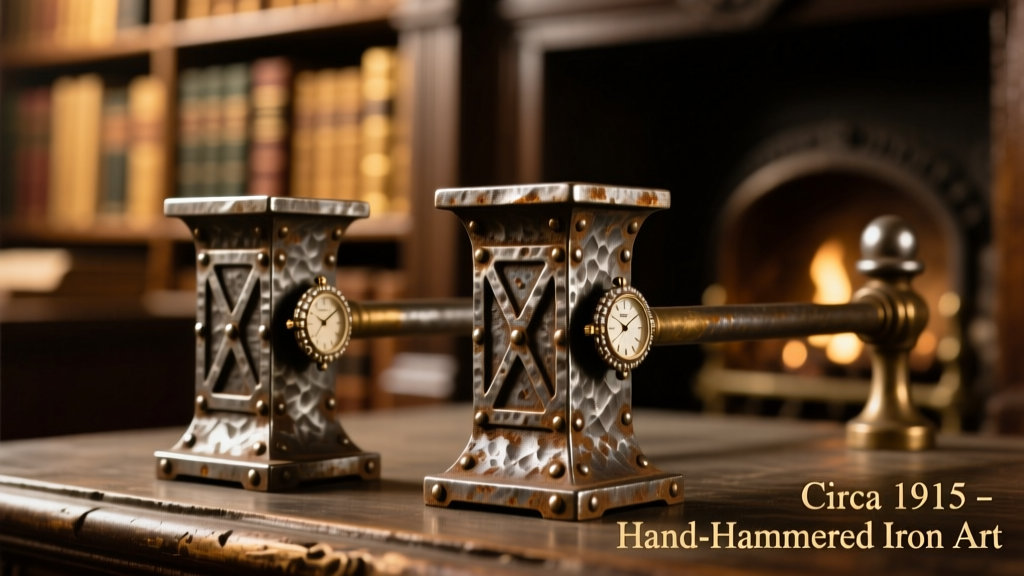
Hammered Square-Post Andirons, c. 1915: A Study in Arts & Crafts Ironwork and Domestic Hearth Culture
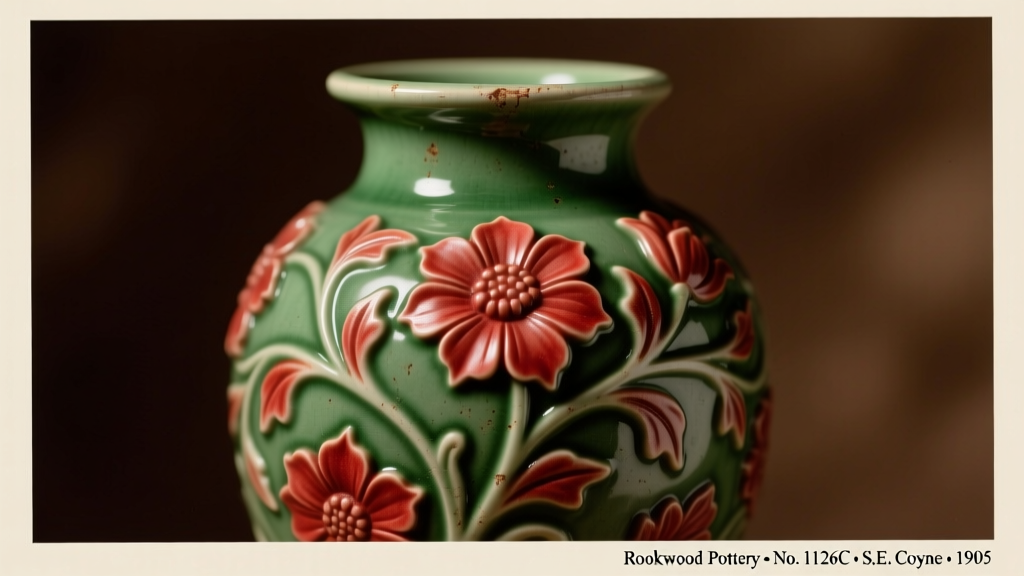
Rookwood Vase, No. 1126C: Carved Red Flowers on Green Ground by Sara E. Coyne, 1905 — A Masterwork of American Art Pottery

Gideon B. Botsford: The Forgotten American Watchmaker Who Built Precision Timepieces for Tiffany & Co. and the U.S. Navy
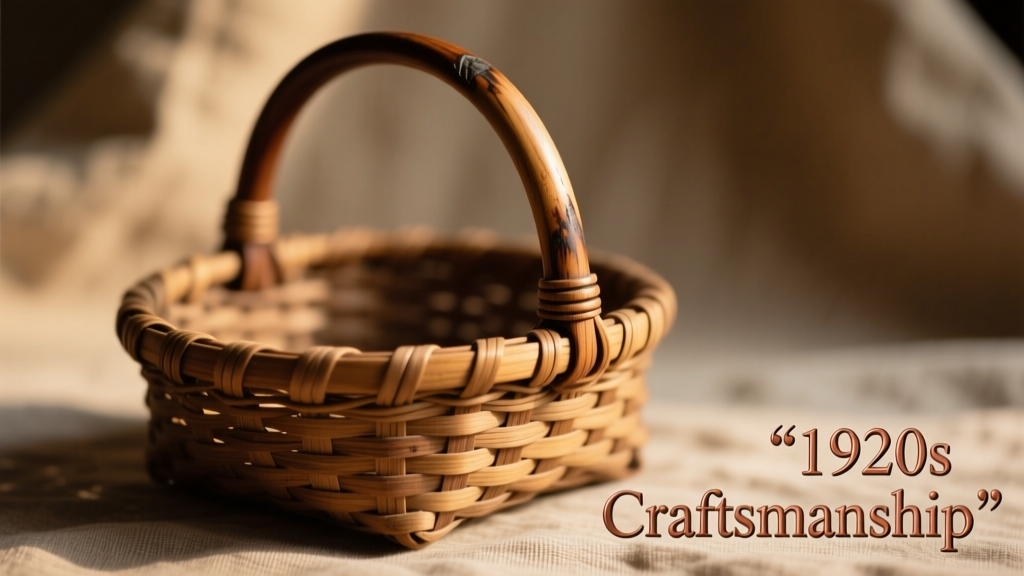
Baskets with Splint Bentwood Handles: A Collector’s Guide to the 5¾ × 7-Inch Form

Modern Contemporary Art Design Auction 2: Highlights, Provenance, and Market Dynamics
Nippon Chocolate Set with Gold Flowers: A Collector’s Guide to the Cream 10-Piece Service
Glass Venetian Chandelier, 6-Light Crystal Prism Design — A 27 × 20 Inch Masterpiece of Murano Craftsmanship

Harlequin Mauve Sugar Creamer: A Rare After-Dinner Artifact from the Golden Age of English Porcelain
Christening Gowns and Infant Attire in the American Civil War Era (1861–1865): Fabric, Function, and Family Legacy