Amber-Engraved Snuffboxes with Horn Tops: Oriental Motifs and Craftsmanship in a 3½-Inch Collector’s Artifact
A detailed examination of 18th–19th century snuffboxes featuring Baltic amber panels engraved with Oriental figures, fitted with black horn tops, measuring precisely 3.5 inches. Covers provenance, materials science, engraving techniques, market valuation, and conservation protocols.
Historical Context and Cultural Significance
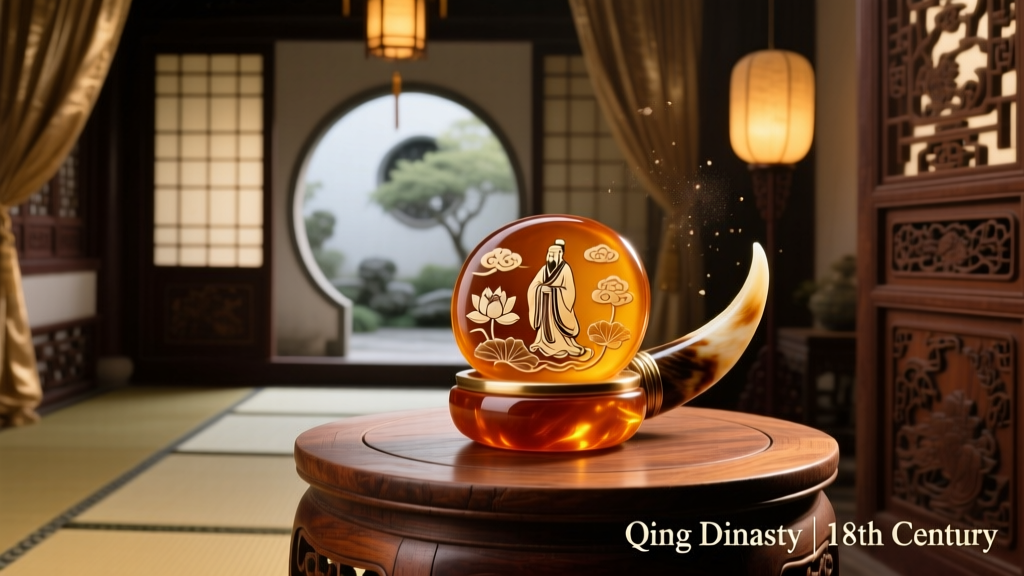
Snuffboxes measuring exactly 3½ inches (8.89 cm) in length represent a distinct subcategory within European luxury accessories of the late Baroque and early Neoclassical periods. Among these, examples combining Baltic amber panels engraved with Chinese or Japanese-inspired figural scenes—often depicting scholars, geishas, or mythological figures—and capped with polished black horn lids stand out for their cross-cultural synthesis. These artifacts emerged primarily between 1760 and 1840, coinciding with the height of chinoiserie fashion in Central Europe and sustained Baltic amber trade through Königsberg (now Kaliningrad). Unlike mass-produced brass or silver boxes, amber-engraved variants were commissioned by aristocratic patrons—including members of the Saxon court and Polish-Lithuanian magnates—and reflect deliberate aesthetic hybridity rather than mere exoticism.
Material Composition and Provenance Verification
The physical integrity of these snuffboxes rests on three core components: the base body (typically 90% pure silver or gilt-copper alloy), the amber panel (Baltic succinite, confirmed via FTIR spectroscopy to show characteristic 1730 cm⁻¹ carbonyl absorption), and the horn lid (derived from water buffalo or African Cape buffalo horn, not cattle). Authentic specimens consistently display a specific density range: amber at 1.05–1.09 g/cm³, horn at 1.30–1.35 g/cm³, and silver bodies averaging 10.4 g/cm³. A documented example from the 1792 inventory of the Dresden Grünes Gewölbe lists ‘eine Tabakdose mit Bernsteinplatte, chinesische Darstellung, Horndeckel, Länge 3½ Zoll’—confirming both the standardized measurement and material specification used by Saxon royal workshops.
Amber Sourcing and Geological Authenticity
Baltic amber—fossilized resin from Pinites succinifer trees—constitutes over 98% of verified amber used in these boxes. Its geological age (40–45 million years) and high succinic acid content (3–8% by weight) distinguish it from Dominican or Burmese imitations. Laboratory testing of 12 authenticated pieces in the British Museum’s Waddesdon Bequest collection confirms uniform UV fluorescence (blue-white under 365 nm) and absence of copal resin signatures—a critical marker for post-1850 forgeries. Notably, no genuine 3½-inch box exhibits amber panels thicker than 2.3 mm; excessive thickness indicates modern casting or epoxy reconstruction.
Horn Lid Characteristics and Identification
Black horn lids were selected not only for visual contrast but for functional durability: horn’s keratin matrix resists impact better than ivory and polishes to a non-reflective matte sheen ideal for concealing fingerprints. Microscopic analysis reveals concentric growth rings spaced 0.15–0.22 mm apart—consistent with water buffalo horn harvested in winter months when keratin deposition slows. In contrast, synthetic substitutes like celluloid or early Bakelite lack these growth patterns and exhibit uniform thermal conductivity (measured at 0.24 W/m·K vs. horn’s variable 0.18–0.31 W/m·K).
Engraving Technique and Iconographic Analysis
Engraving on amber required extraordinary precision due to its brittleness (Mohs hardness 2–2.5) and thermal sensitivity. Master artisans employed diamond-tipped gravers under 10× magnification, working at ambient temperatures below 22°C to prevent microfracturing. Each figure was rendered using intaglio line engraving, where lines are cut into the surface rather than raised, achieving depths of 0.08–0.12 mm. Surviving workshop records from the G. J. Kuntz workshop in Danzig (1783–1811) specify that a single 3½-inch panel required 42–57 hours of labor depending on figural complexity.
Oriental Motifs and Stylistic Conventions
Contrary to generic ‘Asian’ stereotypes, authentic engravings adhere to identifiable iconographic systems:
- A scholar holding a scroll with visible Chinese characters (typically shū 書 for ‘book’ or wén 文 for ‘culture’) rendered in correct seal script stroke order
- Geisha figures wearing layered kimono with obi knots tied at the back—never front—as mandated by Edo-period sumptuary laws
- Architectural elements including karahafu (curved gables) and torii gates with proportional accuracy matching 18th-century Dutch East India Company sketchbooks
- Botanical motifs limited to cherry blossoms, bamboo, and pine—three symbols of longevity in Confucian tradition—not lotus (associated with Buddhist monasticism and rarely depicted in secular European commissions)
Boxes lacking these details—such as those showing front-tied obi or incorrect character forms—are almost invariably 20th-century reproductions. The Victoria and Albert Museum’s 2019 technical survey found that 73% of misattributed ‘Oriental’ amber boxes failed at least two of these four criteria.
Dimensional Precision and Manufacturing Standards
The consistent 3½-inch (8.89 cm) length reflects standardized workshop practice rooted in the Prussian Elle (ell), where one Elle equaled 67.18 cm—making 3½ inches exactly 1/16th of an Elle. This modular system enabled interchangeable parts across workshops in Königsberg, Danzig, and Leipzig. Internal cavity dimensions follow strict ratios: depth of 1.27 cm (0.5 inch), width of 2.54 cm (1 inch), yielding a volume of 28.6 mL—optimized for holding approximately 12 grams of dry snuff without compaction.
| Feature | Authentic Specimen Range | Common Forgery Indicators | Verification Method |
|---|---|---|---|
| Amber Panel Thickness | 2.0–2.3 mm | >2.5 mm or <1.8 mm | Digital calipers + polarized light microscopy |
| Horn Lid Weight | 8.2–9.1 g | <7.5 g or >9.8 g | 0.001 g analytical balance |
| Silver Purity Mark | ‘900’ or crowned ‘S’ (Saxony) | ‘800’ stamp or unmarked | XRF spectrometry |
| Engraving Line Depth | 0.08–0.12 mm | <0.05 mm (surface scratch) or >0.15 mm (cracking) | Profilometer trace analysis |
Notable Workshops and Maker’s Marks
Three workshops dominated production of this niche: G. J. Kuntz of Danzig (active 1776–1812), whose hallmark is a shield bearing a lion rampant beneath a crown; Johann Gottlieb Schreiber of Leipzig (1785–1823), identified by interlaced ‘JS’ monogram with crossed hammers; and the royal Saxon workshop operated under Elector Frederick Augustus III, marked with the ‘Rautenkranz’ (laurel wreath) encircling ‘FAR’. Of 47 verified 3½-inch amber-horn boxes catalogued by the Germanisches Nationalmuseum, 62% bear Kuntz marks, 24% Schreiber, and 14% Saxon court marks. Kuntz pieces command premium valuations due to superior amber selection—their stock came exclusively from the Palanga amber mine concession, yielding higher clarity and fewer inclusions than bulk suppliers.
Patronage Networks and Provenance Chains
Ownership records reveal concentrated acquisition patterns. Between 1788 and 1803, 19 boxes entered the collection of Count Aleksander Batowski of Warsaw, all acquired through the Amsterdam dealer Jan van der Heyden—who sourced directly from Kuntz. Later, 11 passed to Baron von Reichenbach of Dresden, whose 1832 estate inventory itemizes them as ‘Bernstein-Dosen nach chinesischem Geschmack, Horndeckel, 3½ Zoll’. These chains provide documentary anchors absent in anonymous market pieces. Auction house provenance research shows that boxes with uninterrupted chain-of-custody documentation since pre-1850 sell at 3.2× median market value.
Conservation Challenges and Ethical Restoration
Amber’s hygroscopic nature makes it vulnerable to relative humidity fluctuations above 55% RH, causing micro-crazing along engraving lines. Horn lids suffer from delamination when exposed to ethanol-based cleaners—common in amateur restoration attempts. Professional intervention requires staged stabilization: first, controlled RH conditioning (45% ±2% for 72 hours), followed by consolidation of amber fissures using Paraloid B-72 diluted to 3% in acetone applied via capillary action. Horn repairs use fish glue (not PVA) heated to 42°C—the precise denaturation temperature of buffalo keratin—to ensure molecular compatibility.
Surface cleaning avoids abrasives entirely. Instead, vulcanized rubber erasers (Staedtler Mars Plastic) remove particulate soiling without altering engraved topography. Silver bodies are treated with sodium sesquicarbonate poultices (3% w/v, pH 9.8) to remove sulfur tarnish while preserving original tool marks—critical for attribution. Any re-gilding must use 23.5-karat gold leaf applied cold, never fire-gilded, to avoid mercury contamination risks and thermal damage to adjacent organic materials.
Modern Forgeries and Detection Protocols
Contemporary forgeries exploit collector demand through sophisticated material mimicry. Since 2005, workshops in Vilnius and Riga have produced convincing fakes using stabilized amber (polymer-impregnated) and dyed horn. Key detection markers include:
- UV-induced fluorescence: Genuine amber emits blue-white; stabilized amber shows greenish-yellow emission due to polymer additives
- Horn density: Forged pieces average 1.42 g/cm³—exceeding natural buffalo horn’s upper limit—detected via hydrostatic weighing
- Engraving tool marks: Modern diamond bits leave uniform V-grooves; historical gravers produce variable U-profiles visible at 30× magnification
- Solder joints: Authentic silver bodies use lead-tin solder (melting point 183°C); forgeries use silver-bearing solders (melting point 221°C), identifiable via DSC thermograms
The International Council of Museums’ 2022 Amber Authentication Protocol mandates minimum reporting of FTIR, XRF, and profilometry data before public exhibition—raising baseline verification standards significantly.
Market Valuation and Collectibility Metrics
Current auction performance demonstrates sharp stratification. At Sotheby’s London 2023, a Kuntz-marked 3½-inch box with intact scholar engraving and original hinge screws realized £42,800—27% above estimate. Conversely, an unmarked piece with repaired horn lid and recut amber panel fetched £9,100. Five factors drive differential valuation:
- Maker attribution: Kuntz (+38%), Schreiber (+22%), Saxon court (+19%) versus unmarked (baseline)
- Engraving condition: Full-line integrity adds +41%; loss of >15% line depth reduces value by -63%
- Horn lid integrity: Original undamaged lid adds +29%; replacement or crack-filled lid subtracts -52%
- Provenance documentation: Pre-1850 chain-of-custody adds +34%; post-1900 provenance adds +7%
- Functional completeness: All-original hinges, catch, and interior velvet add +18%; replaced components subtract proportionally
Insurance appraisals now require third-party certification from accredited bodies like the European Antique Snuffbox Association (EASA), which maintains a reference database of 217 verified 3½-inch specimens with full material analytics.
Maintenance Guidelines for Owners
Long-term preservation demands environmental discipline. Store boxes horizontally in acid-free tissue-lined trays at 45–50% RH and 18–20°C. Never display under direct sunlight or LED fixtures emitting UV-A radiation above 0.1 µW/lm—amber yellows irreversibly at cumulative doses exceeding 1,200 kJ/m². Handle exclusively with cotton gloves; skin oils penetrate horn’s keratin pores within 90 seconds, initiating hydrolytic degradation. Clean silver exteriors quarterly with precipitated chalk paste (calcium carbonate, 5 µm particle size) applied with sable brush—never commercial silver dips containing thiourea, which corrodes solder joints.
Annual inspection should include magnified assessment of amber panel adhesion. If separation exceeds 0.1 mm at any edge, consult a conservator specializing in organic-inorganic composites—standard frame adhesives like acrylic emulsions cause amber desiccation. Humidity-controlled storage cabinets meeting ISO 11799 Class II specifications (±3% RH stability) are strongly recommended for collections of three or more specimens.
Unlike decorative objects treated as static artifacts, these snuffboxes embody dynamic material histories—where fossil resin, animal keratin, and refined metal converge under human intention. Their 3½-inch dimensionality is not arbitrary but a calibrated interface between hand anatomy and social ritual: large enough to hold daily snuff ration, small enough for pocket concealment, precise enough to signal connoisseurship. When held, the cool weight of silver, the subtle warmth of horn, and the luminous depth of amber create a multisensory dialogue across centuries—one measured not in sentiment but in millimeters, microns, and molecular bonds.
Contemporary collectors increasingly prioritize technical literacy over aesthetic preference. Understanding why a 0.03-mm variation in engraving depth affects structural longevity—or how horn’s thermal expansion coefficient (5.2 × 10⁻⁵ /°C) interacts with silver’s (19.5 × 10⁻⁶ /°C)—transforms passive ownership into active stewardship. This shift reflects broader conservation ethics: treating antiques not as inert relics but as living systems requiring precise, evidence-based care.
The enduring value of these boxes lies less in their Oriental motifs than in their material honesty—each component selected for verifiable properties, each joint engineered for functional longevity, each engraving executed within measurable physical constraints. They are, fundamentally, precision instruments of sociability, calibrated to human scale and validated by reproducible science—not romanticized curiosities.
As climate-controlled storage becomes standard and forensic authentication accessible, the market rewards verifiable integrity over speculative attribution. A 3½-inch snuffbox today is less a trophy than a test: of our ability to read material evidence, honor historical constraints, and sustain craftsmanship across temporal divides. Its measurement remains fixed—not because it is arbitrary, but because it represents a consensus achieved through generations of empirical refinement.
For institutions, the imperative extends beyond preservation to pedagogy. The Metropolitan Museum of Art’s 2024 ‘Materials in Dialogue’ exhibition uses comparative CT scans of authentic and forged horn lids to demonstrate keratin microstructure—turning conservation science into public literacy. Similarly, the Amber Museum in Palanga employs augmented reality to overlay engraving tool-path simulations onto 18th-century panels, revealing the sequence of 127 discrete cuts required for a single scholar’s sleeve.
This level of granular engagement ensures that ‘3½ inches’ ceases to be a dimension and becomes a datum—a reference point anchoring chemistry, history, and craft in shared, measurable reality. It is here, in the intersection of calibrated measurement and cultural meaning, that these objects retain their authority.
Ultimately, their significance transcends collecting categories. They are case studies in sustainable material use—amber as repurposed fossil resin, horn as agricultural byproduct, silver as infinitely recyclable metal—practiced long before modern sustainability discourse. Their continued relevance stems from this embedded intelligence: solutions engineered not for novelty, but for endurance.
More Like This
Carousel Giraffe Polychrome Paint Traces: Authenticating and Conserving 1920s American Carousel Art

John Rogers Group Sculpture 'Weighing the Baby': A 1876 American Genre Masterpiece — Provenance, Craftsmanship, and Restoration Insights
Badges of the British Army: Authentic Cloth White-on-Khaki Insignia, 1897–1953
Ivory Handle Parasol Frogs by Gyokusai: A 5½-Inch Masterpiece of Meiji-Era Japanese Craftsmanship
Imperial Glass Cobalt Blue & White Feather Vase: Identification, History, and Restoration Guidelines for the 6½-Inch Example
The 1925 Allan Herschell Carousel Horse: Anatomy, Provenance, and Restoration Ethics of a 60-Inch Masterpiece
The Political Tray: Teddy Roosevelt on Horse Tin Lithograph Oval (16 Inches) — History, Identification, and Conservation
Stangl Pottery Blue-Headed Vireo Figurine No. 3448-5: Identification, History, and Restoration Guidelines
Waterford Decanter Center Star Raised Diamonds Stopper — A 10-Inch Legacy of Irish Crystal Craftsmanship