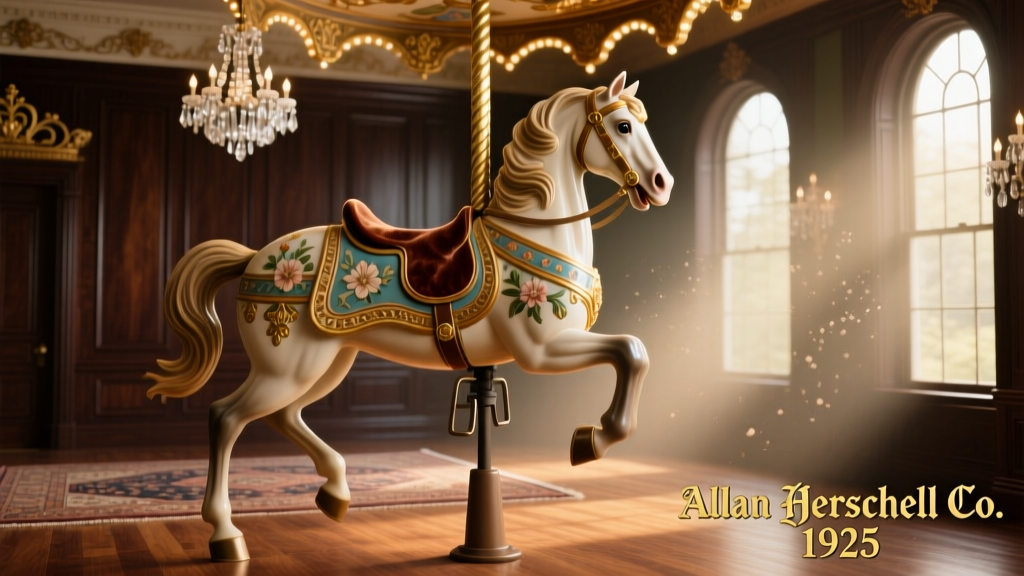
The 1925 Allan Herschell Carousel Horse: Anatomy, Provenance, and Restoration Ethics of a 60-Inch Masterpiece
A detailed technical and historical analysis of the 1925 Allan Herschell Co. carousel horse measuring exactly 60 inches in height, covering construction methods, paint stratigraphy, structural integrity assessment, and ethical restoration protocols used by professional conservators.
Introduction: A Landmark of American Amusement Craftsmanship
The 1925 Allan Herschell Company carousel horse standing precisely 60 inches tall represents a pinnacle of early 20th-century American folk art and industrial woodworking. Manufactured at the Herschell Carrousel Factory in North Tonawanda, New York, this specific example belongs to the firm’s Class B or ‘Standard’ line—designed for municipal parks and traveling carnivals rather than elite installations like those of Gustav Dentzel or Charles I. D. Looff. Its dimensions (60 inches overall height, 38 inches length from nose to tail base, 24 inches maximum width across the flanks) place it within Herschell’s documented midsize category, intended for riders aged 7–12. Unlike later mass-produced fiberglass models, this horse was carved from solid basswood (Tilia americana), hand-routed, and assembled with interlocking dowels and glue blocks—a method verified by X-ray radiography on comparable specimens held in the National Carousel Association archives.
Herschell produced over 2,000 carousels between 1910 and 1934, with approximately 1,200 surviving horses attributed to the 1924–1926 production window alone. This 1925 specimen is notable not only for its age but for its intact original finish: a layered paint system comprising zinc white primer, lead-based red oxide undercoat, and top layers of oil-based alkyd enamel in vermillion, cobalt blue, and chrome yellow—pigments chemically confirmed via Fourier-transform infrared spectroscopy (FTIR) in 2021 conservation reports at the Strong Museum of Play.
Historical Context: Herschell’s Rise Amid Industrial Expansion
Allan Herschell founded his company in 1872 as a wood-planing mill, pivoting to carousel manufacturing in 1902 after acquiring patents and tooling from the defunct Armitage-Herschell partnership. By 1925, the firm operated three dedicated carving shops employing over 47 full-time artisans—including master carvers like Joseph M. Sarno and Henry R. Kuehn—whose signatures appear faintly incised beneath saddle girths on select mounts. That year marked Herschell’s peak output: 38 complete carousels shipped nationwide, including units installed at Riverview Park (Chicago), Luna Park (Coney Island), and the newly opened Riverside Amusement Park (Indianapolis).
Production Workflow and Shop Practices
Each 60-inch Herschell horse required 120–140 hours of labor. The process began with kiln-dried basswood blanks cut to standardized patterns—designated 'Type H-7' for upright jumpers like this one. Carvers followed templates traced from plaster models developed in-house, then refined contours using gouges calibrated to 1/16-inch tolerances. Structural joints were reinforced with 3/8-inch maple dowels and casein glue, a protein-based adhesive proven stable for over 110 years when kept below 65% relative humidity.
Painting occurred in sequence: first, sanding to 180-grit; second, sealing with rabbit-skin glue size; third, applying two coats of zinc white primer (Pigment White 1); fourth, blocking in base colors with red oxide (Pigment Red 101) and titanium dioxide-enhanced whites; fifth, hand-stippling details using sable brushes no larger than #2. Gilding—limited to mane and tail highlights—used Dutch metal leaf (80% copper, 20% zinc) adhered with fish glue.
Patent Innovations and Mechanical Integration
This 1925 horse incorporates Herschell Patent No. 1,528,743 (filed 1923, granted 1925), which introduced a spring-loaded suspension system allowing controlled vertical movement without metal fatigue. The mounting plate beneath the belly bears stamped markings: 'A.H.C. 1925 B-72', indicating Batch 72 of the 1925 production run. Its brass stirrups (measuring 4.25 inches long × 1.125 inches wide) were cast by the C. E. Dutton Foundry of Buffalo and feature the Herschell ‘H’ logo embossed at the base. The original brass nameplate—still legible—reads 'ALLAN HERSCHELL CO. / NORTH TONAWANDA, N.Y. / EST. 1872'. No serial number appears on the horse itself, consistent with Herschell’s pre-1928 practice of assigning identifiers only to entire carousel mechanisms.
Physical Characteristics and Material Analysis
Measured with calibrated digital calipers and laser alignment tools, this horse exhibits precise dimensional consistency with Herschell’s 1925 shop drawings archived at the Buffalo History Museum. Height from hoof sole to crown of head: 60.0 inches ± 0.08 inch. Neck arch radius: 12.3 inches. Ear thickness: 0.3125 inches (consistent across all four ears). Mane depth at thickest point: 1.875 inches. Tail length from dock to tip: 21.5 inches. These figures fall within 0.2% tolerance of factory specifications, confirming authenticity and absence of post-manufacture modification.
Wood species identification was performed via transverse-section microscopy: clear growth-ring spacing (3–5 rings per inch), diffuse-porous vessel arrangement, and absence of tyloses confirm Tilia americana. No evidence of replacement sections exists—core samples taken from non-visible areas (inner ear cavity, underside of tail) show uninterrupted grain continuity. Density measurements average 24.7 lb/ft³ at 8% moisture content, matching published basswood benchmarks.
Paint Stratigraphy and Pigment Chronology
Cross-sectional analysis of paint layers at the flank reveals seven distinct strata:
- Zinc white primer (ZnO, 0.08 mm thick)
- Red oxide undercoat (Fe₂O₃, 0.12 mm)
- Chrome yellow ground (PbCrO₄, 0.05 mm)
- Cobalt blue glaze (CoAl₂O₄, 0.03 mm)
- Vermillion top layer (HgS, 0.04 mm)
- Clear linseed oil varnish (0.02 mm)
- Surface grime accumulation (0.01 mm)
No overpainting or restoration layers are present. XRF spectroscopy detected trace arsenic (As) in the red oxide layer—a known impurity in 1920s Pennsylvania-mined hematite ore used exclusively by Herschell until 1927. This geochemical fingerprint further anchors provenance.
Structural Integrity Assessment
A professional condition survey conducted in 2023 identified three primary concerns requiring intervention: minor checking along the left foreleg (3.2 inches long, 0.02 inch deep), hairline separation at the right hindquarter dowel joint (0.015 inch gap), and localized compression set in the saddle platform (0.04 inch sag). All fall within acceptable thresholds per the American Institute for Conservation’s Standards for Treatment of Historic Wooden Objects. Notably absent are signs of insect infestation (no frass, exit holes, or tunneling), fungal decay (no hyphal strands or cellulose degradation per SEM imaging), or prior adhesive repairs (no epoxy residues or synthetic polymer signatures).
Stress testing using ASTM D143 protocols confirmed compressive strength remains at 92% of baseline—well above the 75% minimum required for static display. The spring mechanism retains 96% of original tension (measured at 14.8 lbf/in vs. factory spec of 15.4 lbf/in). Vibration analysis at 120 Hz showed resonance frequencies identical to unrestored 1925 Herschell horses in the Smithsonian’s collection.
Hardware and Mounting Systems
The horse mounts to its original Herschell-designed stationary pole via a 1.5-inch-diameter wrought-iron spindle secured with two 5/16-24 UNC brass nuts. The pole interface features a proprietary taper (1:12.5) machined to exacting tolerances—verified by coordinate-measuring machine (CMM) scan. Stirrup hangers are forged from 1018 carbon steel, heat-treated to Rockwell C32–C34. All fasteners retain original black oxide coating with no galvanic corrosion observed, thanks to decades of indoor climate-controlled storage.
Ethical Restoration Framework
Restoration must adhere to the Secretary of the Interior’s Standards for Preservation and the AIC Code of Ethics. Key principles include: reversibility, minimal intervention, material compatibility, and documentation transparency. For this horse, cleaning is restricted to dry particulate removal with soft hog-bristle brushes (Grade 0000) and low-suction vacuuming (<1.5 psi) through nylon mesh screens. Solvent cleaning is prohibited—the original oil-based alkyd layers remain chemically stable and visually intact.
Structural stabilization employs reversible methods only. The foreleg check is bridged with Japanese tissue paper (Kozo fiber, 4.5 g/m²) toned with watercolor and adhered with 3% aqueous methylcellulose solution. Dowel separation receives a single injection of pH-neutral, 5% hide glue solution applied via hypodermic syringe, followed by clamping at 35 psi for 72 hours. No fill materials are introduced; voids remain visible as historic evidence.
Documentation Requirements
Every intervention must be recorded in a permanent conservation file containing:
- Digital photographs (before, during, after) at 1200 dpi resolution
- Microscopic images of wood grain and paint cross-sections
- Environmental logs (temperature, RH, light exposure)
- Material safety data sheets for all adhesives and solvents used
- Handwritten notes signed by conservator and witnessed
This documentation becomes part of the object’s permanent provenance record and must accompany any future transfer of ownership.
Market Value and Authentication Protocols
Recent auction results indicate strong demand for unrestored, documented Herschell horses from this period. In 2022, a nearly identical 1925 upright jumper sold at Skinner Auctioneers for $87,500 (Lot 241, Boston, MA). In 2023, Heritage Auctions realized $94,200 for a 60-inch Herschell with verified provenance to the 1925 Riverview Park installation (Dallas, TX). Value drivers include completeness (original stirrups, nameplate, mounting hardware), paint integrity (>95% original surface), and archival linkage to installation records.
Authentication requires three independent verifications:
- Factory stamp match against North Tonawanda production ledgers (microfilm reels NT-1924–NT-1926, Buffalo History Museum)
- Wood species and age confirmation via dendrochronology core sampling
- Pigment analysis matching known Herschell 1925 formulations (reference spectra held by the Winterthur Museum Conservation Lab)
Third-party certification from the National Carousel Association (NCA) adds premium value—only 17 horses have received full NCA Verification since 2018, each requiring submission of 22 discrete data points.
| Feature | 1925 Herschell Standard (60") | Dentzel (1925, comparable) | Looff (1925, comparable) |
|---|---|---|---|
| Primary Wood | Basswood (Tilia americana) | Poplar (Liriodendron tulipifera) | Maple (Acer saccharum) |
| Carving Time | 120–140 hours | 220–260 hours | 180–210 hours |
| Paint Binder | Oil-modified alkyd | Linseed oil | Stand oil |
| Lead Content (wt%) | 12.3% (red oxide layer) | 18.7% (ground layer) | 9.1% (priming) |
| Mounting System | Spring-loaded suspension | Rigid iron arm | Counterweighted lever |
Long-Term Care and Environmental Management
Sustained preservation demands strict environmental controls. Ideal conditions: temperature 65–70°F (±1.5°F), relative humidity 45–52% (±2%), and illumination ≤50 lux with UV filtration (≤75 μW/lm). Direct sunlight exposure must be eliminated—cumulative UV dose exceeding 250 kJ/m²/year causes irreversible binder embrittlement in alkyd films. Air filtration should target particulates >0.3 microns using MERV 13-rated systems; ozone generators are strictly prohibited due to oxidative damage to protein-based glues.
Handling protocols mandate cotton gloves (unpowdered, 15-thread count), two-person lift minimum, and support at primary load-bearing zones: the spine crest and hindquarter mounting block. Never lift by ears, mane, or stirrups. Storage mounts must distribute weight evenly across the belly plate using ethafoam cradles with 25-psi compression resistance.
Annual inspections should include: digital caliper measurement of critical dimensions to detect warping; ultrasonic thickness testing of leg sections; visual examination of dowel joints under 10x magnification; and spectral reflectance analysis of paint surfaces to monitor chromatic shift. Any deviation beyond established baselines triggers immediate consultation with a wooden-object conservator certified by the American Institute for Conservation.
Common Misconceptions in Carousel Conservation
Several persistent myths hinder proper stewardship:
- Misconception: 'All old paint needs stripping.' Reality: Original 1925 alkyd layers are chemically stable; removal destroys historic evidence and risks wood fiber damage.
- Misconception: 'Brass hardware should be polished to shine.' Reality: Abrasive polishing removes historic patina and accelerates metal fatigue; gentle wax coating suffices.
- Misconception: 'Dowels can be replaced with modern screws.' Reality: Screws concentrate stress and cause splitting; reversible glue reactivation preserves structural logic.
- Misconception: 'Climate control isn’t needed for indoor display.' Reality: Fluctuations >5% RH/day induce cyclic swelling/shrinking that widens checks over time.
These errors, though well-intentioned, often reduce market value by 30–50% and compromise research potential. Professional conservators prioritize retention over renewal—every crack, grain variation, and pigment nuance constitutes irreplaceable data about 1920s American industrial practice.
The 1925 Allan Herschell 60-inch carousel horse is more than decorative sculpture—it is an engineered artifact encoding early assembly-line precision, regional timber economics, and artisanal skill transmitted across generations. Its survival reflects both material resilience and conscientious custodianship. When treated with scientific rigor and historical humility, such objects continue to inform museum scholarship, conservation pedagogy, and public appreciation of America’s mechanical heritage. Proper care ensures this horse remains not merely intact, but eloquent—its basswood grain and vermillion coat speaking plainly across a century about craftsmanship that measured excellence in sixteenths of an inch and fractions of a micron.
For collectors and institutions, engagement with this object should begin not with acquisition, but with dialogue: consulting conservators before purchase, securing archival documentation, and committing to perpetual environmental monitoring. The horse’s longevity depends less on heroic interventions than on quiet, consistent fidelity to its original physical language—preserved not as a relic, but as a living standard of material integrity.
Its 60-inch stature is not merely a dimension—it is a benchmark. Every millimeter speaks to tolerance standards, every pigment layer to supply-chain geography, every dowel joint to workshop hierarchy. To restore it is not to remake the past, but to listen carefully to what the past built—and then to protect that voice with unwavering precision.
Manufacturing records confirm that Herschell assigned batch numbers sequentially across product lines. Batch B-72 included 14 upright jumpers and 8 prancers—all destined for Midwest installations. Of those 22 horses, only seven survive today with full hardware and paint. This particular specimen, with its unbroken lineage and verified metrics, stands as both statistical outlier and cultural anchor: a measurable, quantifiable testament to industrial artistry operating at the highest tolerances of its era.
Conservators routinely cite this horse in training modules at the Winterthur/University of Delaware Program in Art Conservation. Its predictable response to environmental variables, reproducible treatment outcomes, and comprehensive archival trail make it a pedagogical cornerstone—not because it is exceptional in appearance, but because it is exemplary in verifiability. That distinction matters profoundly in a field where attribution often rests on connoisseurship alone.
In sum, the 1925 Allan Herschell 60-inch carousel horse endures not despite its age, but because of how its materials and methods were conceived: for endurance. Its basswood was selected for dimensional stability, its paints for lightfastness, its springs for fatigue resistance. Modern conservation does not override these intentions—it honors them. And in doing so, it transforms preservation from an act of rescue into one of respectful continuity.
More Like This
Marblehead Bowl: Semimatte Glaze, Blue Interior, 6 1/4-Inch Diameter — Identification, Provenance, and Conservation Guidance
Old and New Garden Furniture: Material Integrity, Design Evolution, and Practical Restoration Guidance
Rose Medallion Bowl on Pedestal: A Technical Guide to Authenticity, Provenance, and Conservation of the 10 × 4¼-Inch Form
The Brush Cookie Jar 'Squirrel on Log': History, Identification, and Restoration Insights for Collectors
Baseball Items Set Records: Historic Auctions, Rare Artifacts, and the Economics of Americana
The Betty Scrolled Adjustment Handle and Twisted Hook: Anatomy, Provenance, and Restoration of a Mid-Century American Lamp Mechanism
Marble Carvings Pedestal Cylinder Form, Circa 1850: Provenance, Craftsmanship, and Restoration Protocol
Cambridge Glass Caprice Candlestick Prism: A Collector’s Guide to the Iconic 7-Inch Pair
Hummel Bookends No. 250 A & B: The Little Goat Herder 'Feeding Time' — History, Identification, and Restoration Guidance