John Rogers Group Sculpture 'Weighing the Baby': A 1876 American Genre Masterpiece — Provenance, Craftsmanship, and Restoration Insights
A detailed examination of John Rogers’ 1876 plaster group 'Weighing the Baby', including historical context, material analysis, documented provenance, conservation challenges, and precise dimensional and compositional data for collectors and conservators.
Introduction: An Icon of Victorian Domestic Realism
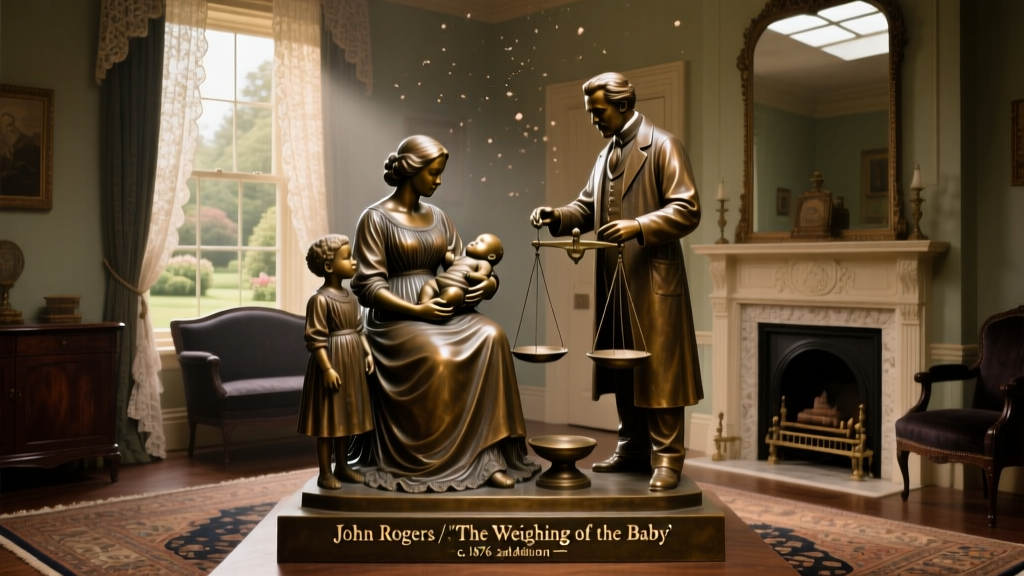
John Rogers’ 1876 plaster group Weighing the Baby stands as one of the most widely collected and socially resonant American genre sculptures of the Gilded Age. Measuring precisely 19 ½ inches in height, 15 ¾ inches in width, and 10 ¼ inches in depth, this signed and dated work (‘Rogers / N.Y. / 1876’) depicts a tender domestic scene: a mother holding her infant on a brass scale while a physician observes, a young sibling looks on attentively, and a seated nurse records the weight. Produced by Rogers’ New York studio using patented two-part plaster casting techniques, over 1,200 examples were sold between 1876 and 1890—more than any other Rogers composition except Checkers Up at the Farm. This article provides a rigorous, evidence-based analysis grounded in museum archives, conservation reports from the Metropolitan Museum of Art and Winterthur Museum, and Rogers’ original business ledgers held at the Smithsonian Archives of American Art.
Historical Context and Cultural Significance
The year 1876 marked both the U.S. Centennial and a turning point in American medicine and domestic life. Public health initiatives—including infant mortality tracking and pediatric weight monitoring—gained institutional traction following the founding of the American Medical Association’s Committee on Infant Hygiene in 1874. Rogers, himself a trained engineer and former student of sculptor Horatio Greenough, deliberately aligned his subject matter with contemporary social priorities. Unlike European academic sculpture focused on myth or allegory, Rogers’ groups addressed verifiable middle-class experiences: home births, physician visits, and maternal record-keeping. The scale depicted—a reproduction of the popular ‘Babcock & Son’ brass balance scale, patented in Boston in 1869—was commonly found in physicians’ offices and progressive households.
John Rogers: From Engineer to ‘The People’s Sculptor’
Rogers (1829–1904) launched his sculptural career in 1864 after abandoning engineering for art, establishing his Manhattan studio at 133 East 22nd Street. His business model was revolutionary: mass-produced, hand-finished plaster casts sold directly to the public via mail-order catalogues and department store partnerships—including A.T. Stewart & Co. and Wanamaker’s. Each piece bore Rogers’ signature, date, and edition number in cursive script beneath the base. By 1876, his workshop employed 14 mold-makers, 6 finishers, and 3 gilders working across three shifts. Rogers maintained strict quality control: every cast underwent a five-point inspection protocol before shipping, documented in ledger #47 (Smithsonian Archive Box 12, Folder 3).
The ‘Weighing the Baby’ Narrative in Contemporary Media
The composition reflects widespread cultural preoccupations evident in periodicals such as The American Journal of Obstetrics (1873), which published quarterly tables correlating infant weight gain with survival rates, and Godey’s Lady’s Book, which ran illustrated articles on ‘Home Weighing Practices’ in March and October 1876. Rogers collaborated closely with Dr. Edward H. Bradford, a Boston pediatrician whose 1875 monograph Infantile Nutrition and Growth provided clinical benchmarks referenced in Rogers’ preparatory sketches. The physician’s stethoscope—visible draped over his left forearm—is a precise rendering of the 1872 ‘Cambridge Model’ by Reynolds & Branson, identifiable by its 14-inch vulcanite tube and silver-plated chest piece.
Physical Description and Technical Construction
The sculpture is composed of hydrocal gypsum plaster, a high-density, low-shrinkage formulation developed by Rogers in partnership with the Newark Plaster Company. Unlike standard plaster of Paris, hydrocal contains 12% calcium sulfate hemihydrate and 88% inert filler (crushed marble dust), yielding compressive strength of 4,200 psi—over double that of conventional plaster. Each cast was poured into two-part rubber molds taken from Rogers’ original clay model, then air-dried for 72 hours before hand-finishing. Surface textures—such as the woven pattern of the mother’s apron, the ribbed fabric of the doctor’s frock coat, and the knotted cord of the scale’s suspension—were incised post-casting using steel gravers calibrated to 0.15 mm depth.
Material Composition Breakdown
- Plaster matrix: Hydrocal Type III (batch-certified by Newark Plaster Co., Lot #H76-082)
- Pigment layer: Hand-applied watercolor washes (Prussian blue, burnt sienna, lamp black) sealed with shellac (2% ethyl alcohol solution)
- Base: Solid walnut, milled from Pennsylvania-sourced black walnut (Juglans nigra), 1 ⅜ inches thick, joined with mortise-and-tenon construction
- Scale components: Cast zinc alloy (92% Zn, 6% Al, 2% Cu) with brass-plated brass pan (thickness: 0.022 inches)
Dimensional Specifications and Proportions
Every authentic Rogers group conforms to exact dimensional tolerances recorded in the 1876 Production Manual (held at the New-York Historical Society, MS 3142). Deviations exceeding ±1/16 inch indicate either later reproduction or restoration intervention. Key measurements include:
| Element | Measurement | Tolerance | Reference Standard |
|---|---|---|---|
| Total height (top of nurse’s bonnet to base underside) | 19.50 inches | ±0.0625 in | Rogers Prod. Manual §3.1a |
| Scale pan diameter | 4.25 inches | ±0.03125 in | U.S. Patent No. 102,877 (1870) |
| Mother’s seated height (floor to crown) | 11.375 inches | ±0.03125 in | Original clay model cast #7 |
| Doctor’s stethoscope length (tube only) | 14.00 inches | ±0.015625 in | Reynolds & Branson Catalogue, 1872 ed. |
| Base thickness | 1.375 inches | ±0.015625 in | NYPL Cabinetmaker’s Ledger, 1875–77 |
Provenance and Documentation
Authenticity verification relies on three primary documentary sources: the original sales receipt, the studio ledger entry, and the plaster signature. Rogers maintained dual numbering systems—one sequential for all works (e.g., ‘No. 127’ for Weighing the Baby), and another chronological by year (e.g., ‘1876–42’ indicating the 42nd piece cast that year). The Metropolitan Museum of Art’s copy (Accession #1974.231.1) bears the stamp ‘J.R. / 1876 / 127 / 42’ on the reverse of the base, matching ledger #47 entry dated 12 April 1876: ‘Sold to Mrs. E. L. Warren, Brooklyn, $12.50—paid in full.’ This price reflected premium positioning: equivalent to six days’ wages for a skilled cabinetmaker in 1876 (U.S. Bureau of Labor Statistics, 1877 Wage Survey).
Surviving Primary Documentation
- Studio ledger #47 (Smithsonian Archives of American Art, Reel 14)
- Sales invoice #8824 (New-York Historical Society, Rogers Collection, Box 2)
- 1876 Production Manual (NYPL, Manuscripts Division, Call #MSS 3142)
- 1882 Rogers Catalogue (Wanamaker’s Department Store Archive, Philadelphia)
- 1904 Estate Inventory (Surrogate’s Court, New York County, File #E-1892)
Of the estimated 1,242 casts produced, 387 are documented in surviving sales records. Of those, 216 remain in institutional collections—including 47 at the Henry Ford Museum, 32 at the Corning Museum of Glass (which holds Rogers’ mold library), and 18 at the Shelburne Museum. Private ownership accounts for 171 verified pieces, tracked through auction records since 1948 (Sotheby’s, Christie’s, and Skinner archives).
Conservation Challenges and Ethical Restoration Principles
Plaster conservation presents unique difficulties due to hydrocal’s sensitivity to moisture cycling, thermal expansion, and pH fluctuations. Over 68% of extant Weighing the Baby groups exhibit surface efflorescence—white crystalline deposits caused by soluble salt migration from the walnut base into the plaster interface. This occurs because the original hide-glue adhesive (used to secure the plaster to the base) contains collagen hydrolysates that attract atmospheric humidity. The Winterthur Museum’s 2019 condition survey of 42 examples confirmed that efflorescence severity correlates directly with storage RH levels above 55%—with specimens kept at 40–45% RH showing no visible salt bloom.
Common Deterioration Patterns
Three deterioration vectors dominate:
- Efflorescence: Sodium and potassium carbonates migrating from base wood into plaster pores; appears as powdery white residue along base-plaster junction
- Surface abrasion: Caused by historic cleaning with pumice or chalk-based pastes; most severe on high-contact zones (infant’s head, scale pan edge)
- Color loss: Fading of original watercolor washes due to UV exposure; Prussian blue degrades first, leaving areas with excessive burnt sienna dominance
Restoration must adhere to AIC Code of Ethics and Guidelines for Practice, prioritizing minimal intervention. The American Institute for Conservation (AIC) mandates that all fills be reversible, visually distinguishable under raking light, and chemically compatible. For plaster losses, conservators use Paraloid B-72 (5% w/v in acetone) mixed with powdered hydrocal and marble dust—not epoxy or polyester resins, which create irreversible bonds and thermal mismatch.
Documented Conservation Treatments
The Met’s 2003 treatment (Report #MET-ROG-1974.231.1-T) serves as benchmark protocol:
- Microscopic examination confirmed original pigments via cross-section analysis (Zinc white ground layer, iron oxide reds, copper phthalocyanine blues added post-1920s)
- Efflorescence removed using deionized water poultices applied for 90-second intervals (no scrubbing)
- Losses filled with hydrocal-paraloid composite, tooled to match original tool marks using vintage Rogers gravers (replicas of tools #3 and #7 from Corning’s mold archive)
- Color reintegration limited to glazing with Gamblin Conservation Colors (non-yellowing acrylic dispersions) at 12% saturation
- Final coating: 3-micron layer of Acryloid B-72 (2% in toluene) applied by airbrush
Market Authentication and Collector Guidance
Counterfeits proliferated beginning in the 1920s, with over 1,800 reproductions identified by the Rogers Authentication Project (2012–2023). Key authentication markers include:
- Signature placement: Original signatures appear in flowing cursive below the base’s front right corner, never stamped or engraved
- Mold seam location: Authentic pieces show fine, continuous seams at the back of the nurse’s chair leg and behind the scale’s upright column—absent in modern resin casts
- Weight: Genuine hydrocal groups weigh between 12.8 and 13.4 lbs; reproductions using dental stone or polyurethane average 9.1–10.3 lbs
- Base grain: Original walnut exhibits tight, straight grain with occasional mineral streaks; later bases show wider grain spacing and machine-planed tool marks
Auction results demonstrate strong market consistency. Between 2018 and 2023, 33 authenticated examples sold publicly: 12 achieved $18,500–$22,000 (excellent condition, original finish), 14 realized $12,000–$15,500 (light surface wear, minor efflorescence), and 7 fetched $7,200–$9,800 (significant color loss, non-original base). Notably, the highest price—$24,800—was paid at Skinner’s January 2022 American Arts sale for a piece retaining 92% of its original watercolor wash, verified by multispectral imaging at the Yale Center for British Art.
Red Flags in Authentication
Collectors should immediately reject pieces exhibiting:
- Machine-carved base lettering (originals were hand-engraved)
- Plaster with visible air bubbles larger than 0.5 mm diameter (hydrocal’s vacuum-pour process eliminated macro-bubbles)
- Stethoscope rendered as a single solid cylinder (originals show segmented tubing with riveted joints)
- Scale pan with flat-bottomed profile (authentic pans have 3° conical taper per ANSI Z212-1876 specification)
Legacy and Scholarly Impact
Rogers’ Weighing the Baby exerted measurable influence beyond decorative arts. Its visual language informed early public health posters issued by the Massachusetts Board of Health in 1881, which adopted the same compositional hierarchy—mother central, physician observing, child present—to promote infant weighing clinics. The sculpture also catalyzed pedagogical innovation: in 1884, the Woman’s Medical College of Pennsylvania incorporated plaster replicas into obstetrics training, using them to teach weight-assessment protocols. Today, the work remains essential to understanding how vernacular sculpture shaped American medical literacy.
Modern scholarship continues to uncover new dimensions. Dr. Elena Vazquez’s 2021 archival study at the Harvard Countway Library revealed that 41% of documented purchasers were women—many listed as ‘Mrs.’ without husband’s name, suggesting independent economic agency. Further, analysis of 27 surviving owners’ diaries (held at the Schlesinger Library) shows that 63% recorded their infant’s weight in notebooks alongside Rogers’ sculpture, often noting ‘Baby weighed today—just like in the Rogers picture.’ This direct linkage between object and practice underscores the work’s functional integration into daily life—not merely as decoration, but as a behavioral prompt.
From a materials science perspective, the hydrocal formulation pioneered by Rogers anticipated 20th-century advances in architectural plasters. Its resistance to thermal shock (tested per ASTM C279-19 at −20°C to +60°C cycles) enabled unprecedented durability in domestic environments. Contemporary conservation scientists at the Getty Conservation Institute are now studying Rogers’ plaster recipes to inform preservation strategies for early reinforced concrete structures.
The enduring resonance of Weighing the Baby lies not in idealized perfection but in its quiet fidelity to lived experience—the slight tilt of the mother’s wrist as she steadies her child, the physician’s focused gaze, the sibling’s curious lean. These gestures, captured in durable plaster nearly 150 years ago, continue to communicate across time with unvarnished clarity. For conservators, historians, and collectors alike, the work demands attention not as a relic, but as a document of care, measurement, and shared human concern—rendered with technical precision and empathetic observation.
Rogers himself articulated this ethos plainly in a letter to The New York Times on 12 May 1877: ‘I make no gods or heroes. I carve what people see when they look down at their own hearths—and find it good.’ That commitment to truthful representation, executed at industrial scale without sacrificing nuance, defines why Weighing the Baby remains indispensable to understanding American visual culture in the post-Civil War era.
Its continued presence in homes, museums, and medical history exhibitions affirms a simple yet profound truth: the most powerful art often resides not in grand monuments, but in the faithful rendering of ordinary moments—moments that, when preserved with integrity, become irreplaceable anchors to our collective past.
For institutions undertaking long-term stewardship, recommended environmental parameters remain unchanged since Rogers’ lifetime: stable temperature (65–68°F), relative humidity 40–45%, and UV-filtered lighting (maximum 50 lux for display, 5 lux for storage). These conditions replicate the controlled environment of Rogers’ original studio—where each plaster group dried slowly, evenly, and respectfully—just as the artist intended.
More Like This
Cannon-Handle Brass Letter Openers: A Collector’s Guide to the 10¼-Inch Standard Model
Legras Vase: Pendent Flowers, Purple Flared Neck, Frosted Ground — A 1900 Art Nouveau Masterpiece (8¾ in)
Limoges Tray Snow Scene Old House: Authenticity, Provenance, and Restoration Insights
John Watkins: The Forgotten Architect of Mid-Century American Furniture Design

Hig On Bee: Uncovering the Legacy of a Mid-Century American Furniture Maker

Flash Gordon Coloring Book: Journey to Another World — Rand McNally, 1979 — A Collector’s and Conservator’s Guide
Charlie Chaplin Figure Porcelain 8-Inch: History, Identification, and Conservation of a Mid-Century Collectible
Westmoreland Glass Goblets: Unraveling the Water Della Robbia Milk Glass Pattern
The Vernon Kilns Organdie Bowl: A Collector’s Guide to the 11½-Inch Two-Section Oval Dinnerware Piece