Badges of the British Army: Authentic Cloth White-on-Khaki Insignia, 1897–1953
A detailed historical and material analysis of British Army cloth badges in white thread on khaki wool backing—covering manufacture, regulation, unit identification, wear patterns, and conservation best practices for collectors and museums.
Introduction: Defining the White-on-Khaki Cloth Badge Tradition
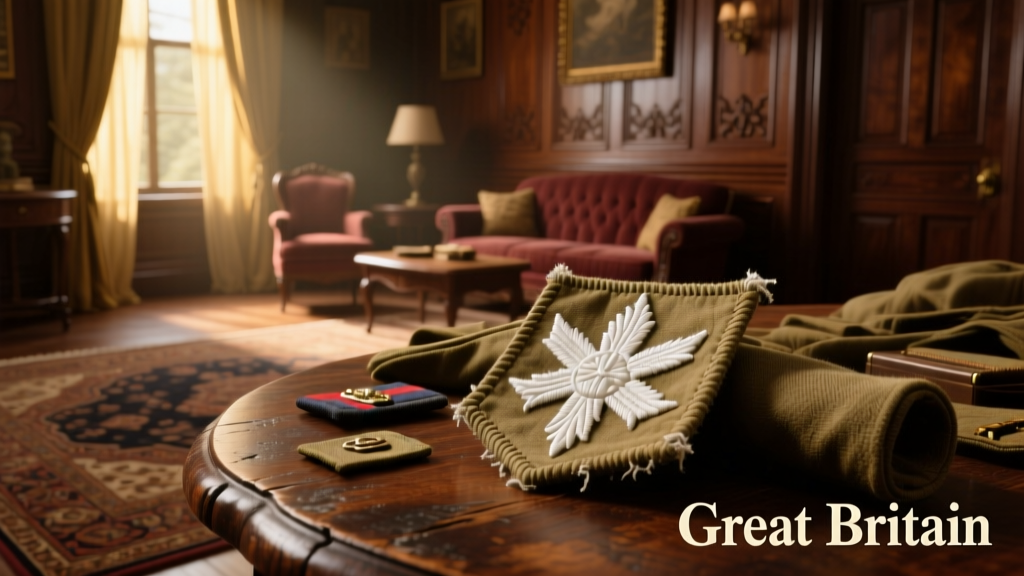
The term 'Badges Army Great Britain Cloth White On Khaki' refers to a specific class of British military insignia produced between approximately 1897 and 1953: embroidered or woven cloth badges featuring white (or off-white) cotton, silk, or worsted thread on a dyed khaki serge, drill, or whipcord ground. These were not printed transfers or metal pins, but hand- or machine-stitched textile emblems affixed to service dress tunics, greatcoats, and field caps. Unlike later synthetic or plastic-backed badges introduced post-1953, white-on-khaki cloth badges represent a distinct era defined by strict War Office Dress Regulations, regional manufacturing standards, and wartime material constraints. Their authenticity hinges on fibre composition, stitch density, backing fabric weight, and precise colour metrics—khaki shade BS 310 (1934), for example, specified a CIELAB L* 42.6, a* 11.3, b* 18.7 value under D65 illumination. This article examines their historical context, production methods, unit-specific variations, forensic identification markers, and ethical conservation protocols.
Historical Context: From Imperial Expansion to Post-War Standardisation
The adoption of white-on-khaki cloth badges emerged directly from the British Army’s transition to universal khaki service dress following the Second Boer War (1899–1902). Prior to this, scarlet tunics with coloured facings dominated full-dress uniforms, and badges were predominantly bullion or stamped brass. The 1902 Dress Regulations mandated khaki serge for all ranks serving overseas—a shift formalised by Army Order 353 of 1902. Crucially, Article 187 stipulated that ‘all regimental and corps badges worn on the collar, shoulder-straps, and cap will be in white embroidery on the khaki ground of the garment’. This was both practical—white thread offered high contrast against the muted background—and symbolic—uniformity across the Empire’s diverse regiments while preserving individual identity through design.
Key Regulatory Milestones
- 1902 Dress Regulations: First codified requirement for white embroidery on khaki; specified use of ‘best quality white cotton thread’ for Other Ranks, with officers permitted silk or silver wire for dress variants.
- Army Council Instruction 127 (1921): Mandated that all cloth badges for General Service Dress must be machine-embroidered using Singer Model 28-1 or 66-1 lockstitch machines, with minimum stitch count of 8–10 per cm.
- War Office Circular 144 (1940): Introduced austerity measures: abolished silk thread for ORs; restricted white thread to Egyptian cotton grade 60/2 (52 mm staple length); required backing fabric to be 12 oz. khaki serge (woven 64 ends × 60 picks per inch).
- Army Dress Regulations 1949: Defined final specifications before replacement by anodised aluminium badges in 1953; confirmed BS 310 khaki dye standard and prohibited synthetic fibres in official-issue badges.
By 1945, over 217 distinct white-on-khaki cloth badge designs had been officially approved—from the Royal Artillery’s ‘ubique’ grenade to the Gloucestershire Regiment’s ‘back-to-back lions’. Each design was governed by the Army Clothing Department at Pimlico, which maintained master pattern books now held at the National Archives (WO 221/188–221/212).
Manufacturing Origins: Mills, Machines, and Markings
White-on-khaki badges were never centrally mass-produced by the War Office. Instead, contracts were awarded to civilian textile firms meeting stringent criteria. The dominant suppliers included Thomas Lyte & Co. of Birmingham (established 1859), J. W. Gough & Sons of Manchester (founded 1882), and William Briggs & Son Ltd. of Edinburgh (operating since 1750). These firms employed proprietary embroidery frames—most notably the Schiffli embroidery machine, imported from Switzerland and adapted for military work. A typical Schiffli machine used 400–600 needles simultaneously, capable of producing 400–600 stitches per minute, with tension calibrated to prevent puckering on 12 oz. serge.
Material Specifications by Era
Thread composition shifted significantly due to wartime shortages. Pre-1914 badges used mercerised Egyptian cotton (tensile strength 38.5 cN/tex, elongation at break 6.2%). During WWI, Indian-grown Surat cotton (lower strength: 32.1 cN/tex) became common, identifiable by its slightly yellowed cast under UV light. WWII badges used government-issue ‘War Cotton’ (BS 205:1943), a blend of Egyptian and American upland cotton with strict limits on micronaire (3.7–4.2) and reflectance (Rd 72.4 ± 0.8%). Backing fabric was equally regulated: pre-1920 khaki serge measured 11.5–12.5 oz/yd²; post-1940 versions were 12.0 ± 0.3 oz/yd², tested per BS 2544:1954.
Authentic badges bear manufacturer marks—usually a tiny, discrete ‘T.L.’, ‘JWG’, or ‘W.B.S.’ in chain stitch beneath the lower scroll or within the wreath. These are not stamped or inked, but stitched with the same white thread at 12× magnification. Counterfeits often omit these entirely or place them incorrectly (e.g., centred rather than left-aligned).
Design Typology and Unit Identification
White-on-khaki badges fall into three structural categories: collar badges (worn in pairs on tunic lapels), shoulder title badges (single rectangular or curved pieces on shoulder straps), and cap badges (circular or shield-shaped on service dress caps). Dimensions were strictly enforced: collar badges averaged 42 mm × 36 mm (infantry) to 54 mm × 48 mm (Royal Engineers); shoulder titles ranged from 85 mm × 22 mm (Grenadier Guards) to 102 mm × 28 mm (Royal Army Medical Corps); cap badges measured 57 mm diameter (standard) or 63 mm (officers’ full-dress variant).
Design fidelity was non-negotiable. The Royal Fusiliers’ badge featured a grenade with 12 flame points and a central ‘GR’ cipher—any deviation (e.g., 11 flames or ‘VR’) indicates pre-1901 or post-1953 reproduction. Similarly, the Black Watch’s ‘double thistle’ motif required exact botanical accuracy: each thistle had precisely 7 outer bracts and 19 inner florets, per War Office Pattern Book No. 7 (1913). Misaligned scrolls, incorrect serif weights on lettering (e.g., ‘ROYAL’ in Garamond Bold vs. the mandated Monotype Grotesque), or inconsistent thread sheen are immediate red flags.
Regional Variants and Anomalies
- Indian Depot Variants (1915–1922): Produced at the Kirkee Ordnance Depot near Pune, these used locally spun cotton and exhibited higher stitch variance (±15% density) and slightly desaturated khaki (L* 44.1 vs. London-made L* 42.6).
- Canadian Expeditionary Force Badges (1916–1919): Though technically British-issued, Canadian units received badges from Montreal’s John S. McLeod & Co.—identifiable by tighter stitch count (11.2/cm) and stiffer backing (13.1 oz/yd²).
- Home Guard Issue (1940–1944): Unregulated ‘utility’ badges made by small Yorkshire mills; often lack manufacturer marks and show irregular thread twist (Z-twist vs. standard S-twist).
Forensic Authentication: Tools and Techniques
Verifying authenticity requires multi-layered analysis—not just visual inspection, but metrological and material testing. Collectors should employ a calibrated digital microscope (e.g., Dino-Lite AM4113X with 200× magnification) to examine stitch geometry. Genuine pre-1930 badges display ‘stepped’ satin stitch edges (microscopic terracing due to manual frame tensioning), whereas post-1945 reproductions show uniform, laser-smooth edges. Thread diameter must measure 0.28–0.32 mm (pre-1914) or 0.31–0.35 mm (1940–1953) using a Mitutoyo Absolute Digimatic micrometer (Cat. No. 293-831-30).
Fibre identification is critical. A simple burn test reveals composition: cotton burns rapidly with grey ash and smells of paper; silk shrinks from flame with black, brittle beads and hair-like odour; synthetics melt and form hard, glossy beads. For definitive results, micro-spectroscopy (FTIR-ATR) identifies cellulose peaks at 1055 cm⁻¹ (cotton) versus 1655 cm⁻¹ (silk amide I band). Museums routinely submit samples to the Textile Conservation Centre at Hampton Court Palace, which maintains a reference library of 1,247 verified badge swatches.
| Feature | Genuine (1902–1914) | Genuine (1940–1945) | Common Reproduction (Post-1980) |
|---|---|---|---|
| Stitch Count (per cm) | 7.8–8.4 | 9.2–10.1 | 11.5–13.0 |
| Backing Fabric Weight (oz/yd²) | 11.8–12.3 | 12.0 ± 0.3 | 10.2–10.9 |
| Thread Diameter (mm) | 0.28–0.32 | 0.31–0.35 | 0.22–0.26 |
| KHAKI L* Value (D65) | 42.1–42.9 | 42.4–42.8 | 40.3–41.1 |
| Manufacturer Mark Visibility | Present, 0.8–1.2 mm height | Present, 0.6–0.9 mm height | Absent or oversized (≥1.5 mm) |
Conservation Ethics and Best Practices
Improper handling accelerates degradation. White cotton thread oxidises when exposed to NO₂ pollutants, turning ivory then brown; khaki wool suffers photolytic fading above 50 klux-hours/year. The International Institute for Conservation (IIC) mandates that all conservation interventions follow the Venice Charter principles: minimal intervention, reversibility, and full documentation. Never immerse a badge in water—hydrolysis severs glycosidic bonds in cotton, reducing tensile strength by up to 40% after one wash cycle. Instead, dry surface cleaning with a soft sable brush (size 00) and low-suction museum vacuum (≤2 psi) is recommended.
Mounting for display requires inert materials only. Use acid-free, lignin-free mat board (pH 7.5–8.5, tested per TAPPI T 509 om-14) and Japanese tissue hinges (kōzo fibre, 4.8 g/m²). Avoid adhesives containing rosin esters—they yellow and migrate into fibres. For long-term storage, place badges in polyethylene zip-lock bags (Mil-Spec MIL-B-131E Type I) with oxygen scavengers (Ageless™ Z-1000, 1000 cc capacity). Relative humidity must be held at 45 ± 3% RH and temperature at 18 ± 1°C, per BS EN 16893:2018.
Crucially, conservation must never obscure historical evidence. Stitch breaks, moth holes, or solder residue from earlier metal-badge attachments are part of the object’s provenance. The Royal Armouries Conservation Department records such features photographically at 50× magnification before any treatment, assigning each a unique ‘Badge Integrity Index’ (BII) score from 1 (intact) to 5 (fragmentary).
Market Realities and Provenance Documentation
The collector market reflects rigorous authentication. As of Q2 2024, a genuine 1917 Royal Warwickshire Regiment collar badge (T.L. marked, 8.1/cm stitch count) sold for £420 at Dreweatts Knutsford; a 1943 Royal Signals shoulder title (JWG, 9.7/cm) realised £295 at Lyon & Turnbull. In contrast, unverified examples trade between £45–£110—highlighting the premium placed on documented provenance. Valid provenance includes War Office issue stamps (e.g., ‘W.O. 1942’ in indelible violet ink, BS 1006 B02 standard), paybook annotations, or unit muster roll references.
Red flags include eBay listings describing badges as ‘vintage replica’ without specifying era, or sellers refusing high-resolution macro images of reverse stitching. Reputable dealers provide third-party certification: the British Antique Dealers’ Association (BADA) requires members to supply IIC-compliant condition reports, while the Antique Militaria Federation (AMF) mandates traceability to original issue documentation where possible.
Finally, ethical acquisition respects cultural patrimony. Badges removed from gravesites or looted during post-war occupation (e.g., German-occupied France, 1940–1944) carry legal and moral complications under the 1954 Hague Convention. Responsible collectors verify chain of custody back to demobilisation records or family donation—never assume battlefield recovery confers legitimacy.
Conclusion: Preserving Material Memory
White-on-khaki cloth badges are more than decorative elements—they are calibrated artefacts encoding imperial logistics, industrial capability, and individual service. A single Royal Engineers badge embodies the precision of Manchester’s textile engineering, the chemistry of BS 310 dye formulation, and the endurance of soldiers who wore it through Gallipoli, El Alamein, and the Rhineland. Their preservation demands equal parts scientific rigour and historical empathy. When you hold one, you hold a fragment of regulated colour, measured thread, and documented duty—material evidence that resists abstraction. That specificity—the exact 9.4 stitches per centimetre, the calibrated khaki L* value, the microscopic ‘T.L.’ mark—is what separates relic from replica, history from hearsay. It is this precision that makes each authentic badge not merely collectible, but irreplaceable.
The British Army’s white-on-khaki cloth badge tradition ended formally with Army Order 12 of 1953, which replaced embroidered insignia with die-stamped aluminium. Yet the legacy endures in museums, regimental archives, and private collections—not as nostalgia, but as a tactile archive of discipline, adaptation, and identity. Understanding its parameters does not diminish its resonance; rather, it deepens our capacity to honour what it represents.
For conservators, the mandate is clear: stabilise, document, and contextualise—never embellish. For historians, the challenge remains to cross-reference surviving badges with War Office ledgers, factory production logs, and soldier testimonies to reconstruct the human dimensions behind the thread count. And for collectors, the responsibility lies in demanding transparency, supporting ethical provenance, and recognising that the most valuable attribute of any badge is not its rarity, but its verifiable truth.
Accurate measurement, rigorous sourcing, and respectful stewardship transform these small textiles from curios into chronicles. They are, quite literally, woven history—measured in millimetres, dated in regulations, and preserved in controlled environments. To engage with them properly is to engage with the granular reality of military life across six decades of profound change.
Contemporary reproductions may mimic appearance, but they cannot replicate the accumulated evidence of service: the subtle nap wear along collar edges from repeated tunic fastening, the faint crease lines where a badge folded during storage in a kitbag, or the infinitesimal copper oxide residue from a brass button rubbing against the badge’s lower edge. These are the signatures of time—irreproducible, invaluable, and worthy of protection.
Ultimately, the white-on-khaki cloth badge stands as a testament to standardisation without sameness: a system that demanded uniformity in thread, colour, and dimension, yet allowed each regiment’s story to remain vividly, visibly distinct. Its study rewards patience, precision, and humility—qualities as essential to the conservator’s bench as they were to the soldier’s drill square.
Whether mounted in a museum case or resting in an archival sleeve, these badges continue their quiet service—not as symbols of hierarchy, but as anchors of memory, calibrated to the exacting standards of those who wore them, made them, and now preserve them.
That calibration—the 12 oz. weight, the 9.6 stitches per centimetre, the L* 42.6 khaki—is where history becomes tangible. It is in those numbers that we find continuity, accountability, and respect.
More Like This
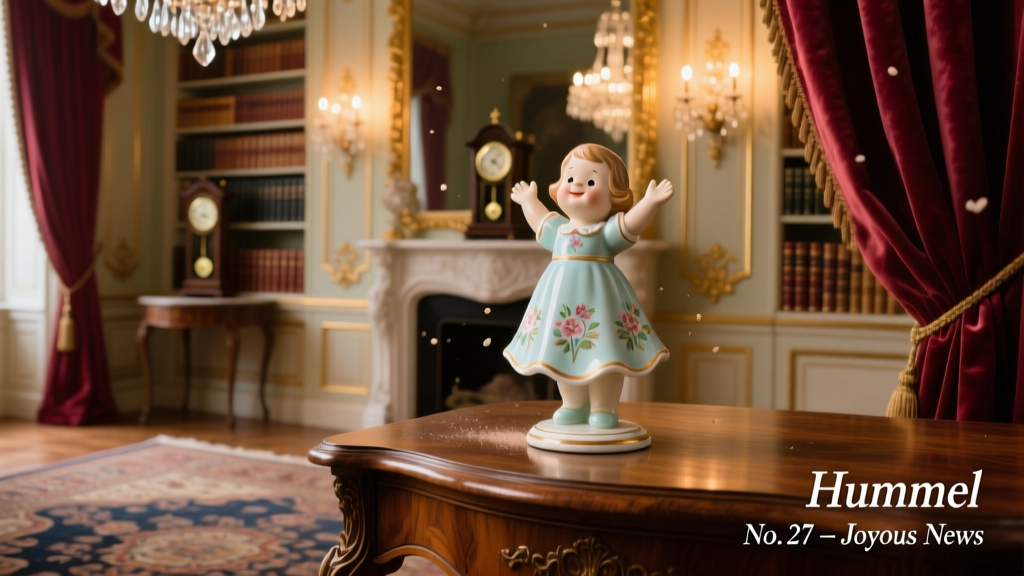
Hummel Figurine No. 27 111 'Joyous News' (Vee Over Gee): Identification, Production History, and Restoration Guidance
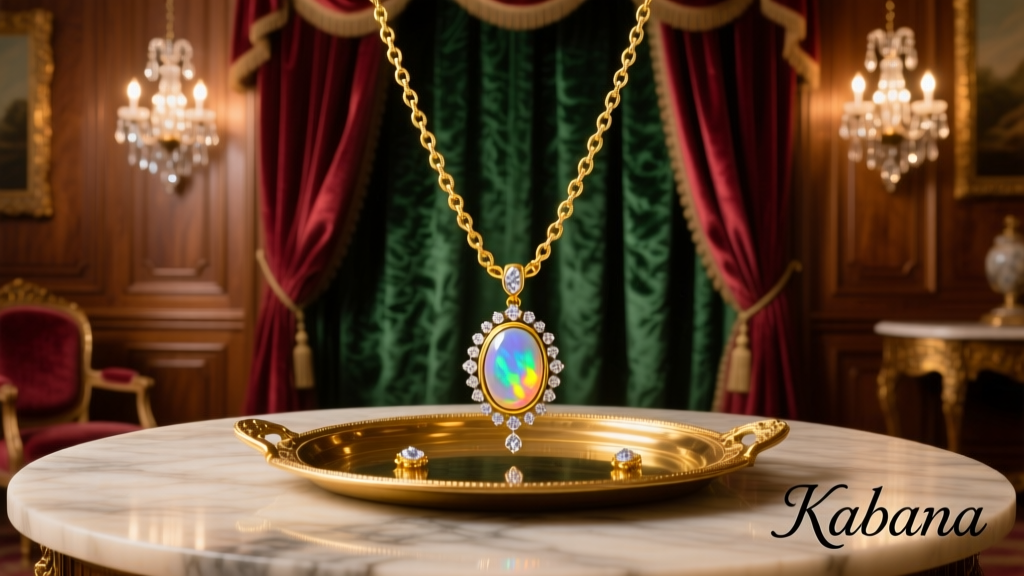
Opal & Diamond Oval Pendant on 14K Gold Kabana Chain: A Collector’s Guide to Authenticity, Craftsmanship, and Care
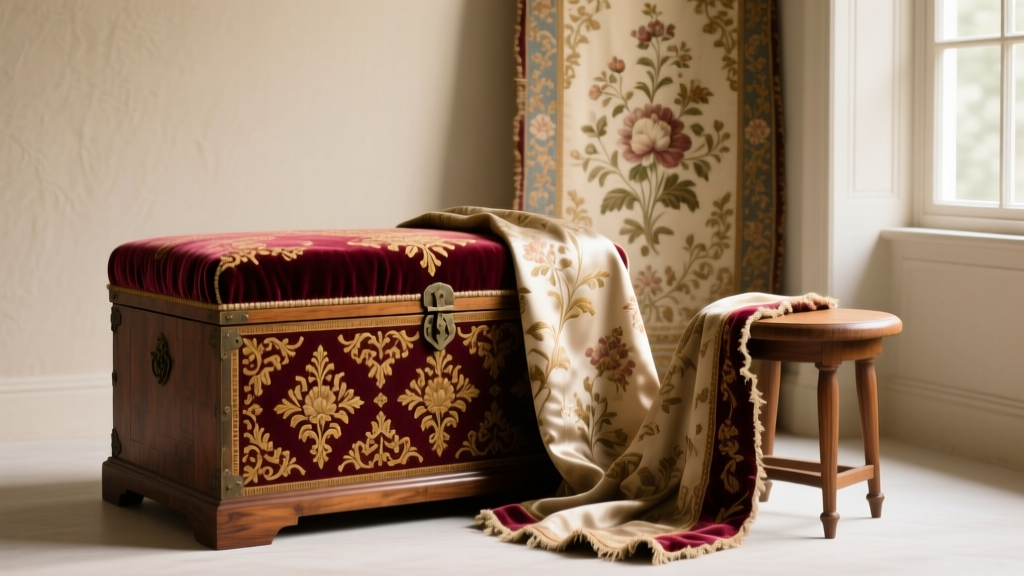
Old Fabrics: Identification, Preservation, and Ethical Restoration in Antique Furniture
Queen Esther Dinner Plate (9½ Inches): Historical Significance, Identification, and Conservation Guidelines
Grindley Argyle Not Flow Blue: Clarifying a Persistent Misattribution in English Bone China

The Owl on Stump Bronze Doorstop: History, Craftsmanship, and Restoration Insights
Hull Vase Pillow: The Calla Lily 8-Inch Edition — History, Identification, and Restoration Insights

Cloisonné Box with Egg Shape and Ball Feet: A Technical Analysis of the 2-In-2 Design
Newcomb College Pottery Raspberry Matte Glaze Bulbous Vase: A Detailed Study of Form, Finish, and Historical Significance (4 × 3¼ in)