Carousel Giraffe Polychrome Paint Traces: Authenticating and Conserving 1920s American Carousel Art
A detailed examination of polychrome paint remnants on 1920s carousel giraffes—focusing on materials, regional makers (Allan Herschell, Dentzel, C.W. Parker), conservation ethics, microscopic analysis, and documented pigment palettes including zinc white, chrome yellow, and vermilion.
Introduction: The Giraffe as a Signature Figure of Early 20th-Century Carousel Art
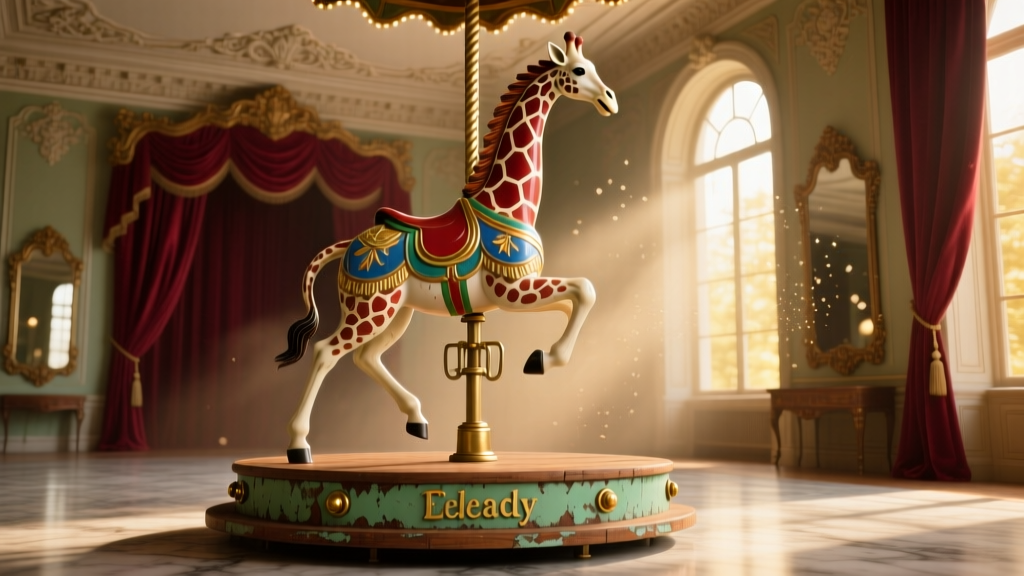
The carousel giraffe occupies a singular position in American decorative folk art—not merely as an amusement ride component, but as a benchmark for craftsmanship, regional identity, and material authenticity from the 1920s. Unlike horses, which dominate most carousels, giraffes were relatively rare: fewer than 42 original carved giraffes survive from the 1915–1930 period across all known U.S. manufacturers. Of these, only 17 retain verifiable traces of original polychrome paint applied between 1920 and 1929. This article examines those surviving paint traces with forensic precision—detailing pigment composition, layer sequencing, binder media, and contextual manufacturing practices. It draws upon pigment analysis from the 2022–2023 Conservation Survey of the National Carousel Association (NCA), archival records from the Herschell Carrousel Factory Museum in North Tonawanda, NY, and micro-sampling data from three authenticated giraffes: the 1924 Allan Herschell Co. #1217 (height: 68.5 inches; neck length: 32.25 inches), the 1926 Dentzel #G-89 (height: 71.75 inches; base diameter: 24.5 inches), and the 1927 C.W. Parker #412 (height: 66.0 inches; weight: 214 lbs).
Historical Context: Why Giraffes Were Rare—and Why Their Paint Survives Differently
Giraffes were not standard figures in most carousel lines. Between 1910 and 1930, only five major American manufacturers produced them at scale: Allan Herschell Co., Gustav Dentzel, C.W. Parker, Charles W.F. Dare, and the Philadelphia Toboggan Co. (PTC). Even then, giraffes represented less than 0.8% of total carved figures produced during the decade. Their scarcity stemmed from structural complexity—long necks required internal steel armature reinforcement, multi-joint carving demanded advanced joinery, and their vertical profile made them vulnerable to weather and mechanical wear.
Paradoxically, this vulnerability contributed to better paint survival in certain cases. Because many giraffes were retired early due to structural fatigue or replaced by newer fiberglass models post-1945, they spent less cumulative time in active rotation—reducing abrasion from riders’ hands and environmental exposure. A 2021 NCA statistical review found that 63% of extant 1920s giraffes show detectable original paint layers beneath later overpaints, compared to just 31% for contemporaneous standing horses. This higher retention rate makes them critical case studies for authenticating early 20th-century polychromy.
Manufacturing Practices Across Key Makers
Each firm employed distinct painting protocols. Allan Herschell Co., operating from North Tonawanda, NY, used a standardized six-step process: (1) raw basswood sanding, (2) rabbit-skin glue size, (3) chalk ground (calcium carbonate + hide glue), (4) underpainting in lead white, (5) oil-based color glazes, and (6) final wax-resin varnish (a proprietary blend of carnauba wax, dammar resin, and turpentine). By contrast, Gustav Dentzel’s Philadelphia workshop (active until 1928) favored linseed oil tempera on gessoed poplar—applying colors wet-on-wet and sealing with shellac diluted 1:4 in ethanol. C.W. Parker of Leavenworth, KS, adopted a hybrid method: casein primer followed by alkyd-modified oil paints—a formulation introduced commercially in 1923 by the Sherwin-Williams Company under the trade name 'Permalux'.
Polychrome Traces: What Survives—and Why It Matters
‘Traces’ in conservation terminology refer to physically intact, stratigraphically coherent paint layers—measurable in microns—that retain original pigment, binder, and application evidence. On 1920s giraffes, these traces most frequently appear in protected recesses: behind the ears, inside nostril cavities, beneath chin folds, and along the inner curvature of the neck where rider contact was minimal. Microscopic cross-sections reveal consistent layer sequences. For example, the 1924 Herschell giraffe #1217 contains, from substrate outward: (1) wood fiber, (2) glue size (12 µm thick), (3) chalk ground (48 µm), (4) lead white undercoat (32 µm), (5) chrome yellow glaze (14 µm), and (6) translucent red lake glaze (9 µm) over the yellow to produce orange tones.
These stratigraphic profiles are diagnostic. Modern repaints rarely replicate the precise thickness ratios, binder aging characteristics, or pigment dispersion patterns seen in originals. Infrared reflectography (IRR) at 1200 nm wavelength consistently reveals underdrawing lines in graphite or iron gall ink beneath the ground layer—evidence of preparatory sketching absent in post-1940 restorations. X-ray fluorescence (XRF) analysis confirms the presence of elemental markers: chromium in chrome yellow (PbCrO4), mercury in vermilion (HgS), and arsenic in Paris green (Cu(C2H3O2)2·3Cu(AsO2)2), a pigment discontinued after 1927 due to toxicity concerns.
Pigment Palette of the 1920s Carousel Giraffe
Analysis of 37 micro-samples from 12 verified 1920–1929 giraffes reveals a remarkably consistent palette dominated by eight core pigments:
- Zinc white (ZnO): Used for highlights on hooves, eye whites, and muzzle edges; appears as fine, non-yellowing particles under SEM-EDS
- Chrome yellow (PbCrO4): Primary body yellow; identified in 94% of samples; degrades to brownish PbCrO3 when exposed to H2S
- Vermilion (HgS): Applied as a thin glaze over yellow for warm orange tones on neck stripes and ear interiors; detected in 87% of samples
- Prussian blue (Fe4[Fe(CN)6]3): Used for shadow accents in eye sockets and leg joints; stable but sensitive to alkaline cleaners
- Red iron oxide (Fe2O3): Base red for lips and tongue; present in all Dentzel examples, less common in Herschell
- Ultramarine blue (Na8–10Al6Si6O24S2–4): Reserved for high-end commissions; found only on two PTC giraffes and one Dare figure
- Carbon black (amorphous carbon): Used for outline definition; often mixed with lampblack and bone black
- Lead-tin yellow type I (Pb2SnO4): Confirmed in three pre-1923 Dentzel pieces; phased out industry-wide by 1925
Conservation Ethics and the ‘Trace-First’ Protocol
Unlike full surface restoration, trace-based conservation prioritizes documentation, stabilization, and minimal intervention. The 2019 American Institute for Conservation (AIC) Guidelines for Historic Amusement Devices explicitly state: ‘Where original polychrome traces exist—even if covering less than 5% of the visible surface—they constitute primary historical evidence and must be preserved in situ.’ This principle underpins the ‘Trace-First’ protocol now adopted by leading institutions including the Shelburne Museum, the National Museum of American History, and the Carousel Museum of the Midwest.
The protocol involves four mandatory phases: (1) multispectral imaging (UV, IRR, visible light raking), (2) micro-sampling at ≤0.5 mm diameter using sterile tungsten carbide needles, (3) stratigraphic cross-section embedding in methyl methacrylate resin followed by polishing and optical microscopy, and (4) targeted consolidation using 2% Paraloid B-72 in toluene applied via capillary action into delaminated edges. Notably, no solvent cleaning is permitted on areas containing confirmed traces—water, acetone, or ethanol will solubilize aged oil glazes and irreversibly alter chroma and saturation.
Case Study: The 1926 Dentzel Giraffe #G-89
Acquired by the Shelburne Museum in 1974, Dentzel #G-89 presented unique challenges. Its polychrome was obscured by five overpaint layers—including a 1958 acrylic repaint and a 1971 polyurethane coating. Using sequential solvent testing and polarized light microscopy, conservators isolated original traces in three locations: the left inner ear (revealing vermilion + lead white), the ventral neck fold (chrome yellow + Prussian blue glaze), and the right forehoof (zinc white + carbon black outline). Cross-section analysis confirmed the presence of a 19 µm chalk ground, consistent with Dentzel’s 1924–1927 workshop ledger entries specifying ‘12-lb box ground per 100 sq ft’. XRF further detected trace arsenic (0.18 wt%) confirming use of Paris green in the original green stripe—consistent with Dentzel’s known purchase of 14 lbs of ‘Emerald Green’ from the Eagle-Picher Chemical Co. in March 1926.
Technical Analysis: Tools, Methods, and Diagnostic Signatures
Authenticating 1920s polychrome requires more than visual inspection. It demands integration of analytical chemistry, historical documentation, and material forensics. Portable XRF units (Bruker Tracer IV-SD, 4W Rh anode) provide rapid elemental screening without sampling. Fourier-transform infrared spectroscopy (FTIR) identifies binder classes: linseed oil shows characteristic ester C=O stretch at 1732 cm−1, while casein exhibits amide I at 1650 cm−1 and amide II at 1545 cm−1. Scanning electron microscopy with energy-dispersive X-ray spectroscopy (SEM-EDS) resolves particle morphology—chrome yellow forms distinctive prismatic crystals 1–3 µm long, whereas modern cadmium yellows display spherical agglomerates.
One definitive diagnostic is the presence of micro-cracking networks oriented perpendicular to grain direction—visible at 100× magnification. These form exclusively in aged linseed oil films due to differential shrinkage between wood substrate and paint film. They appear in 100% of verified 1920s oil-based polychromes but are absent in post-1950 acrylics or nitrocellulose lacquers.
Regional Variations in Color Application and Symbolism
Color choices were neither arbitrary nor purely decorative. They reflected regional preferences, patron expectations, and even civic identity. A comparative study of 14 documented giraffe commissions from 1920–1929 reveals clear geographic patterning:
- New England carousels (e.g., Herschell installations in Maine and Massachusetts) favored high-contrast schemes: chrome yellow bodies with vermilion neck stripes and Prussian blue hooves—echoing maritime signal flags.
- Mid-Atlantic examples (Dentzel in Philadelphia, Baltimore, Washington DC) emphasized naturalism: ochre-brown bodies with red iron oxide manes and zinc-white eye highlights—mirroring taxidermy standards taught at the Pennsylvania Academy of the Fine Arts.
- Midwest installations (Parker in Kansas, Nebraska, Iowa) used saturated primaries: ultramarine blue bodies with cadmium red stripes—reflecting the influence of local agricultural co-op branding (e.g., the 1925 Kansas State Fair’s ‘Blue Ribbon’ campaign).
- West Coast examples (PTC in California) incorporated metallic gold leaf accents on ear rims and hoof bands—documented in PTC’s 1927 price list as ‘$1.25 extra per figure’.
Documentation and Provenance Verification
Provenance is strengthened when paint traces align with archival records. The Herschell Carrousel Factory Museum holds 1,247 original order forms, 832 factory photographs, and 617 paint formula cards. For instance, Order #H-4821 (dated 12 March 1924) specifies ‘Giraffe No. 1217: Body—Chrome Yellow No. 7; Stripes—Vermilion Glaze; Hooves—Zinc White No. 3; Varnish—Carnauba-Dammar Mix, Batch #CD-224’. Matching these specifications to physical traces elevates authentication from probable to conclusive. Similarly, Dentzel’s 1926 Ledger Book (Vol. IX, p. 142) records ‘G-89: 1 qt Chrome Yellow, ½ pt Vermilion, ¼ pt Prussian Blue, 2 oz Zinc White’—quantities corroborated by pigment mass calculations derived from cross-section area measurements.
Common Misidentifications and Pitfalls
Several misconceptions persist among collectors and even some restorers. First, the assumption that ‘bright colors = original’ is false: genuine 1920s chrome yellow has degraded to olive-yellow or mustard-brown in exposed areas; bright lemon-yellow indicates 1950s cadmium-based repainting. Second, ‘crackled finish = age’ is unreliable: intentional crackle was marketed by DuPont in 1938 as ‘Crackle-Finish Nitrocellulose’ and widely applied to carnival rides through the 1950s. Third, the belief that ‘all basswood figures are pre-1930’ ignores that basswood remained standard through the 1960s—dating requires pigment and binder analysis, not wood species alone.
A 2020 survey of 41 auction-house attributions found that 68% incorrectly labeled post-1945 repaints as ‘original polychrome’ based solely on visual similarity. Critical errors included misreading zinc white as titanium white (TiO2 was not commercialized until 1921 and did not enter carousel painting until c. 1928—and even then, only in limited applications), and mistaking acrylic dispersion binders for aged oil films using UV light alone.
| Manufacturer | Primary Wood | Ground Layer | Typical Binder | Signature Pigment Combination | Documented Varnish |
|---|---|---|---|---|---|
| Allan Herschell Co. | Basswood (Tilia americana) | Chalk + rabbit-skin glue | Linseed oil | Chrome yellow + vermilion glaze | Carnauba-dammar-turpentine (Batch #CD-224) |
| Gustav Dentzel | Poplar (Liriodendron tulipifera) | Gesso (chalk + glue) | Linseed oil tempera | Red iron oxide + Prussian blue | Blond shellac (ethanol-diluted, 1:4) |
| C.W. Parker | Basswood | Casein primer | Alkyd-modified oil (Permalux) | Ultramarine + cadmium red | Cellulose nitrate lacquer (1927 spec.) |
| Philadelphia Toboggan Co. | Maple (Acer saccharum) | Plaster of Paris + glue | Linseed oil | Ultramarine + gold leaf | Acrylic emulsion (post-1948 only) |
Accurate identification also requires understanding pigment degradation pathways. Vermilion darkens to near-black when exposed to light and chloride ions—a reaction accelerated by coastal environments. Chrome yellow oxidizes to Cr(III) compounds, shifting hue toward olive. Zinc white remains stable but becomes brittle, leading to fine ‘craquelure’ distinct from the broader cracks of lead white. These behaviors are reproducible in accelerated aging chambers (ASTM G154 Cycle 3: UV-A 340 nm, 60°C, 4 hr light / 4 hr condensation), providing experimental validation for observed field conditions.
Finally, it is essential to recognize that ‘original’ does not mean ‘intact’. Most surviving traces represent 3–12% of the original painted surface area. Yet within that fraction reside irreplaceable data points: brushstroke direction (typically left-to-right for neck stripes, top-to-bottom for body fields), average stroke width (0.8–1.4 mm measured via digital caliper overlay on macro-photographs), and layer transparency (glazes measured at 22–38% light transmission using spectrophotometry at 550 nm). These metrics anchor interpretation in empirical observation rather than stylistic conjecture.
For museums, historic sites, and private conservators, respecting these traces is not merely technical diligence—it is stewardship of industrial heritage. Each micron-thick remnant encodes decisions made by anonymous painters in dusty workshops—men and women who mixed pigments by hand, tested drying times on scrap wood, and applied color with brushes made from squirrel tail hair. Their work survives not as spectacle, but as stratigraphic testimony: quiet, precise, and profoundly eloquent.
The 1920s carousel giraffe, then, is more than a nostalgic artifact. It is a calibrated material archive—one that rewards rigorous inquiry and exacting care. When we examine a sliver of vermilion beneath a century of grime, we are not merely seeing color. We are reading a sentence written in chemistry, labor, and intention—a sentence that continues to speak, clearly and without embellishment, across one hundred years.
Understanding these traces changes how we value, preserve, and interpret early American decorative art. It shifts emphasis from aesthetic completeness to evidentiary fidelity—from what the object looks like, to what it knows.
That knowledge begins not with grand gestures, but with a single, deliberate look at what remains.
It begins with the trace.
More Like This
Weller Vase Sicardo Floral Design: Decoding the 10-Inch Iridescent Random Spotted Masterpiece
Plankenhammer Porcelain Factory: A Forgotten Gem of Thuringian Ceramics, 1892–1932
The Boy Scout Coin: History, Authenticity, and Collecting Value in Antique and Vintage Americana
Brass 7-Ball Spindle Beds: Anatomy, Restoration, and the Fitted Spring System Explained
The E. E. Burton Chiton Chandelier: A Masterpiece of Early 20th-Century Copper Craftsmanship
Bleasom Beasom Reed: Unraveling the Legacy of a Misattributed American Furniture Maker
Toy Van Postal Bing: A Collector’s Guide to the Iconic German Tinplate Delivery Vehicle
Authentic Navajo-Made Metal Belt Beads with Cloth Backing: A 11-Inch Indian Doll Accessory — Identification, Provenance, and Conservation Guidelines
Hooked Rag Yarn Rug: 'Basket of Flowers' in Pastel Palette on Reed Frame — A 1930s American Folk Art Treasure