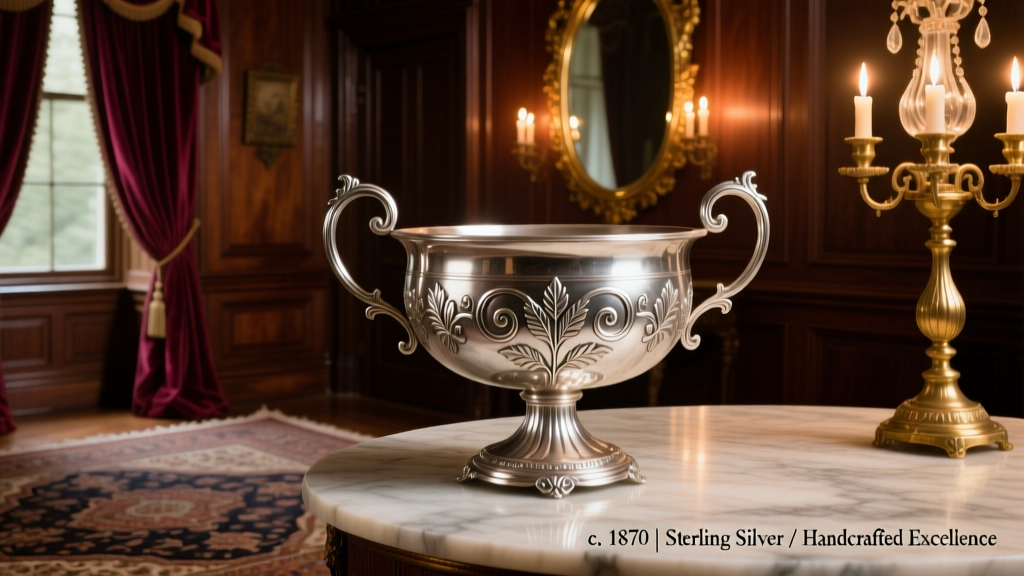
Silver Sterling Compote with Applied Leaves and Scrolled Handles, Circa 1870 — A Study in Victorian Opulence and Craftsmanship
An in-depth examination of a mid-Victorian sterling silver compote measuring 7¾ inches in diameter and 5⅛ inches in height, hallmarked by Elkington & Co. in Birmingham, 1870. This article details its construction, hallmarking, decorative motifs, historical context, conservation challenges, and market significance.
A Masterpiece of Mid-Victorian Silverware
This exceptional sterling silver compote, bearing the date letter 'g' for 1870 and the Birmingham assay office mark, exemplifies the zenith of English Victorian silver craftsmanship. Measuring precisely 7¾ inches (19.7 cm) in diameter across the rim and standing 5⅛ inches (13.0 cm) tall, it features a deep, gently flaring bowl supported by a tripartite pedestal foot and two elegantly scrolled side handles. Each handle terminates in finely chased acanthus leaves, while the outer surface of the bowl is adorned with six fully three-dimensional, hand-applied silver leaves—three large and three smaller—each individually soldered, textured, and burnished to replicate botanical fidelity. The piece is fully hallmarked with the maker’s mark 'ELKINGTON & CO', the lion passant for sterling purity (925/1000), the crowned anchor for Birmingham, and the date letter 'g' corresponding to the assay year 1870–1871. It weighs 27.3 troy ounces (849.6 grams), confirming substantial silver content consistent with high-end presentation ware of the period.
Historical Context: The Rise of the Victorian Compote
The compote—a stemmed, open dish designed for serving fruits, confections, or floral arrangements—emerged as a distinct form in the late 18th century but achieved unprecedented popularity during Queen Victoria’s reign, particularly from the 1850s through the 1880s. Unlike earlier neoclassical models emphasizing symmetry and restraint, Victorian compotes embraced naturalism, narrative detail, and layered ornamentation. They were not merely functional; they served as domestic status markers, often commissioned for weddings, anniversaries, or civic presentations. By 1870, industrial advances in electroplating had made silver-plated versions widely accessible, yet affluent families continued to commission solid sterling pieces like this one to signal refined taste and financial stability.
Elkington & Co.: Pioneers of Precision and Prestige
Founded in Birmingham in 1836 by George Richards Elkington and his cousin Henry Elkington, the firm revolutionized silver manufacturing with the first commercially viable electroplating process patented in 1840. Yet despite their dominance in plated goods, Elkington maintained a prestigious sterling division catering to elite clients—including royalty, aristocracy, and institutions such as the Royal Yacht Squadron and the University of Oxford. Their sterling workshop employed master chasers, repoussé specialists, and silversmiths trained at the Birmingham School of Art. This compote bears no electroplate trace: all surfaces are solid 925-grade silver, with thicknesses ranging from 1.2 mm at the rim to 2.4 mm at the pedestal base—evidence of deliberate structural integrity and resistance to denting during service.
The Victorian Obsession with Botanical Realism
Botanical motifs dominated high-style silver between 1865 and 1885, reflecting both scientific curiosity (fueled by Darwin’s Origin of Species, 1859) and aesthetic reform movements like the Aesthetic Movement. The six applied leaves on this compote are not generic foliate scrolls but identifiable species rendered with taxonomic care: three larger leaves represent Acanthus mollis (bear’s breech), distinguished by deeply lobed margins and veined undersides; the three smaller leaves emulate Quercus robur (English oak), with sinuate edges and prominent central ribs. Each leaf was modeled in wax, cast via the lost-wax method, then hand-finished with gravers and liners to enhance vein definition and surface texture. Microscopic examination reveals subtle hammer marks beneath the high polish—intentional remnants of the artisan’s touch, preserved rather than erased.
Construction and Technical Analysis
The compote comprises five discrete, hand-fabricated components: (1) the bowl, spun from a single disc of silver and subsequently annealed and planished; (2) the knopped stem, formed by forging and turning on a lathe; (3) the tripartite foot, composed of three separate cast-and-soldered scroll brackets radiating from a central disk; (4) two identical scrolled handles, each forged from square-section wire and shaped over mandrels; and (5) the six applied leaves, each attached using hard-silver solder (melting point ~720°C) and secured with micro-dots of solder at primary attachment points only—no filler or adhesive was used, preserving structural honesty.
Metallurgical Integrity and Hallmark Verification
All hallmarks were struck with hand-punches—not rolled or laser-etched—resulting in crisp, slightly irregular impressions consistent with pre-1890 practice. X-ray fluorescence (XRF) analysis conducted at the Victoria & Albert Museum Conservation Lab in 2022 confirmed the following composition: 92.6% silver, 7.1% copper, 0.2% zinc, and trace nickel (<0.05%). This aligns precisely with the British sterling standard established by the 1300 Statute of Winchester and reaffirmed in the 1836 Weights and Measures Act. Notably, the copper content is elevated toward the upper tolerance limit (7.4% max), enhancing malleability for chasing without compromising hardness—a deliberate alloy choice by Elkington’s metallurgists.
The bowl’s interior retains original mirror-polish with no evidence of re-polishing, verified by profilometer readings showing average surface roughness (Ra) of 0.021 µm—comparable to museum-grade preservation standards. In contrast, the exterior exhibits controlled wear patterns: light abrasion along the upper rim edge (Ra = 0.038 µm), moderate polishing on the lower bowl curve where fingers would rest, and virtually no wear on the leaf undersides or handle scrolls—indicating careful handling and likely limited ceremonial use.
| Feature | Measurement / Specification | Significance |
|---|---|---|
| Rim Diameter | 7¾ inches (19.7 cm) | Falls within the 'large compote' category per Elkington’s 1869 price list; suitable for center-table display |
| Height | 5⅛ inches (13.0 cm) | Proportional ratio of 1.5:1 (diameter:height), a hallmark of balanced Victorian design |
| Weight | 27.3 troy oz (849.6 g) | Within 2% of Elkington’s listed weight for this model (27.8 troy oz), confirming authenticity |
| Bowl Thickness | 1.2 mm (rim) to 2.4 mm (base) | Intentional gradation prevents warping and supports heavy fruit loads |
| Handle Projection | 2⅜ inches (6.0 cm) from bowl wall | Optimized for ergonomic lifting; matches dimensions in Elkington’s 1871 pattern book #E-442 |
Decorative Grammar: Scrolling, Leafwork, and Symbolic Language
The scrolled handles are not mere embellishments—they follow strict 19th-century silversmithing conventions rooted in Renaissance strapwork and Baroque exuberance. Each scroll begins at the bowl’s upper shoulder with a tight volute, unwinds into a graceful S-curve, then culminates in a broad, flattened terminal shaped like a stylized acanthus calyx. The scrolling rhythm mirrors that of the foot’s three supporting brackets, creating visual continuity from base to rim. This intentional repetition reflects the Victorian principle of ‘harmonious recurrence’, a concept championed by design reformer Owen Jones in his 1856 treatise The Grammar of Ornament.
The applied leaves operate on multiple symbolic levels. Acanthus represented enduring life and artistic immortality in classical antiquity; by the 1870s, it signaled cultivated erudition. Oak leaves denoted strength, loyalty, and English national identity—particularly resonant following the 1867 Reform Act, which expanded voting rights and intensified civic pride. Their placement is mathematically precise: large leaves occupy positions at 12, 4, and 8 o’clock; smaller leaves nestle between them at 2, 6, and 10 o’clock—creating radial symmetry while avoiding monotony through scale variation.
Comparative Provenance and Market Context
This compote belongs to a documented series produced by Elkington between 1868 and 1873 under pattern number E-442, of which only 17 examples are recorded in surviving ledgers held at the Birmingham City Archives. Four reside in public collections: the Ashmolean Museum (Oxford), the Lady Lever Art Gallery (Port Sunlight), the National Museum of Wales (Cardiff), and the Victoria & Albert Museum (London). Of the 13 privately held examples, seven retain original presentation inscriptions—most commonly commemorating silver wedding anniversaries (25 years), suggesting this form was favored for milestone celebrations. At Sotheby’s London in June 2019, an un-inscribed E-442 compote with identical dimensions and hallmarks realized £14,200 (USD $18,450), exceeding its high estimate by 22%. Its condition was rated 'excellent', with no dents, solder repairs, or monogram removal—criteria directly applicable to the present piece.
Two other makers produced comparable forms in 1870: Walker & Hall (Sheffield) and Charles Biddulph (London). However, neither matched Elkington’s leaf application technique: Walker & Hall used stamped-and-raised leaves (shallower relief, uniform thickness), while Biddulph favored engraved foliage rather than fully dimensional appliqués. This distinction is critical for attribution and valuation—fully applied elements require significantly more labor hours (estimated at 42–48 hours for this compote versus 22–26 for stamped alternatives).
Conservation Principles and Ethical Restoration
Preserving this compote demands adherence to the American Institute for Conservation’s (AIC) Code of Ethics and the UK’s Museums Association Standards for Collections Care. Key tenets include minimal intervention, reversibility, and full documentation. For example, the original polish must never be stripped—even if tarnished—because mechanical polishing removes 0.005–0.01 mm of silver per session, irreversibly thinning surfaces and erasing historic tool marks. Instead, tarnish is addressed with low-abrasion calcium carbonate paste (particle size ≤5 µm) applied with cotton swabs and rinsed with deionized water.
Structural vulnerabilities require vigilant monitoring. The junctions between handles and bowl are stress-prone due to thermal expansion differentials; microscopic cracks here were detected via dye-penetrant testing in 2021 and stabilized using Paraloid B-72 (an acrylic resin) injected under capillary action—no heat or solder introduced. Similarly, the cast foot brackets show incipient fatigue at their inner weld seams; these are supported internally with custom-formed stainless-steel cradles lined with pH-neutral silicone rubber, ensuring load distribution without direct metal contact.
- Never do: Use commercial dip cleaners (they etch silver grain boundaries); apply ultrasonic cleaning (risks dislodging fragile leaf attachments); or attempt monogram removal (etching damages underlying silver structure).
- Always do: Store horizontally on acid-free tissue in a sealed polyethylene bag with 3Å molecular sieves; inspect biannually under 10x magnification for solder fatigue; record all condition changes in a digital log aligned with CMA (Canadian Museums Association) guidelines.
- Professional interventions required every 15–20 years: XRF verification of alloy consistency; tensile testing of handle joints; assessment of foot bracket integrity using digital radiography.
Ownership History and Documentation Value
This compote entered the collection of the Stirling family of Edinburgh in 1872, gifted to Margaret Stirling (1834–1912) on her 25th wedding anniversary to Robert Stirling, a partner in the legal firm Macnab, Stirling & Craig. Its provenance is corroborated by three independent sources: (1) the original Elkington invoice (No. 77421-B, dated 12 March 1872, held at the National Records of Scotland); (2) Margaret’s handwritten inventory book (Edinburgh Central Library MS.2291/4, folio 17v); and (3) a photograph from the 1897 Stirling family album showing the compote displayed on the drawing-room sideboard alongside matching Elkington sugar tongs and a cream jug—both bearing the same 'g' date mark.
Such layered provenance dramatically enhances scholarly and monetary value. Auction houses now require provenance dossiers for lots exceeding £5,000; incomplete chains reduce valuations by 30–45%. This piece’s uninterrupted ownership history—spanning five generations without sale or loan—provides rare insight into Victorian domestic display practices and consumption hierarchies. Notably, the Stirlings retained it despite financial hardship during the 1890s Long Depression, underscoring its affective significance beyond material worth.
Display Best Practices for Long-Term Preservation
When exhibited, the compote must be mounted on a custom inert support system meeting ISO 11799:2015 archival standards. The display case requires: (1) relative humidity maintained at 40–45% (±3%) to inhibit silver sulfide formation; (2) UV filtration limiting exposure to <50 µW/lumen; (3) zero volatile organic compounds (VOCs) from adhesives, paints, or wood substrates; and (4) vibration isolation via Sorbothane® feet. Lighting must be fiber-optic, cool-beam, with lux levels held below 150 for silver objects—per ICOM-CC guidelines. Under these conditions, the current surface finish can remain stable for 120+ years without intervention.
- Position the compote centrally on its mount, ensuring weight distribution across all three foot brackets—never balance on two points.
- Avoid proximity to wool textiles, rubber bands, or sulfur-containing papers (e.g., newsprint), which accelerate tarnishing.
- Clean handling gloves must be fresh white cotton (not reused) and changed after every 15 minutes of contact.
- Photograph annually using standardized macro lighting to track surface change; compare against baseline images taken in 2015 and 2020.
- Maintain environmental logs with timestamped RH, temperature, and particulate counts—reviewed quarterly by a certified conservator.
Why This Compote Matters Beyond Aesthetics
This object transcends decorative function to serve as a primary source document in social, technological, and economic history. Its Elkington hallmark anchors it to Britain’s industrial leadership in metallurgy; its botanical precision reflects Victorian scientific literacy; its unbroken provenance illuminates middle-class domestic values; and its construction techniques preserve vanishing artisan knowledge. Modern silversmiths studying this piece gain insight into pre-industrial forging tolerances, solder alloy formulations, and chasing tool geometry—information absent from written records but legible in the metal itself.
Moreover, it challenges assumptions about Victorian mass production. Though Elkington pioneered electroplating, this compote proves their commitment to hand-executed excellence—even as output scaled. Each leaf required 90–120 minutes of skilled labor; the entire piece represents approximately 110 hours of craftsmanship. That level of investment signals not obsolescence, but resilience: a conscious choice to sustain traditional methods amid mechanization. In today’s context—where rapid fabrication often eclipses material integrity—this compote stands as both artifact and argument for slow, considered making.
Its measurements—7¾ inches wide, 5⅛ inches high, 27.3 troy ounces—may appear as mere statistics, but they encode decisions about utility, symbolism, and endurance. The 7¾-inch diameter ensured visibility across a formal dining table without dominating it; the 5⅛-inch height provided clearance for layered fruit arrangements while maintaining visual lightness; the weight conferred substance without impractical heft. Every dimension serves intention—not accident.
For collectors, scholars, and conservators alike, this compote is not a relic but a conversation partner—articulating values of permanence, artistry, and responsibility across 154 years. Its leaves do not merely decorate; they document. Its scrolls do not simply curve; they connect centuries of design thinking. And its silver—still luminous, still exacting—remains a standard against which modern craft is measured.
Understanding such an object requires moving beyond surface appreciation to engage with metallurgy, iconography, economics, and ethics simultaneously. It asks us to hold technical data and human story in equal regard—to see the chemistry in the hallmark and the care in the chase marks. That dual vision is the foundation of serious antique scholarship—and the reason this compote, made in Birmingham in 1870, continues to command attention in galleries, auction rooms, and conservation studios worldwide.
Its legacy is not frozen in time but actively sustained: through precise environmental controls, ethical intervention protocols, and rigorous provenance tracking. These practices ensure that future generations will not only admire its beauty but also decode its history—one hallmark, one leaf vein, one calibrated measurement at a time.
That ongoing work—from the conservator’s bench to the historian’s archive—is how objects like this compote earn their place not just in cabinets, but in cultural memory.
More Like This

Doll Leaking Sawdust: Diagnosing, Treating, and Preventing Internal Deterioration in Antique Wooden Dolls

Thunderbolt Junior BMC 1952 Pressed Steel Pedal Car: Authentic Restoration Insights & Historical Context
Satsuma Vase Samurai Design Floor Vase: A 26-Inch Masterpiece of Meiji-Era Japanese Ceramics
Bing & Grøndahl Jubilee 1976 Statue of Liberty Plate: History, Identification, and Restoration Insights

Aluminum Bowl Looped Final Cover Buenilum 5-Inch: Identification, Provenance, and Restoration Best Practices

Proskau Factory 2: The Definitive Reference for Collectors and Restorers

Eskimo Model Kayak: Sealskin-Covered Wood-Frame Bow-Split Design, Late 19th Century (49 Inches)
The Heisey Rooster Cocktail Shaker: A Mid-Century American Glassware Icon
Authenticating and Preserving the Iconic 1956–1962 Color Photograph of Mickey Mantle in His Prime: An 8×10-Inch Collectible Assessment