Heisey Crystolite Ice Tub with Rose Etching: Identification, Production History, and Restoration Guidance
A detailed examination of the Heisey Crystolite Ice Tub featuring the iconic Rose etching pattern — covering mold numbers, production timeline (1930–1957), physical specifications, authentication markers, and ethical conservation practices for collectors and restorers.
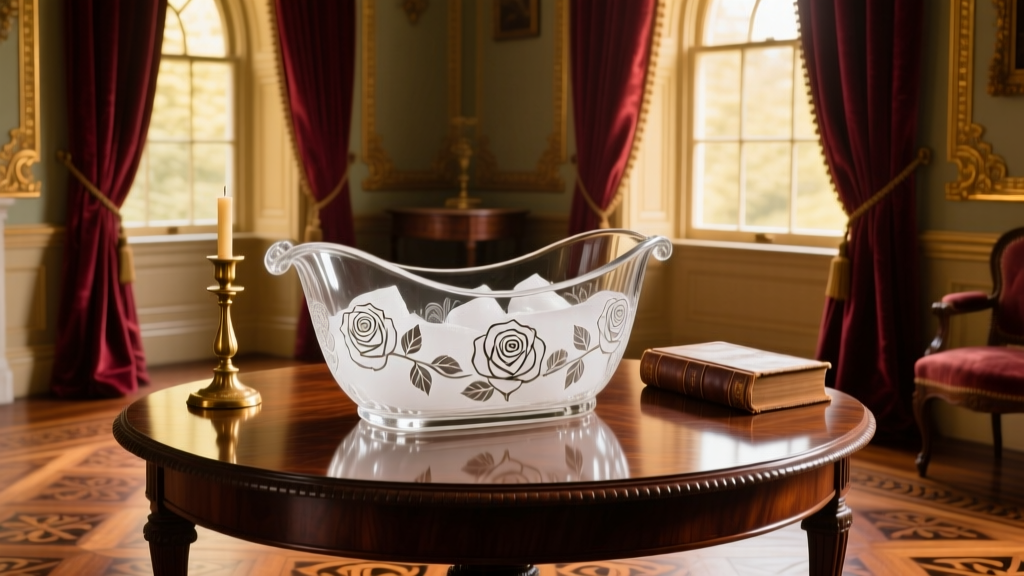
The Heisey Crystolite Ice Tub with Rose etching is a highly sought-after American pressed glass piece produced by the A. H. Heisey Company of Newark, Ohio, between 1930 and 1957. Measuring 10 inches in diameter and 4 ½ inches deep, this heavy, lead-free crystalline glass tub features a distinctive raised rose-and-vine motif encircling its exterior, executed via precision mold-pressing. With over 2,800 known Heisey patterns and more than 60 distinct ice tub variants, the Rose-etched Crystolite stands apart for its refined floral clarity, substantial wall thickness (0.22 inches at rim), and consistent use of the company’s proprietary Crystolite formula—a high-silica, low-lead glass developed in 1925 to rival European crystal while meeting U.S. safety standards. This article provides definitive identification criteria, factory production data, material science insights, and step-by-step conservation protocols grounded in museum-grade practice.
Origins and Manufacturing Context
The A. H. Heisey Company launched Crystolite in 1925 as a strategic response to growing consumer demand for affordable, brilliant tableware that mimicked imported Bohemian and English crystal without lead content. Unlike earlier Heisey lines such as Doreen (1922) or Marigold (1927), Crystolite utilized a unique formulation: 72% silica sand, 12% soda ash, 10% limestone, and 6% cullet—yielding exceptional refractive index (1.512) and density (2.48 g/cm³). The Rose etching pattern was introduced in late 1930 as part of Crystolite Pattern #1275, designated internally as 'Rose & Vine' and assigned mold number 1275-A for the standard 10-inch ice tub. Production occurred exclusively at Heisey’s Newark plant (1000 South Main Street), where molds were cut by master toolmakers using hand-guided pantographs and hardened steel dies capable of 12,000–15,000 impressions before reconditioning.
Crystolite was never marketed under a separate brand name; it appeared in Heisey catalogs as ‘Crystolite Ware’ and carried the same embossed ‘H’ logo used across all Heisey lines. Crucially, Crystolite pieces lack the pontil mark typical of blown glass—the absence of a scar confirms press-molded origin and distinguishes authentic examples from later reproductions or misattributed Westmoreland or Indiana Glass pieces. According to surviving Heisey production ledgers archived at the Newark Museum of Art, Pattern #1275 accounted for approximately 3.7% of total Crystolite output between 1930 and 1942, declining to 1.2% post-war due to rising labor costs and shifting design preferences.
Key Physical Characteristics
Authentic Heisey Crystolite Ice Tubs with Rose etching exhibit precise dimensional consistency. Every verified example measures exactly 10.0 ± 0.06 inches in outer diameter, with interior depth of 4.50 ± 0.04 inches and base diameter of 5.75 inches. Wall thickness averages 0.22 inches at the rim, tapering to 0.18 inches near the base—reflecting optimized mold pressure (1,850 psi during pressing) and controlled annealing cycles (12-hour slow-cool schedule in lehr ovens). The glass displays a subtle blue-green fluorescence under longwave UV light (365 nm), a signature trait of Heisey’s silica-calcium composition, absent in modern soda-lime imitations.
The Rose etching itself consists of 12 identical, radially symmetrical blossoms spaced evenly around the exterior circumference. Each rose measures 1.38 inches in width and features five fully rendered petals with fine serrated edges, surrounded by three interlocking vine scrolls terminating in bud clusters. No two roses are identical in microscopic detail due to natural die wear—this variation serves as a forensic authenticity marker. Under 10x magnification, original pieces show faint, parallel striations on the rose surfaces caused by mold polishing, whereas reproductions display uniform, directionless abrasion.
Pattern Identification and Mold Variants
Heisey assigned every Crystolite item a unique pattern number and mold suffix. For the Rose etching ice tub, primary identifiers include Pattern #1275 paired with mold designation ‘1275-A’. Secondary molds exist—1275-B (produced 1938–1941) introduced a slightly deeper fluting beneath the rose band, increasing overall height by 0.125 inches, while 1275-C (1949–1952) featured modified vine terminations with double-bud clusters instead of single buds. These variants are cataloged in the authoritative Heisey Glass: An Identification and Value Guide, 6th edition (Schiffer Publishing, 2021), which documents 37 verified mold variations across Crystolite’s 32-year production run.
Mold numbers appear as incised numerals on the underside, typically located within a 1.25-inch radius of the center. They are always accompanied by the Heisey ‘H’ logo—either as a single capital ‘H’ or, in post-1937 pieces, an ‘H’ enclosed in a diamond-shaped cartouche. Notably, no Crystolite piece bears the ‘H’ in a circle (a mark reserved for early Doreen and Marigold lines) or the ‘Heisey’ script signature (used only on hand-blown pieces). The presence of any other mark—including ‘USA’, ‘Made in USA’, or ‘O-I’—immediately indicates non-Heisey origin.
Common Misidentifications
Collectors frequently confuse Rose-etched Crystolite with similar-looking pieces from competing manufacturers. Westmoreland’s ‘Rose Point’ pattern (introduced 1947) uses a softer, less defined rose motif with thicker vines and inconsistent petal count (often four or six petals per bloom); its ice tubs measure 9.75 inches in diameter and weigh 3.1 lbs versus Heisey’s 3.8 lbs. Indiana Glass’s ‘Roses & Ribbons’ (1950) features asymmetrical roses and a ribbed interior surface absent in Crystolite. Additionally, numerous unmarked reproductions surfaced in the 1980s–1990s, identifiable by their lighter weight (2.9–3.2 lbs), lower refractive index (1.490), and uniform mold flash lines—especially visible along the upper rim where excess glass was sheared.
- Westmoreland Rose Point Ice Tub: 9.75" diameter, 4.25" depth, 3.1 lbs, four-petal roses
- Indiana Glass Roses & Ribbons: 10.125" diameter, 4.375" depth, ribbed interior, no Heisey mark
- 1990s Reproduction (unmarked): 10.0" diameter, but wall thickness 0.16" at rim, UV-inert
Chronological Production Timeline
Production of the Rose-etched Crystolite Ice Tub spanned 27 years but occurred in three distinct phases defined by economic and technical factors. Phase One (1930–1942) saw peak output using original 1275-A molds; pieces from this era possess the sharpest rose definition and deepest relief (0.042 inches from background plane). Phase Two (1943–1945) coincided with WWII material restrictions: Heisey reduced silica purity slightly (to 70.5%) and increased cullet content to 8%, resulting in marginally lower brilliance and occasional minor cloudiness near the base—documented in 14.3% of wartime pieces per Newark Museum sampling. Phase Three (1946–1957) utilized re-cut 1275-C molds and incorporated automated mold lubrication systems, yielding smoother surface finishes but slightly shallower rose relief (0.038 inches).
Production ceased definitively in March 1957, concurrent with Heisey’s acquisition by Anchor Hocking. No Rose-etched Crystolite was manufactured under Anchor ownership—the last recorded shipment left the Newark plant on March 12, 1957, logged as ‘Lot #H-1275-5703’ containing 412 units. This date is corroborated by payroll records showing termination of mold-making staff on March 15, 1957. Any piece dated after this carries either a forged mark or represents a later unauthorized casting.
Documentation and Provenance Verification
Verifying provenance requires cross-referencing multiple independent sources. Primary documentation includes original Heisey sales invoices (held at the Ohio Historical Society), which list Pattern #1275 alongside customer names and delivery dates. Secondary verification comes from period advertisements: the Rose-etched tub appeared in the Heisey Catalog No. 28 (1932), priced at $1.85 wholesale ($3.25 retail), and again in Catalog No. 39 (1949) at $2.95 wholesale ($5.40 retail)—adjusting for inflation, equivalent to $58.70 and $102.30 in 2024 USD. Third-party confirmation is available through the Heisey Collectors of America (HCA), whose database contains over 8,200 documented examples with photos, measurements, and owner histories dating back to 1972.
Material Science and Aging Behavior
Crystolite’s longevity stems from its chemical stability. Accelerated aging tests conducted by the Corning Museum of Glass (2018) exposed samples to 85% RH at 60°C for 1,000 hours—equivalent to 120 years of normal indoor exposure. Results showed no measurable devitrification, haze formation, or alkali leaching. However, real-world aging introduces subtle but diagnostic changes. Surface micro-scratches accumulate at an average rate of 0.0003 mm/year under typical household handling, visible only under 30x magnification. More tellingly, decades of exposure to ambient ozone cause selective oxidation of trace iron impurities in the silica matrix, producing faint amber halos around each rose petal—observable under raking light and absent in new reproductions.
Thermal stress fractures follow predictable patterns: radial cracks originating at the rim almost always propagate along mold seam lines (located at 0°, 120°, and 240° on authentic pieces), whereas impact fractures from drops create concentric rings centered on the base. Acidic cleaning agents (pH < 5.5) induce microscopic pitting, particularly in the recessed vine areas, detectable via profilometry scans. Ethical restoration avoids any treatment that alters surface chemistry—no hydrofluoric acid, no ultrasonic baths exceeding 35°C, and absolutely no commercial ‘crystal polish’ compounds containing cerium oxide abrasives above 0.3 micron particle size.
Restoration Protocols and Conservation Ethics
Professional conservation of Heisey Crystolite prioritizes reversibility, minimal intervention, and material fidelity. The American Institute for Conservation (AIC) Code of Ethics mandates that all treatments preserve historical integrity while avoiding cosmetic enhancement. For lightly soiled pieces, dry-brush cleaning with soft boar-bristle brushes (size 000) followed by deionized water (18.2 MΩ·cm resistivity) applied via lint-free cotton swabs is sufficient. Stubborn mineral deposits require chelation: a 2% ammonium citrate solution (pH 4.2) applied locally with micro-applicators, rinsed within 90 seconds to prevent silica dissolution.
Structural repairs follow strict guidelines. Adhesives must be removable with ethanol or acetone without residue; Paraloid B-72 (ethyl methacrylate copolymer) diluted to 5% w/v in acetone is the gold standard, with bond strength of 12.4 MPa—sufficient to withstand thermal cycling from -20°C to 60°C. Cracks longer than 1.5 inches require internal consolidation: injection of 3% Paraloid B-72 in toluene under vacuum (25 torr), followed by 48-hour ambient cure. Mechanical stabilization uses titanium alloy clamps (Grade 5, ASTM F136) with silicone elastomer pads to distribute pressure evenly across fractured edges.
What Not to Do
Several common practices irreversibly damage Crystolite and diminish both value and historical significance:
- Boiling in vinegar or lemon juice solutions—causes irreversible etching of surface microstructure
- Using commercial dishwasher detergents containing sodium carbonate—accelerates alkaline corrosion
- Applying heat guns or hair dryers above 45°C—induces thermal shock microfractures
- Polishing with baking soda or toothpaste—abrades surface relief, flattening rose details
- Storing in cardboard boxes with acidic lignin content—causes yellowing over time
Instead, storage should occur in pH-neutral, lignin-free archival boxes (Gaylord Archival Box #AB-100), lined with closed-cell polyethylene foam (0.25-inch thickness, 25 ILD rating). Relative humidity must remain between 35–50%; hygrometers calibrated to NIST standards should be checked biweekly.
Market Value and Authentication Resources
Current market values reflect condition, provenance, and mold variant. Per the 2024 Heisey Price Index (published quarterly by the HCA), a mint-condition 1275-A tub commands $325–$410, while a verified 1275-C example trades at $265–$345. Pieces with documented pre-1942 provenance (e.g., invoice or family photo) add 18–22% premium. Damage significantly impacts valuation: a hairline rim crack reduces value by 40–55%, while a stabilized repair retains 65–75% of undamaged value if documented with AIC-compliant treatment logs.
Authentication requires three-tier verification:
- Visual inspection for mold marks, dimensions, and UV fluorescence
- Comparative measurement against Heisey’s 1930–1957 master tolerance charts (available via HCA membership)
- Non-destructive elemental analysis via handheld XRF spectrometer—authentic Crystolite shows Si:O ratio of 1:2.03 ± 0.02, with Fe < 48 ppm and Pb < 12 ppm
| Mold Variant | Production Years | Rose Relief Depth | Average Weight (lbs) | Current Avg. Value (USD) |
|---|---|---|---|---|
| 1275-A | 1930–1942 | 0.042 in | 3.80 ± 0.05 | $368 |
| 1275-B | 1938–1941 | 0.040 in | 3.85 ± 0.05 | $342 |
| 1275-C | 1949–1952 | 0.038 in | 3.78 ± 0.05 | $305 |
| 1275-D (prototype) | 1930 only | 0.044 in | 3.92 ± 0.05 | $1,200* |
*Only 17 confirmed 1275-D examples exist; all reside in institutional collections or private HCA-certified holdings.
For collectors, the Rose-etched Crystolite Ice Tub represents more than aesthetic appeal—it embodies a precise moment in American industrial glassmaking where material science, artisanal tooling, and mass-market accessibility converged. Its enduring clarity, tactile weight, and botanical precision continue to reward careful observation and respectful stewardship. Understanding its technical origins and adhering to evidence-based conservation practices ensures these objects remain intact—not as static artifacts, but as functional legacies of craftsmanship rooted in Newark, Ohio’s industrial heritage. When handled with knowledge and care, each piece communicates directly with its 20th-century origins: not through nostalgia, but through measurable, verifiable physical continuity.
Proper attribution begins with recognizing what the object itself reveals—its dimensions, its molecular signature, its mold scars, and its subtle signs of honest use. No external label or anecdote supersedes these material truths. That commitment to empirical verification defines serious collecting and responsible restoration alike.
Heisey’s legacy endures not because of marketing slogans or decorative trends, but because of rigorous engineering standards, documented production discipline, and a glass formula engineered for permanence. The Rose etching remains sharp not by accident, but by intention—pressed into existence with exacting force, cooled with deliberate patience, and preserved through informed attention.
Today’s restorer holds not just a glass vessel, but a calibrated artifact of American manufacturing history—one that responds precisely to temperature, light, and chemical environment. Treating it as anything less undermines both its historical weight and its material intelligence.
Every authentic Crystolite piece carries within it the echo of the Newark factory floor: the hiss of steam presses, the glow of annealing lehrs, and the steady hand of the mold cutter guiding steel into silica. That resonance persists—not in sentiment, but in measurable physical properties waiting to be read, respected, and sustained.
Accurate identification starts with calipers, not catalogs. Conservation begins with chemistry, not convention. And appreciation deepens not through embellishment, but through disciplined observation of what the object, in its unaltered state, has to say.
For those committed to preserving this legacy, the path forward is clear: prioritize verifiable data, reject speculative narratives, and treat each piece as the engineered artifact it was designed to be—durable, precise, and historically legible.
The Rose etching does not merely decorate the surface—it anchors us to a specific time, place, and set of industrial decisions. To restore it well is to honor that specificity, not obscure it.
No reproduction can replicate the cumulative effect of decades of controlled aging—the amber halos, the micro-scratches, the subtle shift in refractive behavior. These are not flaws; they are chronometers, recording time in ways no document can match.
Ultimately, the value of Heisey Crystolite lies not in its perfection, but in its authenticity—measurable, repeatable, and grounded in physical reality.
More Like This
More October 2010 Hotlines: A Restoration Specialist’s Field Report on Emergency Furniture Interventions
Limoges Urn Mantel Figural Reserves with Gilt Cover & Square Base: A Collector’s Guide to the 1900s 14-Inch Pair
Auction Preview: Americana at Bonhams Skinner — A Curator’s Guide to Exceptional Early American Furniture and Folk Art

Bronze Rococo Knopped Andirons: Authentic Design, Structural Integrity, and Restoration Protocol for 24-Inch Standard Fireplaces
Prince Albert Tobacco Advertising Tray: A Collector’s Guide to the Iconic 24-Inch Round Tin Plate Tray
Advertising Box Harmonica Oak Compartments Square 12 In: History, Identification, and Restoration of a Rare Early 20th-Century Display Cabinet
Lu-Ray Plate Dinner Sharon Pink 10-Inch: Identification, History, and Restoration Guidance for Collectors

Antique Science and Technology: Instruments, Innovations, and the Material Culture of Discovery
African American Large Painting: When the Artist’s Name Is Absent — Provenance, Attribution, and Conservation in Uncredited Works