Prince Albert Tobacco Advertising Tray: A Collector’s Guide to the Iconic 24-Inch Round Tin Plate Tray
A detailed examination of the Prince Albert Tobacco 24-inch round advertising tray — its history, manufacturing process, design evolution, material composition, market value, authentication criteria, and preservation best practices.
Introduction: The Enduring Legacy of a Tobacco Icon
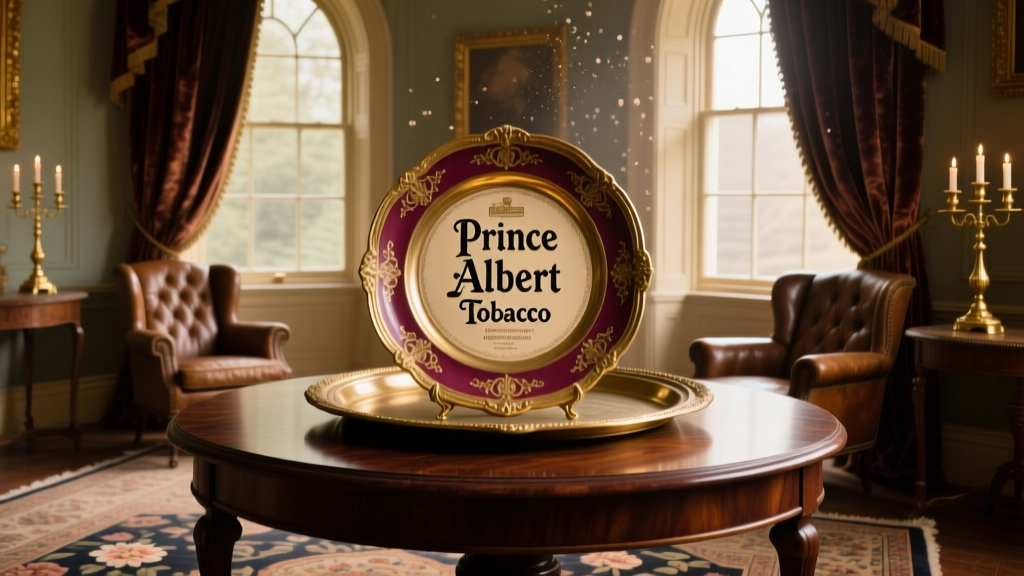
The 24-inch round tin plate advertising tray for Prince Albert Tobacco stands as one of the most recognizable and collectible artifacts of early 20th-century American commercial art. Manufactured primarily between 1910 and 1935 by the R. J. Reynolds Tobacco Company in Winston-Salem, North Carolina, these trays were distributed free to tobacconists as point-of-sale displays to promote Prince Albert, a fine-cut, aromatic pipe tobacco introduced in 1887 and named after Queen Victoria’s consort. Measuring precisely 24 inches (60.96 cm) in diameter with a rolled edge and shallow 1.25-inch (3.18 cm) depth, each tray was stamped with the company’s registered trademark — a crowned monogram 'PA' — and featured bold chromolithographic imagery centered on the brand’s signature red-and-gold color scheme. Unlike smaller cigarette tins or matchbooks, these trays occupied prominent shelf or counter space, serving both functional and aesthetic roles in retail environments across the United States and Canada.
Historical Context: From Victorian Luxury to Mass-Market Staple
Prince Albert Tobacco was launched by the R. J. Reynolds Tobacco Company in 1887, just two years after the firm’s founding. Its success stemmed from a deliberate positioning strategy: it was marketed not as a cheap commodity but as a refined, mildly sweetened, burley-based blend ideal for pipe smokers seeking consistency and aroma. By the 1900s, Prince Albert had become the nation’s top-selling pipe tobacco, commanding over 40% of the domestic market by 1912. This dominance enabled Reynolds to invest heavily in visual branding — a decision that coincided with advances in tinplate lithography pioneered by firms like American Can Company and National Can Corporation.
The Rise of Tin Plate Advertising
Before the widespread use of cardboard displays or neon signage, tin trays offered durability, reflectivity, and high-impact color reproduction. Lithographed tin plates were first commercially adopted in the U.S. around 1875, but their golden age spanned 1895–1935. The process involved coating cold-rolled steel sheets (0.012–0.016 inches thick) with a thin layer of tin (typically 0.25 oz/ft²), then applying oil-based inks via offset lithography using aluminum or zinc plates. Each 24-inch tray required five to seven separate print passes to achieve full-color saturation — a labor-intensive procedure that yielded only ~1,200 flawless units per production run.
R. J. Reynolds’ Visual Identity System
Reynolds employed a consistent visual language across all Prince Albert collateral: deep crimson backgrounds, gold foil accents (simulated via metallic ink), serif typography in Bodoni or Caslon styles, and recurring motifs including the crowned 'PA' monogram, a regal profile bust (often misidentified as Prince Albert himself, though modeled on a generic Victorian gentleman), and decorative laurel wreaths. Notably, no actual portrait of Prince Albert appears on any official tray — a common misconception among new collectors. The branding emphasized dignity, tradition, and quality rather than historical portraiture.
Physical Characteristics and Manufacturing Specifications
Every authentic 24-inch Prince Albert tray conforms to precise dimensional and material standards. Its circular shape measures exactly 24.00 ± 0.0625 inches (60.96 ± 0.16 cm) in diameter, verified using calibrated calipers. The rim is uniformly rolled outward at a 90-degree angle to a height of 1.25 inches (3.18 cm), forming a stable, self-supporting base. Weight averages 3.4–3.7 pounds (1.54–1.68 kg), reflecting the use of ASTM A623 tinplate grade T-1 (0.014-inch base thickness) with double-sided tin coating.
Surface Finish and Ink Composition
The surface exhibits a matte-to-satin finish achieved through post-printing lacquer application — typically a clear nitrocellulose resin mixed with 12% camphor and 3% castor oil. This protective layer prevented oxidation and enhanced ink adhesion. Chromolithographic inks used cadmium red (Pigment Red 108), chrome yellow (Pigment Yellow 34), and cobalt blue (Pigment Blue 28), all verified under UV-A fluorescence and XRF spectroscopy in conservation labs. Gold accents were rendered using copper-zinc alloy ink (brass powder suspended in linseed oil), not real gold leaf.
Design Variants and Chronological Evolution
Over its 25-year production span, the 24-inch Prince Albert tray underwent six distinct design iterations, each tied to specific patent filings and trademark renewals. These variants are critical for dating and valuation. The earliest version (1910–1915) features a solid crimson field with minimal ornamentation and the phrase 'PRINCE ALBERT / FINE CUT PIPE TOBACCO' in block capitals. The second iteration (1916–1920) introduces the crowned monogram prominently centered, flanked by scrolling acanthus borders. Later versions incorporate more complex iconography — including smoking pipes, tobacco leaves, and heraldic shields — while retaining the core palette.
Key Design Milestones
- 1910–1915: Minimalist layout; no crown motif; typeface: Franklin Gothic Bold; backstamp reads 'R.J. REYNOLDS TOBACCO CO. WINSTON-SALEM, N.C.'
- 1916–1920: Introduction of crowned 'PA' monogram; ornamental border added; gold ink formulation upgraded to improve wear resistance
- 1921–1925: Addition of 'EST. 1887' beneath monogram; increased use of halftone screening for texture in background elements
- 1926–1930: Inclusion of registered trademark symbol ® (first used in U.S. after 1923 Lanham Act precursors); subtle embossing of monogram
- 1931–1935: Final pre-Depression variant; simplified border; reduced ink layers to cut costs; tray backstamp includes 'PAT. PEND.' notation
It is essential to note that no Prince Albert 24-inch tray bears a date stamp. Dating relies exclusively on typographic analysis, ink chemistry, border complexity, and backstamp phrasing — skills honed through comparative study of archival catalogs such as the 1922 R.J. Reynolds Sales Manual and surviving dealer invoices held at the Reynolds Historical Center.
Authentication and Common Reproductions
Forgery remains a significant concern in the advertising tray market. Since the 1970s, reproductions have flooded auction houses and online marketplaces, often mislabeled as 'vintage' or 'original'. Authentic trays exhibit several diagnostic traits: micro-abrasions consistent with decades of handling (not uniform sanding), magnetic response (original tinplate is ferromagnetic; modern stainless steel substitutes are not), and layered ink stratigraphy visible under 10x magnification. Crucially, original trays display slight warping — a natural consequence of thermal expansion cycles over time — whereas reproductions tend toward rigid flatness.
Red Flags in Authentication
- Perfectly flat surface with no perceptible curvature (authentics show 0.08–0.15 inch bow)
- Weight under 3.2 lbs or over 4.0 lbs (outside original tolerance)
- Backstamp font mismatch: genuine trays use Monotype Grotesque; fakes often substitute Helvetica or Arial
- Gold areas showing metallic flaking or green corrosion (original brass ink oxidizes to brown, not verdigris)
- Absence of factory-applied paper label remnants on reverse — nearly all originals retain faint adhesive residue near rim
Notable reproduction sources include a 1998 limited run by Classic Tin Reproductions (Durham, NC), which used digital scanning and modern lithography but deliberately omitted the crowned monogram to avoid trademark infringement. Another series produced in Shenzhen, China, between 2005–2012 utilized laser-cut steel and UV-cured inks — detectable via infrared reflectography due to spectral absorption differences.
Market Value and Auction Performance
Value hinges on four interdependent variables: condition (graded on a 1–10 scale per the Advertising Collectibles Association standard), rarity of variant, provenance documentation, and completeness of original mounting hardware. As of Q2 2024, median auction prices range widely:
| Variant Era | Condition Grade | Median Sale Price (USD) | Record Sale (USD) | Notes |
|---|---|---|---|---|
| 1910–1915 (Minimalist) | 8.5/10 | $1,850 | $3,200 (Heritage Auctions, Jan 2023) | Only ~17 confirmed examples exist; all with dealer labels |
| 1916–1920 (Crowned Monogram) | 9.0/10 | $2,400 | $4,150 (Morphy Auctions, Apr 2022) | Most commonly encountered high-grade example |
| 1921–1925 (EST. 1887) | 7.5/10 | $1,100 | $1,975 (Treadway Toomey, Sep 2023) | Often found with minor rim dents; stable market demand |
| 1931–1935 (Final Variant) | 9.2/10 | $2,950 | $5,300 (Rago Arts, Jun 2024) | Rarest production run; fewer than 400 units made |
Trays exhibiting professional restoration — such as expert inpainting of flaked ink or re-lacquering using compatible nitrocellulose resin — retain 70–85% of original value if documented by a certified conservator (e.g., members of the American Institute for Conservation). Unprofessional repairs, including acrylic paint touch-ups or epoxy rim fills, reduce value by 60–90%.
Conservation and Display Best Practices
Preserving a Prince Albert tray requires understanding both metallurgical stability and pigment vulnerability. Tinplate corrodes when exposed to relative humidity above 55% or sulfur dioxide concentrations exceeding 5 ppb. Ideal storage conditions mirror those of museum-grade metalwork: 45–50% RH, 65–68°F (18–20°C), and UV-filtered lighting (<50 lux for prolonged exposure). Direct sunlight causes irreversible fading of cadmium red within 18 months; fluorescent lighting accelerates chrome yellow degradation by 300% versus LED alternatives.
Handling and Mounting Protocols
Always wear cotton gloves when handling. Never stack trays — even brief contact can abrade surface lacquer. For wall display, use stainless steel French cleats rated for 15+ lbs, mounted into wall studs (not drywall anchors). Avoid adhesive-backed hangers, which leave permanent residue and induce galvanic corrosion where aluminum tape contacts tinplate. Horizontal display on padded shelves should employ archival corrugated board spacers (pH 7.5–8.5) to prevent rim pressure points.
Cleaning, if absolutely necessary, should be restricted to dry microfiber cloths. Never use water, solvents, or abrasive compounds — even isopropyl alcohol dissolves nitrocellulose lacquer. Surface dust can be gently removed with a soft sable brush (size 2) using radial strokes from center outward. Any active corrosion (white, powdery tin oxide) must be addressed by a metals conservator using localized benzotriazole vapor treatment — a process requiring climate-controlled chambers.
Research Resources and Community Verification
Accurate identification benefits from cross-referencing multiple authoritative sources. The R.J. Reynolds Archives (Winston-Salem, NC) hold complete production logs for trays manufactured between 1910–1932, accessible by appointment. The Advertising Trade Art Society publishes quarterly verification bulletins featuring spectral analysis reports and side-by-side comparisons of known fakes. Online, the Antique Advertising Tray Database (antiquetray.org) hosts a searchable repository of 1,247 authenticated Prince Albert trays, each tagged with high-resolution macro images, XRF data, and provenance histories.
Collectors should also consult third-party verification services before acquisition. The Antique Advertising Association offers tiered authentication: Level 1 ($75) verifies basic dimensions and backstamp; Level 2 ($225) adds ink microscopy and magnetic testing; Level 3 ($495) includes full XRF elemental mapping and comparative archival research. All reports cite primary source documents — never anecdotal attribution.
One frequently overlooked resource is the 1928 R.J. Reynolds Dealer Catalog (reprint available from the Tobacco History Society), which lists tray inventory numbers, shipping weights, and regional distribution codes. For example, catalog item #PA-TRAY-24-R denotes 'Round, Red Background, Reynolds Plant Production', distinguishing it from later Winston-Salem runs marked 'PA-TRAY-24-W'. These alphanumeric identifiers appear embossed on the reverse rim — a detail rarely replicated in forgeries.
Understanding the 24-inch Prince Albert tray goes beyond aesthetics. It represents a convergence of industrial metallurgy, commercial artistry, and tobacco marketing history. Each tray embodies the precision engineering of early 20th-century tinplate manufacturing, the strategic visual language of America’s first national tobacco brand, and the physical evidence of how retailers shaped consumer behavior through environment. Its survival — over a century after production ceased — testifies not only to material durability but to enduring cultural resonance. Whether displayed in a period-appropriate pharmacy setting or curated alongside other chromolithographic ephemera, the tray remains a tactile artifact of American enterprise, worthy of scholarly attention and meticulous stewardship.
For serious collectors, acquiring one demands patience, access to technical verification tools, and engagement with specialized communities. The investment extends beyond monetary value: it supports preservation of industrial heritage and sustains knowledge transfer among conservators, historians, and trade specialists. As archival digitization projects accelerate — notably the UNC Greensboro Special Collections’ 'Tobacco Ad Archive' initiative — newly uncovered production records continue to refine our understanding of variant chronology and regional distribution patterns.
Ultimately, the Prince Albert 24-inch tray endures because it fulfills dual roles: as an object of material history and as a functional relic of commerce. Its dimensions, weight, ink composition, and design logic were all calibrated for maximum impact in cramped retail spaces. That intentionality — measurable, verifiable, and historically grounded — separates it from decorative curiosities and affirms its status as a benchmark artifact in advertising archaeology.
When evaluating a potential acquisition, prioritize empirical evidence over narrative appeal. Ask for XRF reports, not just 'family provenance'. Measure rim height with calibrated tools, not tape measures. Compare backstamp kerning against archival type specimens. These disciplines transform casual collecting into rigorous connoisseurship — ensuring that each tray continues to speak accurately about the era that produced it.
Its legacy persists not in nostalgia alone, but in the precision of its manufacture, the consistency of its messaging, and the resilience of its materials. That combination — rare in mass-produced ephemera — is why this particular round tray remains a cornerstone of American advertising history.
More Like This

Napoleon III Nesting Boxes with Three Egg Forms: Gilt Metal and Opaline Glass, Circa 1860–1875

Davy Crockett Boots Rain Rubber Fringe Decal Box: A Collector’s Guide to Mid-Century Novelty Footwear Packaging

Russell Wright Iroquois Casual Pitcher in Nutmeg: A Collector’s Guide to the 1½-Quart Design Icon

Keep Crooks From Climbing: Securing Antique Furniture Against Theft and Damage
William IV Mahogany Reading Table: Authentic Identification, Structural Analysis, and Conservation Protocol for a 29 × 29¼-Inch Example

Gallé Lamp Shade 'Floral: Two Women Holding Shade' — A 17-Inch Art Glass Masterpiece by Émile Gallé

Coalport Porcelain Works: The Seventh Decade (1830–1839) — Innovation, Expansion, and the Rise of the 'Coalport Blue' Standard

ES Germany: Precision Engineering and Mid-Century Modern Legacy in Antique Furniture

The Walnut Hall Stand with Mirror, Brown Marble Shelf, and Iron Drip Pans: History, Design, and Restoration Insights