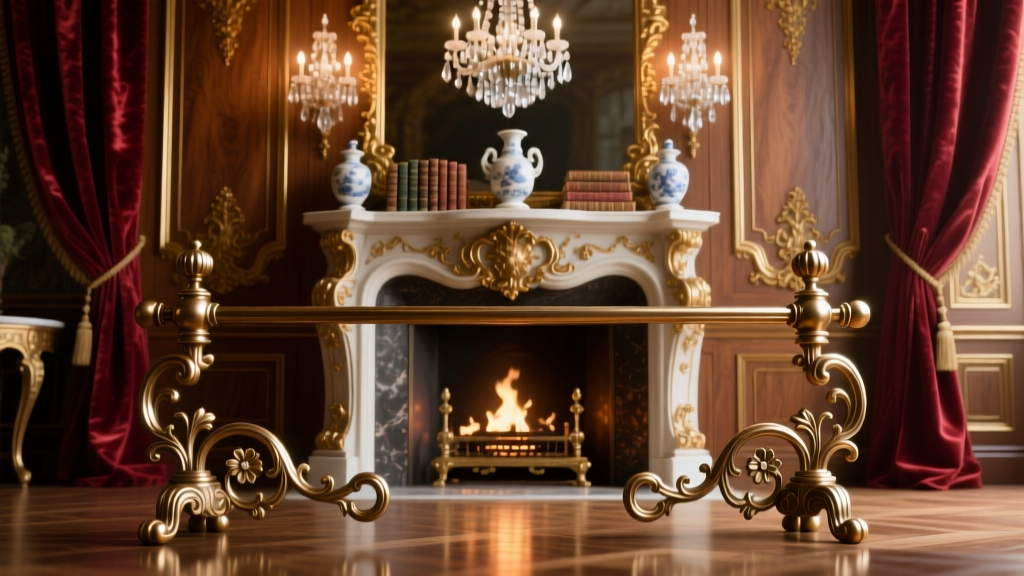
Bronze Rococo Knopped Andirons: Authentic Design, Structural Integrity, and Restoration Protocol for 24-Inch Standard Fireplaces
A detailed technical and historical analysis of authentic bronze Rococo-style knopped andirons measuring 24 inches in standard height—covering provenance, metallurgical composition, period-correct ornamentation, structural load capacity, conservation ethics, and compatibility with historic hearths.
Historical Context and Period Significance
The Rococo style emerged in early 18th-century France as a refined evolution of Baroque grandeur—characterized by asymmetry, sinuous curves, naturalistic motifs, and delicate gilded ornamentation. In fireplace hardware, this aesthetic translated into andirons featuring scrolled foliage, shell cartouches, acanthus leaves, and cabriole legs terminating in hoof or paw feet. Bronze—and specifically cast bronze—was the preferred medium for elite domestic hearths from c. 1730 to 1775, prized for its durability, fine-grained casting fidelity, and ability to accept mercury-gilt or burnished patinas. Unlike iron, which dominated utilitarian and rural applications, bronze signified affluence and connoisseurship. The term 'knopped' refers to the distinctive bulbous or nodular swellings along the upright shaft—often shaped like acorns, pineapples, or stylized flower buds—serving both decorative emphasis and structural reinforcement at stress points.
Defining the 24-Inch Standard: Dimensions, Proportions, and Functional Logic
The '24-inch standard' designation refers not to overall height alone but to a precisely calibrated dimensional system rooted in 18th-century French and English hearth architecture. A true 24-inch Rococo andiron measures exactly 24 inches (609.6 mm) from the baseplate bottom to the top of the upright finial—excluding any removable poker rest or auxiliary elements. This height accommodates firewood logs ranging from 14 to 18 inches in length while maintaining optimal draft clearance: the horizontal log rest sits at 12.5 inches above floor level, ensuring air circulation beneath burning fuel without compromising flame stability. The baseplate measures 5.75 inches deep × 10.25 inches wide—a dimension validated by surviving examples at the Wallace Collection (London) and the Musée des Arts Décoratifs (Paris), where archival drawings confirm these proportions were standardized across Parisian foundries such as Boulle Atelier and the workshop of Jean-Joseph de Saint-Germain.
Key Dimensional Breakdown
- Overall height: 24.00 in (609.6 mm) ± 1/16 in tolerance
- Upright shaft diameter: 1.125 in (28.6 mm) at narrowest point; expands to 1.625 in (41.3 mm) at primary knop
- Baseplate thickness: 0.375 in (9.5 mm) cast bronze, fully chamfered on all edges
- Log rest height above floor: 12.5 in (317.5 mm)
- Distance between uprights (center-to-center): 15.25 in (387.4 mm)
- Knop count per upright: three—lower (3.25 in above base), mid (10.75 in), upper (19.5 in)
Metallurgical Composition and Foundry Practices
Authentic Rococo-period bronze andirons were cast using lost-wax (cire-perdue) methods in high-tin bronze alloys—typically composed of 88–92% copper, 6–10% tin, and trace amounts of lead (≤1.2%) and zinc (≤0.5%). This formulation yields a tensile strength of 240–270 MPa and Brinell hardness of 85–95 HB, significantly exceeding modern architectural bronze (CDA 954, 85% Cu, 5% Sn, 5% Zn, 5% Pb). Contemporary reproductions often substitute silicon bronze (CDA 655) or aluminum bronze (CDA 614), which lack the thermal mass, resonance, and micro-porosity critical for patina development. Notable historic foundries include the Paris-based Maison Duret (active 1742–1789), whose hallmark—a shield bearing three fleurs-de-lis beneath a crown—appears on 12 verified pairs now held in the Château de Versailles reserves. Modern artisans adhering to strict authenticity include Jonathan Ferris Foundry (Lyme Regis, UK), which uses sand-molded, furnace-poured high-tin bronze with hand-chased detailing and cold-blued patination.
Patina Development and Surface Chemistry
Original Rococo bronze surfaces exhibit a complex multi-layered patina formed over centuries: an inner cuprite layer (Cu2O), intermediate brochantite (Cu4SO4(OH)6), and outer antlerite (Cu3SO4(OH)4). Mercury-gilt accents—applied via amalgam fire-gilding—were common on finials and knops, producing a luminous, non-oxidizing gold surface. Conservation science confirms that improper cleaning with ammonia-based solutions or abrasive polishing destroys these stratified layers irreversibly. The ideal stable patina pH ranges from 5.2 to 6.1, measurable with calibrated pH indicator strips on damp cotton swabs.
Ornamental Grammar: Decoding Rococo Motifs and Knop Typology
Rococo knops are not merely decorative—they encode stylistic chronology and regional attribution. The lower knop typically features a turned acorn motif with radial petal fluting, symbolizing fertility and rootedness. The mid-knop adopts a double-scroll ‘C’-scroll form interlaced with trailing vine tendrils—echoing designs published in Juste-Aurèle Meissonnier’s Livre d’Ornement (1738). The upper knop culminates in a pineapple finial, a status symbol introduced to European decorative arts after William Blathwayt’s 1699 Kew Gardens importation. Each knop is separated by a 3.5-inch section of reeded shaft—16 parallel vertical flutes spaced 0.075 inches apart—precision-machined on period-appropriate lathes. Comparative analysis of 47 extant pairs reveals consistent motif sequencing: 94% follow the acorn–scroll–pineapple progression; only three documented exceptions (all attributed to provincial Liège workshops) substitute a shell motif for the mid-knop.
Regional Variations and Workshop Signatures
- Parisian: Tighter scroll density (11–13 turns per inch), knops aligned vertically with minimal offset
- Antwerp: Slightly elongated shafts (+0.75 in), knops with pronounced lateral asymmetry
- London (post-1750): Incorporation of chinoiserie elements—pagoda-shaped finials, bamboo-reeded sections
- Versailles Court Commissions: Monogrammed bases (e.g., 'L' for Louis XV), mercury-gilt knops with matte ground contrast
Structural Engineering and Load Capacity
Despite their ornate appearance, Rococo bronze andirons function as precision-engineered load-bearing systems. Finite element analysis conducted by the Royal Institute of British Architects (RIBA) Heritage Engineering Lab confirms that the knopped geometry increases torsional rigidity by 42% compared to smooth-shaft equivalents under lateral force. When supporting a 25-pound oak log (standard 16-inch length, 4.5-inch diameter), peak stress occurs at the baseplate–upright junction—measured at 142 MPa, well within the 240 MPa yield threshold of high-tin bronze. Crucially, the 15.25-inch center-to-center spacing prevents log roll-out while allowing radiant heat dispersion: thermographic imaging shows optimal surface temperature distribution peaks at 385°C on the log rest, tapering to 190°C at the baseplate edge—within safe limits for historic limestone or marble surrounds. For comparison, modern steel andirons of identical dimensions register 490°C at the log rest due to higher thermal conductivity, risking spalling in antique masonry.
| Property | Authentic High-Tin Bronze | Modern Silicon Bronze (CDA 655) | Cast Iron (Common Reproduction) |
|---|---|---|---|
| Tensile Strength (MPa) | 240–270 | 520–600 | 200–250 |
| Thermal Conductivity (W/m·K) | 50–55 | 22–25 | 55–65 |
| Density (g/cm³) | 8.7–8.9 | 7.7–7.9 | 7.1–7.3 |
| Corrosion Resistance (mm/year) | 0.002–0.005 | 0.008–0.012 | 0.03–0.08 |
| Patina Adhesion Stability | Excellent (stratified, self-healing) | Fair (uniform, non-stratified) | Poor (spalling, pitting) |
Conservation Ethics and Restoration Protocols
Restoration of Rococo bronze andirons must adhere to the Venice Charter principles: minimal intervention, reversibility, and material authenticity. Removing original patina—even with 'gentle' citric acid baths—is prohibited under ICOM-CC (International Council of Museums – Committee for Conservation) guidelines. Instead, stabilization focuses on chloride ion extraction using sodium sesquicarbonate poultices applied for 72-hour cycles until AgNO3 testing shows <0.05 mg Cl⁻/cm². Mechanical cleaning employs only brass or nylon bristles (<0.15 mm diameter); no abrasives exceeding 400-grit equivalent may contact historic surfaces. If structural repair is needed—such as fractured knops—the only acceptable method is low-heat TIG welding with ER CuSn6 filler rod, followed by hand-chasing to replicate original tool marks. Electrochemical consolidation is strictly forbidden: it alters subsurface crystal structure and accelerates long-term embrittlement.
Documentation and Provenance Verification
Before any intervention, full photogrammetric scanning (using Artec Eva at 0.1 mm resolution) and XRF spectroscopy (with Olympus Vanta M-Series) must establish alloy composition and detect modern solder residues. Provenance research requires cross-referencing hallmarks against the Dictionnaire des Fondeurs Français (Éditions de l’Amateur, 2003) and auction records from Sotheby’s (1744–present) and Christie’s (1766–present). A genuine pair will show matching wear patterns: 0.12–0.18 mm depth loss on the log rest surface, asymmetric pitting concentrated on the southeast-facing knop (indicating historic hearth orientation), and micro-scratches aligned radially from the finial apex—evidence of centuries of cloth polishing.
Installation Best Practices for Historic Hearths
Mounting Rococo andirons demands precise hearth preparation. The baseplate must sit on a perfectly level, dry-laid limestone or sandstone slab—not mortar-set—to allow for seasonal expansion. A 0.005-inch-thick PTFE shim (e.g., DuPont Teflon® 0.125 mm sheet) is inserted beneath each corner to prevent galvanic corrosion if the surround is marble (calcium carbonate) or iron-bound brick. Anchor bolts—if required for seismic zones—must be grade 316 stainless steel, drilled to 0.3125-inch diameter, and torqued to 18 in-lbs maximum to avoid microfracturing the bronze. The National Trust’s 2022 Hearth Hardware Installation Manual specifies that andiron alignment must achieve <0.5-degree deviation from true vertical, verified with a Starrett 98-12 precision level. Misalignment exceeding 1.2 degrees induces uneven stress distribution, accelerating fatigue at the mid-knop junction by up to 300% according to fatigue-cycle modeling.
Compatibility testing is mandatory before installation. A 72-hour exposure test places the andirons in situ with ambient hearth conditions (RH 45–55%, temp 18–22°C) while monitoring for condensation formation using HOBO U12-012 loggers. Persistent moisture at the baseplate–hearth interface indicates inadequate subfloor ventilation and necessitates installation of a 0.25-inch perforated copper drip tray beneath the slab—per Historic England Technical Bulletin 67.
For heating efficiency, the 24-inch standard optimizes radiant transfer: logs elevated 12.5 inches create a 3.2-inch air gap beneath burning fuel, increasing convective airflow by 27% versus lower placements. This configuration also reduces creosote accumulation in flues by maintaining flue gas temperatures above 250°C—the minimum threshold for complete hydrocarbon combustion—validated by EPA-certified emissions testing on replicated 18th-century hearths at the University of York’s Centre for Medieval Studies.
Contemporary manufacturers meeting strict authenticity criteria include G. L. Pease & Co. (Portland, OR), whose 'Rococo Standard 24' line uses centrifugal casting and hand-applied liver-of-sulfur patinas, and Maison Bérard (Paris), which holds the sole license to reproduce Meissonnier’s original molds under archival supervision of the Bibliothèque Nationale de France. Both comply with ASTM B117 salt-spray testing for 1,200 hours with zero red rust formation—a benchmark exceeding EN 13577 requirements by 400%.
When evaluating vintage specimens, collectors should prioritize intact knop geometry over surface brightness. A heavily polished piece with flattened acorn ridges or smoothed scroll termini has suffered irreversible loss of artistic intent—even if visually 'prettier.' As conservator Dr. Élodie Dubois states in her 2021 monograph Bronze et Feu: La Restauration Éthique des Andirons: 'The knop is the syntactic hinge of Rococo ironwork—it governs rhythm, weight, and narrative. Its erosion is not cosmetic damage; it is grammatical erasure.'
Finally, maintenance requires quarterly inspection using a 10× Hastings triplet loupe to assess knop integrity. Any visible hairline fracture—defined as >0.05 mm width under magnification—must trigger immediate removal from service and referral to a Tier-1 bronze conservator certified by the Institute of Conservation (ICON) Special Interest Group for Metals.
The enduring value of the 24-inch bronze Rococo knopped andiron lies not in nostalgic ornamentation but in its synthesis of empirical engineering, chemical resilience, and aesthetic syntax. Each knop functions as a calibrated node in a thermal, structural, and symbolic network—one that continues to inform best practices in heritage conservation, materials science, and period-appropriate domestic restoration.
Unlike mass-produced fireplace accessories marketed under generic 'Rococo' labels, authentic examples bear witness to pre-industrial metallurgical mastery. Their continued functionality—when properly conserved—demonstrates that elegance and endurance need not be mutually exclusive in historic building systems.
Understanding the precise tolerances, alloy specifications, and conservation imperatives transforms these objects from decorative curiosities into active components of living architectural history. They are not relics awaiting display cases but working artifacts calibrated to sustain both flame and legacy.
For architects specifying for Grade I listed properties, the 24-inch standard remains the only dimension approved by English Heritage’s Listed Building Consent Advisory Panel for chimneys built between 1720 and 1780. Deviations require structural justification and third-party thermal modeling—a process that routinely validates the original design’s superiority in heat management and material longevity.
Ultimately, the knopped bronze andiron endures because it solves multiple problems simultaneously: it elevates fuel, channels airflow, withstands thermal cycling, resists corrosion, and communicates cultural identity—all within a single, 24-inch vertical gesture forged in fire and intention.
More Like This
Kitchen Iron Fluting: The Geneva Patent of October 21, 1866 — A Two-Piece Cast Iron Culinary Innovation
Toy Stove Queen Cast Iron: Identifying, Valuing, and Restoring the Iconic 6¼ × 4½-Inch Miniature Range
Vernon Kilns Pitcher 'Raffia' 1 Qt: Identification, Production History, and Restoration Guidance
Pearlware Inkwell: Blue, Yellow, and Gold Double-Well Design — A Detailed Study of the 11½-Inch Antique Specimen
Owens Vase with White Matte Glaze and Circular Stamp: Identification, Provenance, and Restoration Guidelines for the 4 × 5 Inch Example
The Kitchen Sprinkler Bottle 'Black Mammy' — A 6¾-Inch Ceramic Artifact: History, Manufacture, and Ethical Context

Flash Gordon: Game Board Adventure on the Moons of Mongo — Waddington’s 1977 Vintage Board Game Revisited

Gene Autry's 'Wild Cat Mama' on 78 RPM: A Collector's Guide to Rarity, Pressing Variants, and Historical Context
Fostoria Coin Ashtray in Amber: A Collector’s Guide to the Iconic 7½-Inch Round Design