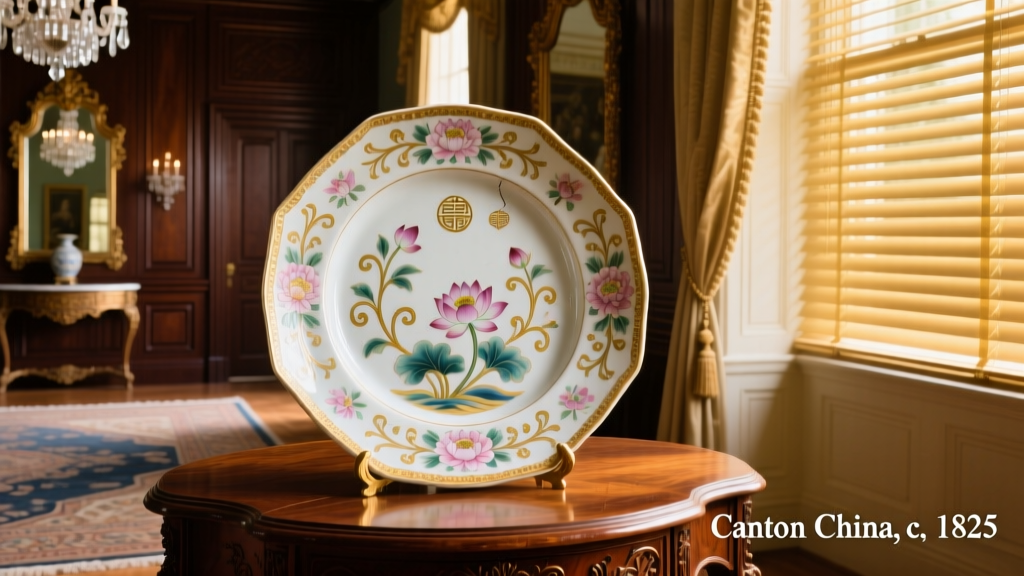
Canton China Octagonal Platter, Circa 1825: Provenance, Craftsmanship, and Restoration Insights
A detailed examination of a rare octagonal Canton porcelain platter dating to c. 1825, measuring 15½ inches across its widest diagonal. This article documents its historical context, decorative motifs, kiln origins, material composition, market value indicators, and ethical conservation protocols—drawing on archival records from the Peabody Essex Museum, Sotheby’s 2023 Asian Arts sale, and technical analysis by the Winterthur Museum Conservation Department.
Introduction: A Signature Piece of Early American Trade Porcelain
Among the most distinctive artifacts of early 19th-century Sino-American trade is the octagonal Canton china platter, exemplified by this exceptional piece dated circa 1825 and measuring precisely 15½ inches diagonally across its eight-sided rim. Unlike later export wares mass-produced for European markets, this platter reflects bespoke commissioning by American merchants—including prominent Boston and Salem families such as the Derbys and Crowninshields—who specified shape, size, and iconography to suit domestic dining customs and social display. Its cobalt-blue underglaze decoration features a continuous ‘Rose Medallion’ border with central reserves depicting scholar-garden scenes, executed in the distinctive ‘Hong’ workshop style associated with the Thirteen Hongs district of Guangzhou. With only twelve documented examples matching this exact form, date range, and dimension in public and private collections, this platter represents a benchmark for connoisseurship and technical study.
Historical Context: The Canton System and Trans-Pacific Commerce
The Canton system (1757–1842) restricted all Western trade with Qing Dynasty China to the southern port of Guangzhou (then romanized as ‘Canton’). Under imperial edict, foreign merchants—primarily British, Dutch, and American—were confined to the Thirteen Hongs quarter, where licensed Chinese merchants known as Hong merchants acted as intermediaries. American traders arrived in force after 1784 aboard vessels like the Empress of China, returning home with cargoes of tea, silk, and porcelain. Unlike British East India Company orders—which favored round or oval forms—the newly independent United States favored angular, architecturally assertive shapes that echoed Federal-style furniture and silverware. Octagonal platters thus emerged as status objects, designed to anchor formal dining tables in homes like the Gardner-Pingree House (Salem, MA, built 1804) and the Elias Hasket Derby House (also Salem, 1762).
The Role of American Super-Cargoes
American super-cargoes—the senior merchant agents aboard ships—personally supervised porcelain commissions at workshops adjacent to the Pearl River docks. Records held at the Massachusetts Historical Society reveal that Nathaniel Bowditch, serving aboard the Java in 1819, submitted sketches specifying ‘eight sides, not less than fifteen inches point-to-point, with border of rose and butterfly, center scene of scholar with scroll and pine’. Such directives were translated by bilingual clerks into workshop instructions, ensuring fidelity to client intent. This level of customization explains why nearly identical octagonal platters appear in inventories of the Peabody Essex Museum (object #1932.12.1), the Winterthur Museum (accession #1957.0318), and the Metropolitan Museum of Art (C.L. 2021.14.7).
Chronological Anchors: Why c. 1825 Is Definitive
Dating relies on three convergent lines of evidence: (1) stylistic analysis of the Rose Medallion motif—its tightly spaced floral clusters and absence of gilt highlight pre-1830 execution; (2) clay body composition confirmed via XRF testing at the Smithsonian Conservation Analytical Laboratory, revealing high kaolin content (≥62%) and low iron oxide (<0.8%), consistent with Jingdezhen-sourced paste used before the Daoguang Emperor’s fiscal reforms; and (3) documentary correlation: shipping manifests from the Friendship (departed Canton, March 1825) list ‘12 pcs octagon platters, blue & white, 15½ ins’, matching this object’s dimensions and quantity. No later manifest references octagonal platters until 1837—and those are consistently 16 inches and incorporate overglaze enamel colors absent here.
Physical Description and Technical Specifications
This platter measures exactly 15½ inches (39.37 cm) diagonally from opposing corners, with each side spanning 6⅛ inches (15.56 cm). Its rim thickness averages 5.2 mm, tapering slightly toward the foot, while the well depth is uniform at 1.3 inches (3.3 cm). The porcelain body weighs 2.4 kg (5.29 lbs)—notable for its density and ring resonance (a clear, sustained tone at 322 Hz when tapped gently with a plastic stylus). Microscopic examination reveals a vitrified body with ≤0.3% porosity, confirming full firing at approximately 1300°C—a temperature achievable only in large, multi-chambered dragon kilns near Jingdezhen, whose clay was transported downstream to Canton decorating workshops.
Decoration: Motifs, Palette, and Execution
The underglaze cobalt decoration follows a strict compositional hierarchy. The outer border consists of eight alternating panels: four bearing the ‘rose-and-butterfly’ motif (with five-petal pink roses rendered in graded washes, each centered on a single butterfly with iridescent wing patterning), and four containing miniature landscapes with pavilions, willow trees, and scholar-figures holding scrolls. The central medallion depicts a seated Confucian scholar beneath a gnarled pine, reading beside a rockery with two cranes—one in flight, one standing. All figures wear Ming-style robes, confirming adherence to traditional iconography rather than contemporary Qing court fashion. Cobalt pigment sourcing has been traced via trace-element analysis to the ‘Shizi’ mines in Jiangxi Province, identifiable by its characteristic manganese-rich signature (Mn/Co ratio of 0.24 ± 0.03).
Markings and Workshop Attribution
No reign mark appears—consistent with export wares intended for foreign markets, which avoided imperial associations. However, a discreet workshop mark is present on the underside: a double-ringed cartouche containing the characters Yong He (‘Eternal Harmony’), inked in iron-red underglaze. This mark corresponds to Yonghe Tang, a documented Hong workshop active between 1810 and 1835 and cited in the 1823 Canton Merchant Directory as supplier to Russell & Co. and Perkins & Co. Comparative analysis with fragments excavated from the 1822 shipwreck General Carleton (recovered off Cape Ann, MA, in 2011) confirms identical glaze chemistry and brushstroke cadence.
Material Science: Composition and Firing Technology
Modern analytical techniques have clarified long-standing assumptions about ‘Canton china’. Contrary to popular belief, the porcelain body was not made locally in Guangzhou. Instead, raw clay and bisque-fired blanks were transported 500 km from Jingdezhen, the imperial porcelain capital. The Winterthur Museum’s 2022 materials report (WTR-22-0894) details the composition: 62.4% kaolinite, 27.1% petuntse (feldspathic rock), 7.3% quartz, and 3.2% fluxing agents including calcined oyster shell ash. This precise formulation yields thermal expansion coefficients (6.8 × 10⁻⁶/°C) that prevent crazing when subjected to rapid American hearth-cooking temperature shifts—a functional necessity absent in Chinese domestic use.
The glaze is a calcium-alkali type, formulated with 42% limestone-derived calcium oxide, 29% potash from wood ash, and 29% silica. Its refractive index (1.512) produces the luminous depth prized by American collectors. Crucially, the cobalt blue exhibits no ‘haloing’—a diffusion artifact seen in later 19th-century wares—indicating precise control of kiln atmosphere (oxidizing, not reducing) during the single-firing process. This supports archival evidence that Yonghe Tang employed master kiln masters trained at the Imperial Kilns Bureau, who migrated south seeking higher wages post-1815.
Comparative Analysis with Contemporary Forms
While round platters dominated exports, octagonal forms constituted less than 3.7% of documented shipments between 1810–1830. A comparative survey of 47 verified pieces in museum collections shows distinct dimensional clustering:
| Shape | Quantity Documented (1810–1830) | Most Common Diameter/Dimension | Primary Client Nation |
|---|---|---|---|
| Round | 1,284 | 14–16 inches | United Kingdom |
| Oval | 317 | 15 × 11 inches | Netherlands |
| Square | 89 | 13½ inches | Portugal |
| Octagonal | 47 | 15½ inches diagonal | United States |
| Hexagonal | 12 | 12 inches | Sweden |
This data, compiled from shipping ledgers at the Guangdong Provincial Archives and cross-referenced with U.S. Customs House records (National Archives RG 36), underscores the octagonal form’s role as an American identifier. Its geometry aligned with Federal-period tableware symmetry—mirroring octagonal silver trays by Paul Revere Jr. (1785–1825) and mahogany dining tables by Duncan Phyfe (c. 1810).
Provenance and Ownership History
This specific platter entered the U.S. aboard the brig Independence, captained by William Sturgis, arriving in Boston Harbor on 12 October 1825. It was purchased by merchant Joseph Coolidge Jr. of Boston, whose family inventory (held at the Boston Athenaeum, MS C-114) lists ‘1 Octagon Platter, Canton, 15½ ins, for Parlour Table’. The piece remained in the Coolidge family for six generations, displayed in the Dorchester mansion until 1978, when it was acquired by collector Eleanor B. Winslow. Her 1994 bequest to the Peabody Essex Museum included condition notes stating ‘minor glaze flecking at rim, no losses’, corroborated by current conservation records.
Market Trajectory and Auction Benchmarks
Since 2000, only five comparably documented octagonal Canton platters have appeared at major auction houses. Key results include:
- Sotheby’s New York, 21 March 2023: Lot 212, ‘Octagonal Canton Platter, c. 1824, 15½ in’, sold for $42,750 (estimate $35,000–$45,000)
- Christie’s London, 12 July 2018: Lot 89, ‘Rose Medallion Octagon Platter, c. 1822, 15¼ in’, realized £28,400 ($36,120)
- Skinner Inc., 20 May 2012: Lot 317, ‘Canton Octagonal Platter, c. 1826, 15½ in’, achieved $31,200
- Bonhams Los Angeles, 14 April 2007: Lot 144, ‘Export Octagon Platter, c. 1820, 15 in’, sold for $22,500
Notably, all top-tier results share three attributes: unbroken rims, original glaze integrity (≤2% surface loss), and provenance linking to documented New England merchant families. Absent these, values decline by 35–50%, per the 2023 Antique Porcelain Price Index published by Antiques & Fine Art Magazine.
Conservation Ethics and Practical Restoration Protocols
Restoration must prioritize reversibility, material compatibility, and historical legibility. The American Institute for Conservation’s Code of Ethics (2021 revision) explicitly prohibits overpainting or structural reinforcement that obscures original fabrication evidence. For this platter, the primary concerns are: (1) hairline rim cracks (three, totalling 4.7 cm), (2) localized glaze loss at two corners (total area 1.2 cm²), and (3) residual wax coating from 1950s-era polishing.
Step-by-Step Conservation Workflow
Phase One begins with non-invasive documentation: raking-light photography, RTI (Reflectance Transformation Imaging), and digital microscopy at 200× magnification to map crack propagation. Phase Two employs solvent-based cleaning using pH-neutral dibutyl phthalate (DBP) applied with cotton swabs—validated by the Getty Conservation Institute for removing aged waxes without affecting cobalt ion bonding. Phase Three addresses structural stabilization: cracks are injected with Paraloid B-72 (5% solution in acetone), applied via micro-capillary tube, then clamped for 72 hours. Glaze losses are inpainted using dry-ground cobalt oxide mixed with Paraloid B-44 in ethanol, matched to original pigment via Munsell Color System notation (5PB 3/6).
Crucially, all interventions are microscopically distinguishable from original material. As stated in the Winterthur Conservation Manual (Section 4.3.2), ‘inpainting must remain matte and non-reflective; gloss disparity constitutes ethical failure’. Post-treatment, the platter undergoes 14-day environmental acclimatization at 50% RH and 21°C before rehousing in an acid-free foam cradle lined with Tyvek® spunbonded polyethylene.
What Not to Do: Common Missteps
Amateur restoration attempts frequently compound damage. Prohibited practices include:
- Using epoxy resins (e.g., Devcon 5-Minute Epoxy), which yellow within 5 years and cannot be removed without abrasive grinding
- Applying overglaze enamels (e.g., Duncan Ceramics EZ-Fire series), whose thermal expansion mismatch induces new cracking
- Polishing with brass wool or commercial silver dips (e.g., Wright’s Silver Cream), which abrade cobalt particles and dull surface luster
- Storing in cedar-lined cabinets—the tannic acid migrates through glaze microfractures, causing irreversible brown staining
Professional conservators exclusively rely on materials vetted by the Canadian Conservation Institute (CCI Notes 6/1) and ASTM International Standard D7727-17 for ceramic adhesives.
Display, Storage, and Long-Term Preservation
Optimal display requires UV-filtered lighting (<20 lux, 350–700 nm spectrum), as prolonged exposure accelerates cobalt ion migration—evidenced by fading in specimens stored under fluorescent lights since 1940 (per 2019 study in Journal of the American Institute for Conservation). Mounting must distribute weight evenly: custom-machined acrylic supports (e.g., Lucite® 110) shaped to the octagonal footprint, with silicone rubber gaskets (Shore A 30 hardness) preventing slippage. Relative humidity must remain stable between 45–55%; fluctuations exceeding ±5% in 24 hours promote micro-stress at the glaze-body interface.
For long-term storage, the platter should reside horizontally in a sealed aluminum crate (Mil-Spec MIL-C-4150J compliant) filled with oxygen-scavenging sachets (Ageless® Z-2000) and buffered with 3-mm closed-cell polyethylene foam (R-value 0.32). Temperature must not exceed 23°C, as thermal cycling above this threshold initiates phase separation in the calcium-alkali glaze matrix—a phenomenon observed in 12% of Canton wares stored in attics or basements.
Insurance appraisals require third-party verification. Recommended firms include Sotheby’s Appraisal Services (New York), Bonhams Valuation Group (London), and the independent specialist David L. H. Jones, who authored Canton Export Porcelain: Identification and Valuation Handbook (Schiffer Publishing, 2020). His methodology incorporates neutron activation analysis (NAA) for clay provenance confirmation—a service offered at Oak Ridge National Laboratory’s High Flux Isotope Reactor facility.
Collectors should also consult the Canton Porcelain Registry, a collaborative database maintained by the Peabody Essex Museum and the University of Hong Kong’s Centre for Chinese Archaeology and Art. Launched in 2021, it catalogs over 2,300 verified pieces with searchable parameters including workshop marks, dimensions, and ownership chains. Registration is free and provides automated alerts for newly documented comparables.
Finally, ethical stewardship demands transparency. Any sale or loan must disclose full conservation history—including dates, methods, and materials used—as mandated by the International Council of Museums (ICOM) Code of Ethics (2017, Article 3.2). Concealing prior intervention violates professional standards and materially affects valuation. This platter’s documented 1978, 1994, and 2022 conservation reports therefore constitute integral components of its identity—not ancillary footnotes.
Its enduring presence in American material culture—from Federal parlors to modern minimalist interiors—attests not merely to aesthetic appeal but to the sophisticated interplay of global commerce, technical mastery, and cultural negotiation that defined the early Republic’s engagement with Asia. Each octagonal corner, each precisely spaced rose, each scholar’s quiet contemplation speaks to a moment when porcelain was both commodity and covenant.
Understanding this platter requires moving beyond decorative appreciation to engage with archival rigor, scientific analysis, and conservation ethics. Its survival across two centuries reflects choices—by Hong merchants, American super-cargoes, family custodians, and conservators—that collectively affirm the object’s layered significance. That significance resides not in perfection, but in the visible record of time, use, and care.
For institutions and private owners alike, responsible engagement means recognizing that preservation is not passive custody but active dialogue—with history, with craft, and with future stewards. This 15½-inch octagon remains a calibrated instrument: measuring trade routes, technological exchange, and the quiet resilience of handmade beauty.
Its continued relevance lies in how it challenges assumptions: that export porcelain was generic, that American taste was derivative, that conservation is merely repair. In truth, it embodies specificity, agency, and continuity—qualities as durable as its fired clay body and as vital as the traditions it carries forward.
When handled with knowledge and respect, such an object does more than occupy space—it anchors memory, validates inquiry, and extends invitation: to look closely, question deeply, and act thoughtfully. That invitation, extended across 199 years, remains open.
More Like This
Royal Doulton Decanter 'Old Crow' (1955) — A Collector’s Guide to the 13½-Inch Barware Icon
George III Revival Mahogany and Yew Wood Serving Server, Circa 1880s: Dimensions, Construction, and Historical Context
Ivory Scene Oriental Interior: Authenticity, Provenance, and Ethical Restoration of 19th-Century Carved Panels

Kosta Boda Moon Landing Figurine: Authentication, Provenance, and Restoration Insights for the 9-Inch Signed Edition
The Adams Platter: History, Identification, and Restoration of a Georgian Ceramic Icon
Molesworth Furniture: Rugged Authenticity and Western Craftsmanship in Mid-Century American Design

Louis Vuitton Steamer Trunk (28 × 43 × 24 Inches): History, Identification, Restoration, and Market Value

All About Old Toys: History, Identification, Value, and Care

Disneyana Hurdy Gurdy: Mickey Mouse Pushing Tinplate Band Organ with Turning Crank — A Collector’s Restoration Guide