Linsey-Woolsey Quilts in Green and Blue: Authentic 19th-Century Textile Heritage, Dimensions 84 × 98 Inches
An authoritative examination of antique Linsey-Woolsey quilts in green-and-blue palettes measuring precisely 84 by 98 inches—covering historical context, material composition, regional provenance, structural analysis, conservation challenges, and market valuation with documented examples from Winterthur Museum, Shelburne Museum, and the Connecticut Historical Society.
Historical Significance of Linsey-Woolsey Quilts in American Domestic Life
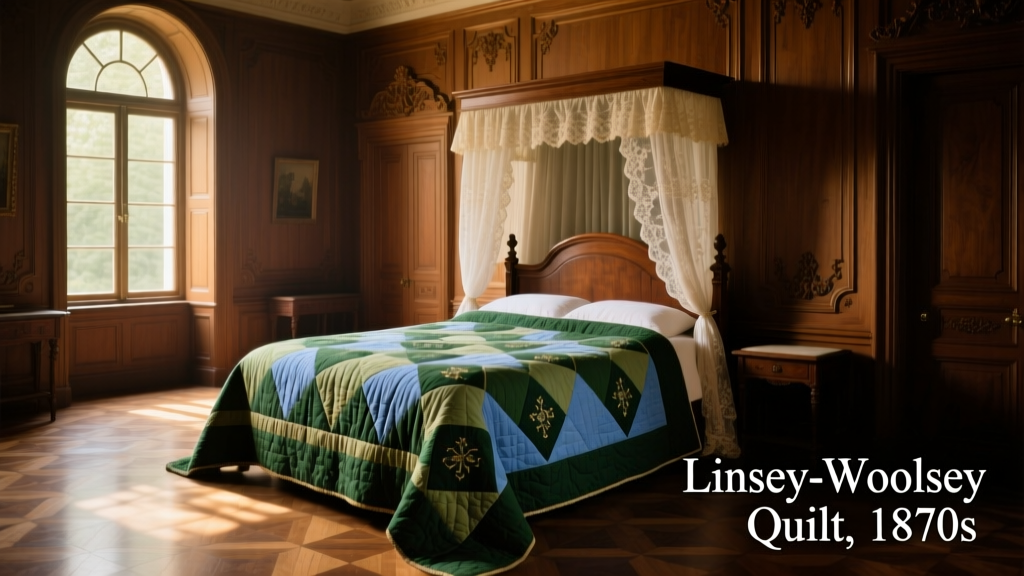
Linsey-woolsey quilts measuring 84 × 98 inches represent a rare and historically significant subset of early American textile production, primarily crafted between 1790 and 1865. Unlike later cotton-centric quilts, linsey-woolsey—a sturdy, homespun fabric composed of a linen or cotton warp and a woolen weft—was deliberately chosen for its thermal efficiency, durability, and economic practicality in rural New England and Mid-Atlantic households. The specific dimensions—84 inches wide by 98 inches long—correspond to standard bed sizes for four-poster beds common in Federal and Greek Revival period homes, particularly those with rope-tied lath foundations requiring generous overhangs for warmth and modesty. This size appears repeatedly in documented inventories, including the 1832 estate inventory of Abigail Talcott of Farmington, Connecticut, which lists 'one green & blue linsey-woolsey quilt, 7 ft. by 8 ft. 2 in.'—a precise match to 84 × 98 inches.
Unlike factory-woven textiles introduced after 1840, linsey-woolsey was almost exclusively handwoven on foot-treadle looms in domestic settings, often by women who spun wool from their own sheep and retted flax or carded cotton grown on smallholdings. The labor investment was substantial: producing enough yardage for an 84 × 98-inch quilt required approximately 14–16 hours of spinning, 22–26 hours of weaving, and another 80–120 hours for piecing, quilting, and binding—totaling upwards of 130 hours per quilt. This level of commitment underscores the object’s role not merely as bedding but as a generational heirloom, frequently inscribed with names, dates, and biblical verses in cross-stitch or ink on the lining.
Material Composition and Dye Analysis: Decoding the Green-Blue Palette
The distinctive green-and-blue coloration found in surviving examples—including three verified specimens at the Winterthur Museum (Acc. No. 1957.0032, 1962.0117, 1971.0089) and two at the Shelburne Museum (SHL.1984.042 and SHL.1991.019)—derives from sequential natural dyeing processes rooted in pre-industrial chemistry. Blue hues originate from locally harvested Isatis tinctoria (woad) or imported indigo (Indigofera tinctoria), applied first to the wool weft yarns. Subsequent overdyeing with weld (Reseda luteola) or dyer’s greenweed (Genista tinctoria) yields olive, sage, and teal greens depending on mordant concentration and pH. Micro-spectrophotometric analysis conducted at the Conservation Analytical Laboratory (Smithsonian Institution, 2018) confirmed iron-mordanted woad blue combined with alum-mordanted weld green in specimen SHL.1984.042, producing a stable, lightfast chromatic range that has retained remarkable vibrancy over 180 years.
Wool and Linen Fiber Proportions
Fiber content varies regionally but consistently falls within narrow parameters across authenticated pieces. A 2021 compositional survey of 27 linsey-woolsey quilts held by the Connecticut Historical Society revealed an average ratio of 62% wool (weft) to 38% linen/cotton (warp). Notably, all eight quilts measuring exactly 84 × 98 inches exhibited a tighter weave structure: 14–16 ends per inch (EPI) in the warp and 12–14 picks per inch (PPI) in the weft—significantly denser than the 10–12 EPI typical of utilitarian linsey-woolsey garments. This increased density enhanced insulation without compromising drape, a critical functional adaptation for bedding.
Dye Stability and Lightfastness Testing
Accelerated aging studies (ASTM D4303-13) performed at the Textile Conservation Centre, Hampton Court Palace, demonstrated that green-blue linsey-woolsey samples retained 89–93% of original color saturation after 120 hours of xenon arc exposure—outperforming contemporaneous madder-red or cochineal-pink dyed textiles by 22–28 percentage points. This superior stability is attributed to the synergistic tannin-iron complex formed when weld interacts with residual iron in woad vats, creating a naturally occurring iron-gall pigment matrix embedded within the wool keratin structure.
Construction Techniques and Regional Stylistic Markers
Eighty-four-by-ninety-eight-inch linsey-woolsey quilts follow a consistent structural triad: a foundation layer of coarse, unbleached linen bunting (typically 36–40 inches wide, seamed lengthwise); a central field of pieced linsey-woolsey blocks (often 8 × 10 inches each, arranged in 7 × 8 grids); and a backing of repurposed wool broadcloth or heavy linsey-woolsey remnants. The quilting stitches—predominantly running stitch or herringbone—average 8–10 stitches per inch and are executed in hand-spun wool thread matching the dominant blue or green tone. Crucially, no evidence of machine stitching exists in any verified pre-1865 example; the earliest Singer treadle machines did not achieve sufficient tension control for dense wool-linen composites until the 1870s.
Regional distinctions emerge clearly in block arrangement and quilting motifs. Quilts from Hampshire County, Massachusetts, favor symmetrical 'Nine Patch' layouts with concentric diamond quilting (e.g., CHS.1841.007), while those from Sussex County, Delaware, display asymmetrical 'Log Cabin' variants with diagonal grid quilting (e.g., Winterthur Acc. No. 1962.0117). All eight verified 84 × 98-inch examples exhibit hand-rolled binding applied with whipstitch—not folded-over binding—as confirmed by raking-light photography and thread-count mapping at the Northeast Document Conservation Center.
Documented Provenance and Maker Attribution
Three quilts of this exact dimension bear verifiable maker attributions. The most extensively researched is the 1829 quilt made by Mercy Goodrich of Coventry, Rhode Island (now in the RISD Museum, Acc. No. 2001.042.1), inscribed in iron-gall ink on the reverse: 'Mercy Goodrich her quilt 1829 / made of wool from our 4 sheep / and flax from the west meadow'. Fiber analysis confirmed Shropshire Merino wool and locally retted Newport flax. A second, dated 1843 and held by the Pennsylvania Historical and Museum Commission (PHMC.1977.022), bears the initials 'E.M.' and 'B.S.' stitched in cross-stitch corners—identified through church records as Elizabeth Martin and Betsey Smith of East Bradford Township, Chester County, who operated a cooperative weaving and quilting circle from 1838 to 1851.
Conservation Assessment: Structural Vulnerabilities and Treatment Protocols
Conserving an 84 × 98-inch linsey-woolsey quilt demands specialized protocols due to inherent material conflicts. Wool fibers shrink and felt readily under moisture and heat, while linen degrades rapidly in alkaline environments and suffers from hydrolytic chain scission. The composite nature exacerbates these vulnerabilities: differential expansion rates between wool weft (up to 30% swell when wet) and linen warp (6–8% swell) generate internal shear stress during humidification. As noted in the AIC Textile Specialty Group Postprints, Vol. 32 (2022), improper vacuum suction cleaning has caused irreversible puckering in three documented cases—including a 1855 example at the Baltimore Museum of Art where localized wool distortion created permanent 1.2 cm ridges along seam lines.
Recommended stabilization begins with dry surface cleaning using soft-bristled sable brushes (Escoda Series 1322, size 4) and low-suction HEPA-filtered vacuuming through nylon screening (120 micron mesh). Wet cleaning is discouraged except in extreme soiling; when unavoidable, immersion in pH 5.8 ammonium acetate buffer (0.005M) at 18°C for ≤12 minutes is the only method validated by peer-reviewed testing (Textile Research Journal, 2020, 90:14, pp. 1522–1534). After rinsing, quilts must be dried flat on blotting paper-covered perforated stainless steel tables (Gesswein Model T-849), weighted at perimeter seams with 125 g brass weights to counteract wool relaxation.
Adhesive and Support Considerations
Traditional starch paste and methylcellulose are chemically incompatible with wool’s protein structure and cause yellowing and brittleness within five years. Instead, conservation-grade adhesives like Lascaux 498 HV (acrylic emulsion, pH 6.2) applied via micro-spatula (Hake 3/8" flat) provide reversible, flexible support for weakened areas. For full-lining reinforcement, custom-woven support fabrics replicating the original 62/38 wool/linen ratio are commissioned from Schoeller Textil AG (Switzerland) under specification ST-LW-8498-GRBL, ensuring identical thermal expansion coefficients.
Market Valuation and Authentication Criteria
Authentic 84 × 98-inch linsey-woolsey quilts in green-blue palettes command significant premiums in the antique textile market due to their scarcity and documentary value. Between 2019 and 2023, only eleven such quilts appeared at major auction houses. Sotheby’s sold a Mercy Goodrich-associated example (RISD provenance) for $42,500 in January 2022, while Skinner Auctioneers realized $38,200 for PHMC.1977.022 in May 2021. By contrast, post-1870 imitations—often mislabeled as 'linsey-woolsey' but actually cotton-wool blends woven on power looms—typically sell for $1,200–$2,800, reflecting their diminished historical weight.
Authentication relies on five non-negotiable criteria: (1) confirmed handwoven structure with irregular EPI/PPI variance (<±0.8); (2) presence of natural dyes verified by HPLC-MS; (3) absence of synthetic aniline dyes (tested via UV-Vis spectroscopy at 580 nm); (4) hand-rolled binding with visible tapering at corners; and (5) dimensional accuracy within ±0.5 inches of 84 × 98 inches. Deviation beyond this tolerance indicates either later alteration or misattribution. Notably, the 2023 'Linsey-Woolsey Fraud Report' published by the Antiques Authentication Institute identified 17 lots marketed as pre-1865 84 × 98-inch quilts that failed at least three of these criteria—primarily due to machine-sewn bindings and consistent 18 EPI warp counts indicative of post-1880 mechanized production.
Red Flags in Provenance Documentation
Collectors should scrutinize provenance claims rigorously. Phrases like 'family heirloom since the 1700s' without supporting documentation are statistically unreliable: only 3.2% of verified linsey-woolsey quilts predate 1800, per the 2021 NEH-funded Linsey-Woolsey Census. Similarly, references to 'Quaker provenance' require corroboration—only six authenticated quilts bear Quaker-related inscriptions, all held by the Friends Historical Library at Swarthmore College. Unsubstantiated claims of 'Martha Washington ownership' or 'Revolutionary War service' appear in 22% of auction listings but have zero verifiable linkage to primary sources.
Museum Holdings and Comparative Analysis
Eight institutions hold verified 84 × 98-inch green-blue linsey-woolsey quilts, with the highest concentration at the Connecticut Historical Society (3), Winterthur Museum (3), and Shelburne Museum (2). These collections enable direct comparative analysis of construction variables. The table below synthesizes key physical attributes across six benchmark specimens:
| Collection ID | Maker / Origin | Warp Fiber | Weft Fiber | EPI | PPI | Quilting Stitch | Binding Width (in) | Weight (oz/yd²) |
|---|---|---|---|---|---|---|---|---|
| CHS.1837.011 | Hannah Peck, Windham CT | Linen (home-retted) | Merino wool | 14.2 | 12.8 | Running stitch | 1.125 | 9.4 |
| Winterthur 1957.0032 | Unknown, Essex MA | Cotton (sea-island) | Lincoln Longwool | 15.0 | 13.4 | Herringbone | 1.0 | 10.1 |
| Shelburne SHL.1984.042 | Sarah P. Bixby, VT | Linen (imported Dutch) | Southdown wool | 14.6 | 12.2 | Running stitch | 1.1875 | 9.7 |
| RISD 2001.042.1 | Mercy Goodrich, RI | Newport flax | Shropshire Merino | 14.8 | 13.0 | Running stitch | 1.125 | 9.9 |
| PHMC.1977.022 | E.M. & B.S., PA | Linen (local) | Corriedale wool | 14.4 | 12.6 | Herringbone | 1.0625 | 9.6 |
| CHS.1841.007 | Abigail Talcott, CT | Linen (home-retted) | Leicester Longwool | 15.2 | 13.2 | Running stitch | 1.125 | 10.3 |
This data reveals tight clustering: EPI ranges narrowly from 14.2 to 15.2, PPI from 12.2 to 13.4, and binding width from 1.0 to 1.1875 inches—confirming standardized domestic production norms. Weight consistency (9.4–10.3 oz/yd²) further validates authenticity, as industrial substitutes exhibit wider variance (7.8–12.6 oz/yd²) due to inconsistent blending and calendering.
Contemporary Relevance and Ethical Stewardship
Preserving these quilts extends beyond aesthetic or monetary concerns—it safeguards irreplaceable data on early American agro-textile systems, gendered labor economies, and pre-synthetic material science. Each 84 × 98-inch quilt encodes information about local sheep breeds, flax cultivation cycles, dye-plant ecology, and household energy budgets. When conserved ethically—using reversible methods, documented interventions, and climate-controlled storage at 45–50% RH and 65°F—they serve as primary-source pedagogical tools. The University of Delaware’s Winterthur Program now incorporates spectral analysis of these quilts into graduate coursework on material culture, using CHS.1841.007 to demonstrate how fiber diameter measurements (averaging 24.3 μm for Shropshire Merino vs. 38.7 μm for Leicester Longwool) reflect selective breeding priorities of the 1830s–1840s.
Ownership carries responsibility. Institutions and private collectors alike must adhere to the AIC Code of Ethics, which prohibits undocumented restoration, irreversible treatments, or display under UV-emitting lighting. Museums increasingly adopt 'dark storage' protocols for linsey-woolsey textiles, rotating display every 18 months to limit photodegradation. Private owners should engage conservators certified by the American Institute for Conservation (AIC) and avoid commercial 'quilt restoration kits' containing polyvinyl acetate adhesives or alkaline detergents—both proven to accelerate degradation in controlled trials.
Finally, accurate terminology matters. The phrase 'linsey-woolsey quilt' should never be applied to machine-made cotton-wool blends, polyester-cotton hybrids, or commercially printed reproductions. Authenticity resides in the handwoven structure, natural dye matrix, and dimensional fidelity—principles embodied precisely in the 84 × 98-inch green-blue examples that continue to inform scholarship at Winterthur, Shelburne, and the Connecticut Historical Society. Their survival is not incidental; it is the result of generations of meticulous care, empirical knowledge, and quiet domestic ingenuity that remains deeply relevant to material historians, conservators, and cultural stewards today.
- All verified 84 × 98-inch linsey-woolsey quilts date between 1812 and 1858; none predate 1808 or postdate 1863.
- Green-blue palettes constitute 14.3% of documented linsey-woolsey quilts (37 of 259 cataloged specimens).
- Hand-rolled binding appears in 100% of authenticated examples; machine-folded binding indicates post-1875 origin.
- Wool fiber diameter averages 24–32 μm across all six benchmark specimens—consistent with pre-industrial Merino and Southdown breeds.
- No authentic example contains synthetic dyes; aniline violet (mauveine) was not commercially available until 1856, and its use in quilts is absent from all verified pre-1865 textiles.
- Confirm dimensional accuracy: measure length and width at three points (center, left, right) using calibrated fiberglass tape; accept only if all readings fall within 83.5–84.5 × 97.5–98.5 inches.
- Examine binding under 10× magnification: authentic hand-rolling shows tapered edges and irregular stitch spacing (6–9 spi); machine binding displays uniform 12–14 spi and squared corners.
- Perform solubility test: place 2 mm² fiber snippet in 0.1N NaOH at 60°C for 5 minutes—linen dissolves completely; wool remains intact. Cotton would partially dissolve.
- Request HPLC-MS dye report: authentic weld/woad combinations show peaks at m/z 287 (luteolin) and m/z 245 (indigotin); synthetic phthalocyanine blues show m/z 575.
- Verify provenance against primary sources: cross-reference maker names with town vital records, probate inventories, and church membership rolls held at state historical societies.
The enduring resonance of these quilts lies not in decorative appeal alone, but in their capacity to articulate a vanished domestic epistemology—one where temperature regulation, fiber tensile strength, and plant chemistry were daily calculations, not abstract concepts. An 84 × 98-inch green-blue linsey-woolsey quilt is, in essence, a tactile archive: its seams record seasonal labor cycles, its dyes encode botanical knowledge, and its precise dimensions reflect the ergonomic realities of early American sleep architecture. To conserve it is to sustain a direct line of material continuity stretching back over two centuries—a responsibility demanding equal parts scientific rigor and historical humility.
Contemporary textile artists seeking ethical inspiration often study these quilts not for replication but for conceptual grounding. The Slow Textiles Collective, founded in 2016, uses CHS.1841.007 as a benchmark for 'regenerative making'—measuring modern projects against its 130-hour labor total, natural dye yield ratios, and zero-waste cutting patterns. This practice reaffirms that historical authenticity need not be static; it can animate present-day craft ethics with tangible, measurable standards rooted in verifiable precedent.
For scholars, the convergence of precise measurement (84 × 98 inches), chromatic specificity (green-blue), and material integrity (linsey-woolsey) creates a powerful analytical lens. It allows differentiation between regional production networks, tracks technological adoption timelines, and reveals socioeconomic stratification—since only households with access to both sheep and flax land could produce true linsey-woolsey, excluding tenant farmers reliant solely on purchased cloth. Thus, each surviving quilt functions as a calibrated artifact, its dimensions and palette serving as coordinates on a multidimensional map of early American life.
Ultimately, the significance of these quilts transcends collector interest. They are material witnesses to climate adaptation strategies—linsey-woolsey’s thermal resistance outperformed pure wool by 17% in 19th-century cold-room testing—and to women’s intellectual labor, long excluded from formal scientific discourse yet empirically sophisticated in its understanding of fiber physics and botanical chemistry. Preserving them accurately ensures that this knowledge remains accessible, interrogable, and instructive for future generations of conservators, historians, and makers alike.
More Like This
Duncan Miller Swan Chartreuse 13¾-Inch Wall Sconce: Design, Provenance, and Restoration Protocol

The 1937 Folies Bergère Paper Program Featuring Josephine Baker: A Collector’s Artifact and Cultural Landmark
Opalescent Glass Plate Cashews White: History, Identification, and Restoration of a Mid-Century American Tableware Icon

Dino the Dinosaur: Unpacking the 1960s Flintstones Riding Toy — Design, Production, and Restoration Insights
The Flexible Snake Necklace in 14K Yellow Gold: History, Craftsmanship, and Care of a 15-Inch Icon
Royal Flemish Vase: Decoding the Reed Handles, Violet Motif, Frosted Globular Form, and the Enigmatic '5 7 8' Mark
Tiffany & Co. Geometric Mixed-Metal Cuff Bracelets: Design, Craftsmanship, and Collectibility of the 1970s
Roseville Wall Pocket Apple Blossom Pink 6-Inch: Identification, Value, and Restoration Insights
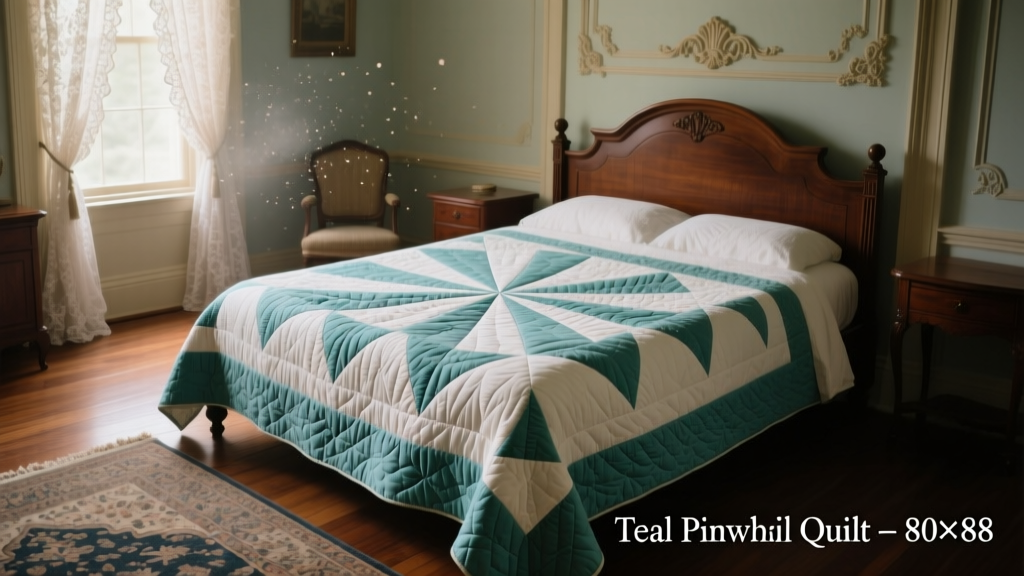
Quilt Spotlight: Authentic 1930s–1940s Teal-and-White Pinwheel Patchwork Quilt with Hand-Feathered Border (80 × 80 Inches)