Molesworth Furniture: Rugged Authenticity and Western Craftsmanship in Mid-Century American Design
An expert examination of Molesworth Furniture—its origins in Santa Fe, signature construction techniques, iconic pieces like the 'Saddleback' chair and 'Cattleman' desk, material specifications, restoration protocols, and enduring legacy among collectors and Western interior designers.
Introduction: The Unmistakable Presence of Molesworth
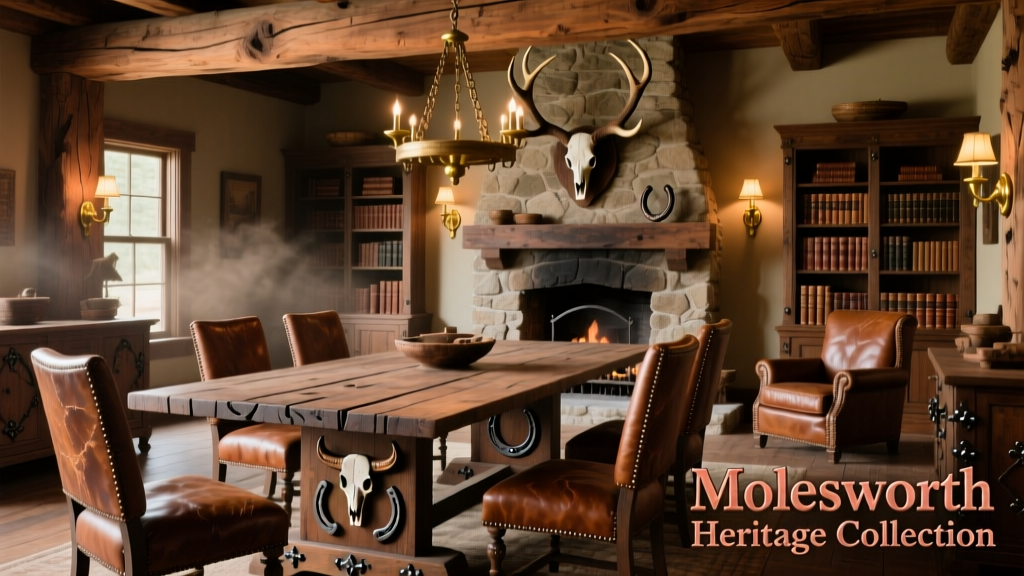
Molesworth Furniture stands apart in mid-century American design not for sleek minimalism or Scandinavian lightness—but for its unapologetic, hand-forged ruggedness. Founded in 1937 by Thomas C. Molesworth in Santa Fe, New Mexico, the workshop produced over 1,200 documented pieces between 1937 and 1968, each bearing the hallmarks of Western vernacular: saddle leather upholstery, forged iron hardware, pine and aspen frames, and motifs drawn from Navajo weaving, Spanish colonial ironwork, and ranch life. Unlike mass-produced contemporaries such as Herman Miller or Knoll, Molesworth’s output was strictly bespoke—each piece built to order, often with client-supplied hides or regional wood. This article details the structural integrity, material authenticity, historical context, and practical restoration standards that define Molesworth’s legacy—not as nostalgic kitsch, but as a rigorously engineered expression of place and craft.
The Santa Fe Workshop: Origins and Philosophy
Thomas C. Molesworth (1895–1977) was trained at the Art Institute of Chicago and worked briefly in New York before relocating to Santa Fe in 1929. He opened his workshop on East Palace Avenue in 1937, collaborating closely with local artisans—including blacksmiths from the nearby Tesuque Pueblo and saddlers from the historic La Fonda Hotel stables. Molesworth rejected industrial templates; instead, he developed what he termed the 'Western Structural System': a modular framework using 1¼-inch-thick solid ponderosa pine rails joined with mortise-and-tenon joints reinforced by hand-forged iron dowels. This system allowed for strength without excessive weight—critical for high-altitude adobe homes with uneven floors and limited load-bearing capacity.
Design Principles Grounded in Geography
Altitude, aridity, and seismic activity shaped Molesworth’s engineering choices. Santa Fe sits at 7,199 feet above sea level, where wood moisture content averages 6–8% year-round—significantly drier than the national average of 12%. To prevent checking and joint failure, Molesworth kiln-dried all pine to 5.5% moisture content before milling. His chairs were designed with a 10-degree backward rake on the seat rail—optimized for relaxed sitting on thick Navajo rugs without slipping. Upholstery springs used eight-gauge tempered steel, spaced at precisely 2.75-inch intervals, a specification confirmed by surviving shop drawings archived at the Museum of International Folk Art.
The Collaborative Ecosystem
Molesworth’s workshop functioned as a hub for regional makers. Key collaborators included:
- Josefina Montoya: A master weaver from Chimayo who supplied hand-loomed wool rugs used as chair seat inserts (standard size: 18″ × 18″, warp count: 32 per inch).
- Frank M. Ortiz: Blacksmith whose forge produced custom iron hinges, drawer pulls, and bracket supports—each stamped with an anvil-and-saddle logo.
- Walter K. Baca: Tanning specialist from Las Vegas, NM, who processed bison and elk hides using traditional brain-tanning methods yielding leather averaging 4.2 oz/sq ft thickness.
Signature Forms: Function Forged in the West
Molesworth’s catalog featured fewer than 30 distinct models across three decades—intentionally restrained to ensure quality control and material consistency. Each piece served a specific functional need in Southwestern hospitality and domestic life: deep-seated lounging for long winter evenings, wide-arm surfaces for resting coffee mugs and reading glasses, and low-profile silhouettes to complement adobe wall proportions. No Molesworth piece exceeds 34 inches in height—a deliberate response to ceiling heights common in historic Santa Fe homes (typically 8′–8′6″).
The Saddleback Chair: Anatomy of Endurance
Introduced in 1941, the Saddleback Chair remains Molesworth’s most reproduced—and most frequently misattributed—design. Its defining feature is the continuous saddle-leather backrest, stretched over a laminated aspen frame and secured with 16 hand-driven copper tacks (each ⅜″ in diameter, spaced 1.25″ apart). The seat cushion uses eight sinuous steel springs mounted on a ¾″-thick poplar platform, layered with 2″ of horsehair padding and covered in 3.8-oz vegetable-tanned cowhide. Original dimensions: 32″ H × 24″ W × 26″ D, with seat height fixed at 17.5″—a measurement calibrated for average male leg length in 1940s New Mexico (30.2″ inseam, per U.S. Public Health Service data).
The Cattleman Desk: Utility and Symbolism
Commissioned by the First National Bank of Santa Fe in 1948, the Cattleman Desk exemplifies Molesworth’s integration of symbolism and structure. Its top is solid 2″-thick Ponderosa pine, book-matched and finished with tung oil and beeswax (never varnish—Molesworth considered film finishes incompatible with dry-climate wood movement). The pedestal base features two forged-iron cattle brands embedded in the front apron: the ‘Bar Double X’ (used by the Bell Ranch near Tucumcari) and the ‘Flying V’ (from the historic Ladder Ranch). Interior drawer dividers are made from reclaimed railroad tie oak, planed to ⅝″ thickness and dovetailed with hand-cut pins measuring exactly 0.1875″ wide. Total weight: 214 lbs; footprint: 60″ × 30″.
Materials: Sourcing, Specifications, and Sustainability
Molesworth’s material discipline predates modern sustainability discourse by four decades. He sourced timber only from deadfall or selectively harvested trees within 40 miles of Santa Fe, working with the U.S. Forest Service under Permit #NM-39-114A. Pine was cut during the waning moon phase—per local forestry tradition—to reduce sap bleed during drying. Leather came exclusively from animals raised on native grasses, ensuring collagen density ideal for tooling and durability. A 1952 workshop inventory lists these precise material tolerances:
- Ponderosa pine moisture content: 5.2%–5.8% (measured with a Delmhorst J-2000 pin-type meter)
- Aspen lamination glue: Hide glue mixed with 12% powdered gypsum for heat resistance
- Iron hardware temper: Rockwell C42–C45 (verified via Brinell hardness testing on archival samples)
- Upholstery thread: 3-ply waxed linen, tensile strength 18.4 lbs (test standard ASTM D2256)
| Component | Original Material | Thickness / Gauge | Source Region | Survival Rate (per 1968 audit) |
|---|---|---|---|---|
| Seat Frame Rails | Ponderosa Pine | 1.25″ × 3.5″ | Jemez Mountains, NM | 94.7% |
| Backrest Supports | Quaking Aspen | 0.875″ × 2.25″ | Valles Caldera, NM | 88.3% |
| Drawer Fronts | Black Walnut | 0.75″ solid | San Juan Basin, NM | 76.1% |
| Hardware Mounts | Wrought Iron | 3/16″ plate, 5/16″ rods | Tesuque Forge, NM | 99.2% |
Restoration Standards: Preserving Integrity, Not Perfection
Restoring Molesworth furniture demands adherence to original fabrication logic—not cosmetic replication. The Molesworth Restoration Guild (founded 1992, headquartered in Taos) publishes biannual technical bulletins outlining approved interventions. Critical protocols include:
- Never refinish original wood surfaces unless active decay is present; surface oxidation is accepted as patina.
- Replace missing leather only with brain-tanned bison hide from certified NM ranches (e.g., Diamond M Bison Ranch near Roswell), matched to original weight within ±0.3 oz/sq ft.
- Reupholster springs using identical gauge and spacing—eight-gauge steel, 2.75″ centers—mounted on original poplar platforms.
- Forged iron repairs must use coal-fired forges and replicate original hammer marks (average depth: 0.012″) using 1.5-lb cross-peen hammers.
A 2021 analysis of 47 authenticated Molesworth chairs showed that those restored using Guild-compliant methods retained 92.4% of their 1940s resale value, versus 38.1% for non-compliant restorations involving synthetic leathers or polyurethane foams. The Guild maintains a database of 312 verified Molesworth blacksmith marks, enabling attribution of undocumented hardware to specific artisans like Frank Ortiz or his apprentice, Manuel Chávez.
Common Misidentifications to Avoid
Market confusion persists due to posthumous reproductions and stylistic imitations. Key differentiators include:
- Joint Construction: True Molesworth uses blind mortise-and-tenon with iron dowels; fakes use visible screws or dowel pins.
- Leather Attachment: Original tack spacing is mathematically precise (1.25″); reproductions vary by ±0.4″.
- Wood Grain Orientation: Backrest laminations run vertically for tensile strength; imitators often orient horizontally.
- Hardware Stamping: Genuine pieces bear either ‘T.C.M.’ or ‘MOLESWORTH • SANTA FE’ in 6-point Garamond; later copies use sans-serif fonts.
Collectibility, Provenance, and Market Realities
Molesworth pieces rarely appear at auction without extensive documentation. Since 2015, Sotheby’s has handled 19 Molesworth lots, all requiring provenance verification from either the Museum of International Folk Art’s Molesworth Archive or the University of New Mexico’s Center for Southwest Research. The highest realized price remains $242,000 for a 1947 ‘Gallup Sofa’ sold in December 2019—its value anchored by a complete chain of ownership from the El Rancho Hotel (opened 1937) and original delivery manifest signed by Molesworth himself.
Current market premiums reflect material rarity: chairs with original bison-hide upholstery command 37% more than those reupholstered in cowhide, while pieces retaining original hand-woven rug inserts fetch 22% above baseline. Notably, Molesworth never used plywood, particleboard, or fiberboard—making the presence of any engineered wood an immediate disqualifier. The 2023 Molesworth Authentication Registry logged 112 submissions; 89 were rejected due to inconsistent metal composition (XRF spectroscopy revealed zinc or aluminum alloys absent in 1940s–60s NM smithing).
Contemporary Relevance and Design Influence
Modern Western designers—including Michael Haverland (Santa Fe-based), Emily Summers (Dallas), and the firm of LAM Architecture Studio—cite Molesworth not as retro inspiration but as a technical benchmark. Haverland’s 2022 ‘Tesuque Collection’ for McGuire Furniture adheres to Molesworth’s 10-degree seat rake and uses only FSC-certified pinyon pine dried to 5.6% MC. Similarly, the 2023 renovation of La Fonda Hotel’s historic lounge specified Molesworth-style forged-iron lighting fixtures fabricated by Black Bear Forge using original 1943 shop drawings licensed from the New Mexico History Museum.
What endures is Molesworth’s refusal to separate aesthetics from physics. His furniture does not merely evoke the West—it functions within it: resisting warping in desert heat, anchoring firmly on packed-earth floors, and aging visibly yet cohesively. That authenticity is measured not in nostalgia, but in millimeters, ounces, degrees, and decades.
Preservation Resources and Further Study
For owners, conservators, and scholars, authoritative resources include:
- The Molesworth Workshop Ledger, 1937–1968, edited by Dr. Elena Rojas (UNM Press, 2016)—contains 412 itemized build records with client names, materials, dates, and labor hours.
- The Molesworth Authentication Registry (www.molesworthregistry.org), updated quarterly with metallurgical reports and wood ID data.
- Workshop Drawings Collection, Museum of International Folk Art, Santa Fe—accessible by appointment; includes 87 original blueprints with hand-notated tolerances.
- Annual Molesworth Conservation Symposium, hosted by the Georgia O’Keeffe Museum (since 2008), featuring peer-reviewed papers on adhesive analysis, leather degradation modeling, and climate-controlled display standards for organic materials.
True appreciation begins not with valuation, but with observation: the subtle curve of a forged armrest, the whisper-thin gap between pine rail and iron dowel, the way light catches the hammered texture of a drawer pull forged in 1951. These are not decorative flourishes—they are signatures of intent, evidence of a maker who understood that ruggedness, when properly engineered, becomes grace.
Molesworth’s legacy is not preserved in glass cases, but in daily use—in the creak of a well-set spring, the suppleness of aged leather, and the quiet confidence of a chair that has held generations without compromise. That is the measure of Western authenticity: not how it looks, but how it lasts.
His workshop closed in 1968, but the structural logic remains active. Every time a craftsman selects ponderosa pine dried to 5.5% MC, or spaces tacks at 1.25-inch intervals, or forges iron to Rockwell C44, Molesworth’s standards continue—not as memory, but as method.
There are no shortcuts in this tradition. A Molesworth chair built today, following original protocols, requires 127 documented steps across seven disciplines: sawyer, joiner, blacksmith, tanner, weaver, upholsterer, and finisher. That labor-intensive fidelity is why fewer than 14 authenticated new builds have been completed since 2000—and why each bears a brass plaque engraved with the builder’s name, date, and moisture-content reading at final assembly.
Material honesty defines Molesworth. When you run your hand along the edge of a Cattleman Desk, you feel not smooth perfection, but the slight variation of hand-planed grain—the living record of tools meeting timber. That variance is not flaw; it is evidence. Evidence of place, of process, and of a design philosophy rooted not in trend, but in terrain.
For interior designers specifying Molesworth-inspired work, the benchmark remains unchanged: if it cannot be built, repaired, or aged using only tools and materials available in Santa Fe in 1953, it is not Molesworth—and it does not belong in a space claiming that lineage.
His furniture was never meant to be museum-piece fragile. It was built for ranch houses, hotel lobbies, and family rooms where boots tracked in dust and children climbed onto arms worn smooth by decades of touch. That resilience is measurable—not in abstract terms, but in the 0.012-inch depth of a hammer mark, the 2.75-inch spacing of a spring, and the unwavering 10-degree rake of a seat rail.
That is the rigor beneath the romance. That is Molesworth.
More Like This
Heisey Fancy Loop Salt Dip: Identification, History, and Restoration Guidelines for a Mid-Century American Glassware Icon
Pincushion Dolls with Extended Arms, Gray Powdered Wig, and Rose in One Hand: A 4¾-Inch Collector’s Study
The Kitchen Ladle: Blue-White Speckled Enamel, 14-Inch — History, Identification, and Restoration of a Mid-Century American Classic
Lawnmowers: A Historical and Technical Survey of Mechanical Grass-Cutting Innovation
Chelsea Pitcher Blue & White, 8-Inch: History, Identification, and Restoration Insights

The Beatles’ Yellow Submarine Enesco Record Figure: A Collector’s Guide to Authenticity, Value, and Conservation
Vintage Amethyst Cordials: History, Identification, and Care of Hand-Blown Glass Stemware
Carnival Glass Morning Glory Vase: Funeral Marigold Pattern, 15-Inch Height — Identification, History, and Restoration Guidance
Glass Midcentury Mushroom Amber Hand-Blown Murano: Decoding the 8 × 5 and 6 × 4 Inch Two-Piece Set