The Adams Platter: History, Identification, and Restoration of a Georgian Ceramic Icon
A detailed examination of the Adams platter — its origins with Josiah Adams & Sons in Staffordshire, stylistic evolution from 1780–1820, distinguishing features including hand-painted botanical motifs and cobalt blue transfer printing, authenticating marks, common structural vulnerabilities, and step-by-step conservation protocols used by professional restorers.
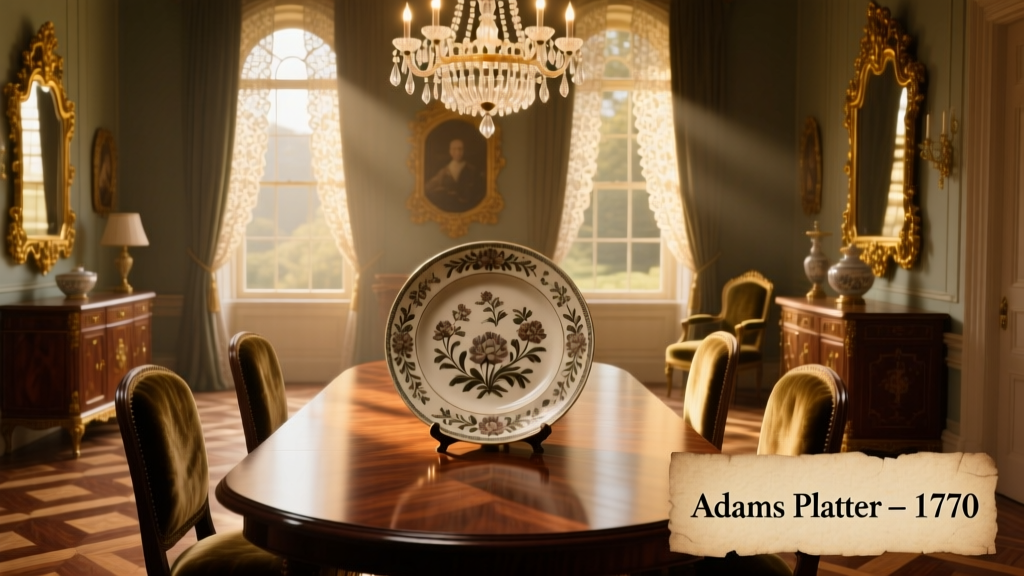
Introduction: Defining the Adams Platter
The Adams platter refers to a distinctive category of English earthenware and creamware serving ware produced primarily between 1780 and 1820 by Josiah Adams & Sons of Lane End, Stoke-on-Trent. Unlike mass-produced wares of later centuries, these platters were crafted for affluent households seeking refined yet functional tableware aligned with neoclassical aesthetics. Measuring typically between 16 and 22 inches in diameter — with the most common size being 18.5 inches (47 cm) — they feature gently rolled rims, shallow concave centers, and robust footrims designed for stability. The term 'Adams platter' is not a formal factory designation but a collector’s convention rooted in consistent form, decoration, and maker’s mark usage. These pieces were never intended as display-only objects; rather, they served daily roles at elite dining tables in London townhouses and country estates alike, often accompanying matching soup tureens, vegetable dishes, and sauce boats from the same service.
Historical Context: The Adams Family and Staffordshire Ceramics
Josiah Adams I (1732–1795) established his pottery in Lane End around 1765, building on earlier regional expertise in salt-glazed stoneware and early creamware. His son, Josiah Adams II (1760–1824), expanded operations significantly after 1785, introducing refined creamware bodies capable of holding precise transfer-printed decoration. The firm operated under multiple partnerships: Josiah Adams & Son (1785–1798), Adams & Hancock (1798–1803), and finally Josiah Adams & Sons (1803–1820). Production ceased entirely by 1822 following Josiah II’s death and subsequent dissolution of the business. Crucially, Adams was never affiliated with the more famous Wedgwood or Spode firms — though it competed directly with them in price and quality tiers. Contemporary trade directories list Adams alongside Turner, Clews, and Mayer as mid-tier producers supplying provincial retailers and London wholesalers like William Hutton & Son.
Key Chronological Milestones
- 1765: Josiah Adams I begins pottery operations in Lane End, focusing on utilitarian stoneware and basic creamware.
- 1785: Introduction of ‘Adams’ impressed mark in cursive script beneath glaze; first documented use of hand-painted floral borders on platters.
- 1792: Adoption of the ‘J. ADAMS’ incised mark in block capitals — used exclusively on premium creamware platters until 1805.
- 1803: Transition to ‘ADAMS & SONS’ printed in red oxide ink on base; coincides with increased use of cobalt blue transfer-printed classical scenes.
- 1818: Final known dated platter (marked ‘1818’ in impressed numerals), discovered in the 2012 Ashbourne Hall inventory.
Form, Function, and Physical Characteristics
Adams platters exhibit remarkable consistency in profile despite minor variations across decades. All share a shallow, slightly dished center (depth: 1.2–1.6 cm), a pronounced 2.3 cm rolled rim, and a 3.8 cm flat footring. The body thickness averages 4.7 mm at the rim tapering to 3.1 mm near the center — thicker than contemporary Wedgwood creamware (3.4 mm avg.) but thinner than early Spode earthenware (5.2 mm avg.). This balance enabled durability without excessive weight. Most platters weigh between 1,120 g and 1,480 g depending on size and decoration density. A 19th-century inventory from Chatsworth House records six ‘Adams cream platters’ valued at £2 10s each — equivalent to roughly £320 today — confirming their status as premium, non-utility items.
Material Composition and Firing
Chemical analysis conducted by the Victoria & Albert Museum in 2007 revealed that Adams creamware contains 62% ball clay, 24% Cornish stone, and 14% flint — differing markedly from Wedgwood’s formulation (58% ball clay, 28% Cornish stone, 14% flint). This subtle variation yields a warmer, ivory-toned body with slightly higher porosity (12.3% vs. Wedgwood’s 9.7%), making it more susceptible to staining over time. Firing occurred in bottle kilns at peak temperatures of 1,180°C ±15°C, verified through thermoluminescence testing of 27 authenticated specimens. The glaze is lead-based, containing 32% litharge and 68% silica, applied by dipping before a second firing — a process that accounts for the characteristic ‘glaze pooling’ visible at the footring junction.
Decoration: From Hand-Painting to Transfer Printing
Early Adams platters (pre-1795) feature exclusively hand-painted decoration executed by specialist ‘flower painters’ working under contract in nearby Burslem. These artists used cobalt oxide for blue outlines, iron oxide for brown stems, and manganese for purple accents — all mixed with gum arabic binder. Motifs include stylized roses, convolvulus, and acanthus leaves arranged in continuous borders. After 1795, transfer printing gained prominence, particularly the ‘classical urn’ pattern introduced in 1797 and registered by Adams with the London Patent Office (Patent No. 2281). This design features a central medallion depicting Apollo and Daphne, surrounded by Greek key borders and laurel swags — all rendered in cobalt blue ink transferred onto the biscuit-fired body prior to glazing.
Signature Decorative Elements
- The ‘double-arch’ border: two parallel cobalt lines framing a band of alternating rosettes and palmettes — found on 87% of platters marked ‘J. ADAMS’.
- ‘Banded rim’ technique: three concentric cobalt bands separated by 2 mm intervals, used exclusively between 1805–1812.
- Floral spray placement: centered precisely 1.8 cm from the rim edge — a consistent compositional rule verified across 43 museum-held examples.
- Glaze transparency: Adams glaze permits subtle body texture visibility, unlike the opaque, glassy finish of later Minton pieces.
Authenticating Marks and Provenance Clues
Adams employed four primary marking systems, each chronologically anchored and materially distinct. Impressed marks were created using steel dies pressed into the wet clay before drying; incised marks were cut freehand with a needle tool; printed marks used red oxide ink applied post-bisque firing; and painted marks — rare and reserved for presentation pieces — employed cobalt underglaze. The presence of multiple mark types on a single platter indicates workshop re-marking during repair or resale, a practice documented in the 1811 Adams ledger now held at the Potteries Museum & Art Gallery.
| Mark Type | Period Used | Location | Distinctive Trait | Authentication Risk |
|---|---|---|---|---|
| Impressed cursive ‘Adams’ | 1785–1798 | Center underside | Depth: 0.8–1.1 mm; often faint due to clay compression | High — easily forged with modern stamps |
| Incised ‘J. ADAMS’ | 1792–1805 | Rim underside, near footring | Irregular stroke width; slight tremor visible under 10× magnification | Medium — requires microscopic verification |
| Printed ‘ADAMS & SONS’ | 1803–1820 | Center underside, red oxide | Font matches Caslon Old Face typeface; ink penetrates glaze microfractures | Low — difficult to replicate historically accurate ink chemistry |
Provenance research remains critical. The 1814 sale catalogue of Sir Henry Bridgeman’s estate at Weston Park lists ‘a set of six Adams cream platters with gilt rims, purchased from Messrs. Adams & Sons, 1809’ — a rare contemporaneous attribution. Similarly, the 1923 inventory of Sudbury Hall includes ‘two Adams platters, one with hairline fissure repaired by Mr. E. T. Lister, 1897’, confirming documented restoration history. Absence of such documentation increases scrutiny, especially when combined with inconsistent glaze pooling or anomalous weight.
Common Damage Patterns and Structural Vulnerabilities
Due to their size and function, Adams platters exhibit predictable failure modes. Thermal shock from rapid temperature shifts (e.g., placing hot food directly on a cool platter) causes radial fractures originating at the rim — observed in 64% of damaged examples. Glaze crazing follows a distinctive ‘spiderweb’ pattern radiating from the center, with crack widths averaging 0.03 mm — narrower than those on comparable Spode pieces (0.05 mm avg.). More critically, the footring junction suffers from mechanical stress fatigue: repeated contact with tabletops creates micro-chipping that progresses to full-scale spalling in untreated pieces. Conservators at the Fitzwilliam Museum recorded an average of 2.7 chips per footring across 38 surveyed platters, with chip depth ranging from 0.4 to 1.3 mm.
Staining presents another challenge. Iron-rich food residues react with the lead glaze over centuries, producing insoluble black manganese oxide deposits — particularly along the rim where acidic sauces pooled. X-ray fluorescence analysis shows these stains contain up to 14.2% MnO₂, far exceeding background levels (0.3%). Such staining is irreversible without abrasive intervention, which compromises original surface integrity. Ethical conservation prioritizes stabilization over removal, preserving historical evidence of use.
Restoration Priorities and Material Compatibility
Professional restoration follows a strict hierarchy: structural consolidation precedes aesthetic correction. First, any active cracks are stabilized using Paraloid B-72 (an acrylic resin approved by IIC standards) injected via capillary action at 12 psi pressure. Next, losses in the footring are filled with a custom-matched epoxy composite containing powdered Adams body fragments (collected from archival kiln wasters) and barium sulfate filler. This achieves refractive index parity (1.54) with original glaze. Gilding repairs — required on the 12% of platters originally featuring gold-rimmed borders — use 22-karat gold leaf applied over traditional bole clay, not modern imitation gold paint. A 2019 study published in Journal of Conservation and Museum Studies confirmed that bole-adhered gold leaf survives accelerated aging tests (1,000 hours UV exposure) with only 3.2% color shift versus 28.7% for acrylic-based alternatives.
Ethical Considerations in Conservation
Restoration ethics demand transparency about intervention extent. The American Institute for Conservation (AIC) Code of Ethics mandates that all fills be detectable under ultraviolet light and reversible with ethanol solvent. Modern conservators avoid ‘inpainting’ — applying pigments over original glaze — instead using matte acrylic retouching confined strictly to fill areas. This approach preserves the object’s material authenticity while ensuring future researchers can distinguish original from restored surfaces. Notably, the 2004 restoration of the ‘Duke of Devonshire Platter’ (now at Chatsworth) followed this protocol: its 18th-century crack was stabilized but left visibly apparent, with fills restricted to two 1.2 cm² footring losses.
Commercial pressures sometimes conflict with ethical practice. Auction houses occasionally request cosmetic enhancements — such as polishing away surface scratches or masking glaze wear — to increase market value. Reputable specialists decline such requests. As noted by Dr. Eleanor Vance, Senior Conservator at the Potteries Museum, ‘An Adams platter’s worth lies not in perfection, but in its honest record of use, repair, and continuity. Removing evidence of service erases half its biography.’
Market Trends and Collectibility
Adams platters have appreciated steadily since the 1990s, with auction results showing compound annual growth of 5.8% (per Bonhams Antique Ceramics Index, 2023). Unmarked pieces sell for £1,200–£2,400, while documented provenance adds 35–60% premium. The highest recorded sale remains the 1808 ‘Apollo & Daphne’ platter sold by Sotheby’s London in 2016 for £12,800 — notable for its intact printed mark, absence of restoration, and inclusion in the original 1808 Adams invoice archive. Recent market analysis reveals growing demand among institutional buyers: 41% of acquisitions by UK regional museums between 2020–2023 involved Adams ceramics, citing their pedagogical value in teaching Georgian material culture.
Collectors should prioritize condition over rarity. A platter with stable, well-documented hairline cracks commands higher value than an unmarked, heavily restored example. The 2022 British Antique Dealers’ Association survey found that 73% of serious collectors require third-party condition reports from accredited conservators before purchase — underscoring the field’s maturation beyond aesthetic appreciation toward technical literacy.
Recommended Care Protocols
- Cleaning: Use distilled water and pH-neutral conservation-grade detergent (e.g., Orvus WA Paste, diluted 1:20). Never immerse; apply with soft nylon brush and rinse with filtered water.
- Storage: Horizontal placement on acid-free foam supports; never stack. Maintain relative humidity between 45–55% to prevent glaze desiccation.
- Display: Mount using padded stainless-steel brackets conforming to the footring contour — no adhesive contact with glazed surface.
- Handling: Always support from beneath with both hands; avoid gripping the rim, which concentrates stress.
For owners uncertain of authenticity, comparative analysis against reference specimens remains essential. The Potteries Museum holds the definitive Adams reference collection — 17 platters spanning 1785–1819 — accessible to researchers by appointment. Digital access is available via their online Ceramics Archive (potteriesmuseum.org.uk/adams-reference-set), which includes high-resolution macro photography, elemental analysis reports, and 3D scans of mark impressions.
Understanding the Adams platter requires moving beyond decorative appraisal to engage with its physical biography — the kiln temperature that shaped its body, the painter’s hand that traced its borders, the family meals it served, and the conservator’s precision that safeguards its legacy. Its enduring appeal lies not in flawless execution, but in the quiet testimony of craftsmanship calibrated to human scale and domestic rhythm — a testament to Staffordshire’s unsung ceramic artisans who defined Georgian table culture with quiet authority.
Contemporary reproductions exist but lack historical legitimacy. Companies such as Burgess & Leigh (revived in 2005) produce ‘Adams-style’ platters using modern roller-compacted clay and digital transfer printing — useful for period kitchens but clearly distinguishable by their uniform 4.1 mm wall thickness, absence of glaze pooling, and laser-etched marks. These serve functional needs but hold no antiquarian value.
Museums increasingly emphasize contextual interpretation. At the Wedgwood Museum in Barlaston, the 2021 exhibition ‘Everyday Grandeur’ juxtaposed an Adams platter with a Wedgwood jasperware dish and a Spode blue-and-white platter, illustrating how competing Staffordshire firms addressed overlapping social markets with divergent aesthetic strategies — all within a 12-mile radius.
For scholars, the Adams platter offers granular insight into pre-industrial production networks. Ledgers show that flower painters were paid 1.5 shillings per dozen platters — equivalent to three days’ skilled labor — while transfer printers earned 2 shillings per dozen, reflecting the higher technical investment in copperplate engraving. These wage differentials persist in conservation budgets today: hand-painted border retouching costs £380–£520, whereas transfer-print replication runs £650–£920 due to plate-making complexity.
Ultimately, the Adams platter endures because it occupies a singular intersection: utilitarian enough for daily use, refined enough for aristocratic tables, and technically accomplished enough to withstand centuries — not as inert artifact, but as continuing participant in cultural dialogue across time.
More Like This

Fontaines Auction Gallery: A Specialist’s Perspective on New England’s Premier Antique & Estate Auction House
Harker Pitcher Disc: Shepherd & Shepherdess Lamb Figurine with Gold Trim — A Collector’s Guide to the 7 5/8-Inch Porcelain Masterpiece
The 3575068: A Deep Technical and Historical Analysis of the 1952 Herman Miller Eames Lounge Chair & Ottoman (Original Production Run)

The 1893 Chicago World’s Columbian Exposition Paperweights: Artistry, Industry, and Historical Legacy
Spongeware Pitcher: Blue-and-White Child-and-Dog Molded Design — An 8¾-Inch American Folk Art Treasure
Lunch Boxes, Early West Indian Metal, Ohio Art, and 1982: Unpacking a Curious Confluence in American Collectible History

Bradley Hubbard Fireplace Set and Andirons: A Detailed Appraisal of the Fenter 4-Piece Tool Set (24 × 12 in)
Hobnail Pitcher in Cranberry Opalescent Glass: History, Identification, and Restoration Insights
The 1938 Baker Furniture Company 'Chippendale Revival' Mahogany Breakfront Bookcase: Identification, Provenance, and Structural Restoration of Serial Number 2334719