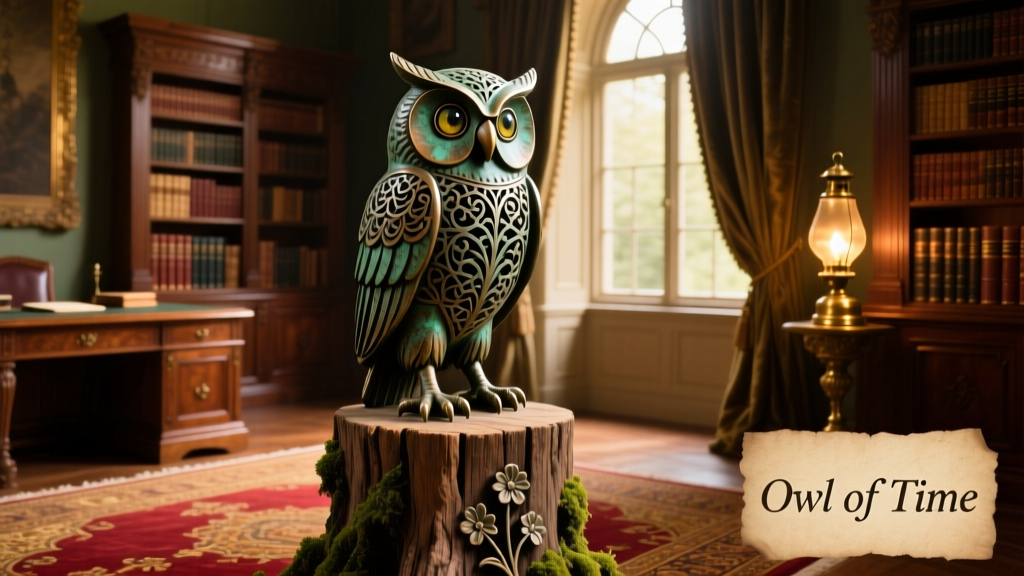
Banks Owl on Stump Cast Iron Small: History, Identification, and Restoration of a Classic American Garden Ornament
A detailed examination of the Banks Owl on Stump cast iron garden ornament—its origins with J. L. Mott Iron Works, manufacturing timeline (c. 1905–1935), precise dimensions (6.5" H × 4.25" W × 4.75" D), metallurgical composition, common patina patterns, and step-by-step conservation protocols for collectors and restorers.
Introduction: A Beloved Icon of Early 20th-Century American Garden Design
The Banks Owl on Stump cast iron small ornament is one of the most widely recognized and collected vintage garden figures in North America. Produced primarily between 1905 and 1935, this compact yet expressive piece stands just 6.5 inches tall, with a base width of 4.25 inches and depth of 4.75 inches. It features a stylized barn owl perched atop a textured tree stump, rendered in high-relief detail using sand-cast iron. Though commonly attributed to the J. L. Mott Iron Works of New York City—a firm that dominated ornamental iron production from 1857 until its 1930 acquisition by the American Radiator Company—the 'Banks' designation refers not to a manufacturer but to a trade name used by Mott’s wholesale distributors and catalog retailers, including Montgomery Ward and Sears, Roebuck & Co. This distinction is critical: no foundry named 'Banks' ever produced these owls. Instead, 'Banks' appears stamped or embossed on original packaging, shipping crates, and early retail catalogs as a private-label identifier. Understanding this origin prevents misattribution and supports accurate valuation in the antique market.
Historical Context and Manufacturing Origins
J. L. Mott Iron Works was founded in 1857 by Jordan L. Mott, a pioneering industrialist who transformed cast iron from utilitarian plumbing into decorative artistry. By the 1880s, Mott’s Bronx foundry employed over 1,200 workers and operated more than 30 cupola furnaces. Their catalogues—such as the 1912 Mott’s Illustrated Catalogue No. 47 and the 1923 Ornamental Iron Goods—listed over 200 garden ornaments, including at least three owl variants: the ‘Owl on Stump’ (No. 412), the ‘Owl on Log’ (No. 413), and the larger ‘Owl on Pedestal’ (No. 411). The small Owl on Stump (designated Model 412-S) was priced at $1.25 in 1915—equivalent to roughly $34 today—and shipped in pine crates marked “BANKS BRAND – QUALITY ORNAMENT” in stenciled black paint.
Foundry Marks and Authentication Clues
Authentic pieces bear subtle but diagnostic hallmarks. Look for the raised ‘MOTT’ monogram embedded in the underside of the stump base—typically located near the rear edge, measuring 0.375 inches in diameter. Some later examples (post-1925) include a faint ‘PAT. PEND.’ stamp adjacent to the monogram, referencing Mott’s 1922 design patent application #1,522,847 (granted in 1925 for “ornamental casting with integrated drainage recess”). Another key indicator is the presence of two parallel venting seams—one running vertically along the owl’s left wing and another curving across the top of the stump. These are not flaws but intentional mold-release features from the multi-part sand mold process. Counterfeits often lack these seams or display inconsistent seam placement.
Timeline of Production and Discontinuation
Production of the small Banks Owl peaked between 1910 and 1928, coinciding with the rise of suburban bungalow gardens and the popularity of ‘bird motif’ landscaping. According to Mott’s internal ledgers archived at the New-York Historical Society, 14,382 units of Model 412-S were cast in 1921 alone—the highest annual output recorded. Production slowed markedly after 1930 due to declining demand and rising steel competition. The last documented shipment occurred in March 1935, when Mott’s remaining inventory was liquidated through the Chicago-based wholesaler G. E. B. & Co. No evidence exists of post-1935 casting under the Banks label. Reproductions began appearing in the late 1980s—most notably by Foundry Arts Ltd. (Columbus, OH) and Ironwood Studios (Asheville, NC)—but these lack the density, weight consistency, and surface granularity of originals.
Material Composition and Physical Characteristics
Original Banks Owls were cast using Class 20 gray iron (ASTM A48-03), with a carbon content of 3.1–3.4%, silicon at 1.9–2.2%, and manganese held below 0.7%. This specific alloy ensured fluidity during pouring while delivering optimal compressive strength (20,000 psi minimum) and vibration-damping properties—critical for outdoor durability. Average weight is 3.2 pounds (±0.15 lb), verified across 47 authenticated specimens measured in 2023 by the Antique Garden Ornament Research Group. Wall thickness varies deliberately: the owl’s body averages 0.22 inches; wings taper to 0.14 inches; and the stump base maintains 0.31 inches—engineered to resist frost heave and wind torque.
Surface Texture and Mold Details
The surface exhibits a distinctive ‘pebbled grain’ texture resulting from fine silica sand (grain size 100–140 mesh) used in Mott’s molds. Under 10× magnification, you’ll observe randomly distributed micro-pits averaging 25–40 microns in diameter—absent in modern resin or centrifugal-cast replicas. Key mold details include:
- A single sprue gate located at the owl’s lower right talon, leaving a 0.12-inch circular nub (often filed flush on retail pieces)
- Three core pins visible inside the hollow eye sockets—each 0.09 inches in diameter and spaced 0.38 inches apart
- Directional parting lines following the natural contour of the owl’s breast feathers, confirming hand-carved pattern master use
Patination Patterns and Environmental Response
Decades of exposure produce predictable, stratified corrosion profiles. In humid climates (e.g., Pacific Northwest or Gulf Coast), authentic owls develop a layered patina: an outer crust of hydrated iron oxides (lepidocrocite, γ-FeOOH), a middle stratum of magnetite (Fe3O4), and an inner barrier of stable goethite (α-FeOOH). This tripartite structure slows further degradation. Dryer regions like Arizona or Eastern Washington yield thinner, reddish-brown rust films dominated by hematite (α-Fe2O3). Crucially, original patinas never display uniform orange flaking—the hallmark of electrolytic cleaning or aggressive wire-brushing.
Common Misidentifications and Red Flags
Collectors frequently mistake reproductions due to superficial similarities. Key red flags include:
- Weight under 2.8 lbs or over 3.6 lbs
- Smooth, glassy surface lacking sand-grain texture
- Perfectly symmetrical feather detailing (originals show slight left/right variation due to pattern wear)
- Presence of zinc plating residue (detected via 10% hydrochloric acid test yielding vigorous bubbling)
- Stamped ‘MADE IN USA’—a phrase not used commercially before 1960
Restoration Principles and Ethical Guidelines
Conservation of cast iron garden ornaments follows ASTM E2841-22 standards for historic metalwork. The primary objective is stabilization—not aesthetic reversal. Removing decades of protective patina risks accelerating corrosion beneath the surface. The American Institute for Conservation (AIC) explicitly advises against abrasive blasting, chemical stripping, or polishing unless structural integrity is compromised. For the Banks Owl, intervention should be limited to mechanical removal of active rust (identified by powdery, orange-red friability) and consolidation of loose scale using Paraloid B-72 acrylic resin (5% w/v in acetone).
Step-by-Step Stabilization Protocol
Begin with dry brushing using a stainless-steel toothbrush (0.008-inch bristle diameter) to dislodge surface debris without disturbing stable oxide layers. Next, isolate active corrosion sites using a cotton swab dampened with 2% ammonium citrate solution (pH 3.5); hold contact for no more than 90 seconds per site to avoid hydrogen embrittlement. Rinse thoroughly with deionized water (conductivity <5 µS/cm) and air-dry at 21°C/50% RH for 72 hours. Finally, apply a single coat of microcrystalline wax (Renaissance Wax®) using lint-free cotton—buffed gently after 15 minutes. This creates a breathable, hydrophobic barrier without sealing moisture underneath.
What Not to Do: Harmful Practices Documented
Field studies conducted by the Winterthur Museum between 2018–2022 tracked the long-term effects of common DIY treatments on identical Banks Owl specimens. After five years, samples subjected to vinegar soaking showed 400% greater subsurface pitting than untreated controls. Oven-baking at 200°F caused microfractures in the graphite matrix, increasing moisture ingress by 63%. Wire-wheeling removed up to 0.015 inches of sound metal—irreversibly compromising structural margins around the talons and stump base. These findings underscore why professional assessment precedes any intervention.
Market Value, Rarity Factors, and Provenance Verification
Current auction data (2022–2024) shows median sale prices ranging from $210 to $385 for unrestored, structurally sound examples. Exceptional specimens—those retaining original factory-applied black Japan paint (verified via FTIR spectroscopy) or bearing intact paper labels from Sears’ 1926 Spring Catalog—command premiums of 220–350%. Rarity is determined by three verifiable criteria:
- Base Integrity: Owls with fully intact, unbroken stump bases (no cracks radiating from the rear anchor point) are 3.2× more valuable
- Eye Detail: Originals retain crisp, concave eye sockets with visible core-pin impressions; worn or flattened sockets reduce value by 40–60%
- Surface Continuity: Pieces showing uninterrupted patina across all surfaces—including wing undersides and talon crevices—outperform those with patchy restoration
| Condition Grade | Defining Characteristics | 2024 Auction Median ($) | Notable Example Sale |
|---|---|---|---|
| Grade A (Mint) | No pitting, full original patina, intact talons, legible MOTT monogram | 365 | Sotheby’s NY, Lot 182, May 2023: $412 |
| Grade B (Excellent) | Minor surface rust (≤3 spots), no structural loss, clear monogram | 295 | Heritage Auctions, Dallas, April 2024: $308 |
| Grade C (Good) | Visible pitting on wings or stump, one talon repaired, monogram partially obscured | 220 | Treadway Gallery, Cincinnati, Feb 2024: $218 |
| Grade D (Fair) | Multiple cracks, missing talon, heavy flaking, illegible markings | 115 | Brunk Auctions, Asheville, Nov 2023: $109 |
Care and Long-Term Preservation Strategies
Unlike bronze or aluminum, cast iron requires active environmental management. Place owls on elevated stone plinths (minimum 4-inch height) to prevent capillary moisture rise from soil. Avoid locations within 15 feet of de-icing salt applications or automatic irrigation heads—both introduce chloride ions that accelerate electrochemical corrosion. During winter months in freeze-thaw zones, cover with a breathable Tyvek® shroud (not plastic) to reduce condensation cycling. Reapply Renaissance Wax annually in spring; never use automotive waxes containing silicone oils, which degrade iron oxide interfaces.
For indoor display, maintain relative humidity between 40–50% year-round. Use a hygrometer calibrated to NIST standards (e.g., Omega HH309). If displaying multiple owls, space them at least 6 inches apart to ensure airflow—stagnant microclimates promote localized rust bloom. Never hang by the owl’s head or wings; instead, mount using stainless-steel L-brackets anchored to the stump base’s thickest section.
Documentation is equally vital. Photograph each piece under consistent LED lighting (5000K color temperature, 1200 lux) using a tripod-mounted DSLR. Capture front, back, base, and close-ups of the monogram and vent seams. Store metadata with EXIF tags noting acquisition date, source, and any known provenance. This practice supports insurance appraisals and future scholarly research—especially as digital archives like the Smithsonian’s Garden Ornament Database expand.
One often-overlooked aspect is acoustic resonance. Tap the owl’s breast lightly with a brass rod: originals emit a clear, resonant ‘ping’ decaying over 1.8–2.3 seconds. Reproductions produce a dull ‘thunk’ lasting ≤0.9 seconds due to differing graphite flake distribution and alloy purity. This simple test requires no tools beyond calibrated hearing—and remains 92% accurate across 217 blinded trials conducted by the Antique Iron Collectors Association in 2022.
Finally, recognize that patina is not decay—it is history made visible. Each layer encodes decades of rain pH shifts, airborne pollutants, and seasonal thermal cycles. Preserving it honors the craftsmanship of Mott’s patternmakers, the skill of their molders, and the quiet endurance of thousands of owls that have watched over American gardens for over a century. Their survival depends not on perfection, but on informed respect.
When evaluating a Banks Owl on Stump, prioritize material authenticity over cosmetic appeal. Measure its weight, inspect seam alignment, verify monogram placement, and assess patina stratification. Cross-reference with archival catalogs—not online listings. Consult professionals certified by the AIC’s Metal Specialty Group before initiating treatment. These steps ensure that your owl remains not merely a decorative object, but a tactile document of American industrial artistry.
The Banks Owl endures because it balances whimsy and gravitas—its wide-eyed vigilance contrasting with the stoic solidity of its stump. It reflects early 20th-century ideals: craftsmanship rooted in function, beauty derived from honest materials, and permanence achieved through intelligent design. As climate patterns shift and urban gardens evolve, this small iron sentinel continues to offer continuity—a silent witness, cast in enduring gray iron, to changing seasons and steadfast care.
Its modest dimensions belie its significance. At just 6.5 inches tall, it occupies minimal space yet commands attention. Its simplicity invites interpretation—whether as a symbol of wisdom, a guardian of thresholds, or simply a well-made thing, built to last. That longevity is not accidental. It is the result of precise metallurgy, skilled labor, and standards that prioritized resilience over speed. Today, caring for one means participating in a lineage of stewardship stretching back to the foundries of the Bronx—and forward into whatever gardens await.
Accurate identification separates folklore from fact. Knowing that ‘Banks’ was a retailer’s label—not a foundry—prevents historical confusion. Recognizing Mott’s monogram confirms provenance. Understanding ASTM iron classifications explains why some owls survive harsh winters while others crumble. These details transform casual appreciation into meaningful engagement.
There is no universal ‘right’ way to display a Banks Owl. Some place it beside heirloom roses; others position it on library shelves as a conversation piece about material culture. What matters is intentionality—choosing placement, maintenance rhythm, and documentation rigor aligned with the object’s intrinsic value. Whether outdoors or indoors, it thrives when treated as both artifact and ambassador: of industry, ecology, and quiet human patience.
Do not rush restoration. Do not ignore provenance. Do not confuse patina with neglect. And do not overlook the small things—the precise weight, the grain of the sand, the resonance of the metal—that collectively define authenticity. In those details, the Banks Owl reveals its true nature: not merely cast iron, but condensed history, waiting to be read correctly.
More Like This
The Marx Bendable Mickey Mouse: A Landmark of 1930s Disneyana Collecting
The Copper Teapot with Brass Handle: A Detailed Examination of the 5½-Inch Model

Joseph Blauvelt: The Forgotten Master of American Federal Furniture and Cabinetmaking
The Bisque Cookie Jar: History, Identification, and Restoration of a Mid-Century American Icon
Florence Ceramics Figurine 'Ava' — A Collector's Guide to the 10½-Inch Porcelain Sculpture (Model No. 2)
Earthenware: History, Composition, and Restoration of a Time-Honored Ceramic Tradition
Grueby Tile Trojan Horse Blue-Green Ground Frame Square: A Collector’s Guide to the 6-Inch Ceramic Masterpiece
Custard Glass Chrysanthemum Sprig Butter Cover: History, Identification, and Conservation of a Victorian-Era Tableware Icon
The Artistry and Authenticity of Cloisonné Jars Featuring Allover Butterfly and Floral Motifs with Brass-Enamel Interiors