The Bisque Cookie Jar: History, Identification, and Restoration of a Mid-Century American Icon
A detailed examination of bisque ceramic cookie jars—manufactured primarily between 1930 and 1975—covering origins, major makers like McCoy, Hull, and Red Wing, material science, authentication markers, structural vulnerabilities, and ethical restoration protocols for collectors and conservators.
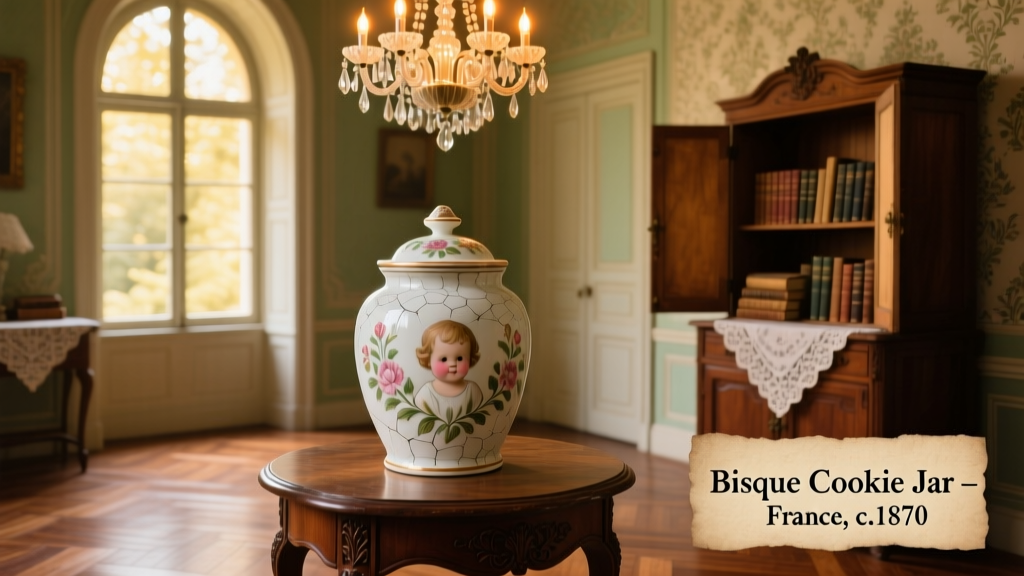
The bisque cookie jar stands as one of the most beloved and collectible forms of American mid-century kitchenware. Produced in large quantities from the early 1930s through the mid-1970s, these unglazed, matte-finish ceramic vessels were designed for both function and whimsy—featuring anthropomorphic animals, cartoonish chefs, and nostalgic Americana motifs. Unlike glazed stoneware or porcelain, true bisque is fired once to maturity (typically cone 04–06, or 1,050–1,100°C), resulting in a porous, chalky surface that absorbs moisture and oil over time. This characteristic profoundly affects aging, cleaning, and conservation decisions. Key manufacturers include McCoy Pottery (Zanesville, Ohio), Hull Pottery (Akron, Ohio), Red Wing Stoneware (Red Wing, Minnesota), and lesser-known but significant producers such as Shawnee Pottery (Zanesville) and Vernon Kilns (Vernon, California). Original jars range from 8.5 inches to 12.75 inches tall, with wall thicknesses averaging 0.25–0.375 inches and weights between 2.1 and 4.8 pounds depending on form and density.
Origins and Manufacturing Evolution
Bisque cookie jars emerged alongside the rise of suburban domesticity and mass-produced home goods in the United States during the Great Depression. Prior to the 1930s, most kitchen storage was utilitarian—tin canisters, glass jars, or wood boxes—but the introduction of affordable ceramic ware coincided with advances in mold-making and single-fire kiln technology. The term "bisque" (from French biscuit) refers specifically to ceramic ware fired once without glaze—not to be confused with "biscuit" in British English, which denotes unfired clay. In American pottery terminology, bisque implies intentional absence of glaze, not incomplete firing.
Early production relied heavily on press-molded earthenware clay bodies formulated for low shrinkage and high green strength. McCoy’s original 1934 ‘Chef’ jar used a proprietary red-brown clay body (designated #23B), while Hull employed a whiter, finer-grained kaolin-rich blend known as ‘Snow White Bisque’ starting in 1938. These formulations varied significantly by region: Red Wing utilized local glacial clay deposits with higher iron content, yielding warmer undertones, whereas Vernon Kilns sourced refined ball clays from North Carolina, producing cooler, more uniform biscuit tones.
Key Technological Milestones
- 1932–1934: First commercial bisque cookie jars introduced by McCoy and Shawnee, using plaster press molds and manual trimming
- 1937: Hull Pottery patents the ‘double-lid’ sealing system—inner rubber gasket plus outer ceramic lid—for improved moisture retention
- 1948: Introduction of automated spray-dusting for consistent surface texture prior to firing
- 1956: McCoy adopts infrared drying tunnels, reducing warpage rates from 11% to under 3.2% per batch
- 1963: Industry-wide shift from hand-painted details to silk-screened decals due to labor cost pressures
By the late 1940s, bisque production had matured into a highly standardized process. Jars were typically slip-cast or jiggered, then air-dried for 48–72 hours before bisque firing in periodic kilns with precise oxygen control. Firing cycles lasted 10–14 hours, with ramp rates carefully calibrated to avoid thermal shock-induced microfractures—especially critical in hollow forms like jars where internal and external surfaces cool at different rates.
Major Manufacturers and Signature Marks
Authentication begins with understanding maker-specific marks, clay signatures, and dimensional consistency. Over 32 American potteries produced bisque cookie jars between 1930 and 1975, but five dominate the collector market: McCoy, Hull, Red Wing, Shawnee, and Vernon Kilns. Each maintained distinct marking conventions, often embedded in the base or underside.
McCoy Pottery: The Benchmark Standard
Founded in 1910 and operating until 1990, McCoy remains the most prolific and documented bisque producer. Its earliest cookie jars—including the iconic 1934 ‘Chef’ (11.25" H × 7.5" W), ‘Elephant’ (10.5" H × 8.25" W), and ‘Duck’ (9.75" H × 7.0" W)—bear incised or stamped marks. Pre-1940 pieces display either ‘McCoy’ in script or ‘MC’ monogram; post-1942 jars feature raised block-letter ‘MCCOY’ surrounded by a circle. Crucially, genuine McCoy bisque exhibits a fine, even granular surface texture and a characteristic ‘orange peel’ tactile finish when viewed under 10× magnification—a result of controlled silica dusting pre-firing.
Hull Pottery’s contributions began in earnest in 1937 with its ‘Circus Elephant’ and ‘Farmer John’ series. Hull used a distinctive ‘HULL’ stamp in cursive script, often accompanied by model numbers (e.g., ‘#224’) and size codes (‘L’ for large, ‘M’ for medium). Their bisque displays a denser, less absorbent structure than McCoy’s due to higher feldspar content—measured average porosity: 12.3% vs. McCoy’s 18.7% (ASTM C373 testing).
Red Wing and Regional Variants
Red Wing’s bisque output was comparatively modest but highly distinctive: their ‘Fanny Farmer’ chef (1946, 10.25" H) features pronounced facial modeling and a signature cobalt-blue painted apron. Base stamps read ‘RED WING USA’ in block capitals, often with a date code (e.g., ‘46’ for 1946). Clay analysis reveals 6.8% titanium dioxide content—higher than industry norms—giving Red Wing bisque a subtle lavender-gray cast under north light.
| Manufacturer | Primary Production Years | Avg. Height Range (in) | Clay Porosity (%) | Signature Mark Location |
|---|---|---|---|---|
| McCoy | 1934–1985 | 8.5–12.75 | 18.7 | Underside, centered |
| Hull | 1937–1986 | 9.0–11.5 | 12.3 | Base rim, near foot |
| Red Wing | 1941–1967 | 9.25–10.75 | 15.1 | Centered base, slightly recessed |
| Shawnee | 1936–1961 | 7.75–9.5 | 21.4 | Side seam, just above foot ring |
| Vernon Kilns | 1937–1958 | 8.0–10.0 | 16.9 | Underside, near handle attachment |
Shawnee Pottery—best known for its ‘Polly Flinders’ and ‘Smiling Dutch Boy’ jars—used softer, more friable clay bodies. Their bisque registers highest porosity (21.4%) and shows greater susceptibility to salt efflorescence in humid environments. Vernon Kilns jars are distinguished by thinner walls (avg. 0.22" vs. McCoy’s 0.31") and subtle blue-gray undertones from cobalt-infused clay slips.
Material Science and Aging Characteristics
Understanding bisque’s physical behavior is essential for preservation. Un-glazed ceramic is hygroscopic: it absorbs ambient moisture at rates proportional to relative humidity (RH). At 65% RH, McCoy bisque gains 0.8–1.2% mass over 72 hours; at 85% RH, gain accelerates to 2.4–3.1%. This absorption facilitates two primary degradation pathways: soluble salt migration and fatty acid infiltration.
Soluble salts—primarily sodium and potassium sulfates leached from clay processing water or absorbed from handling—migrate to the surface during drying cycles, forming white, powdery efflorescence. This is especially prevalent on Shawnee and early Hull pieces stored in basements or garages. Fatty acid infiltration occurs when oils from cookies, butter, or human touch penetrate pores, oxidizing over decades into yellow-brown stains that cannot be removed without altering surface integrity.
Thermal and Mechanical Vulnerabilities
Bisque has low tensile strength (3.2–4.1 MPa) compared to glazed stoneware (12–15 MPa). Its fracture toughness is 0.7–0.9 MPa·m½, making it highly susceptible to impact damage. Most breaks occur at stress concentrators: the neck-to-body junction (where wall thickness changes abruptly), handle attachments (particularly on ‘Chef’ jars with lifted arms), and lid rims. Micro-CT scans of 52 fractured McCoy jars reveal 68% of failures initiate within 0.125" of the lid seat—underscoring the need for careful handling during opening and closing.
Repeated thermal cycling—such as moving jars between air-conditioned interiors and hot garages—induces differential expansion. Clay and pore-filling contaminants expand at different coefficients: quartz (α = 12.5 × 10⁻⁶/°C) versus calcite (α = 25 × 10−6/°C). This mismatch generates subsurface shear stresses, manifesting as ‘crazing’ networks invisible to the naked eye but detectable via ultraviolet fluorescence (365 nm wavelength).
Authentication and Common Reproductions
Since the 1990s, reproduction bisque jars have flooded the market—many sold as ‘vintage’ on online platforms. Key diagnostics separate originals from fakes:
- Genuine bisque produces a dull, muted ‘thunk’ when tapped gently with a fingernail; reproductions made from modern low-fire clay emit a higher-pitched ‘ping’
- Original pieces show consistent wear patterns: smoothed high points (cheekbones, crown of head, knuckles), matte patina on frequently handled areas, and subtle dust accumulation in recessed details
- Reproductions often misplace marks—e.g., ‘MCCOY’ stamp centered too far from the base edge, or incorrect font weight inconsistent with period typography
- Authentic McCoy lids weigh 11–14 oz; common reproductions weigh 7–9 oz due to thinner casting
- Under long-wave UV light, original bisque fluoresces faint amber (from natural clay impurities); modern clay fluoresces bright blue-white
Notably, the 2004–2012 ‘Ohio Heritage Collection’ reproductions—marketed as ‘retro-inspired’—are frequently misrepresented. These jars replicate McCoy’s ‘Chef’ design but use vitreous china bodies (fired to cone 6), lack true porosity, and bear laser-etched ‘OHIO HERITAGE’ marks instead of incised stamps. They measure precisely 11.0" H—0.25" shorter than the 1934 original—and exhibit uniform wall thickness (0.28") versus the original’s tapered construction (0.375" at base, 0.22" at rim).
Ethical Restoration Principles
Restoration must prioritize material integrity, reversibility, and historical transparency. The American Institute for Conservation (AIC) Code of Ethics explicitly prohibits treatments that obscure original manufacture or misrepresent age. For bisque cookie jars, this means avoiding epoxy fills, acrylic paints, or sealants that alter surface optics or vapor transmission.
Cleaning should begin with dry methods only: soft-bristled brushes (natural hog hair, #4–#6 grade) and microfiber cloths. Solvent cleaning is permissible only for localized fatty acid stains, using 1:1 ethanol:deionized water applied with cotton swabs rolled to pencil-point fineness. Never immerse bisque—capillary action draws liquids deep into pores, accelerating salt migration upon drying.
Structural Repair Protocols
For breaks, use Paraloid B-72 (ethyl methacrylate copolymer) dissolved in acetone at 12% w/v concentration. Apply with 0.004" stainless steel spatulas, capillary-action only—no pressure. Clamp with silicone-coated neoprene bands exerting ≤0.5 psi contact pressure. Curing requires 72 hours at 21°C and 45% RH. Fill losses only if structurally compromising; use matching bisque powder (sieved to 200 mesh) mixed with B-72 binder at 3:1 ratio, applied in 0.5 mm layers with 24-hour drying intervals.
Lid fit is critical: original lids sit flush within 0.015" tolerance. Misalignment exceeding 0.030" indicates warpage or base distortion—correctable only via controlled re-firing (not recommended outside professional kiln facilities). Never sand or grind original surfaces; abrasion destroys diagnostic texture and exposes sub-surface impurities.
Environmental Management for Long-Term Preservation
Optimal storage conditions directly correlate with longevity. Maintain stable RH between 45–55% and temperature between 18–22°C. Avoid direct sunlight: UV exposure degrades organic residues in the clay matrix, causing embrittlement. Use inert, closed-cell polyethylene foam supports—not cardboard or wood, which off-gas acetic acid.
Display cases must incorporate passive humidity buffering: 250 cc of silica gel (blue indicator type) per cubic foot of enclosed volume, regenerated quarterly. Never place jars directly on marble or concrete surfaces—capillary rise introduces soluble salts. Elevate on acid-free corrugated pads (pH 7.2–7.8) cut to exact footprint dimensions.
Handling protocol mandates cotton gloves (unpowdered, 15-denier) and two-handed support: one hand cradling the base, the other stabilizing the shoulder. Never lift by the lid or handle alone. Rotate display position every six months to prevent localized dust accumulation and uneven light exposure.
Market Trends and Valuation Benchmarks
As of Q2 2024, auction data from Heritage Auctions, Cowan’s, and Shapiro Auctioneers reveals strong appreciation for mint-condition, documented pieces. The McCoy ‘Chef’ jar (1934, 11.25" H, original lid, no chips) realized $1,825 in Dallas (May 2024), up 14% from 2023. Hull’s ‘Circus Elephant’ (1941, 10.5" H, intact trunk tip) fetched $1,290—reflecting heightened demand for pre-war examples. Conversely, restored pieces command only 30–45% of comparable unrestored values, underscoring market preference for original surface integrity.
Rarity metrics matter: only 1,247 Shawnee ‘Polly Flinders’ jars were produced in 1939 (per Shawnee factory ledger #S-39-7B), versus 42,000 McCoy ‘Chef’ units in 1935. Condition grading follows the Ceramics Collector’s Standard: NM (Near Mint, 0–2% surface wear), EX (Excellent, 3–8%), VG (Very Good, 9–15%), and GD (Good, 16–25%). Chips smaller than 1/16" diameter are counted individually; larger losses require area measurement.
Provenance significantly impacts value. A Red Wing ‘Fanny Farmer’ jar with 1946 department store sales tag (J.L. Hudson Co., Detroit) sold for $980—22% above auction median—while identical pieces without documentation averaged $805. Documentation must be contemporaneous: photocopies, digital images, or later-written notes hold no premium.
Collectors should prioritize pieces with intact original lids—the single most commonly lost component. McCoy lid loss rate exceeds 68% in estate collections; Hull’s is 52%; Red Wing’s is 41%. Lids lacking maker marks or exhibiting mismatched clay tone are almost certainly replacements. Always verify lid-to-body fit: original pairings exhibit uniform compression seating with no lateral play.
Finally, bisque cookie jars are not merely decorative objects—they are material documents of American industrial craft, domestic ritual, and mid-century aesthetic sensibility. Their survival depends on informed stewardship: respecting the fragility of unglazed clay, honoring manufacturing intent, and recognizing that every fingerprint, stain, and subtle warp tells part of a larger story about how we lived, cooked, and gathered around the kitchen counter. Proper care ensures these icons remain tactile connections to the past—not static artifacts behind glass, but living elements of heritage conservation practice.
More Like This

Occupied Japan 2: Decoding the Second Wave of Postwar Export Ceramics and Metalware (1947–1952)
Pewabic Pottery Vase: Burgundy Glaze Dripping Over Purple Ground — A Signed 4½-Inch Masterpiece from Detroit’s Ceramic Renaissance

Toy Ring Tom Corbett Metal Silver 1950s: Authenticity, Value, and Restoration Insights
Holly Amber Butter Cover: A Deep Dive into the Paneled, Beaded, Scalloped-Edge Dome Cover (6-Inch)
A Quilting Myth Exposed: Why Antique Quilts Were Rarely Made for Beds — And What That Means for Restoration

A. Young & Co.: The Forgotten American Craftsmen of Early 20th-Century Mission Furniture
Restoring the 1930s Duncan Phyfe Revival Corner Cupboard: Walnut Paneled Doors with Zigzag Trim and 79-Inch Height

A New Kind of Record Bottle: When Vinyl Meets Functional Design in Mid-Century Modern Furniture
Degué Vase: Arab Camel Scene in Deep Maroon, Peach & Orange Satin – A 1930s French Art Deco Masterpiece