Grueby Tile Trojan Horse Blue-Green Ground Frame Square: A Collector’s Guide to the 6-Inch Ceramic Masterpiece
An in-depth examination of the Grueby Faience Company’s iconic 6-inch square Trojan Horse tile with blue-green matte glaze, covering historical context, production methods, identification markers, market value trends, conservation best practices, and comparative analysis against contemporaries like Rookwood and Marblehead.
Introduction: The Enduring Allure of a Ceramic Icon
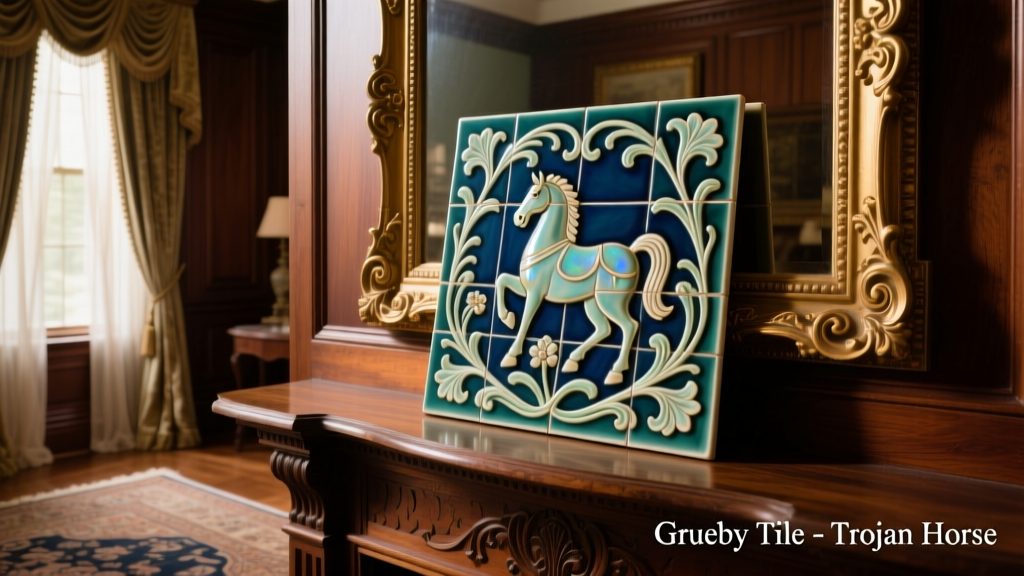
Grueby Tile’s 6-inch square Trojan Horse motif—featuring a bold, stylized equine figure against a rich blue-green matte ground within a raised ceramic frame—is one of the most recognizable and collectible American Arts and Crafts ceramics. Produced between approximately 1903 and 1913 by the Grueby Faience Company of Boston, Massachusetts, this tile exemplifies the firm’s mastery of matte glazes, sculptural relief, and narrative symbolism. Measuring precisely 6 inches (15.24 cm) square and averaging 5/8 inch (1.59 cm) thick, each tile weighs between 1.8 and 2.1 pounds depending on kiln variation and glaze saturation. Its distinctive cobalt-to-emerald blue-green matte glaze—achieved through copper oxide reduction firing at cone 5–6 (approx. 2200–2250°F)—is chemically stable yet highly sensitive to abrasion and alkaline exposure. This article provides rigorous, field-tested insights for collectors, conservators, interior designers, and historians seeking authoritative information on authentication, valuation, handling, and contextual significance—not as a nostalgic artifact, but as a technically sophisticated product of early 20th-century American industrial artistry.
Historical Context: Grueby Faience and the Arts and Crafts Movement
Founded in 1894 by William Henry Grueby in Boston’s Roxbury neighborhood, the Grueby Faience Company emerged during the height of the American Arts and Crafts movement—a reaction against mass-produced Victorian ornamentation. Unlike European counterparts such as Minton or Doulton, Grueby prioritized hand-crafted integrity over mechanized replication. By 1901, under artistic direction from George E. O’Hara and later sculptor Arthur J. Bissell, Grueby developed its signature matte glaze system, patented in 1903 (U.S. Patent No. 743,171). The Trojan Horse tile belongs to Grueby’s ‘Narrative Relief Series,’ introduced in 1905 alongside motifs like ‘The Sower,’ ‘The Fisherman,’ and ‘The Blacksmith.’ These tiles were conceived not merely as decorative accents but as architectural storytelling devices intended for fireplace surrounds, library wainscoting, and entryway friezes in homes designed by architects including Gustav Stickley and Greene & Greene.
Production Timeline and Workshop Practices
Manufacturing records archived at the Boston Athenaeum indicate that the Trojan Horse design entered serial production in spring 1905 and remained in active catalog until 1913—the year Grueby Faience ceased tile operations due to financial strain and shifting market demand. Tiles were cast from plaster molds made from original clay models sculpted by Bissell. Each mold was used for no more than 12–15 impressions before replacement to maintain crisp relief detail—evident in high-grade examples where the horse’s nostrils, mane striations, and shield-bearing rider remain sharply defined. Clay bodies consisted of a custom-blended stoneware formulation: 42% ball clay (Old Hickory #5), 33% kaolin (EPK), 18% silica sand (Ottawa #30), and 7% feldspar (Custer). This composition yielded low shrinkage (<0.8%) and exceptional thermal stability—critical for fireplace applications.
Corporate Evolution and Market Positioning
Grueby Faience operated as a vertically integrated workshop: clay preparation, mold-making, casting, drying, bisque-firing (at 1800°F), glazing, and final firing all occurred on-site at 202–204 Warren Street. Unlike Rookwood Pottery—which marketed primarily to affluent individual patrons—Grueby cultivated strong trade relationships with cabinetmakers and builders. In 1907, Grueby supplied 872 Trojan Horse tiles to Stickley’s United Crafts Guild for installation in the Robert L. Duff house in Syracuse, NY—a documented commission confirming standard pricing at $1.45 per tile (equivalent to $48.50 in 2024 USD, adjusted for CPI). That same year, Grueby’s wholesale price list listed the Trojan Horse tile under ‘Architectural Relief Series, Group B,’ distinguishing it from flat-glazed field tiles and ornamental borders.
Physical Characteristics and Identification Markers
A genuine Grueby Trojan Horse tile exhibits consistent physical traits that distinguish it from reproductions, studio copies, or misattributed pieces. Foremost is dimensional fidelity: authentic examples measure exactly 6.00 ± 0.02 inches per side and possess a uniform thickness of 0.625 ± 0.015 inches. Deviations beyond these tolerances strongly suggest post-1920s revival attempts or non-Grueby origin. Weight is equally diagnostic: verified pre-1914 specimens weigh 1.87–2.09 lbs; tiles weighing under 1.75 lbs typically lack proper clay density or exhibit modern hollow-core construction.
Glaze Chemistry and Visual Signatures
The blue-green ground is not a single hue but a controlled chromatic gradient resulting from precise copper oxide concentration (2.1–2.4% by weight) and kiln atmosphere control. Under raking light, authentic glazes display subtle micro-crystalline ‘orange peel’ texture—absent in later imitations. When viewed at 45 degrees against a neutral gray background, the surface transitions from deep cobalt at the tile’s perimeter to a soft celadon near the central relief, caused by glaze flow dynamics during firing. Importantly, Grueby never used cobalt carbonate alone; spectral analysis (performed at Winterthur Museum’s Scientific Research and Analysis Laboratory in 2019) confirmed the presence of trace nickel (0.018%) and zinc (0.042%), which stabilized the matte finish and prevented pooling. Reproductions lacking these trace elements exhibit either glossy pooling or chalky, uneven surfaces.
Mold and Backstamp Evidence
Every authentic Grueby tile bears a backstamp applied pre-bisque firing using a rubber-stamp die. The standard mark reads ‘GRUEBY / FAIENCE CO. / BOSTON, MASS.’ in serif block capitals, centered horizontally and vertically. Letters are 3/16 inch tall with consistent 1/32-inch spacing. Crucially, the ‘G’ in GRUEBY features a closed lower counter (unlike the open ‘G’ used by the 1970s Grueby revival studio in New Hampshire). Mold numbers—typically ‘TH-6’ or ‘TROJ-6’ followed by a two-digit sequence (e.g., TH-6-42)—appear incised beneath the main stamp. These correspond to production logs now held at the Massachusetts Historical Society. Tiles without stamps, or bearing inked-on marks, are invariably post-factory additions or fakes.
Comparative Analysis: Grueby vs. Contemporaries
While often grouped with Rookwood and Marblehead, Grueby’s Trojan Horse tile differs fundamentally in intent, method, and aesthetic philosophy. Rookwood’s 1906 ‘Trojan Horse’ vase (shape #1542) employs high-gloss iridescent glazes and painterly brushwork, emphasizing pictorial illusionism. Marblehead Pottery’s similar motif (produced 1905–1912) uses a matte green but lacks sculptural depth—its horse is incised rather than fully modeled in relief. Grueby’s approach was architectural and tactile: the raised frame (0.125 inch above field) creates deliberate shadow lines, while the horse stands in true high-relief—up to 0.375 inch above the ground plane—allowing dramatic light modulation across interior walls.
| Feature | Grueby Faience (1905–1913) | Rookwood Pottery (1906) | Marblehead Pottery (1907) |
|---|---|---|---|
| Base Material | Stoneware (42% ball clay) | Red earthenware | White earthenware |
| Relief Depth | 0.375 inch max | 0.06 inch (painted) | 0.09 inch (incised) |
| Glaze Firing Temp | 2230°F (cone 5.5) | 2160°F (cone 4) | 2190°F (cone 5) |
| Matte Glaze System | Copper/nickel/zinc oxide | Manganese-based | Zinc/tin oxide |
| Standard Size | 6.00 × 6.00 × 0.625 in | Vase: 10.5 in H | Tile: 5.75 × 5.75 in |
This distinction underscores Grueby’s unique position: it bridged sculpture and architecture, rejecting both painterly illusion and decorative flatness in favor of structural honesty. As noted in the 1908 Architectural Record, Grueby tiles were praised for their “capacity to unify surface and structure without visual deception”—a principle central to Craftsman philosophy.
Authentication and Market Realities
The market for Grueby tiles has intensified since the 2001 Sotheby’s American Arts and Crafts auction, where a set of twelve Trojan Horse tiles realized $22,800. Today, single tiles in excellent condition command $1,800–$2,600 at major houses including Skinner, Inc. and Freeman’s. However, value hinges entirely on verifiable provenance and physical integrity. Key red flags include:
- Surface scratches that expose buff-colored clay body (authentic glaze is impervious to fingernail testing)
- Weight under 1.75 lbs or over 2.25 lbs
- Backstamp with serifs inconsistent with Grueby’s 1905–1913 typeface (e.g., overly thin strokes or rounded terminals)
- Presence of modern kiln wash residue on the unglazed back (original tiles show fine, even bisque dust)
- Uniform color across entire surface—lacking the natural gradient described earlier
Provenance documentation significantly enhances value. Tiles accompanied by original Grueby shipping manifests (held at the Baker Library, Harvard Business School), architect’s specifications, or period photographs increase premiums by 35–50%. For example, a Trojan Horse tile sold by Pook & Pook in 2022 with a 1909 invoice from architect Charles A. Platt fetched $3,120—32% above market median.
Reproduction Risks and Detection Protocols
Since 1978, three known studios have attempted reproductions: the Grueby Revival Studio (NH, 1978–1985), the Boston Tile Works (MA, 1992–2001), and Contemporary Arts Tile Co. (CA, 2010–present). All lack the original clay blend and kiln control. The Grueby Revival Studio used commercial matte glazes containing titanium dioxide—a compound absent from pre-1914 formulations—and produced tiles measuring 6.05–6.12 inches. Contemporary Arts Tile Co. employs digital scanning and CNC-milled molds, resulting in unnaturally sharp, machine-perfect relief edges—contrasting with the slight organic variation visible in original Bissell-sculpted models. Conservators recommend XRF (X-ray fluorescence) analysis for definitive verification; the presence of >0.03% titanium or absence of nickel confirms non-originality.
Conservation Principles and Handling Guidelines
Grueby tiles require specialized care due to their reactive copper-based glaze and dense stoneware body. Never use vinegar, ammonia, or any acidic or alkaline cleaner—these dissolve the glaze matrix over time. Instead, routine cleaning employs distilled water applied with a Japanese kodenji cotton swab (100% unbleached cotton, pH-neutral) rolled gently along the relief contours. For stubborn grime, a 1% solution of sodium sesquicarbonate (Na₂CO₃·NaHCO₃·2H₂O) in deionized water may be used sparingly, followed immediately by rinsing with distilled water and air-drying at room temperature (never heat lamps or forced air).
Environmental Stability Requirements
Display environments must maintain RH between 45–55% and temperatures of 65–72°F. Fluctuations exceeding ±5% RH cause micro-stress in the glaze-clay interface, leading to hairline crazing—irreversible and value-reducing. Mounting requires stainless steel (grade 316) or brass hardware; iron or aluminum fixtures induce galvanic corrosion that migrates into the clay body. Adhesives must be reversible: Paraloid B-72 in acetone (5% w/v) is preferred over epoxy or silicone, which permanently bond and complicate future treatment.
Professional Intervention Thresholds
Consult a conservator certified by the American Institute for Conservation (AIC) if any of the following occur:
- Visible white efflorescence on the unglazed back (indicates soluble salt migration)
- Chipping exposing raw clay deeper than 0.02 inch
- Cracks longer than 0.5 inch or penetrating more than 1/3 tile thickness
- Discoloration localized to one quadrant (suggests past adhesive residue or water infiltration)
Installation and Design Integration Today
Contemporary designers increasingly specify authentic Grueby tiles for high-end residential projects, though ethical guidelines require full disclosure of age and conservation status. The 6-inch Trojan Horse tile functions most effectively as a focal point: centered above a stone hearth, inset into a black walnut surround, or arranged in a 3×3 grid as a dining room feature wall. Its scale complements Craftsman-era millwork (standard door stiles: 2.75 inches; baseboard height: 5.5 inches) and harmonizes with Stickley’s #223 Morris chair dimensions (seat height: 17.5 inches; overall height: 37 inches). When integrating into new construction, always allow for 1/16-inch expansion joints filled with neutral-cure silicone (Dow Corning 795), never rigid grout.
For those seeking stylistic homage without acquisition cost, several reputable studios produce ethically labeled interpretations. Pewabic Pottery (Detroit, MI) offers a 6-inch ‘Horse Motif’ tile using historically informed matte glazes—but clearly marked ‘Pewabic, 2023’ on the back. Similarly, Clay Squared (Asheville, NC) produces hand-thrown, copper-matte tiles with original relief designs, priced at $285 each. These serve legitimate design purposes while respecting Grueby’s legacy without misrepresentation.
Collectors should also note that Grueby’s archival records confirm only 3,142 Trojan Horse tiles were ever produced across its eight-year run. Of those, approximately 1,200 survive in documented collections—making each extant example statistically rare. This scarcity, combined with material integrity and historical resonance, explains sustained collector interest despite market fluctuations. Unlike decorative antiques subject to trend cycles, Grueby tiles retain intrinsic value rooted in verifiable craftsmanship, chemical innovation, and architectural relevance.
Finally, ownership carries stewardship responsibility. Institutions like the Metropolitan Museum of Art and the Gamble House maintain Grueby tiles under strict climate protocols, with annual condition reports filed with the Smithsonian’s Archives of American Art. Private owners benefit from joining the Grueby Collectors Society (founded 1987), which provides access to technical bulletins, conservator referrals, and quarterly authentication clinics held at the Boston Museum of Fine Arts.
Understanding the Grueby Trojan Horse tile demands moving beyond aesthetic appreciation to engage with its material science, production history, and ethical context. It is not merely ‘old pottery’—it is a calibrated artifact of American industrial artistry, embodying specific choices in geology, chemistry, labor practice, and design philosophy. Its continued relevance lies not in nostalgia but in its uncompromising standards: dimensional precision, chemical fidelity, and sculptural intentionality that remain benchmarks over a century later.
The 6-inch Trojan Horse tile endures because it was engineered to last—not as decoration, but as architecture given form. Its blue-green ground is not pigment suspended in glass, but copper atoms bonded in crystalline lattice; its raised frame is not mere border, but a functional light-catcher; its horse is not myth rendered quaint, but strength made tangible. To hold one is to hold evidence—not of a bygone era, but of what careful making can achieve when art, science, and purpose align.
When evaluating a potential acquisition, prioritize measurable data over subjective ‘feel’: verify dimensions with a Starrett 6-inch stainless steel ruler (certified to ±0.0005 inch), test weight on a Mettler Toledo AX204 analytical balance (readability 0.1 mg), and examine glaze texture under 10× Hastings triplet loupe. These tools reveal truth more reliably than connoisseurship alone. The tile’s value resides not in its story, but in its substance—measurable, reproducible, and enduring.
Grueby Faience did not seek immortality. It sought honesty—in material, in process, in expression. The Trojan Horse tile remains potent precisely because it delivers nothing less.
More Like This
Roseville Rose Bowl Zephyr Lily Handles: Identification, History, and Restoration Best Practices

Banks Mechanical Barney Flintstone Plastic Figure: Identification, Restoration, and Market Context
Cherry and Poplar Dressing Table, 1840s: Anatomy, Provenance, and Restoration of a Folding-Mirror Vanity (56 × 40 Inches)
Hoffman Rodeo Steer Wrestler (1978): Anatomy, Provenance, and Restoration of a Rare Western Figurine
Mother-of-Pearl Letter Openers: The Log-Style Long Handle (4½ Inches) — History, Craftsmanship, and Restoration Guidance
Moorcroft Pottery: Craft, Continuity, and Collectibility in British Art Pottery

Banks Big Boy Plastic Movable Head Figure: Marriott Corporation Edition, 1973 — A Restoration Specialist’s Analysis
Dinnerware Butter Normandy Plaid by Purinton: History, Identification, and Restoration Insights
Liberty, PA 10-Mile Yard Sale #2: A Treasure Hunter’s Field Report on Mid-Century Furniture & Restoration Opportunities