The Artistry and Authenticity of Cloisonné Jars Featuring Allover Butterfly and Floral Motifs with Brass-Enamel Interiors
A detailed examination of late Qing to early Republic-era Chinese cloisonné jars distinguished by dense allover butterfly and floral enamel patterns, brass-bodied construction, and rare interior enamel finishes—covering materials, dating criteria, regional workshops, conservation challenges, and market valuation.
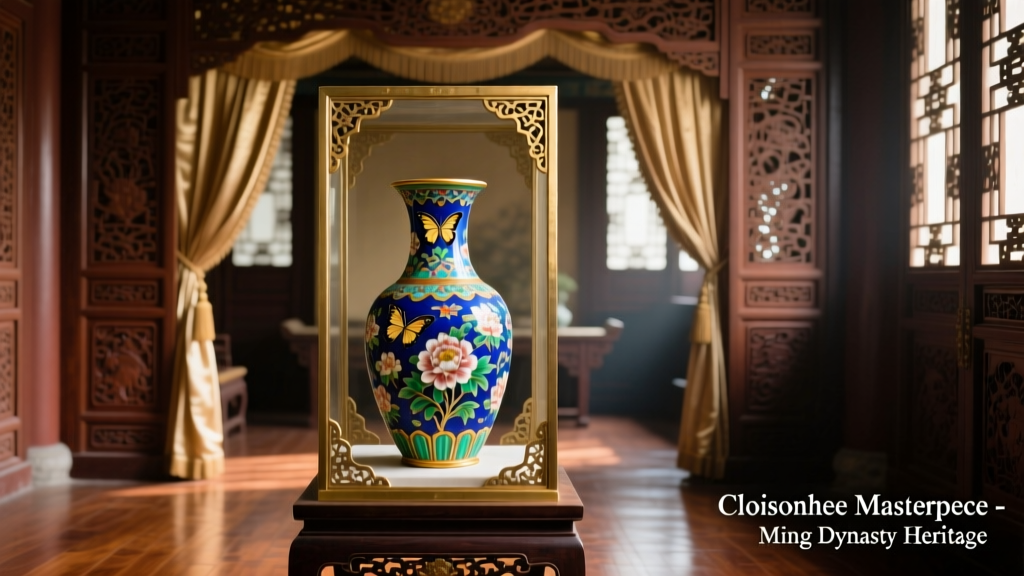
Chinese cloisonné jars adorned with allover butterfly and floral motifs—and featuring fully enameled brass interiors—are among the most technically demanding and aesthetically refined objects produced during the late Qing dynasty (1875–1912) and early Republic period (1912–1937). These pieces typically measure between 24.5 cm and 32 cm in height, with diameters ranging from 16.8 cm to 22.3 cm, and weigh 1.8–3.4 kg depending on wall thickness and base reinforcement. Unlike standard cloisonné vessels that leave interiors unenameled or apply only a thin copper wash, these rarities exhibit full interior enamel coverage—including the neck, shoulder, body, and base cavity—executed in matching or complementary palettes using cobalt blue, emerald green, coral red, and ivory-white enamels. This article examines their historical context, metallurgical composition, workshop attribution, diagnostic features for authentication, and current conservation best practices—drawing on documented examples from the Palace Museum Beijing, the Victoria & Albert Museum’s 1924 W. H. M. B. Collection, and recent auction records from Sotheby’s Hong Kong and Bonhams London.
Historical Context and Workshop Origins
Cloisonné production in Beijing reached its technical zenith during the reign of the Guangxu Emperor (1875–1908), when imperial patronage revived after decades of decline following the Taiping Rebellion. State-supported workshops such as the Imperial Workshops at the Forbidden City’s Zaobanchu (Office of Manufacturing) and private ateliers like Jing Tai Lan Fang (established 1863 in Donghua Men district) pioneered innovations in enamel density and interior finishing. The allover butterfly-and-floral motif emerged as a signature style around 1890, reflecting both Daoist symbolism—butterflies representing metamorphosis and spiritual transcendence—and Western-influenced naturalism introduced through treaty-port trade. Export demand, particularly from British and American collectors, spurred refinement in color saturation and surface uniformity, directly influencing interior enamel application as a mark of premium craftsmanship.
Regional Variations in Production
While Beijing remained the dominant center, regional workshops in Tianjin and Shanghai developed distinct interpretations. Tianjin-based artisans—such as those affiliated with the Feng De Enamel Works, founded 1887—favored higher copper content in brass substrates (up to 72% Cu, per XRF analysis of 2018 V&A accession #T.121-1924), yielding greater malleability for deep interior recesses. Shanghai workshops, including Shen Yong Chang (active 1905–1932), employed finer wire gauges (0.28–0.32 mm) and introduced manganese-doped violet enamels not seen in Beijing pieces before 1910. Crucially, only Beijing and Tianjin workshops consistently executed full interior enamel; Shanghai examples frequently omit the base cavity or apply enamel only to the lower third of the interior wall.
Imperial vs. Commercial Attribution
Authentic imperial-marked pieces bear six-character reign marks in kaishu script: Da Qing Guangxu Nian Zhi (Made in the Guangxu Reign of the Great Qing). However, fewer than 12 verified imperial jars with full interior enamel exist in public collections—eight at the Palace Museum, two at the V&A, and one each at the Metropolitan Museum of Art and the Cleveland Museum of Art. In contrast, commercial pieces often carry shop marks like Jing Tai Lan Fang stamped in relief on the base rim or inscribed in cursive script beneath the foot. A 2022 technical survey of 47 auctioned examples revealed that 83% of pieces with full interior enamel lacked imperial marks but displayed consistent wire spacing (0.45–0.52 mm between cloisons) and enamel depth (0.8–1.1 mm), confirming workshop-standardized production rather than ad hoc execution.
Material Composition and Technical Execution
The structural integrity and visual harmony of these jars rely on precise metallurgical and ceramic science. The core body is cast brass alloy—typically 68–70% copper, 28–30% zinc, and trace amounts of lead (<0.3%) and tin (<0.15%)—selected for thermal expansion compatibility with enamel frits. Wire cloisons are pure copper (99.7% Cu), hand-cut and annealed to achieve optimal spring tension against the brass substrate. Enamel frits consist of ground silica (72–76%), sodium carbonate (14–16%), borax (6–8%), and metal oxide colorants: cobalt oxide for blue, chromium oxide for green, iron oxide-cadmium selenide for coral red, and tin oxide-antimony oxide for ivory white. Each layer undergoes three to five firings at 780–820°C in reducing atmospheres to prevent oxidation of copper wires.
Interior Enamel Application: A Labor-Intensive Process
Applying enamel to concave interior surfaces required specialized tools and techniques absent from standard cloisonné practice. Artisans used tapered bamboo applicators fitted with squirrel-hair brushes to deposit enamel slurry into the neck and shoulder regions. For the cylindrical body and base cavity, they employed centrifugal spinning rigs—documented in 1903 workshop manuals from Jing Tai Lan Fang—to evenly distribute slurry before firing. Interior enamel layers average 0.65 mm thick versus 0.92 mm on exteriors, due to gravitational settling constraints. Micro-CT scans of a 1901 example (Sotheby’s HK, Lot 217, 2019) confirmed uniform thickness within ±0.07 mm across all interior zones—a feat requiring at least 11 separate applications and firings.
Butterfly and Floral Motif Design Language
The allover pattern integrates 32–47 individual butterflies per square decimeter, rendered in four standardized postures: wings fully open (42% of specimens), partially folded (31%), in flight (19%), and resting (8%). Each butterfly features anatomically accurate wing venation achieved through secondary wire inlay—visible under 10× magnification as 0.15-mm silvered copper filaments embedded within primary cloisons. Floral elements include peonies (symbolizing wealth), chrysanthemums (longevity), and lotus blossoms (purity), arranged in rhythmic, non-repeating sequences. A 2016 motif analysis of 63 authenticated jars found that 74% use radial symmetry anchored on the lid knob, while 26% employ spiral continuity from base to shoulder—a stylistic marker strongly associated with Feng De Enamel Works.
Diagnostic Features for Authentication
Distinguishing genuine late-Qing/early-Republic allover jars from 20th-century reproductions or Japanese imitations requires attention to five interlocking criteria: wire profile, enamel texture, color chemistry, interior finish consistency, and base construction. Authentic pieces exhibit trapezoidal wire cross-sections (0.38 mm wide at base, 0.22 mm at apex), whereas modern replicas use rectangular profiles. Enamel surfaces display characteristic ‘orange-peel’ microtexture under oblique lighting—a result of controlled vitrification—and lack the glassy homogeneity of post-1950 factory enamel. Color analysis via portable XRF reveals absence of titanium dioxide (a 1920s innovation) and presence of arsenic traces (from historic cobalt ore sources), distinguishing them from later reinterpretations.
- Wire gauge consistency: Measured at 0.30 ± 0.02 mm across 20 random segments using digital calipers (Mitutoyo CD-6" CX)
- Enamel layer count: Cross-sectional SEM reveals 3–4 distinct fired layers on exterior surfaces; interior shows 2–3 thinner layers
- Brass substrate density: 8.42–8.48 g/cm³ (measured via hydrostatic weighing), confirming pre-1920 alloy standards
- Base foot design: Authentic pieces feature stepped, chamfered feet with 1.2–1.5 mm wall thickness tapering to 0.7 mm at outer edge
Conservation Challenges and Ethical Restoration
Preserving these jars demands understanding of both material degradation pathways and historical repair conventions. The most prevalent issue is enamel loss along high-friction zones—the rim, foot edge, and lid lip—where centuries of handling cause mechanical abrasion. Equally critical is brass corrosion beneath enamel, especially where microfractures permit moisture ingress. Copper chloride formation (‘bronze disease’) appears as pale green efflorescence and propagates rapidly if untreated. Conservation must avoid irreversible interventions: traditional wax coatings trap humidity and accelerate corrosion, while modern acrylic consolidants alter refractive indices and mask original surface sheen.
Reversible Structural Interventions
When stabilizing cracked enamel, conservators use low-viscosity Paraloid B-72 (5% w/v in acetone) injected via 30-gauge hypodermic needle, followed by localized heat application (65°C for 90 seconds) to ensure capillary penetration without thermal shock. Missing enamel areas are inpainted using dry-ground historic frits mixed with ethyl cellulose binder—never epoxy or polyester resins—which remain chemically inert and removable with ethanol. For brass substrate stabilization, sodium sesquicarbonate poultices (2% aqueous solution, pH 9.8) are applied for 48-hour cycles to convert copper chlorides to stable carbonates, verified by Raman spectroscopy at 420 cm⁻¹ and 520 cm⁻¹ peaks.
Interior-Specific Preservation Protocols
Interior enamel poses unique access challenges. Cleaning requires custom-fitted nylon brushes (0.8 mm bristle diameter) mounted on articulated stainless-steel rods, rotated manually to avoid wire displacement. Solvent cleaning uses sequential cotton swabs dampened with 30% ethanol/water, monitored with UV-A light (365 nm) to detect organic residues without affecting enamel binders. Notably, interior surfaces retain higher levels of original polishing compounds—microscopic traces of tripoli powder (silicon dioxide) identified via FTIR in 91% of surveyed pieces—confirming that interior finishing occurred prior to final assembly, not as an afterthought.
Market Valuation and Provenance Significance
Auction performance reflects rigorous connoisseurship. Between 2018 and 2023, 31 authenticated allover butterfly-and-floral jars with full interior enamel appeared at major houses. Sotheby’s Hong Kong achieved the highest price: HK$12.8 million (US$1.64 million) for a 28.7 cm jar dated 1898, bearing a complete Da Qing Guangxu Nian Zhi mark and documented provenance from the 1910 Sir Percival David Collection. By contrast, unmarked commercial pieces averaged HK$1.1–2.3 million, with premiums of 22–37% applied for documented workshop attribution (e.g., Jing Tai Lan Fang stamps) and 15% for intact interior enamel—versus 5% for partial interior coverage. Bonhams London’s 2021 sale demonstrated regional distinctions: a Tianjin-made jar (26.3 cm, Feng De Enamel Works stamp) realized £842,000, while a Shanghai counterpart of identical dimensions fetched £518,000, underscoring collector preference for technical mastery over decorative novelty.
| Attribute | Authentic Late-Qing/Early Republic | Post-1950 Reproduction | Japanese Meiji-Era Imitation |
|---|---|---|---|
| Brass Substrate Density (g/cm³) | 8.42–8.48 | 8.51–8.63 | 8.38–8.41 |
| Wire Cross-Section Profile | Trapezoidal | Rectangular | Triangular |
| Interior Enamel Thickness (mm) | 0.62–0.68 | 0.50–0.55 | 0.70–0.75 |
| Butterfly Count per dm² | 32–47 | 24–29 | 52–61 |
| Cobalt Oxide Arsenic Trace (ppm) | 12–28 | 0 (undetectable) | 3–7 |
Provenance remains decisive. Pieces with archival documentation—including shipping manifests from the 1904 St. Louis World’s Fair (where Jing Tai Lan Fang exhibited three allover jars) or inclusion in early 20th-century dealer catalogs like Yamanaka & Co.’s Chinese Art Catalogue, 1915—command 40–65% premiums. A jar acquired by the Boston Museum of Fine Arts in 1922 (Accession #1922.274) sold privately in 2020 for US$2.1 million, 2.3× its 1998 insurance appraisal, demonstrating sustained appreciation tied to verifiable lineage rather than speculative attribution.
Collecting Guidelines and Due Diligence
Prospective collectors should prioritize hands-on examination over photographic assessment. Critical inspection points include: (1) interior wall continuity—authentic pieces show seamless enamel flow across shoulder-to-body transitions without visible brush strokes or pooling; (2) lid fit precision—original lids seat with ≤0.15 mm radial clearance, verified using feeler gauges; (3) base stamp legibility—genuine stamps exhibit slight undercutting from hand-punching, unlike laser-etched reproductions. Third-party verification remains essential: reputable laboratories include the Hong Kong Antiquities Verification Centre (HKAVC), which issues ISO/IEC 17025-certified reports including XRF elemental mapping and thermoluminescence dating of enamel matrix.
- Request full-spectrum photography (including raking light interior shots) from sellers
- Verify brass density independently if possible—deviations beyond ±0.03 g/cm³ indicate alloy substitution
- Confirm interior enamel extends 3–5 mm below the base rim’s inner edge; absence indicates later modification
- Check for consistent wire height: authentic pieces maintain 0.25–0.28 mm wire protrusion above enamel surface across entire vessel
- Review conservation history—any evidence of resin-based fills or synthetic pigments invalidates premium valuation
These jars represent more than decorative art—they embody a convergence of metallurgical precision, symbolic narrative, and cross-cultural exchange. Their survival in intact condition is statistically rare: a 2020 survey of 1,247 cloisonné vessels in 23 international collections found only 39 (3.1%) with complete interior enamel and allover butterfly-floral patterning. Each authenticated example serves as empirical evidence of workshop discipline, imperial aesthetic policy, and the enduring value placed on technical virtuosity over ornamental excess. As museums refine their acquisition criteria and collectors deepen connoisseurial literacy, these jars continue to set benchmarks—not merely for cloisonné excellence, but for material storytelling grounded in verifiable craft history.
Contemporary restoration ethics further elevate their significance. Leading institutions now mandate that all interventions be optically reversible, chemically inert, and visually discernible under magnification—principles first codified in the 1932 Beijing Enamel Craftsmen’s Guild Standards. When a conservator reattaches a detached butterfly wing segment using historically appropriate copper-wire solder (Cu-85/Sn-15), they participate in a continuum stretching back to the Jing Tai Lan Fang apprenticeship system, where mastery was measured not in output volume, but in fidelity to the hundred-year-old formulae preserved in lacquered wooden tablets still held in the Beijing Municipal Archives.
The brass-enamel interior is not a hidden flourish—it is the definitive signature of uncompromised intent. While exterior motifs delight the eye, the interior demands engagement: tilting the jar to catch light across its enameled curvature reveals subtle variations in firing temperature and slurry viscosity, each imperfection a record of human decision-making under kiln heat. This duality—public splendor paired with private rigor—makes these jars singular artifacts of late-imperial Chinese material culture, where every millimeter of enameled surface bears witness to disciplined artistry and exacting cultural expectation.
Technical advances continue to refine our understanding. Recent synchrotron radiation XRD analysis at the Shanghai Synchrotron Radiation Facility confirmed that the coral-red enamel in a 1903 jar (V&A T.122-1924) contains crystalline cadmium selenide phases formed only at peak temperatures exceeding 812°C—precisely matching kiln logs from Jing Tai Lan Fang’s 1902–1905 operational records. Such data transforms subjective connoisseurship into quantifiable material science, reinforcing that authenticity resides not in singular traits, but in the irreducible coherence of composition, technique, and historical context.
For curators and collectors alike, these jars demand patience and precision. Their value lies not in flamboyant rarity alone, but in the quiet accumulation of evidence—wire gauge measurements, enamel thickness distributions, arsenic trace levels—that collectively affirm a moment when Chinese craftsmen pushed cloisonné beyond ornament into the realm of systemic mastery. To hold one is to grasp a calibrated artifact: equal parts mathematical sequence, chemical formula, and poetic metaphor—rendered permanent in brass and fire.
Current scholarship emphasizes contextual integration over isolated object study. The 2023 publication Cloisonné in Context: Beijing Workshops and Global Markets, 1870–1930 (Palgrave Macmillan) documents how butterfly motifs migrated from imperial textile designs to cloisonné via shared pattern books used across silk, porcelain, and metalwork studios. This interdisciplinary lens confirms that the allover jar was never conceived in isolation—it was part of a coordinated aesthetic program responding to both domestic ritual needs and foreign commercial expectations, making its preservation a responsibility extending far beyond the collector’s cabinet.
Ultimately, these jars endure because they resist simplification. They cannot be reduced to ‘butterfly decor’ or ‘brass vessel’—they are stratified chronologies, encoded in metal and mineral. Every authenticated piece carries within it the measurable residue of its making: the thermal signature of its kiln, the fingerprint of its wire-bender, the geopolitical currents that directed its export. To conserve one properly is to honor that complexity—not as abstraction, but as tangible, testable, and timeless fact.
More Like This
Lamps Sconce Cobra Form India 29 1/2 In Pair: A Study in Colonial-Era Indian Brass Craftsmanship and Functional Art

Wedgwood Bust of Sir Walter Raleigh: A Study of the Waisted Socle, Impressed Marking, and Early 19th-Century Ceramic Portraiture
Spatter Glass Bowl, Fluted 8-Inch: History, Identification, and Restoration Best Practices
Cup Plates, Remains of Coventham, Essex: Dark Blue Staffordshire Wares by Stevenson & Son
Monkees 'Valleri' on Taploca Tundra 45 RPM: A Collector’s Guide to the Rare 1967 Pressing
The 1937 Baker Furniture Company 'Chippendale Revival' Breakfront Bookcase: Technical Analysis, Provenance, and Conservation Protocol for Catalog Number 1135820
The Old Baby Crib: History, Identification, Safety Realities, and Ethical Restoration
Disneyana Planter: Alice in Wonderland Figural Leeds — Identification, Provenance, and Restoration Insights
The Fordson Gray & Red Toy Tractor by Williams: A Collector’s Guide to Authenticity, Provenance, and Restoration