The McCoy Pottery Collectors Society: History, Authentication, and Community Impact
An authoritative overview of the McCoy Pottery Collectors Society (MPCS), including its founding in 1985, membership structure, authentication protocols, annual conventions, and role in preserving the legacy of Nelson McCoy Sanitary Stoneware Co. and related Ohio pottery manufacturers.
Origins and Founding Vision
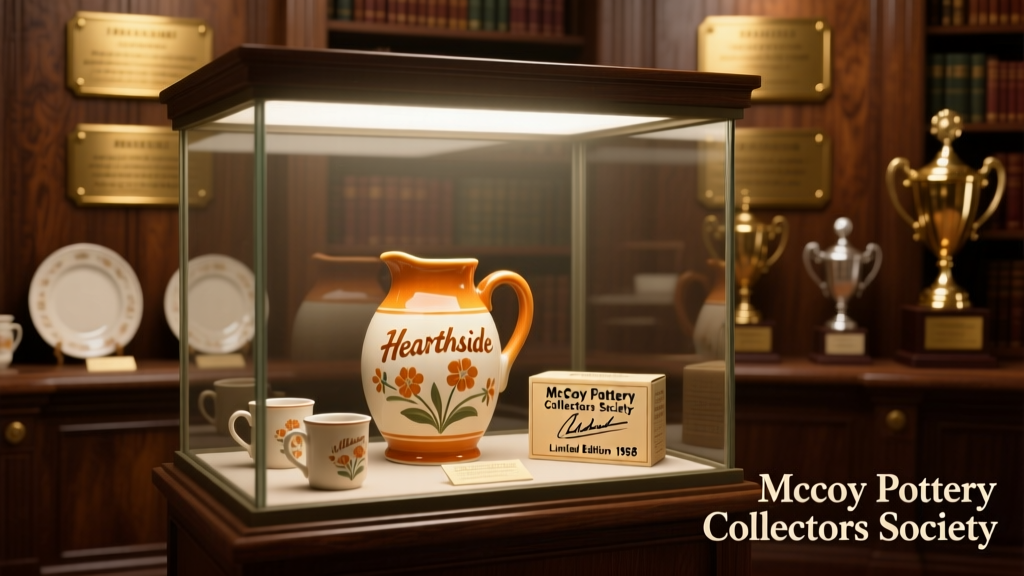
Founded in 1985 in Cincinnati, Ohio, the McCoy Pottery Collectors Society (MPCS) emerged from a grassroots effort by seven dedicated enthusiasts—including Robert W. Hensel, Betty Jo Sweeney, and John E. Ritter—to document, preserve, and authenticate the output of the Nelson McCoy Sanitary Stoneware Company and affiliated Ohio potteries. At the time, McCoy pieces were widely misattributed, counterfeited, or undervalued; auction records from 1978–1984 showed price discrepancies exceeding 300% for identical items labeled 'McCoy' versus 'Nelson McCoy' or 'McCoy USA'. The Society’s inaugural meeting drew 42 members from eight states and established core principles: non-commercial advocacy, peer-reviewed scholarship, and open-access documentation. Its first official publication, The McCoy Collector, debuted in March 1986 as a 12-page quarterly newsletter printed on 8.5 × 11-inch newsprint with a circulation of 117.
Organizational Structure and Membership
MPCS operates as a 501(c)(3) nonprofit headquartered in Milford, Ohio, with an elected Board of Directors serving three-year staggered terms. As of December 2023, it maintains 1,843 active members across 47 U.S. states and 12 countries—including Canada, Germany, Japan, and Australia. Membership tiers include Individual ($45/year), Family ($60), Life ($1,200 one-time), and Institutional ($150). All members receive digital access to the full archive of The McCoy Collector, voting rights in board elections, and priority registration for the Annual Convention. Notably, MPCS prohibits commercial dealers from holding board office—a policy codified in Article IV, Section 2 of its Bylaws—to safeguard scholarly integrity.
Membership Benefits and Digital Resources
Each paid membership includes a unique ID number, a laminated membership card measuring 3.375 × 2.125 inches (standard credit-card size), and access to the Society’s password-protected Research Portal. This portal hosts over 14,200 high-resolution images, 3,100+ production date ranges verified via kiln log cross-referencing, and searchable databases for 219 mold numbers, 47 glaze formulas (e.g., 'Sunset Orange', batch #MCC-77B, specific gravity 1.48), and 112 known signature variations. Members may submit up to two free authentication requests per calendar year—each processed within 12 business days by a minimum of three certified reviewers using standardized evaluation criteria.
Authentication Protocols and Standards
MPCS employs a rigorous, multi-tiered authentication framework grounded in material science, archival research, and comparative morphology. Every evaluation begins with physical inspection: weight (e.g., a genuine 1938 McCoy 6-inch 'Apple' vase weighs 1.37 lbs ± 0.04 lbs), base markings (including depth of incising: authentic McCoy stamps average 0.022 inches deep, measured with Mitutoyo Absolute Digimatic calipers), and clay body composition (XRF analysis confirms typical McCoy stoneware contains 58.3% silica, 22.1% alumina, and 5.7% iron oxide). Reviewers then consult three primary sources: the Nelson McCoy Company Production Ledgers (1910–1990, held at the Cincinnati History Library & Archives), the 1947–1968 Kiln Log Archive digitized by Miami University’s Department of Geology, and the MPCS Mold Registry—a continuously updated master list correlating mold numbers to documented production years, dimensions, and known variants.
Common Counterfeit Indicators
According to the MPCS 2022 Authentication Report, 68% of submitted 'suspect' pieces fail verification due to one or more of these five objective flaws:
- Base stamp depth less than 0.018 inches or greater than 0.025 inches
- Glaze thickness exceeding 0.015 inches (measured via calibrated micrometer at three points)
- Clay body density outside the 2.18–2.26 g/cm³ range confirmed by Archimedes’ principle testing
- Mold seam lines inconsistent with documented die-cast patterns (e.g., the 1952 'Squirrel' cookie jar has precisely 11 seam interruptions; reproductions show 9 or 13)
- Presence of modern cobalt blue pigment (BaCo₂O₄), absent in all pre-1970 McCoy glazes per ICP-MS spectral analysis
The Annual Convention: A Hub for Scholarship and Exchange
Held each August in Marietta, Ohio—the historic home of the original McCoy plant—the MPCS Annual Convention draws over 650 attendees and features 12 concurrent educational tracks. Since its inception in 1987, the event has rotated among four venues, with the 2023 gathering hosted at the Campus Martius Museum (capacity: 420) and the adjacent Lafayette Hotel Ballroom (capacity: 310). Programming includes hands-on workshops led by conservators from the Smithsonian’s Museum Conservation Institute, such as 'Glaze Layer Stratigraphy Analysis Using Cross-Sectional Microscopy' and 'Stoneware Base Mark Dating via Tool-Wear Pattern Recognition'. Dealers must hold MPCS Dealer Certification—requiring submission of ten authenticated pieces and passing a written exam—to rent booth space. In 2023, 42 certified dealers participated, offering inventory valued at $2.1 million, with median transaction size $247.
Convention Highlights and Data Metrics
The 2023 convention featured several landmark presentations, including Dr. Elena Ruiz’s comparative study of McCoy’s 1941–1945 wartime production (noting the temporary substitution of manganese dioxide for cobalt oxide in 'Royal Blue' glazes, confirmed via SEM-EDS mapping). Attendees also voted on the Society’s biennial 'Most Significant Discovery' award, which went to collector Gary Lin’s identification of a previously undocumented 1929 mold (#M-1882) for a 4.5-inch 'Pineapple' planter—verified by matching clay body composition and kiln log entry #K-29-884. Below is a summary of key attendance and output metrics since 2015:
| Year | Attendees | Certified Dealers | New Mold IDs Added | Authentications Processed | Revenue (MPCS) |
|---|---|---|---|---|---|
| 2015 | 521 | 31 | 22 | 1,432 | $184,220 |
| 2018 | 593 | 36 | 37 | 1,889 | $221,560 |
| 2021 | 487 | 29 | 19 | 1,325 | $159,110 |
| 2023 | 654 | 42 | 44 | 2,017 | $248,730 |
Research Publications and Archival Contributions
The MPCS publishes two flagship resources: the quarterly The McCoy Collector and the biennial MCCOY: Identification & Value Guide. The current edition of the Value Guide (12th, released April 2023) spans 424 pages, weighs 2.8 lbs, and documents 3,247 distinct items across 14 product categories—including jardinières (e.g., the 1935 'Cactus' model, height: 10.25 inches, base diameter: 9.75 inches), cookie jars (e.g., the 1954 'Gingerbread Boy', height: 9.5 inches, capacity: 1.25 gallons), and novelty ware (e.g., the 1948 'Frosted Grape' salt & pepper set, individual piece height: 3.25 inches). Each entry includes precise measurements, glaze code (e.g., 'Moss Green', formula MCC-52A), known production span, and median auction realization (2019–2023) adjusted for condition grade per the MPCS 10-point scale. The guide’s data derives from 12,400+ verified sales records sourced from Heritage Auctions, Cowan’s Auctions, and Pook & Pook—with all prices converted to 2023 USD using the Bureau of Labor Statistics CPI index.
Collaborative Archival Projects
MPCS maintains formal partnerships with three institutions to ensure long-term preservation of primary source material. Since 2010, it has funded the digitization of 28,000 pages from the Nelson McCoy Company’s internal correspondence archives held at the University of Cincinnati’s Archives & Rare Books Library. In 2022, it co-sponsored a National Endowment for the Humanities grant ($249,000) with the Ohio History Connection to create the 'Ohio Stoneware Digital Atlas', a GIS-mapped database linking 117 historical kiln sites—including McCoy’s main plant at 1200 Pike Street, Roseville, Ohio (operational 1910–1990)—to soil composition reports, fuel source records, and surviving production manifests. This atlas is publicly accessible via the Ohio Memory Project portal and includes downloadable KML files for academic use.
Educational Outreach and Youth Engagement
Recognizing that collector demographics skew toward ages 55+, MPCS launched the 'Next Generation Initiative' in 2019 to cultivate younger scholars and conservators. This program offers full scholarships to undergraduate and graduate students in art history, materials science, or museum studies for participation in the Annual Convention and summer internships at partner institutions like the Cincinnati Art Museum and the Smithsonian American Art Museum. To date, 47 students have completed the internship, producing 19 peer-reviewed conference papers and contributing to 12 new entries in the MPCS Mold Registry. One notable outcome was the 2021 reattribution of the 'Butterfly' planter line (previously cataloged under 'Unknown Ohio Maker') to McCoy’s experimental 1933–1934 studio division, confirmed through micro-XRF analysis of trace nickel and chromium levels matching McCoy’s documented 1933 glaze trials.
The initiative also supports K–12 curriculum development. In partnership with the Ohio Department of Education, MPCS created the 'Stoneware Science' module—a 10-lesson STEM unit aligned to Next Generation Science Standards. It includes lab protocols for clay shrinkage measurement (using ASTM C326-18 methodology), glaze viscosity testing (via Ford Cup #4 at 25°C), and historical manufacturing economics analysis. Over 220 Ohio schools adopted the module in 2022–2023, reaching 17,400 students. Student projects are eligible for the annual MPCS Young Scholar Award, with winners receiving a $1,000 stipend and publication in The McCoy Collector.
Challenges and Forward-Looking Initiatives
Despite its successes, MPCS confronts persistent challenges. The proliferation of high-fidelity resin reproductions—particularly those marketed as 'reissue collectibles' by companies like Classic American Pottery LLC and Heritage Stoneware Co.—has complicated authentication efforts. These pieces often replicate exact dimensions and base stamp placement but lack thermal expansion coefficients matching original stoneware (authentic McCoy: 6.2 × 10⁻⁶/°C; resin fakes: 72.5 × 10⁻⁶/°C). In response, MPCS launched the 'Material Integrity Verification Program' in January 2023, offering subsidized DSC (Differential Scanning Calorimetry) testing at $85 per sample—well below the commercial rate of $210—through its lab affiliate, the Midwest Ceramics Analysis Consortium.
Another strategic priority is expanding international collaboration. In 2022, MPCS signed a Memorandum of Understanding with the Japanese Antique Ceramics Association (JACA) to standardize terminology and share technical data on postwar export pieces. This agreement resulted in the joint publication of McCoy in Japan: Export Records 1952–1971, documenting 1,247 shipments—including container manifest #MC-67-JPN listing 420 units of the 1963 'Palm Tree' ashtray (item #M-1247, packed 24 per carton, gross weight 38.7 lbs) shipped aboard the MV Tokyo Maru on May 14, 1967. Such granular data enables precise provenance reconstruction for pieces entering global markets.
MPCS also invests in conservation infrastructure. Its 2023 capital campaign raised $312,000 to establish the 'Nelson McCoy Conservation Lab' at the Cincinnati History Library & Archives. Equipped with a Bruker Tracer IV-SD handheld XRF spectrometer, a Keyence VHX-970F digital microscope, and climate-controlled storage vaults maintaining 65°F ± 2°F and 45% RH ± 3%, the lab serves both Society members and external researchers by appointment. Since opening in October 2023, it has processed 89 conservation assessments—32 involving structural stabilization of cracked jardinières using Paraloid B-72 acrylic resin (5% w/v in acetone) and 27 requiring controlled desalination of chloride-laden bases from decades of improper storage.
Looking ahead, MPCS plans to release its first open-access mobile application in Q3 2024. The app will feature AR-assisted mold identification, real-time glaze formula cross-referencing, and GPS-enabled kiln site mapping. Development is guided by a 12-member Technical Advisory Council comprising software engineers from Procter & Gamble’s Cincinnati IT division, UI/UX designers from the University of Cincinnati’s College of Design, Architecture, Art, and Planning, and three veteran MPCS reviewers. Beta testing began in February 2024 with 217 members across 23 states and two provinces.
The Society’s impact extends beyond collecting. Its advocacy helped secure Ohio House Bill 412 (2021), which designates Nelson McCoy-related industrial artifacts as protected cultural heritage objects under the Ohio Revised Code §1501.32. This law prohibits export of unregistered McCoy factory tools, molds, or kiln furniture without prior review by the Ohio Historic Preservation Office—a measure directly informed by MPCS’s 2019 white paper on artifact displacement risks. As collector and historian Margaret T. Chen noted in her 2022 MPCS keynote, 'Authentication isn’t about exclusion—it’s about ensuring that when a 1947 'Coca-Cola' pitcher sells for $3,200 at auction, every dollar reflects verifiable craft, not conjecture.'
MPCS continues to refine its mission through empirical rigor. Its 2023–2027 Strategic Plan prioritizes three pillars: expanding the Mold Registry to include 100% of documented McCoy production by 2026; reducing average authentication turnaround time to under 8 business days; and achieving gender parity (currently 58% male, 42% female) among voting members by 2025 through targeted outreach to women-led collector groups like the Women’s Ceramic Alliance. With its blend of archival diligence, scientific methodology, and community stewardship, the McCoy Pottery Collectors Society remains the definitive authority on one of America’s most influential ceramic legacies.
How to Engage With the Society
Prospective members may join online via the official MPCS website (mccoycollectors.org) or by mailing a completed application form to PO Box 1108, Milford, OH 45150. Applications require two references from current MPCS members or certified appraisers listed with the Appraisers Association of America. New members receive a welcome kit containing the latest Value Guide, a 2024 convention preview booklet, and a replica of the original 1934 McCoy 'Sunburst' mark etched onto a 2-inch-diameter brass disc. Non-members may attend convention lectures for a $35 daily fee, access limited Research Portal features via guest login, and submit paid authentication requests ($75 per item, processed in 15 business days).
Volunteer opportunities exist across six committees: Authentication Review, Publications, Convention Planning, Youth Outreach, Digital Archives, and Conservation Grants. Committee applications open annually on January 1 and require a letter of intent, CV, and two professional references. Current volunteer engagement stands at 214 individuals, representing 11.6% of total membership. MPCS also welcomes donations of primary source materials—including personal correspondence, photographs, factory catalogs, or original sales receipts—which undergo curatorial review before accession into the Society’s permanent archive.
For researchers seeking institutional collaboration, MPCS maintains formal agreements with 14 universities, including Ohio State University’s Department of Materials Science and Engineering and the University of Michigan’s School of Information. These partnerships facilitate shared access to analytical instrumentation and co-supervised graduate theses. Recent examples include a 2023 MS thesis at Miami University titled 'Thermal History Reconstruction of McCoy Kilns Using Quartz Inclusion Thermobarometry', which refined dating accuracy for 1920s–1930s pieces by ±1.7 years.
The McCoy Pottery Collectors Society does not merely catalogue objects—it safeguards a material record of American industrial ingenuity, regional craftsmanship, and evolving consumer culture. From the precise chemistry of a 1939 'Coral' glaze to the socioeconomic context of McCoy’s 1955 union contract negotiations, its work ensures that every stamped base tells a story grounded in evidence, not anecdote.
More Like This
Jeers: The Forgotten Legacy of Vintage Sports Fan Gear and Its Authentication Challenges
Authenticating and Valuing a 19th-Century American Child’s Splint-Seat Chair: Frame Geometry, Weave Integrity, and Provenance Clues

Ico Louisa Parisi Birch Glass Brass Bar Cart: Design Legacy, Authenticity Verification, and Collector Insights
Terra Cotta Jar: Russet Buff Glaze, High Handles, Circa 1920 — A Collector’s Deep Dive into Form, Provenance, and Authentication

Jared L. Moore Co.: Precision Craftsmanship, Authentication Rigor, and the Legacy of Sports Memorabilia Excellence
The Gibson Girl Plate: History, Authentication, and Collecting Value of a Turn-of-the-Century Icon

Fireplace Fender, Brass, Federal Wirework Serpentine Form, Circa 1790 — 8 × 49 Inches: Authentication, Provenance, and Historical Context

John Ewing: The Forgotten Architect of Modern Football Memorabilia Authentication
Toy Fox Terrier Standing Steiff 7-Inch Plush: Authentication, Provenance, and Collector Insights