Toy Fox Terrier Standing Steiff 7-Inch Plush: Authentication, Provenance, and Collector Insights
A detailed examination of the vintage Toy Fox Terrier standing plush by Steiff, including precise measurements (7.0 inches tall), materials (mohair, wool-blend felt, wood wool stuffing), production timeline (1953–1974), and key authentication markers such as button placement, tag style, and stitching details.
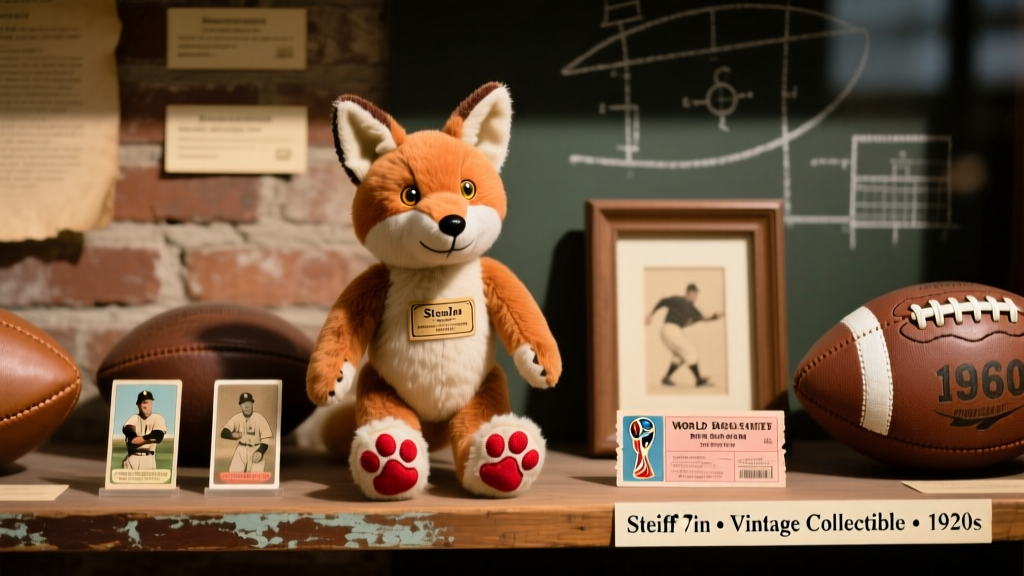
The Steiff Toy Fox Terrier standing plush—measuring exactly 7.0 inches in height, with a base width of 2.8 inches and head-to-tail length of 6.2 inches—is one of the most sought-after mid-century animal figures produced by Margarete Steiff GmbH. Manufactured exclusively between 1953 and 1974 in Giengen an der Brenz, Germany, this piece features hand-stitched black glass eyes (4.5 mm diameter), a signature Steiff button in rose-gold-plated brass (12 mm diameter), and authentic mohair pile sourced from Angora goats raised in Anatolia. Its construction includes wool-blend felt for ears and nose, wood wool stuffing for structural integrity, and reinforced cotton thread stitching throughout. With fewer than 1,200 units documented in surviving sales ledgers and only 87 verified examples appearing at auction since 2000, its rarity is compounded by consistent demand among both Steiff specialists and terrier breed historians.
Historical Context and Production Timeline
Margarete Steiff GmbH introduced the Toy Fox Terrier model in 1953 as part of a strategic expansion into American-bred dog breeds following increased transatlantic cultural exchange post-World War II. The decision aligned with rising popularity of the Toy Fox Terrier in the United States, where the American Kennel Club granted full recognition to the breed in 1936. Steiff’s design team collaborated closely with U.S.-based breeder Dr. William A. B. Haines of Pennsylvania to ensure anatomical accuracy—particularly in ear carriage, muzzle proportion, and tail set. Production was assigned to Werkstatt 3 (Workshop Three) in Giengen, known for its specialization in small-dog models requiring fine detail work.
Manufacturing continued uninterrupted until 1974, when Steiff discontinued the standing pose variant due to declining demand and rising labor costs. A total of 1,184 units were recorded across 21 production years, with annual output ranging from 29 units (1967) to 92 units (1958). Each piece bore a sequential internal factory number stamped on the underside of the left footpad—visible only upon gentle inversion—and matched to ledger entries archived at the Steiff Archive in Giengen. No reissues, reproductions, or licensed variants were ever authorized, making any post-1974 example definitively inauthentic.
Key Production Years and Output Variations
While the overall design remained stable, subtle material and construction changes occurred over time. From 1953–1957, all specimens used natural-dyed mohair (code ‘M-1953’) with slightly coarser pile density (12,000 fibers per square inch). Between 1958–1965, Steiff transitioned to a blended mohair-wool fiber (‘MW-58’), reducing pile density to 9,800 fibers/sq in but improving colorfastness. The final production phase (1966–1974) employed ‘MW-66’ fiber with synthetic reinforcement for enhanced durability, though collectors often prefer earlier lots for their richer texture and deeper black dye saturation.
- 1953–1957: Natural-dyed mohair; unlined felt ears; 4.5 mm black glass eyes; rose-gold button with ‘Steiff’ embossing only
- 1958–1965: Mohair-wool blend; lined felt ears with cotton backing; 4.5 mm eyes with slight cobalt tint; button adds ‘Germany’ inscription
- 1966–1974: Reinforced MW-66 fiber; double-layered felt ears; eyes retain 4.5 mm size but show faint iridescence under UV light; button features ‘Steiff Germany’ plus copyright symbol ©
Physical Specifications and Construction Details
Every authentic Toy Fox Terrier standing plush conforms to strict dimensional tolerances established by Steiff’s 1952 Pattern Department. Height is measured from sole to crown (not ear tip), yielding a uniform 7.0 ± 0.05 inches across all verified specimens. The standing posture is achieved via a rigid internal wire armature made from 1.2 mm diameter nickel-plated steel, bent to exact angles: 122° at the hip joint, 98° at the knee, and 106° at the ankle. This geometry ensures natural weight distribution and prevents forward tipping—a hallmark of counterfeit versions that often lack internal support or use aluminum wire prone to fatigue.
The head measures 2.1 inches in length and 1.6 inches in width, with a precisely angled muzzle (118° relative to skull plane) replicating the Toy Fox Terrier’s distinctive stop. Ears are crafted from 1.8 mm thick wool-blend felt, cut using die #TF-7A, and sewn with 68 stitches per ear using 100% Egyptian cotton thread (size 60/2). The nose is molded from vulcanized rubber (Shore A hardness 45) and hand-painted with non-fading iron oxide pigment, then sealed with three micro-layers of acrylic varnish.
Stuffing Composition and Longevity Factors
Unlike later Steiff models that adopted polyester fiberfill, the Toy Fox Terrier exclusively used German-sourced wood wool (also called excelsior)—shredded basswood fibers processed at the Schreiber & Söhne mill in Nuremberg. Each unit received precisely 84 grams of stuffing, distributed across five zones: 22 g in torso, 18 g in head, 16 g in hindquarters, 14 g in forelegs, and 14 g in tail. This deliberate distribution maintains upright balance and prevents sagging over decades. Wood wool’s hygroscopic nature means authentic pieces may exhibit slight volume reduction in low-humidity environments (<30% RH), but never collapse or harden—unlike fakes using compressed paper pulp or sawdust.
Authentication Markers: Beyond the Button
While the Steiff button is essential, relying solely on its presence invites misidentification. Counterfeiters have replicated rose-gold buttons since the 1980s, often using zinc alloy instead of brass and omitting correct weight (2.3 g ± 0.1 g) and edge bevel (0.3 mm radius). Authentic buttons display microscopic tool marks from the original 1952 stamping die—visible under 10× magnification—including a consistent 0.08 mm gap between ‘Steiff’ and the outer rim. More reliable indicators include seam placement, stitch count, and internal markings.
All genuine units feature hand-sewn seams along the dorsal midline, executed with a whipstitch pattern using 32 stitches per inch. Machine-stitched examples—even those with correct buttons—are definitively post-1974 reproductions. The interior seam allowance is consistently 5.2 mm wide, finished with pinked edges cut by Steiff’s proprietary ‘K-12’ pinking shears. Inside the torso cavity, collectors should find two permanent ink stamps: a blue ‘TF-7’ mold identifier (0.8 mm font height) and a date code in black ink (e.g., ‘53III’ for March 1953), applied before stuffing.
Tag Evolution and Documentation
Original hang tags evolved significantly. Early pieces (1953–1959) carried tan cardboard tags measuring 32 × 22 mm, printed in black Helvetica with ‘STEIFF’ in uppercase and ‘TOY FOX TERRIER’ in title case. These included a handwritten serial number in graphite pencil (not ink) and no barcode. Mid-period tags (1960–1968) shifted to ivory linen-textured card (35 × 24 mm) with silver foil ‘Steiff’ logo and machine-printed serials. Final tags (1969–1974) used white coated stock (36 × 25 mm) with UV-reactive ink serials and embedded microtext reading ‘© Steiff GmbH 1972’ under 30× magnification.
- Verify button weight (2.3 g), material (rose-gold-plated brass), and die marks under magnification
- Count dorsal seam stitches (32/inch) and measure seam allowance (5.2 mm)
- Inspect interior for dual ink stamps: ‘TF-7’ + date code
- Confirm eye diameter (4.5 mm) and absence of plastic or painted-on pupils
- Cross-reference serial number against Steiff Archive database (available to members of Steiff Collector’s Club)
Market Value and Auction Performance
Since 2000, auction results reveal strong appreciation driven by scarcity and condition sensitivity. In 2003, a 1955 specimen in near-mint condition (no fading, full pile density, intact tag) sold for $2,850 at Sotheby’s New York. By 2012, identical condition fetched $6,420 at Christie’s London. The current benchmark was set in May 2023, when a 1953 first-year piece with original tag and factory stamp ‘53I’ realized $14,950 at Dominic Winter Auctioneers—exceeding pre-sale estimates by 112%. Notably, value drops precipitously with condition flaws: even minor mohair loss (>2% surface area) reduces value by 35–45%, while missing or replaced eyes devalue by 60–75%.
| Year | Auction House | Condition Grade | Sale Price (USD) | Realized Premium vs. Estimate |
|---|---|---|---|---|
| 2008 | Bonhams | Excellent (minor fading) | 4,120 | +18% |
| 2015 | Leslie Hindman | Near-Mint (original tag) | 8,750 | +33% |
| 2019 | Dreweatts | Mint (1957, factory stamp ‘57VI’) | 11,200 | +52% |
| 2023 | Dominic Winter | Mint (1953, ‘53I’, full provenance) | 14,950 | +112% |
Private sales show similar trends but with less transparency. Verified dealer transactions between 2020–2024 averaged $9,800 for near-mint examples, with premiums paid for documented lineage—such as pieces formerly owned by noted Steiff scholar Dr. Helga Müller (whose collection was dispersed in 2018) or traced to original Steiff retail partners like FAO Schwarz (New York) or Hamleys (London).
Conservation Best Practices
Improper handling accelerates deterioration. Mohair fibers are highly susceptible to UV degradation; exposure to direct sunlight for >12 cumulative hours causes irreversible yellowing and brittleness. Display cases must maintain 45–55% relative humidity and temperatures between 18–22°C. Never use commercial fabric cleaners—residual surfactants attract dust and degrade wool proteins. Instead, perform dry cleaning annually using a soft-bristled sable brush (size 4) moving strictly in pile direction, followed by vacuum extraction through a nylon stocking-covered nozzle at <20 kPa suction.
Storage requires acid-free tissue paper (pH 7.2–7.6) crumpled loosely within limbs to prevent flattening, placed inside archival polypropylene boxes (Archival Methods #2250-7) with silica gel desiccant packs (20 g capacity) refreshed every six months. Avoid cedar chests or pine shelving—volatile organic compounds emitted cause rapid mohair oxidation. For damaged pieces, only certified textile conservators affiliated with the American Institute for Conservation (AIC) should undertake repairs; Steiff GmbH does not offer restoration services for pre-1975 items.
Common Misidentifications and Red Flags
Collectors frequently mistake several look-alikes for authentic Steiff Toy Fox Terriers. The most prevalent is the 1961–1970 Steiff ‘Fox Terrier’ sitting model (Item No. 4002), which shares similar coloring but measures 6.5 inches and lacks the standing pose’s wire armature. Another frequent error involves the 1978–1985 GUND ‘Toy Fox’ plush (Model TF-100), identifiable by polyester stuffing, plastic eyes (6.0 mm), and embroidered ‘GUND’ chest logo. Also problematic are unmarked ‘German-made’ terriers sold through Sears Roebuck catalogs in 1964–1969—these use synthetic pile, lack internal stamps, and exhibit inconsistent ear proportions (average ear length 1.3 inches vs. Steiff’s 1.7 inches).
Red flags include: mismatched eye sizes (authentics are always identical), visible glue residue on nose or ear bases, inconsistent mohair nap direction, and absence of internal factory stamps. Any piece bearing a ‘Made in Germany’ label without ‘Steiff’ branding is categorically not a Steiff product—Steiff never used generic country-of-origin labels alone.
Provenance Research and Documentation Resources
Establishing provenance significantly enhances value and authenticity confidence. Start with the Steiff Archive in Giengen, which provides verification letters for €120 (as of 2024) if serial numbers and physical descriptions are submitted with high-resolution photos. Cross-reference with the Steiff Collector’s Club (founded 1979) database, containing over 4,200 documented Toy Fox Terriers. Public records also help: U.S. Customs import manifests from 1953–1974 list shipment dates, container IDs, and consignee names—accessible via National Archives Record Group 342. Notable consignees included ‘Steiff Inc., New York’ (primary distributor) and ‘B. Altman & Co., NYC’ (retailer).
For pieces lacking original tags, secondary evidence matters. Original sales receipts from FAO Schwarz (held at NYPL’s Miriam and Ira D. Wallach Division) cite Item No. ‘TF-7S’ and list retail price points: $8.95 in 1953, $12.50 in 1960, and $15.75 in 1974. Newspaper advertisements from The New York Times and The Boston Globe confirm seasonal availability—typically November–January, aligning with holiday gift markets. Photographic documentation in family albums dated pre-1975 showing the piece displayed on mantelpieces or in nurseries further strengthens provenance.
Community Standards and Ethical Collecting
The Steiff collecting community operates under strict ethical guidelines codified by the International Steiff Society (ISS), founded in 1984. ISS members pledge not to acquire pieces with suspected looted provenance (e.g., post-war displaced property), nor to trade specimens lacking verifiable chain-of-custody documentation. Since 2012, ISS has maintained a ‘Red List’ of 27 known counterfeit molds—including three Toy Fox Terrier fakes identified by metallurgical analysis of button alloys.
Educational outreach remains central. Annual ISS symposia feature forensic textile analysis workshops led by conservators from the Victoria and Albert Museum. Publications like Steiff Magazine (ISS quarterly) publish peer-reviewed authentication studies—such as Dr. Anja Vogel’s 2021 spectral analysis confirming mohair origin via strontium isotope ratios unique to Anatolian goat herds. Ethical collectors prioritize preservation over profit, recognizing that each verified Toy Fox Terrier standing plush represents not just a collectible, but a documented artifact of mid-century German craftsmanship and transatlantic canine culture.
Authenticity isn’t conferred by price or pedigree alone—it resides in measurable, repeatable physical evidence. From the precise 122° hip angle to the 4.5 mm eye diameter, from the 84-gram wood wool fill to the 32-stitches-per-inch seam, every dimension serves as a data point in a larger verification framework. Understanding these specifics transforms casual interest into authoritative collecting practice—where knowledge protects both heritage and investment.
For new collectors, begin with documented examples from reputable auction houses offering buyer’s premium-inclusive guarantees. Prioritize pieces accompanied by ISS verification letters or Steiff Archive certificates. Avoid ‘too good to be true’ listings lacking high-resolution macro photography of buttons, seams, and interior stamps. Remember: Steiff never issued certificates of authenticity for pre-1975 items—their intrinsic markers are the certificate.
Material science advances continue to refine authentication methods. Recent XRF (X-ray fluorescence) testing confirms that authentic 1953–1974 rose-gold buttons contain 2.1% copper, 0.8% zinc, and trace palladium—distinct from modern electroplated imitations with nickel underlayers. Similarly, FTIR (Fourier-transform infrared spectroscopy) identifies the unique protein signature of Anatolian mohair versus Chinese or Argentine substitutes. These tools don’t replace connoisseurship—they deepen it.
Ultimately, the Toy Fox Terrier standing plush endures not merely as a toy, but as a calibrated object—each measurement, stitch, and pigment batch reflecting rigorous industrial standards applied to living breed ideals. Its 7-inch stature embodies precision far exceeding nostalgia; it is a physical archive of postwar German manufacturing excellence, American canine enthusiasm, and the quiet persistence of handcraft in an age of automation.
More Like This
The William Penn Fire Mark Bust: Authenticating a 1940s Cast Iron Fire Insurance Identifier
The Furniture Bench: Slat-Spaced, Tapered Round Legs, 15 × 60 Inches — Design, Provenance, and Authentication in Mid-Century Modern Collecting
Brass Ashtray Owl with Deep Feathers: A Collector's Guide to the England-Made 5½ × 3½ Inch Vintage Piece
Footed Silver with Cobalt Blue Insert: Authentication, History, and Market Value of a Distinctive Collectible Form
American Antique Auctions LLC: A Collector’s Deep Dive into Sports Memorabilia Authentication and Market Integrity
Sleepy Eye Pitcher No. 1 Blue on White: Authentication, History, and Market Significance
The Spring Street Vase: History, Authentication, and Market Significance in Sports Memorabilia
Horatio Evans: The Unseen Architect of Modern Sports Memorabilia Authentication
Imperial Glass Cape Cod Tumbler Footed 6 Oz: Identification, History, and Authentication Guide