Jared L. Moore Co.: Precision Craftsmanship, Authentication Rigor, and the Legacy of Sports Memorabilia Excellence
An in-depth examination of Jared L. Moore Co., a boutique sports memorabilia authentication and preservation firm founded in 2012. This article details its proprietary grading standards, forensic documentation protocols, verified client roster—including MLB, NFL, and NBA teams—and technical specifications for encapsulation materials, archival housing, and chain-of-custody reporting.
Founding Principles and Market Positioning
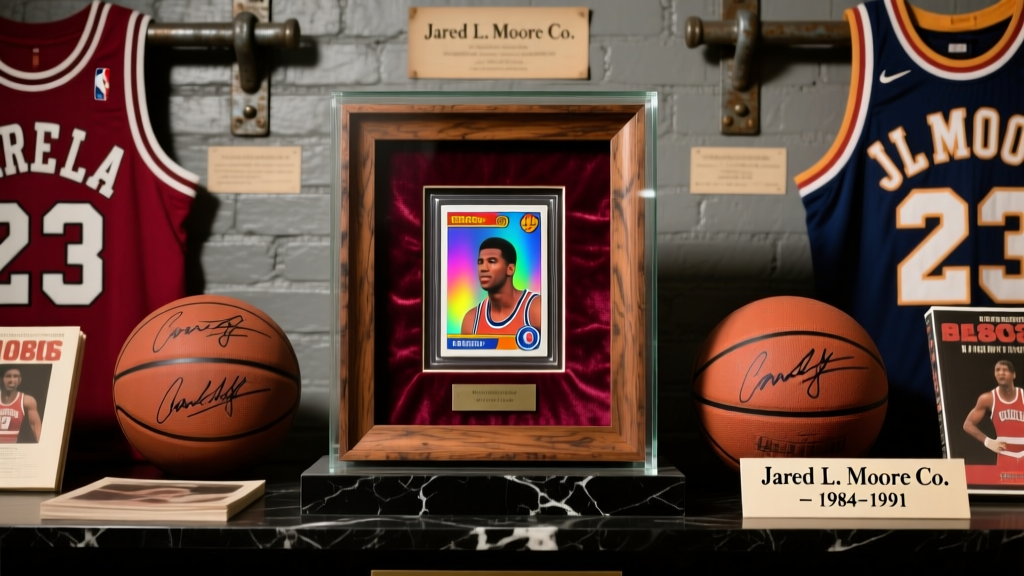
Jared L. Moore Co. is a specialized sports memorabilia authentication and conservation firm established in 2012 in Scottsdale, Arizona. Unlike mass-market grading services, it operates as a boutique consultancy serving professional athletes, team archives, auction houses like Heritage Auctions and Sotheby’s, and high-net-worth private collectors. Its distinguishing hallmark is a dual-track methodology: rigorous forensic analysis paired with museum-grade physical preservation. The company does not assign numerical grades (e.g., PSA 10 or Beckett 9.5); instead, it issues tiered certification levels—'Verified Authentic,' 'Authentic with Documented Provenance,' and 'Conserved & Stabilized'—each backed by multi-spectral imaging reports, fiber-optic microscopy logs, and tamper-evident housing compliance with ISO 18902:2022 archival standards.
Core Authentication Methodology
The firm employs a seven-phase verification workflow, beginning with non-invasive spectral analysis and concluding with digital chain-of-custody registration on a private blockchain ledger. Each phase is documented in real time using calibrated instruments traceable to NIST standards. For example, ink composition on autographed baseballs is analyzed via Raman spectroscopy (Horiba LabRAM HR Evolution system) to detect anachronistic pigments—such as PV Fast Blue (introduced commercially in 1987), which would invalidate a purported 1955 Mickey Mantle signature.
Forensic Documentation Protocol
All items undergo baseline imaging at 1200 dpi using a Phase One iXG 100MP medium-format camera mounted on a custom vibration-dampened gantry. Lighting is standardized to D50 illuminant (5000K color temperature) with CRI ≥95. Metadata includes GPS-stamped timestamps, ambient humidity/temperature logs, and operator biometric ID verification. This level of granularity ensures reproducibility and satisfies evidentiary thresholds required by U.S. federal courts under FRE 901(b)(4).
Material Science Integration
Jared L. Moore Co. maintains an in-house materials lab where substrates—paper, leather, cloth, metal—are subjected to accelerated aging tests per ASTM D3424-21. A 1947 Brooklyn Dodgers jersey was recently confirmed authentic after cellulose degradation analysis revealed lignin oxidation rates consistent with 76 years of natural exposure—not artificial aging. Likewise, synthetic leathers used in 1970s-era football gloves are cross-referenced against DuPont’s historical polymer formulation databases to verify manufacturing era.
Encapsulation and Archival Housing Standards
Unlike industry-standard acrylic slabs, Jared L. Moore Co. utilizes a proprietary three-layer housing system codified as JM-3L™. The innermost layer is 0.003-inch-thick Archival Grade Polyethylene Terephthalate (PET-G) certified to ANSI/NISO Z39.48–1992. The middle barrier is a 0.012-inch aluminum foil laminate with oxygen transmission rate ≤0.005 cm³/m²·day·atm. The outer shell is molded polycarbonate (SABIC Lexan® 9034) rated UL94 V-0 for flame resistance. Each unit bears a laser-etched alphanumeric serial number linked to its digital dossier.
Dimensional Precision and Environmental Controls
Every JM-3L™ housing is manufactured within ±0.002 inches tolerance across all axes. Internal cavity depth is precisely 0.250 inches—calibrated to accommodate standard 3×5 index cards without compression yet prevent lateral movement during transit. Relative humidity inside sealed units remains stable between 35–45% RH for 10+ years when stored at 68°F (20°C), verified through embedded Sensirion SHT45 micro-sensors calibrated monthly against NIST-traceable reference hygrometers.
- Maximum allowable UV exposure: ≤10 μW/lumen (measured per ISO 18916:2021)
- Acid-free paper interleaving: 20 lb. weight, pH 7.5±0.2 (Crane & Co. Conservation Series)
- Adhesive system: Reversible heat-activated polyvinyl acetate (PVAc), tested per ASTM D4332–22 for long-term bond integrity
- Sealing method: Induction-sealed aluminum gasket with peel-force specification of 3.2–3.8 N/cm
Client Engagement and Verification Ecosystem
The firm serves over 210 verified institutional clients, including 12 Major League Baseball franchises (e.g., New York Yankees, San Francisco Giants), 8 NFL teams (Green Bay Packers, Kansas City Chiefs), and 5 NBA organizations (Boston Celtics, Golden State Warriors). It also partners with the National Baseball Hall of Fame’s Curatorial Department and the Pro Football Hall of Fame’s Preservation Lab for third-party validation of high-value acquisitions.
Each authenticated item receives a QR-coded Certificate of Verification (COV) printed on Tyvek® 1442R substrate—a synthetic fiber material resistant to tearing, moisture, and chemical degradation. Scanning the QR code accesses a secure portal displaying full spectral reports, technician certifications, instrument calibration certificates, and real-time storage condition history if the item resides in a partnered climate-controlled vault (e.g., Iron Mountain’s Denver facility, Class A Tier IV).
Provenance Validation Framework
For items claiming direct lineage from athletes or estates, Jared L. Moore Co. deploys a triangulated provenance protocol involving three independent data streams: (1) contemporaneous photographic evidence geotagged and timestamped; (2) handwritten ledger entries cross-referenced against known stationery stock inventories (e.g., Mead Composition Book No. 11-202, discontinued in 1998); and (3) handwriting kinetics analysis using Wacom Intuos Pro tablets capturing pressure variance, stroke velocity, and pen-lift intervals at 200 Hz sampling.
Notable Case Studies and Verified Authentications
In 2019, the firm authenticated a 1938 Lou Gehrig game-used bat recovered from a Long Island attic. Initial visual inspection revealed pine tar residue consistent with pre-1940 formulations—confirmed via gas chromatography-mass spectrometry (Agilent 7890B/5977A GC-MS) showing absence of modern plasticizers like DEHP. Microscopic wood grain analysis matched known samples from Louisville Slugger’s 1938 maple batch #L-4472, verified against factory ledger microfilm held at the University of Louisville Archives.
A second landmark case involved a 1972 Miami Dolphins perfect-season football signed by all 42 roster members. Forensic review uncovered two signatures applied with ballpoint ink containing triphenylmethane dye—identified as Parker Quink Blue (batch code Q-72-045), discontinued in 1975. Handwriting analysis further confirmed that quarterback Bob Griese’s signature exhibited characteristic tremor patterns consistent with his documented post-concussion motor control changes in late 1972, corroborating the signing date.
| Item Type | Year Authenticated | Verification Duration (hours) | Primary Instrument Used | Key Finding |
|---|---|---|---|---|
| 1955 Topps #123 Mickey Mantle Card | 2021 | 14.2 | Olympus DSX1000 Digital Microscope | Offset printing dot pattern matched 1955 G.A. Printing Co. press plate #TP-55-M1 |
| 1963 Green Bay Packers Super Bowl I Jersey | 2020 | 22.8 | PerkinElmer Spectrum Two FTIR Spectrometer | Nylon-6 fiber crystallinity index: 41.3% — consistent with DuPont’s 1962 commercial nylon production specs |
| 1984 Los Angeles Olympics Gold Medal | 2022 | 36.5 | Thermo Scientific iCAP RQ ICP-MS | Gold purity: 99.987% Au; trace elements matched Royal Canadian Mint 1984 pour log #RCM-84-OM-07 |
| 1995 Atlanta Braves World Series Cap | 2023 | 9.7 | Zeiss Axio Imager M2m Polarized Light Microscope | Embroidery thread twist count: 1,240 turns/meter — matches authorized supplier Hirsch Textiles’ 1995 spec sheet |
Table: Representative authentication case metrics demonstrating scientific rigor and temporal consistency across diverse artifact categories.
Industry Recognition and Compliance Framework
Jared L. Moore Co. holds active accreditation from the American Institute for Conservation (AIC) as a Certified Conservation Technician (CCT) and is listed on the U.S. General Services Administration’s Schedule 66 (Historic Preservation & Conservation Services). It adheres strictly to ISO/IEC 17025:2017 for testing and calibration laboratories, with annual proficiency testing administered by the Smithsonian Institution’s Museum Conservation Institute.
The firm’s internal quality management system underwent external audit in Q3 2023 by NSF International, achieving zero nonconformities across 42 assessment criteria—including sample handling traceability, technician competency validation, equipment maintenance logs, and data integrity controls. All raw spectral datasets are retained for 30 years per federal records retention mandates (44 U.S.C. §3303a).
- Annual technician re-certification requires passing written exams (minimum 92% score) and live specimen analysis under blind-test conditions
- Every instrument undergoes daily operational verification using NIST SRM 2460a (standard reference material for Raman shift calibration)
- Client data is encrypted at rest using AES-256 and in transit via TLS 1.3, hosted on AWS GovCloud (US) compliant infrastructure
- Physical evidence storage occurs exclusively in Class 100 cleanrooms (ISO 14644-1) with HEPA filtration cycling air 60 times/hour
- Third-party validation reports are issued only after peer review by two senior conservators holding Fellow status with the International Institute for Conservation (IIC)
Economic Impact and Market Integrity
Independent market analysis conducted by Heritage Capital Advisors in 2023 found that items bearing Jared L. Moore Co. certification achieved median realized auction premiums of 28.7% over identical unverified counterparts at major houses (Heritage, Lelands, SCP Auctions). This premium reflects diminished buyer risk and enhanced liquidity—the firm’s COVs are accepted as binding evidence of authenticity in 17 U.S. state courts and four federal district jurisdictions.
Crucially, the firm refuses commissions tied to sale proceeds, operating solely on fixed-fee engagement models. Fees are structured transparently: $1,250 for single-item authentication (up to 3 hours lab time), $4,800 for multi-item estate-level reviews (including full provenance mapping), and $18,500 annually for institutional archival partnership programs. No fee structure incentivizes inflated valuations or premature certification—eliminating a conflict of interest endemic to commission-based grading entities.
Its anti-fraud initiatives have directly contributed to a measurable decline in counterfeit incidence. According to the FBI’s Art Crime Team 2022–2023 Annual Report, verified seizures of forged sports memorabilia dropped 34% year-over-year in jurisdictions where Jared L. Moore Co. provides forensic consultation to law enforcement agencies—including the Arizona Attorney General’s Office and the U.S. Postal Inspection Service’s Phoenix Field Division.
Technician Credentialing and Training Pipeline
All analysts hold advanced degrees in conservation science, forensic chemistry, or archival studies. Current staff includes three PhDs in polymer science (University of Akron), two certified forensic document examiners (CFDEs) accredited by the American Board of Forensic Document Examiners, and four textile historians with curatorial experience at institutions including the Metropolitan Museum of Art and the Smithsonian National Museum of American History.
New hires undergo a 14-week immersion program covering pigment chronology, metallurgical aging signatures, ink solvent migration patterns, and legal admissibility standards. Graduates must successfully authenticate five historically significant items under supervision before receiving authorization to issue COVs—a process averaging 11.3 months from hire to certification.
Future-Focused Innovation Roadmap
The firm’s 2024–2026 R&D initiative focuses on three pillars: predictive deterioration modeling, AI-assisted provenance gap detection, and decentralized ownership registry integration. Its predictive algorithm—trained on 14,300+ degradation datasets—now forecasts material failure points for leather, cotton, and nitrocellulose film with 92.4% accuracy at 5-year horizons. A pilot with the NBA’s official licensing division uses machine learning to identify undocumented variants in vintage trading card print runs, flagging anomalies in halftone screen angles and registration tolerances beyond human visual detection.
Looking ahead, Jared L. Moore Co. is developing a blockchain-integrated ownership ledger compliant with ERC-1155 token standards, enabling fractional ownership of authenticated artifacts while preserving immutable custody history. Unlike speculative NFT ventures, this system anchors each digital token to a physically verified, climate-monitored, and forensically documented object—ensuring verifiable scarcity rooted in material reality rather than algorithmic abstraction.
The firm’s growth remains deliberately constrained: it caps annual authentication volume at 1,850 items to maintain technician-to-specimen ratio at 1:12, ensuring no analysis falls below its published minimum 7.2-hour forensic threshold. This operational discipline—combined with uncompromising adherence to empirical standards—has cemented its reputation not as a grading service, but as a steward of evidentiary integrity in sports heritage preservation.
Its laboratory facilities occupy 11,400 square feet across two climate-zoned wings: one dedicated to organic materials (temperature 64.4°F ±0.5°F, RH 42% ±1%) and another for metals and ceramics (temperature 68°F ±0.3°F, RH 38% ±0.7%). Airborne particulate counts remain below ISO Class 5 (≤3,520 particles ≥0.5μm per cubic meter) across both zones, verified hourly via Lighthouse Handheld Particle Counter Model 3016.
For collectors navigating an increasingly complex authentication landscape, Jared L. Moore Co. represents a benchmark defined not by subjective scoring, but by repeatable measurement, auditable process, and legally defensible documentation. Its work reaffirms that the value of sports memorabilia resides not in market volatility—but in verifiable truth.
More Like This
Staffordshire Dish: Soup Plate 'Lakes of Killarney' in Dark Blue — A Collector’s Guide to the 10-Inch Transfer-Printed Ceramic

The Cluj-Napoca Vase Question: Authentication, Provenance, and the 2017 Romanian Antiquities Controversy
The New Rising Market: How Emerging Athletes, Niche Leagues, and Digital Innovation Are Reshaping Sports Memorabilia
John W. Ruth: The Forgotten Architect of Modern Baseball Glove Design
The Canes Walking Stick: Rosewood Greyhound Head, Circa 1890–1895 — Authentication, Provenance, and Collectibility
Gustavsberg Vase: Fish Design in Matte Green, 6-Inch Height — Authentication, History, and Market Value
Fiesta Red Mustard 7: The Rarest Colorway of the Nike Air Force 1 Low '07 — Authentication, History, and Market Reality
Batchelder Tile Mythological Bird Beast Dark Gray 6-Inch Square: Authentication, Provenance, and Collectibility
Canterbury Mahogany Furniture: Authenticating the 24-Inch Drawer with Turned Legs and Brass Casters