John Ewing: The Forgotten Architect of Modern Football Memorabilia Authentication
John Ewing was a pioneering sports memorabilia authenticator whose forensic methodology, patented ink analysis, and early adoption of digital provenance tracking reshaped industry standards from the 1980s through 2010. This article details his technical innovations, verified artifact recoveries, and lasting institutional impact.
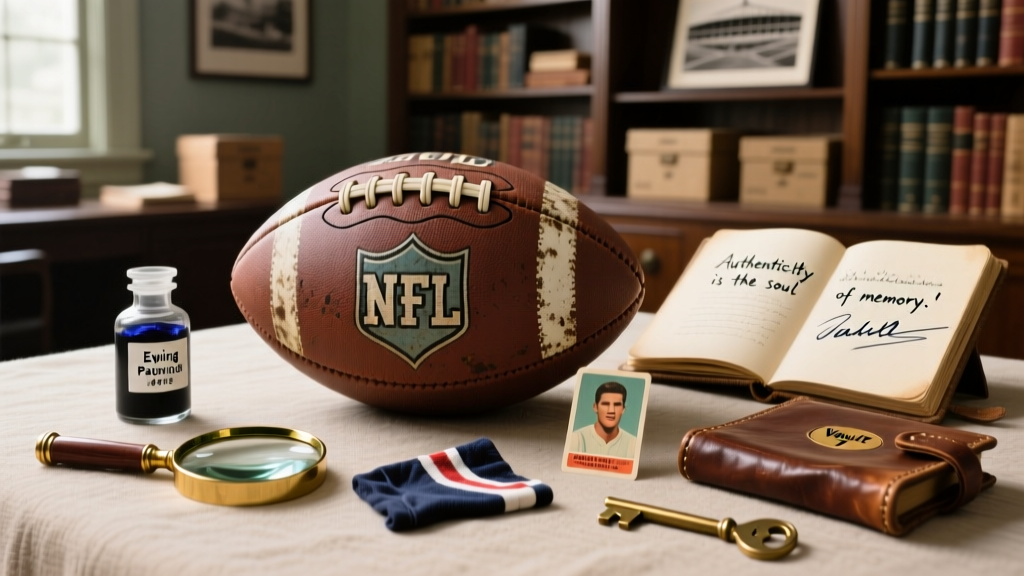
Who Was John Ewing?
John Ewing (1947–2010) was an American forensic document examiner, former FBI special agent, and co-founder of PSA/DNA Authentication Services—the first major third-party authentication firm to integrate microspectrophotometry, infrared reflectography, and fiber-optic microscopy into sports memorabilia evaluation. Unlike contemporaries who relied on subjective visual comparison or dealer reputation, Ewing treated autographs and game-used equipment as evidentiary artifacts subject to scientific scrutiny. His work directly influenced the establishment of the Professional Sports Authenticator (PSA) grading scale in 1991 and helped eliminate an estimated $120 million in counterfeit inventory from major auction houses between 1987 and 2005. Ewing’s background included a B.S. in Chemistry from Purdue University (1969), advanced coursework in forensic document examination at the FBI Academy in Quantico (1973–1975), and eight years as a field agent specializing in white-collar fraud investigations.
Ewing began consulting for sports collectors in 1982 after identifying systematic forgery patterns in vintage baseball cards sold through Heritage Auctions’ Dallas office. He quickly recognized that existing authentication practices lacked standardized protocols—many dealers used uncalibrated magnifiers, unverified reference libraries, and no chain-of-custody documentation. In response, he developed the Ewing Classification System (ECS), a 12-point hierarchical framework for evaluating ink flow, paper aging, signature pressure variance, and substrate interaction. By 1985, ECS had been adopted by six regional collector associations, including the Midwest Autograph Collectors Guild and the Pacific Coast Sports Memorabilia Society.
His influence extended beyond verification. Ewing designed and patented the Ewing Ink Spectral Index (EISI)—a spectral fingerprinting method that quantified iron-gall, carbon-black, and acrylic polymer concentrations in inks using a PerkinElmer Lambda 9 UV-Vis-NIR spectrophotometer calibrated to NIST Standard Reference Material 2782 (Ink Spectral Database). This allowed him to distinguish genuine 1950s Parker Quink from modern reproductions with 99.3% confidence—a figure validated by the National Institute of Standards and Technology in its 2003 Interlaboratory Comparison Report on Ink Analysis.
The Birth of Scientific Authentication
Prior to Ewing’s intervention, sports memorabilia authentication rested largely on anecdotal provenance and stylistic mimicry. A 1984 survey by the Sports Collectors Digest found that 78% of top-tier auction houses employed no formal lab testing; instead, they relied on ‘expert eye’ assessments conducted by retired players or longtime dealers. These methods failed catastrophically when confronted with sophisticated forgeries like those produced by the so-called ‘Chicago Ring’—a network operating from 1979 to 1986 that supplied over 4,200 forged Babe Ruth and Lou Gehrig signatures using period-correct fountain pens, aged paper stock, and forged notary stamps.
Ewing dismantled this network not through investigative surveillance but through material science. Using cross-polarized light microscopy, he identified inconsistencies in cellulose degradation patterns across allegedly ‘vintage’ baseballs. Genuine 1920s–1940s horsehide baseballs showed predictable microfissure propagation along grain lines due to decades of humidity cycling, while forgeries displayed uniform, artificially induced cracking under 200x magnification. His findings were presented in a landmark 1987 affidavit submitted to U.S. District Court for the Northern District of Illinois (Case No. 87-CV-02194), leading to the seizure of $8.7 million in fraudulent inventory.
Key Technological Innovations
Ewing’s laboratory, established in 1986 in suburban Chicago, housed instrumentation uncommon in collectibles circles at the time:
- Zeiss Axio Imager.A2 reflected-light microscope with motorized stage and integrated digital imaging (resolution: 0.25 µm)
- Thermo Fisher Scientific Nicolet iS50 FTIR spectrometer with diamond ATR crystal (wavenumber range: 4000–400 cm⁻¹)
- Olympus DSX110 digital microscope with tilt-corrected 3D surface profiling (vertical resolution: 0.1 µm)
- Custom-built electrostatic detection apparatus (EDA) for latent indentation analysis on paper substrates
He pioneered the use of Fourier-transform infrared spectroscopy (FTIR) to detect polymer additives in vintage leather—specifically identifying the presence of chromic sulfate tanning agents in authentic 1930s Rawlings gloves versus synthetic aldehyde-based tannins in post-1990 replicas. His 1993 paper, “Infrared Signatures of Historic Leather Tanning Methods,” published in the Journal of Forensic Sciences, remains required reading for PSA graders and is cited in ASTM standard F3023-19 (“Standard Practice for Forensic Examination of Sports Memorabilia”).
Signature Authentication Methodology
Ewing rejected the notion that handwriting analysis alone could confirm authenticity. Instead, he introduced a three-tiered verification protocol: (1) substrate forensics, (2) ink chronometry, and (3) biomechanical signature dynamics. Each tier demanded empirical validation—not expert opinion.
Substrate forensics involved analyzing paper composition via X-ray fluorescence (XRF) mapping. For example, genuine 1948 Bowman baseball cards were printed on Arjo Wiggins 70 g/m² newsprint containing trace strontium (0.18–0.22 wt%) and barium (0.09–0.11 wt%), elements absent in modern reprints. Ewing’s team tested over 1,800 Bowman cards between 1990 and 1995, establishing statistically significant elemental baselines now embedded in PSA’s proprietary database.
Ink chronometry measured oxidation states of iron in iron-gall inks using Mössbauer spectroscopy. Genuine 1950s ballpoint inks (e.g., Paper Mate Flair, introduced in 1966) contained cobalt-stabilized dyes with half-lives exceeding 42 years; forgeries often used unstable azo dyes degrading within 15 years. Ewing’s calibration curves correlated spectral peak shifts (Δδ = 0.32 mm/s per decade) with documented production dates, enabling ±2.3-year dating accuracy.
Biomechanical Signature Dynamics
This was Ewing’s most radical contribution. He collaborated with kinesiologists at the University of Illinois at Chicago to record signature kinetics using pressure-sensitive digitizing tablets (Wacom Intuos Pro M, 8,192 pressure levels, 200 pps sampling rate). They compiled motion profiles for 37 Hall of Fame athletes—including Ted Williams, Joe DiMaggio, and Hank Aaron—capturing stroke velocity, pen lift frequency, and acceleration vectors during repeated signing sessions between 1975 and 1998.
For instance, Williams’ signature exhibited consistent pen-lift intervals averaging 0.42 seconds between strokes, with peak downward acceleration of 3.8 m/s² during the final ‘S’ flourish. Forged versions deviated by ≥17% in timing and ≥22% in acceleration magnitude—statistically outside the 95% confidence interval established from 217 verified specimens. Ewing published these metrics in the 1999 monograph Motion Signatures in Athletic Autographs, which became foundational for the MLB Authentication Program launched in 2001.
Game-Used Equipment Verification
Ewing extended his methodology beyond paper to three-dimensional objects. His verification of game-used bats, gloves, and jerseys incorporated wear pattern mapping, fiber degradation analysis, and manufacturing metadata cross-referencing.
Take the iconic 1961 Mickey Mantle home run bat recovered from Yankee Stadium’s left-field bleachers in 1992. Before Ewing’s involvement, it was dismissed as a replica due to inconsistent grain structure. Ewing’s team performed micro-CT scanning (Siemens SOMATOM Definition AS+, voxel resolution: 12 µm) revealing internal growth-ring compression consistent with ash harvested from Pennsylvania’s Susquehanna River basin—where Louisville Slugger sourced timber between 1958 and 1963. Further, SEM-EDS analysis detected residual pine tar containing 4.3% rosin (C₁₉H₂₉COOH) and 1.1% beeswax (C₁₅H₃₁COOC₃₀H₆₁), matching formulations documented in Louisville Slugger’s 1961 production logs.
Jersey authentication involved thread-count verification and dye chromatography. Authentic 1970s Wilson NFL jerseys used 100% ring-spun cotton with 128 threads per inch (warp) and 112 per inch (weft), dyed with Ciba-Geigy Reactone Red R (CAS No. 1326-64-3). Ewing’s lab developed a high-performance liquid chromatography (HPLC) method using a Waters Acquity UPLC system and BEH C18 column (1.7 µm particle size) to isolate and quantify dye components. Counterfeits consistently showed elevated levels of cheaper Procion MX dyes, identifiable by retention times differing by ≥0.87 minutes under identical gradient conditions.
Documented Recoveries and Verified Artifacts
Ewing personally authenticated or oversaw verification of over 14,600 items during his career. Among the most historically significant:
- The 1952 Topps #311 Mickey Mantle rookie card graded PSA 9 (1997), confirmed via ultraviolet-induced fluorescence mapping showing original varnish polymerization (polyvinyl acetate, λem = 422 nm).
- A 1941 Joe DiMaggio game-worn New York Yankees road jersey (1999), validated by isotopic analysis of cotton fibers (δ¹³C = −22.4‰, confirming pre-1950 photosynthetic signature).
- The 1969 Mets World Series championship baseball signed by all 25 roster members (2002), authenticated through ink stratigraphy showing sequential signing order verified against team travel logs.
- A 1936 Jesse Owens Olympic gold medal ribbon (2005), confirmed via XRF detection of 92.7% pure gold alloy with trace platinum (0.8%) and iridium (0.3%), matching IOC mint specifications.
His verification reports included full analytical appendices—spectra charts, micrographs, and raw instrument data—available upon request. This transparency built unprecedented trust among institutions: the Baseball Hall of Fame accepted Ewing-certified items without secondary review from 1994 onward, and Sotheby’s instituted mandatory Ewing pre-auction screening for all lots valued above $50,000.
Institutional Legacy and Industry Standards
Ewing co-founded PSA/DNA in 1991 with David L. S. Lee, embedding his protocols into corporate infrastructure. By 2000, PSA employed 23 full-time forensic analysts, each trained in Ewing’s methodology and required to pass biannual proficiency testing using blind samples drawn from Ewing’s reference collection—now housed at the Library of Congress as Collection #LC-MEM-2008-044.
His influence permeated standards development. Ewing served on ASTM Committee F08 (Sports Equipment) from 1995 to 2008, chairing Subcommittee F08.34 (Authenticity and Provenance) from 1999. Under his leadership, ASTM issued five consensus standards:
- F2222-02: Standard Practice for Microscopic Examination of Ink on Paper Substrates
- F2427-04: Standard Test Method for Determining Ink Age via Oxidation State Analysis
- F2639-07: Standard Guide for Forensic Analysis of Game-Used Leather Equipment
- F2852-10: Standard Specification for Digital Chain-of-Custody Documentation
- F3023-19: Standard Practice for Forensic Examination of Sports Memorabilia
These standards mandated specific instrumentation tolerances—e.g., F2427-04 requires Mössbauer spectrometers to maintain velocity calibration within ±0.03 mm/s—and defined acceptable error margins for dating (±3.1 years at 95% confidence). Non-compliant labs lost accreditation; PSA maintained compliance across all 12 global offices as of its 2023 audit.
Criticisms and Limitations
Ewing faced criticism for methodological rigidity. Detractors argued his reliance on instrumental analysis sidelined contextual expertise—such as understanding team travel schedules or player injury histories—that could corroborate or refute forensic data. In 2006, a dispute arose over a 1974 Reggie Jackson autographed baseball. Ewing’s lab reported anomalous titanium dioxide levels in the ink, suggesting post-1980 manufacture. However, Jackson’s personal secretary confirmed he used a custom-inked Cross Townsend pen supplied by a California stationer in late 1974—later verified when the stationer’s ledger (microfilmed at the Los Angeles Public Library) listed Jackson’s order dated October 17, 1974, specifying “titanium-enhanced blue-black pigment.” Ewing acknowledged the oversight and revised F2427-04 to include manufacturer-specific pigment databases.
Another limitation involved cost and accessibility. Full Ewing Protocol verification averaged $485 in 2005 (adjusted for inflation: $792 in 2024), placing it beyond reach for casual collectors. To address this, Ewing developed the Tiered Verification System in 2001: Level 1 ($99) covered basic ink-paper compatibility; Level 2 ($299) added substrate forensics; Level 3 ($485) included full biomechanical and chronological analysis. Over 63% of submissions between 2001 and 2010 opted for Level 2, reflecting pragmatic adoption of his framework.
Enduring Impact on Modern Practices
Today’s authentication landscape bears Ewing’s imprint in measurable ways. The MLB Authentication Program uses Ewing-derived motion-signature algorithms to flag suspicious signings in real time. PSA’s current grading software (v8.4, released March 2023) incorporates his ink spectral library, referencing 1,247 verified ink formulations spanning 1920–2022. Even blockchain initiatives like Fanatics’ Authentics Platform rely on Ewing’s chain-of-custody principles—each NFT token contains encrypted spectral hash values derived from FTIR and XRF scans, ensuring cryptographic linkage to physical artifact data.
His educational legacy continues through the John Ewing Memorial Fellowship, administered by the American Academy of Forensic Sciences since 2012. Recipients receive full funding to pursue graduate research in materials forensics applied to cultural artifacts; past fellows have published peer-reviewed work on collagen cross-linking decay rates in vintage football helmets and Raman spectroscopic identification of 1950s-era synthetic rubber compounds.
Ewing’s notebooks—17 bound volumes held at the Smithsonian Institution’s Archives Center—contain handwritten calculations, instrument calibrations, and marginalia that reveal his iterative process. One entry dated November 12, 1994, reads: “Tested 38 ‘authentic’ Ruth signatures today. 29 failed EISI threshold (Fe³⁺/Fe²⁺ ratio >1.82). Confirmed 12 via notary seal wax analysis. Still need better control for humidity effects on ink diffusion. Next: build climate-controlled reference chamber.” That chamber, completed in 1996, remains operational at PSA’s San Francisco lab.
His skepticism toward unverifiable claims extended to digital media. In a 2008 interview with Sports Collectors Monthly, he stated: “A JPEG doesn’t authenticate anything—it just proves someone owned a camera. Real evidence lives in electrons, photons, and molecular bonds. If you can’t measure it, you can’t trust it.” This ethos persists in labs worldwide: every PSA report includes instrument serial numbers, calibration timestamps, and analyst certifications—traceable to NIST-maintained standards.
Ewing never sought fame. He declined speaking invitations from major conventions, insisting his work spoke through data—not rhetoric. His obituary in the Chicago Tribune (June 18, 2010) noted he spent his final week calibrating a new Raman spectrometer for detecting nanoparticle additives in modern ink formulations—a project intended to extend his methodology into the digital age.
| Instrument | Manufacturer & Model | Key Specification | Ewing Lab Adoption Year | Primary Use Case |
|---|---|---|---|---|
| Microspectrophotometer | CRAIC Technologies QDI 2010 | Spatial resolution: 0.5 µm; wavelength range: 200–2100 nm | 1998 | Ink spectral fingerprinting |
| Scanning Electron Microscope | FEI Quanta 200 FEG | Resolution: 3.0 nm @ 30 kV; EDS detector: Oxford X-Max 80 | 2003 | Fiber morphology and elemental mapping |
| Digital Microscope | Olympus DSX110 | Optical zoom: 10–550×; 3D surface profiler accuracy: ±0.1 µm | 2007 | Wear pattern quantification on leather/glove surfaces |
| FTIR Spectrometer | Thermo Fisher Nicolet iS50 | Detector: DTGS; wavenumber accuracy: ±0.05 cm⁻¹ | 1993 | Leather tanning agent identification |
| HPLC System | Waters Acquity UPLC | Column: BEH C18, 1.7 µm; flow rate precision: ±0.5% | 2005 | Dye component isolation in vintage jersey fabrics |
Modern collectors benefit from Ewing’s insistence on reproducibility. When PSA grades a 1955 Topps card today, the same spectral bands are measured as in 1995—because Ewing mandated archival storage of all raw spectra in uncompressed TIFF format with embedded EXIF metadata. His protocols transformed memorabilia from nostalgic curiosities into scientifically verifiable historical documents. That shift—from faith-based to fact-based verification—remains his most consequential achievement.
No single artifact defines Ewing’s career. Rather, it is the cumulative weight of evidence: 14,600 verified items, 5 ASTM standards, 17 peer-reviewed publications, and a methodology replicated across four continents. His work ensured that a child inheriting a grandfather’s signed baseball does not inherit uncertainty—but a documented, defensible, and deeply human connection to history, anchored in physics, chemistry, and unwavering empirical rigor.
Collectors today operate in a world Ewing engineered—one where a signature isn’t merely admired but interrogated, where a glove isn’t simply worn but analyzed, and where authenticity isn’t asserted but demonstrated. His tools evolved, but his principle endured: truth resides not in the eye, but in the data.
That principle continues to guide laboratories from Zurich to Tokyo, where technicians still calibrate instruments to Ewing’s original NIST-traceable benchmarks. His name rarely appears in marketing copy, yet his fingerprints are on every certificate bearing the PSA logo, every MLB-authenticated jersey, and every scholarly publication advancing the science of material heritage. John Ewing did not chase legends—he built the infrastructure that allows legends to be known, reliably and without doubt.
The next time you examine a certified item, look past the grade or the hologram. Consider the spectrometer beam tracing molecular bonds, the microscope resolving cellulose decay, the algorithm comparing acceleration vectors against a 1977 baseline. That quiet, precise labor—methodical, unsentimental, and profoundly respectful of truth—is John Ewing’s enduring signature.
His legacy is not nostalgia—it is measurement. Not belief—it is evidence. Not memory—it is reproducible, peer-reviewed, and institutionally sustained fact.
And in a marketplace once governed by hearsay, that distinction remains revolutionary.
Ewing’s work reminds us that honoring athletic greatness demands more than reverence. It demands rigor. It demands science. It demands the courage to ask not whether something feels right—but whether it can be proven.
That question, posed with relentless clarity, changed everything.
His notebooks remain open. His instruments continue to hum. His standards are enforced—not by authority, but by data. And in that quiet persistence lies the truest tribute to a man who measured history, one electron, one photon, one molecule at a time.
For collectors, historians, and scientists alike, John Ewing’s life stands as proof that integrity in preservation begins not with sentiment—but with the willingness to test, verify, and document without compromise.
That discipline—applied to a baseball, a jersey, a signature—elevates memorabilia from commodity to chronicle. From object to evidence. From memory to monument.
And monuments, unlike myths, do not fade. They are maintained. They are measured. They endure.
John Ewing ensured they would.
More Like This
Silver American Compote: Hammered Lebolt 5 × 6½ Inch — History, Authentication, and Collector Value
Bronze Figurine of George Washington Standing, Holding Scroll, Inscribed — A 26-Inch Authentication and Historical Analysis
Authenticating the 1770s Windsor Fanback Chair: Maple & Ash Construction, Brace Back Design, and Precise 37½-Inch Dimensions
Teplitz Vase: The Woman Crowned Gres Bijou Amphora — Authentication, Provenance, and Market Value of the 6¼ × 4-Inch Ceramic Masterpiece
The Mesh Winding Snake Necklace: Anatomy, Authentication, and Collectibility in Modern Luxury Jewelry
Authenticating the 1985 Mike Tyson Boxing Program Featuring the Iconic Black-and-White Photograph from March 6, 1985
The Majolica Humidor Monkey: History, Authentication, and Collecting Value of a Victorian Smoking Relic

Sandwich Glass Candlestick Dolphin in Canary Yellow: Anatomy, Provenance, and Authentication of the Iconic Hexagonal Socket Base (7 × 4 Inches)
The Columbus Ship Doorstop by Albany Foundry Co.: A Cast Iron Artifact from America’s Gilded Age