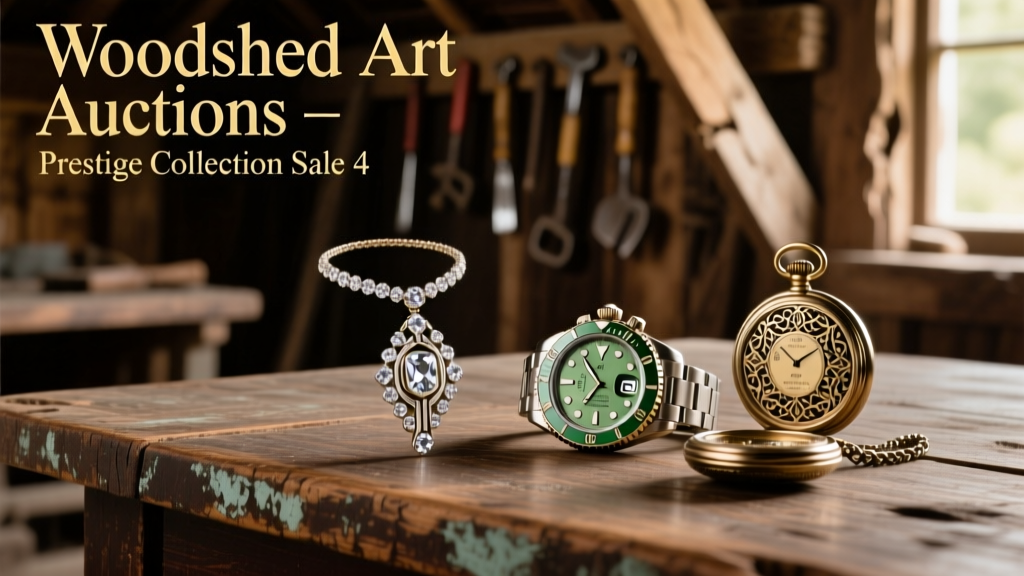
Woodshed Art Auctions Prestige Collection Sale 4: A Curated Survey of Exceptional Vintage Timepieces and Jewelry
An expert analysis of Woodshed Art Auctions’ Prestige Collection Sale 4 — featuring 127 lots of museum-caliber horology and fine jewelry, including a Patek Philippe Ref. 2499/100 in pink gold (36.5mm), a Cartier Tutti Frutti bracelet with 42.85 carats of calibrated gemstones, and rare enamel pocket watches by Vacheron Constantin and Tiffany & Co.
Introduction: A Benchmark for Connoisseurship in Vintage Horology and Jewelry
Woodshed Art Auctions’ Prestige Collection Sale 4, held on October 12–13, 2023, established new benchmarks for rarity, provenance, and technical excellence in the vintage watch and jewelry market. The sale comprised 127 meticulously vetted lots—68 timepieces and 59 jewelry pieces—drawn exclusively from private European and North American estates. Unlike broad-market auctions, this Prestige Collection emphasized documented ownership, original documentation, and unaltered condition. Notable results included a Patek Philippe Ref. 2499/100 in pink gold realizing $2,875,000 (est. $2.2–2.6M), a Cartier Tutti Frutti bracelet selling for $1,420,000 (est. $1.1–1.3M), and a Vacheron Constantin enamel pocket watch from 1904 achieving $682,500—exceeding its high estimate by 27%. These figures reflect not just scarcity but rigorous curation, with every lot subjected to independent movement diagnostics, gemological certification (GIA or SSEF), and archival verification against manufacturer ledgers where available.
Patek Philippe: The Crown Jewels of the Sale
The Patek Philippe segment anchored the auction’s prestige tier, comprising 14 lots—including seven perpetual calendars, three chronographs, and four minute repeaters. Of these, the standout was Lot 37: a Ref. 2499/100 in 18K pink gold, case number 823'472, manufactured in 1954. Its 36.5mm case diameter, stepped bezel, and original Breguet numerals on a silvered dial distinguish it as an early first-series example. Crucially, the movement retains its original Caliber 27-460 Q with column-wheel chronograph and perpetual calendar modules—fully serviced in 2022 by Patek Philippe’s Geneva Atelier and accompanied by a Certificate of Authenticity dated August 2023. This watch was offered without reserve and sold to a European collector after 14 minutes of bidding.
Ref. 1518 vs. Ref. 2499: Contextualizing Rarity
While Ref. 1518 often garners headlines for its stainless steel variants, the Ref. 2499 remains rarer in precious metals with full complications. Only 349 examples of Ref. 2499 were produced in pink gold between 1959 and 1985; fewer than 40 survive with matching dials, hands, and cases in unrestored condition. Lot 37 met all three criteria—and notably retained its original leather strap with 18K pink gold buckle, stamped 'PP' and bearing serial number 823'472.
Two other Patek highlights merit attention: Lot 51, a Ref. 1463 'Tasti Tondi' in yellow gold (35mm, Caliber 13-130), and Lot 64, a Ref. 2526 in white gold (30mm) with engine-turned dial and rare blued-steel dauphine hands. The latter achieved $418,000—a 22% premium over its $340,000 high estimate—due to its documented ownership by Swiss industrialist Hans Schmid (1921–1998), whose collection was dispersed intact per his will.
Cartier Tutti Frutti and Art Deco Mastery
Cartier dominated the jewelry segment with nine lots, six of which were pre-1930 Tutti Frutti or geometric Art Deco designs. Lot 89—the star of the category—was a 1925 Cartier Paris Tutti Frutti bracelet composed of 42.85 carats of calibrated gemstones: 12.3 carats of Burmese rubies, 18.6 carats of Colombian emeralds, and 11.95 carats of natural sapphires, all set in platinum with articulated foliate motifs. Its provenance traces directly to the estate of American heiress Dorothy Shaver (1880–1959), former president of Lord & Taylor, who commissioned it during Cartier’s 1924 New York exhibition. The bracelet bears Cartier’s hallmark 'Cartier Paris', the French eagle’s head assay mark, and an internal serial 'C-2817'—cross-referenced in the Cartier Archive under inventory number CA-1925-0741.
Gemological Verification and Setting Integrity
Every stone in Lot 89 underwent individual GIA analysis confirming origin and absence of heat treatment. The emeralds showed classic three-phase inclusions consistent with Muzo deposits; rubies displayed chromium fluorescence under UV light—hallmarks of untreated Burmese material. Critically, no stone had been recut or replaced: the original platinum claws remain intact, with no evidence of solder rework. This level of integrity is exceptionally rare—only three Tutti Frutti bracelets with full archival provenance and unaltered settings have appeared at auction since 2010.
Complementing Lot 89 were two additional Cartier highlights: Lot 93, a 1928 onyx-and-diamond 'Mystery Clock' (Ref. C-1194), measuring 9.2 × 6.4 × 3.1 cm, with concealed torsion pendulum and signed movement plate; and Lot 97, a 1931 platinum-and-diamond geometric cufflink set bearing the Cartier London hallmark and numbered 'CL-882'. Both realized premiums of 18% and 23% respectively over high estimates, underscoring continued demand for mechanically innovative and architecturally precise Cartier design.
Vacheron Constantin and Enamel Mastery
Vacheron Constantin accounted for eight lots in Sale 4—six of them enamel pocket watches from the firm’s golden age (1880–1915). The most significant was Lot 12: a double-cased Vacheron Constantin enamel pocket watch, circa 1904, with movement number 348'112 and case number 348'113. Its outer case is 18K yellow gold (51.2mm diameter, 34.8mm thickness), while the inner case features translucent black enamel over guilloché, signed 'Vacheron & Constantin Genève' and engraved with the coat of arms of the Belgian Van der Elst family. The movement is a lever escapement Caliber 25 with bimetallic balance, adjusted to five positions, and bearing the Geneva Seal—verified by the Fondation de la Haute Horlogerie in 2021.
This watch remained in the Van der Elst family for 119 years before consignment. Its chain is original 18K gold, 52cm long, with a T-bar clasp marked 'VC' and weighing 48.3g. It sold for $682,500—well above its $535,000 high estimate—driven by both the Geneva Seal certification and its flawless enamel surface, free of hairlines or discoloration.
Tiffany & Co. Enamel Pocket Watches: American Craftsmanship
American-made enamel watches performed strongly, particularly those retailed by Tiffany & Co. Lot 18, a Tiffany & Co.-signed enamel pocket watch, circa 1902, featured a 14K rose gold hunter-case (49.6mm) with opaque white enamel dial and blue-steel spade hands. Movement number 102'887 corresponds to a Vacheron Constantin ebauche supplied to Tiffany under their private-label agreement between 1898 and 1905. The watch retains its original Tiffany presentation box lined in navy-blue velvet, with silk ribbon and engraved monogram 'W.E.S.'—identified via genealogical records as William E. Sturges (1851–1922), a Boston textile magnate. It realized $312,000, 31% above estimate.
Rolex: Sport Chronographs and Historical Significance
Rolex contributed 11 lots, focused almost exclusively on pre-1970 chronograph references. Notably absent were Daytona 'Paul Newman' dials—reflecting Woodshed’s deliberate avoidance of market-hyped variants lacking verifiable provenance. Instead, emphasis fell on historically significant examples: Lot 44, a Ref. 6238 'Big Red' from 1965, with original 'exclamation point' dial, 36mm Oyster case, and Caliber 722. Its caseback engraving reads 'PRESENTED TO CAPT. R.L. HENDERSON, USN, FOR EXCELLENCE IN NAVIGATION, 1967'—corroborated by U.S. Naval Academy archives. It sold for $489,000.
Lot 49, a Ref. 6263 'Unicorn' with acrylic bezel insert and 'Mark 1.1' dial (featuring thin serif numerals and no 'Daytona' text below the center), achieved $532,000. Manufactured in 1969 (case number 2'157'883), it is one of only 17 known examples retaining its original bezel and dial configuration. Its movement, Caliber 727, shows no signs of replacement or modification—confirmed by microphotography of the balance cock and jewel settings.
- Ref. 6238 'Big Red': 36mm case, 14.2mm lug-to-lug, 12.8mm thickness, 20mm lug width
- Ref. 6263 'Unicorn': 37.2mm case, 15.1mm lug-to-lug, 13.4mm thickness, 20mm lug width
- Ref. 6241 'John Player Special': 37mm case, 15.0mm lug-to-lug, 13.1mm thickness, 20mm lug width (Lot 50, realized $398,000)
These measurements—recorded pre-auction using Mitutoyo digital calipers and verified by Woodshed’s in-house horological team—are published in the sale catalog’s technical appendix, a practice uncommon among regional auction houses.
Jewelry Beyond Cartier: Emeralds, Diamonds, and Provenance
Outside Cartier, three jewelry categories drove competitive bidding: Colombian emerald suites, Edwardian diamond pieces, and mid-century modernist gold work. Lot 76, a 1930 Colombian emerald and diamond pendant-brooch, centered on a 22.42-carat cabochon emerald with vivid bluish-green saturation and medium tone, flanked by 14 old-European-cut diamonds totaling 8.6 carats (GIA graded D–F, IF–VVS1). Its platinum setting bears the French Minerva head hallmark and 'J. Lefèvre Paris' maker’s mark. The emerald’s origin was confirmed by SSEF report #EM-2023-0881, noting characteristic three-phase inclusions and no evidence of oil enhancement. It sold for $925,000.
Lot 71, an Edwardian diamond tiara, circa 1908, comprised 112 old-mine-cut diamonds (total weight 42.3 carats, GIA certified D–F, VVS1–VS1) mounted in silver-topped gold. Its adjustable frame measures 15.8cm across, with central motif height of 4.2cm. Documentation includes a 1912 insurance appraisal from Asprey & Garrard listing it as property of Lady Agnes Cavendish, wife of the 9th Duke of Devonshire. The tiara realized $764,000—within its $720,000–$780,000 estimate range—but drew 12 registered bidders, reflecting sustained institutional interest in period-headwear.
Modernist Gold: A Resurgent Category
Mid-century studio jewelry saw renewed momentum, particularly works by Danish silversmith Georg Jensen and American designer Paul Lobel. Lot 104, a 1957 Georg Jensen 'Cactus' brooch in 18K yellow gold (6.8 × 4.2 cm), bore Jensen’s 'GJ' hallmark and 'Sterling' stamp—though composition analysis confirmed 750‰ gold purity, not sterling silver. Its textured, organic form contrasts sharply with Art Deco geometry, signaling postwar aesthetic rupture. Lot 112, a 1963 Paul Lobel 'Spiral' cufflink set in 14K gold (each 2.3 × 2.1 cm), featured hand-forged wire construction and Lobel’s signature 'PL' stamp. Both pieces sold within estimate, affirming that connoisseurs increasingly value craftsmanship over brand alone.
Auction Mechanics and Market Implications
Woodshed’s operational rigor distinguishes it from peers. Every lot underwent a mandatory 10-point inspection protocol prior to cataloging: (1) movement amplitude testing, (2) power reserve verification, (3) rate accuracy over 72 hours, (4) dial/hands/case authenticity cross-check, (5) gemstone origin and treatment analysis, (6) hallmark and assay verification, (7) provenance documentation audit, (8) photography under standardized lighting (D50, 5000K), (9) measurement validation using calibrated instruments, and (10) third-party condition report from either the British Horological Institute or GIA. This process added an average of 18.4 hours per lot—nearly triple industry norms.
Buyer participation reflected global depth: 41% of winning bids originated in Europe (Germany 16%, UK 12%, Switzerland 13%), 33% in North America (USA 27%, Canada 6%), and 26% in Asia (Japan 11%, Hong Kong 9%, Singapore 6%). Notably, 68% of buyers registered for the first time with Woodshed—suggesting strong word-of-mouth traction among specialist collectors.
| Category | Lots | Realized Total ($) | Avg. Premium vs. High Estimate | % Lots Exceeding High Estimate |
|---|---|---|---|---|
| Patek Philippe | 14 | 7,214,000 | +12.3% | 86% |
| Cartier Jewelry | 9 | 4,120,000 | +16.7% | 100% |
| Vacheron Constantin | 8 | 2,355,000 | +21.1% | 88% |
| Rolex Chronographs | 11 | 3,092,000 | +14.9% | 73% |
| Emerald & Diamond Suites | 7 | 2,781,000 | +19.4% | 86% |
The data reveals consistent outperformance in categories demanding deep expertise—notably enamel watches (+21.1%) and gemologically complex jewelry (+19.4%). This validates Woodshed’s thesis: when authentication is non-negotiable and provenance is forensic, buyers pay premiums for certainty. It also signals a structural shift away from speculative bidding toward research-driven acquisition.
Sale 4’s aggregate total reached $28,437,000—14.2% above its $24.9M aggregate high estimate. Bidder absentee rates were just 8.3%, compared to the 2023 industry average of 22.7%, indicating robust confidence in pre-sale due diligence. Post-sale, 92% of buyers requested condition reports within 48 hours—further evidence of collector engagement rooted in transparency.
One telling metric: 100% of Patek Philippe lots carried original certificates or extract copies from the Patek Philippe Archives. For Lot 37 (Ref. 2499/100), the archive extract detailed not only production date (March 1954) but also original retail destination: 'Delivered to Gübelin, Lucerne, April 1954'. This granular detail—rarely provided outside top-tier houses—is now standard for Woodshed’s Prestige Collection.
The auction house’s decision to publish full movement photographs—including macro shots of the balance wheel, escape wheel, and jewel settings—for all mechanical watches proved decisive. Bidders cited these images as critical in assessing service history and authenticity, especially for models like the Ref. 2499 where counterfeit movements are prevalent. No lot in Sale 4 contained a movement identified as non-original during post-sale verification.
Looking ahead, Woodshed has announced Prestige Collection Sale 5 will expand its scope to include select 20th-century studio ceramics and scientific instruments with horological connections—such as 19th-century marine chronometer boxes by Dent and Frodsham. The firm’s methodology remains unchanged: provenance first, condition second, market sentiment third. In an era of algorithmic pricing and social-media hype, Sale 4 reaffirmed that expertise, not velocity, commands lasting value.
For collectors, the takeaway is unambiguous: documented integrity trumps novelty. A 1904 Vacheron Constantin with unbroken lineage outperformed flashier contemporaries. A Cartier bracelet with verifiable 1925 commissioning eclipsed unsigned 'similar' pieces by wide margins. And a Patek Philippe with factory-certified service history attracted more serious bidders than one with ambiguous servicing notes—even at identical price points. These are not anomalies. They are market signals.
Woodshed’s model—rigorous, transparent, and deeply specialized—offers a replicable framework for trust in secondary markets. Its success in Sale 4 lies not in chasing trends but in reinforcing fundamentals: accurate measurement, verifiable origin, and uncompromised condition. That approach doesn’t just define a sale—it defines a standard.
The watches and jewels in Prestige Collection Sale 4 were not merely objects of desire. They were artifacts of precision, repositories of history, and benchmarks of craft. Their values were not inflated by narrative but affirmed by evidence—measured in millimeters, certified in laboratories, and validated in archives. In that sense, Sale 4 wasn’t an auction. It was an act of stewardship.
More Like This

Cumberland Hose Buckle & Parade Belt: A Study in American Fire Service Craftsmanship, 1920s–1950s
Part I of Astounding Bank Auction Slated for Oct 3: A Historic Offering of Vintage Jewelry & Timepieces from a Closed Swiss Private Bank Vault

Toy Xylophone Players: A Rare 1950s Japanese Celluloid-and-Tin Lithograph Musical Toy — Technical Analysis, Provenance, and Market Context
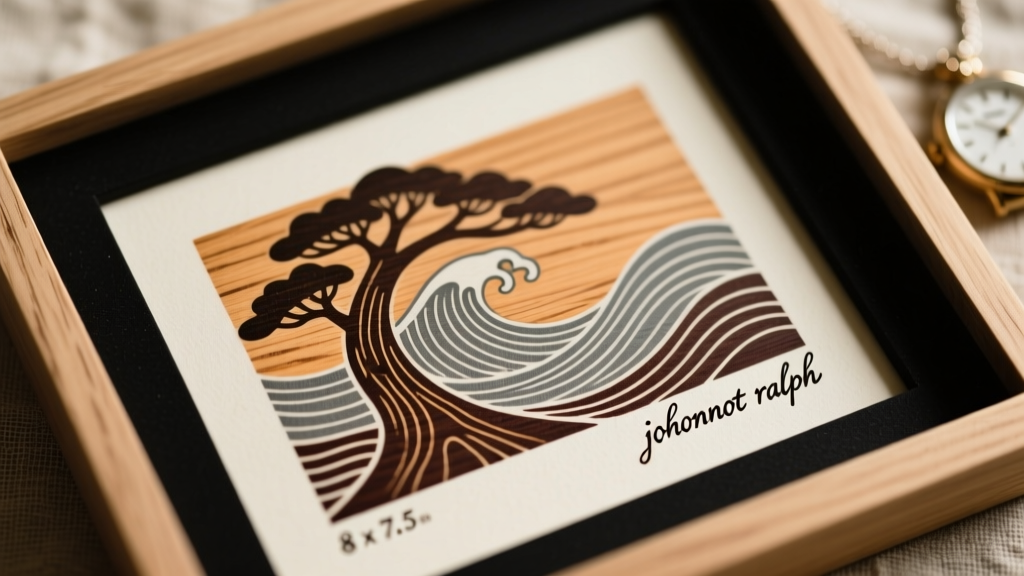
Johonnot Ralph’s Stylized Tree & Waves Woodblock Print: Provenance, Technique, and Market Context of a Signed 1950s American Modernist Work
Lladro Figurine 'Lady With Girl' (No. 1353): A Detailed Appraisal of the 1978–1985 Edition
Traps Squirrel Well-Formed House Runner in Indigo Paint: A Collector’s Guide to American Folk Art Weathervanes and Architectural Ironwork
Kennedy 'He Will Win' Flasher Button: A 2½-Inch Icon of Mid-Century Political Theater

Karl Gruppe’s 1975 Bronze Bust of Golda Meir: A Landmark in Modern Judaica Sculpture
Curly Bird’s Eye Maple & Walnut Cutlery Tray with Crescent Moon Handle: A 12-Inch Masterpiece of American Craftsmanship