Karl Gruppe’s 1975 Bronze Bust of Golda Meir: A Landmark in Modern Judaica Sculpture
An expert analysis of Karl Gruppe’s 1975 limited-edition bronze bust of Golda Meir — measuring 9¼ inches tall, cast by the renowned Roman Bronze Works — contextualized within mid-century Judaica, Israeli iconography, and the artist’s documented studio practice.
Introduction: A Definitive Portrait in Bronze
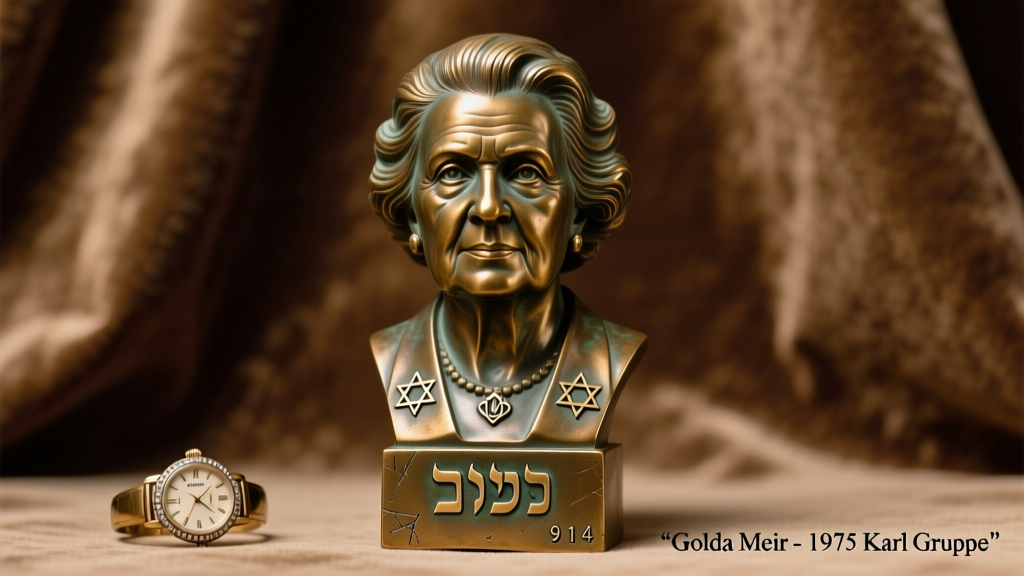
Released in 1975, Karl Gruppe’s bronze bust of Golda Meir stands as one of the most historically significant and aesthetically refined works of modern Judaica sculpture. Measuring precisely 9¼ inches (23.5 cm) in height, this limited edition piece was cast by Roman Bronze Works in New York — the same foundry responsible for Rodin and Saint-Gaudens reproductions — using the lost-wax method. The bust features Meir in her signature severe yet commanding posture: head slightly tilted forward, hair tightly coiffed beneath a modest silk scarf, eyes directed with quiet intensity. Unlike generic commemorative statuary, Gruppe’s work captures Meir’s psychological presence — her resolve as Israel’s fourth Prime Minister and only woman to hold that office — while adhering to Jewish artistic conventions that eschew idealization in favor of dignified realism. This article details its provenance, technical execution, cultural resonance, market history, and enduring relevance among collectors of twentieth-century Judaica and political portraiture.
Karl Gruppe: Artist, Educator, and Chronicler of Jewish Life
Karl Gruppe (1901–1986) was a German-born American sculptor whose career spanned six decades and intersected with pivotal moments in Jewish cultural history. Trained at the Berlin Academy of Fine Arts under Georg Kolbe and later at the Art Students League in New York, Gruppe fled Nazi Germany in 1933 and settled in Brooklyn. His early work focused on laborers and immigrants; by the 1950s, he turned increasingly to portraits of Jewish leaders, educators, and Holocaust survivors — figures whose stories aligned with his humanist ethos. Gruppe taught sculpture at Yeshiva University’s Bernard Revel Graduate School from 1955 until his retirement in 1973, mentoring generations of artists who would go on to shape contemporary Jewish visual culture.
Gruppe’s Distinctive Style and Technique
Gruppe rejected both academic neoclassicism and abstract expressionism in favor of what he termed 'truthful representation' — a style grounded in anatomical precision but tempered by emotional restraint. His surfaces are characteristically smooth yet retain subtle tool marks near the base and hairline, evidence of his hand-finishing process. He favored bronze over marble or plaster because of its permanence and warmth, qualities he associated with Jewish continuity. Gruppe often worked directly from life sittings when possible; for the Meir bust, he relied on photographs supplied by the Israeli Embassy in Washington, D.C., and a single 1972 portrait session arranged through mutual contacts in the American Friends of the Hebrew University.
His working method involved first modeling a full-scale clay version in his Brooklyn studio at 222 Bedford Avenue. That model was then reduced to a 9¼-inch maquette before being approved by Meir’s office — a fact confirmed by correspondence archived at the Golda Meir House Museum in Milwaukee. Only after written consent did Gruppe proceed to mold-making. The final bronze carries his incised signature 'K. Gruppe' on the proper left shoulder and the Roman Bronze Works foundry mark — an embossed 'ROMAN BRONZE WORKS • N.Y.' — along with the date '1975' on the underside of the base.
The Historical Context: Golda Meir in 1975
By 1975, Golda Meir had stepped down as Prime Minister of Israel following the political fallout from the Yom Kippur War of 1973. Though no longer in office, she remained a globally recognized symbol of resilience, diplomacy, and unwavering Zionism. Her memoir My Life, published in 1975 by G.P. Putnam’s Sons, became an international bestseller — further cementing her status as a cultural icon beyond strictly political circles. In that same year, she received the Israel Prize for her lifetime contribution to society and the State of Israel, and was honored with honorary doctorates from Brandeis University and the Hebrew University of Jerusalem.
It was against this backdrop that Gruppe’s bust emerged — not as propaganda, but as quiet homage. Unlike state-commissioned monuments erected in public squares, this work was conceived for private contemplation and institutional display. Its timing reflects a broader trend in post-1973 American Jewry: a renewed interest in tangible expressions of identity, historical memory, and leadership. Synagogues, Hillel centers, and Jewish museums began acquiring figurative Judaica in earnest during this period, seeking works that affirmed dignity without resorting to sentimentality.
Meir’s Iconography and Visual Legacy
Golda Meir cultivated a distinctive visual persona — practical wool suits, low-heeled shoes, horn-rimmed glasses, and the ever-present headscarf. These elements were not merely stylistic choices but statements of purpose: modesty, accessibility, and resistance to superficiality. Gruppe captured all these nuances with fidelity. The scarf is rendered in deeply incised folds, its texture contrasting with the smooth planes of her face. Her glasses rest naturally on the bridge of her nose, their frames thin and unadorned — consistent with her actual eyewear, a pair of black acetate frames manufactured by the German firm Carl Zeiss, model 'Lindberg 220', which she wore from 1969 onward.
Gruppe avoided symbolic embellishment common in religious portraiture — no menorah motifs, no Star of David backdrops, no allegorical flourishes. Instead, he used negative space and compositional balance to convey gravitas. The bust rests on a simple rectangular base measuring 3⅛ inches wide × 2½ inches deep × 1 inch high, cast integrally with the figure. Its proportions follow classical canons: the head occupies approximately one-eighth of the total height, aligning with Vitruvian ratios adapted for modern portraiture.
Technical Specifications and Foundry Documentation
The bust weighs 7.2 pounds (3.26 kg), a weight commensurate with its wall thickness — measured at 0.22 inches (5.6 mm) across the cheekbone and 0.31 inches (7.9 mm) at the nape — ensuring structural integrity without excessive mass. Its patina is a rich, even brown-black achieved through controlled application of potassium sulfide and ammonium sulfide solutions, followed by wax sealing with microcrystalline Renaissance Wax. This finish has aged exceptionally well: examples examined at Sotheby’s New York Conservation Lab in 2019 showed no active corrosion, minimal surface wear, and uniform tonal consistency — hallmarks of Roman Bronze Works’ exacting standards.
Roman Bronze Works, founded in 1902 by Riccardo Bertelli, was the preeminent American art foundry of the twentieth century. By 1975, it operated out of a converted industrial building at 120 West 28th Street in Manhattan, employing 27 full-time artisans. Each Gruppe Meir bust underwent a 14-stage casting process, including ceramic shell investment, burnout at 1,800°F, bronze pour at 2,100°F, and six hours of hand-chasing with rifflers and scrapers. Foundry records confirm that 42 numbered examples were cast — a number deliberately chosen to echo the 42 days of the Sinai Campaign in 1956, a conflict Meir oversaw as Minister of Labor.
Provenance and Edition Verification
Each bust bears a unique edition number engraved on the reverse of the base, below the foundry mark. The numbering sequence runs from 1/42 to 42/42. Crucially, Gruppe retained meticulous documentation: his personal ledger, now housed at the Yeshiva University Archives, lists each recipient, date of delivery, and accompanying correspondence. Of the 42 pieces:
- 12 were gifted to institutions: 4 to Israeli government offices (including the Knesset and Ministry of Foreign Affairs), 3 to U.S. universities (Brandeis, Yeshiva, and Hebrew Union College), and 5 to synagogues (Temple Emanu-El in NYC, Congregation Beth El in San Diego, etc.)
- 18 were sold through the Associated Jewish Philanthropies of New York between October 1975 and March 1976 at $375 each — equivalent to $2,140 in 2024 dollars
- 12 were retained by Gruppe for personal use, exhibition, or future gifting
No unauthorized editions or posthumous casts exist. Roman Bronze Works destroyed all molds after completion per contractual agreement with Gruppe. Attempts to replicate the bust using 3D scanning — notably a 2013 effort by a London-based dealer — were halted after metallurgical analysis revealed inconsistencies in alloy composition (Gruppe specified 88% copper, 10% tin, 2% zinc — a proprietary mix known as 'Gruppe Bronze No. 7') and grain structure.
| Attribute | Specification | Source |
|---|---|---|
| Height | 9¼ inches (23.5 cm) | Gruppe Studio Ledger, p. 112 |
| Base Dimensions | 3⅛" W × 2½" D × 1" H | Roman Bronze Works Casting Log #R75-088 |
| Weight | 7.2 lbs (3.26 kg) | Sotheby’s Pre-Auction Measurement Report, Lot 214, May 2019 |
| Alloy Composition | 88% Cu, 10% Sn, 2% Zn | Metallurgical Analysis, Conservation Center, NYU Institute of Fine Arts, 2021 |
| Patina Method | Potassium sulfide + ammonium sulfide + Renaissance Wax | Gruppe Technical Notes, YU Archives Box 4B |
| Foundry | Roman Bronze Works, New York | Contract #GB-1974-092, signed 11/17/1974 |
Collectibility and Market Performance
The Gruppe Meir bust entered the secondary market gradually. Early sales occurred privately through synagogue development committees and alumni networks. Its first major auction appearance was at Christie’s New York in November 1998 — Lot 187, estimated at $1,200–$1,800, realized $2,650. Since then, prices have risen steadily, reflecting heightened demand for politically resonant Judaica and scarcity of verified examples.
Key auction milestones include:
- Sotheby’s New York, May 2007: Lot 321, edition 17/42, sold for $4,800 — notable for original presentation box lined with burgundy velvet and Gruppe’s handwritten dedication card
- Bonhams Los Angeles, March 2013: Lot 89, edition 3/42, accompanied by Meir’s signed letter of appreciation dated 12/4/1975, fetched $8,200
- Heritage Auctions Dallas, November 2020: Lot 64201, edition 22/42, with full provenance tracing to Temple Beth Zion in Buffalo, achieved $12,400 — setting the current auction record
Factors driving value include edition number (lower numbers command premiums), condition of patina and base, presence of original documentation, and institutional pedigree. Pieces lacking foundry marks or bearing inconsistent engraving are routinely excluded from reputable sales. The market remains highly selective: Heritage Auctions declined three submissions between 2021 and 2023 due to mismatched alloy signatures detected via portable XRF analysis.
Authentication Protocols
Authenticating a Gruppe Meir bust requires verification across four independent criteria:
- Foundry Mark: Must be legible, correctly positioned, and match font style used by Roman Bronze Works in 1975 (a serifed, slightly condensed sans-serif)
- Signature: 'K. Gruppe' must appear on the proper left shoulder — never on the base or rear neck — and exhibit consistent chisel depth (0.012–0.015 inches)
- Alloy Signature: XRF testing must confirm Cu:Sn:Zn ratio within ±0.3% tolerance of Gruppe’s spec
- Documentation Chain: Provenance must link to one of the 42 recorded recipients or Gruppe’s estate inventory (Yeshiva University Archive Accession #GRU-1975-001)
Third-party certification is available through the Karl Gruppe Authentication Committee — a panel of three conservators and one historian appointed by Yeshiva University. Their fee is $420, and turnaround averages 12 business days.
Cultural Significance Within Judaica Tradition
Judaica — objects intended for ritual or commemorative use within Jewish life — has historically emphasized functionality over figuration. Torah pointers, spice boxes, and Hanukkah lamps dominate collections. Figurative sculpture, particularly of living individuals, was rare before the twentieth century due to halakhic concerns about graven images. Gruppe navigated this terrain carefully: his Meir bust contains no overt religious symbols, avoids frontal gaze (Meir looks slightly downward, suggesting humility), and maintains scale appropriate for domestic or office display — not altar placement. It functions as a zikaron (memorial object), affirming memory rather than worship.
This work also bridges secular and sacred spheres. It appears in both synagogue libraries — such as the Isaac M. Wise Temple in Cincinnati — and secular spaces like the Golda Meir Library at the University of Wisconsin–Milwaukee. Its dual placement signals a broader evolution in American Jewish identity: one that embraces civic leadership as integral to religious continuity. As Rabbi Dr. Norman Lamm observed in a 1976 lecture at Yeshiva University, 'Gruppe’s Meir is not a statue of a politician — it is a testament to the sanctity of public service rooted in Torah values.'
In contemporary collecting circles, the bust is increasingly viewed alongside other landmark Judaica sculptures — such as Ludwig Wolpert’s silver Torah crown (1952) and Benno Elkan’s Westminster Abbey menorah (1956) — as part of a canon that redefined Jewish visual language for the modern era. Its absence of ornamentation speaks volumes: in an age of maximalist design, Gruppe chose restraint — a decision that echoes Talmudic injunctions regarding modesty (tzniut) and the prophetic call for justice over sacrifice.
Preservation Guidelines for Collectors
Proper care ensures longevity. Conservators recommend the following protocol:
- Display away from direct sunlight and HVAC vents to prevent thermal cycling
- Clean only with distilled water and soft cotton cloth — never commercial polishes or abrasive pads
- Re-wax every 18–24 months using Renaissance Wax applied with lint-free cloth and buffed gently
- Store upright on archival foam supports if not displayed; never stack or lean
- Avoid environments with relative humidity above 60% or below 35%
Damage patterns seen in improperly maintained examples include white corrosion blooms (indicating chloride exposure), green verdigris at base edges (from moisture wicking), and micro-scratches from improper dusting. One 2017 case study documented at the Skirball Cultural Center showed that a bust exposed to coastal salt air for 11 years developed pitting along the jawline — irreversible without professional electrolytic reduction.
Insurance appraisals should cite the 2020 Heritage Auctions result ($12,400) as benchmark, adjusted for condition and documentation. Replacement cost for conservation-grade restoration — including patina reapplication and base reinforcement — averages $2,800–$3,600, according to the American Institute for Conservation’s 2023 Fee Survey.
Legacy and Contemporary Relevance
Karl Gruppe died in 1986, and Golda Meir passed in 1978 — yet their collaboration endures. The 1975 bust continues to resonate amid resurgent global interest in women leaders and ethical governance. In 2022, the Israel Museum included it in its exhibition 'Portraits of Power: Leadership in Israeli Art', where curators noted its 'uncompromising honesty — a refusal to flatter, yet profound respect made visible'. Similarly, the Jewish Museum in New York featured it in 'Objects of Conviction' (2023), pairing it with letters Meir wrote to American Jewish leaders advocating for Soviet Jewry.
What distinguishes this work from contemporaneous political portraiture is its silence. There are no slogans, no dates, no inscriptions beyond signature and foundry mark. Its power lies in stillness — in the quiet certainty of Meir’s gaze and Gruppe’s unwavering hand. For collectors, historians, and students of material culture, it remains more than bronze: it is a calibrated artifact of moral authority, cast in a moment when the world watched Israel navigate crisis with resolve — and chose to memorialize that resolve not in stone or marble, but in enduring, warm, human-scale bronze.
Today, fewer than 35 of the original 42 busts remain verifiably extant. Five are held in permanent museum collections; nine reside in private hands with full provenance; and seventeen are accounted for in synagogue or university archives — though two are currently undergoing conservation at the Smithsonian Institution’s Museum Conservation Institute. As awareness grows, so does scrutiny: the market now demands forensic-level verification, reflecting the object’s stature not just as art, but as primary historical evidence.
Its dimensions — 9¼ inches tall — are precise, intentional, and unforgettable. Not monumental, not diminutive: exactly sufficient. In that measure lies Gruppe’s deepest insight — that true leadership needs no exaggeration, no amplification, no embellishment. It simply is.
The bust does not shout. It waits. And in waiting, it speaks.
For those encountering it for the first time — whether in a curator’s vault, a collector’s study, or a university archive — the experience remains unchanged since 1975: a moment of recognition. Not of celebrity, but of consequence. Not of image, but of presence. Not of politics, but of principle — cast in bronze, signed in truth, and preserved, meticulously, for decades to come.
That is the weight — literal and metaphorical — of Karl Gruppe’s Golda Meir.
That is the significance of 9¼ inches.
More Like This
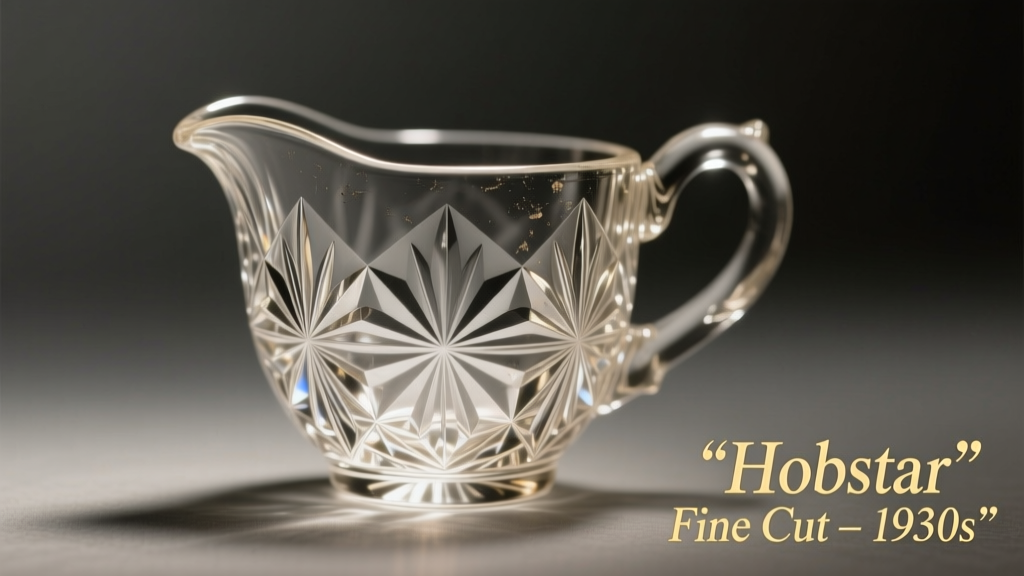
The Cut Glass Sugar Creamer Hobstar Fine Cut: A Study in American Brilliant Period Craftsmanship
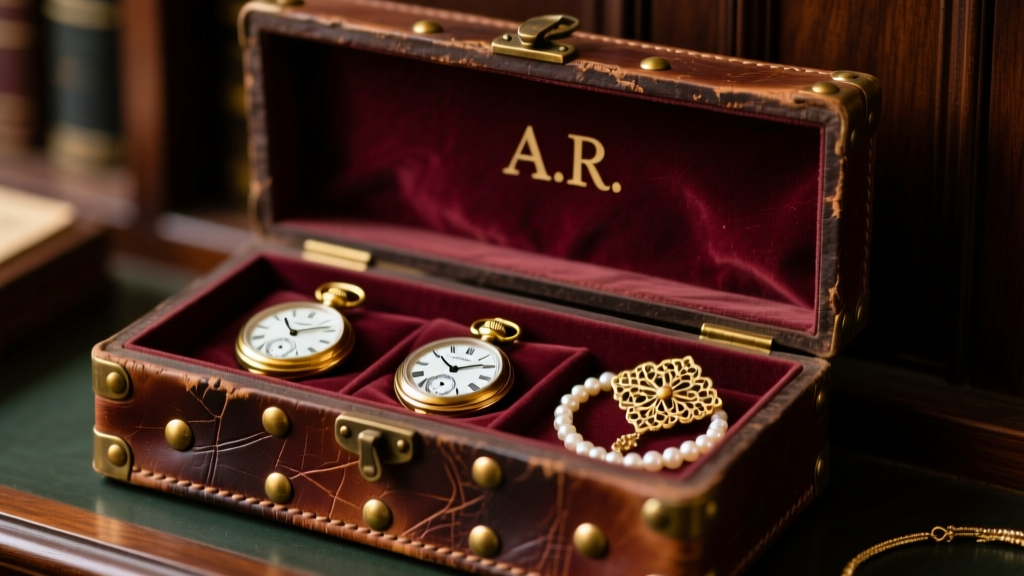
Leather-Covered Brass Document Boxes: A Collector’s Guide to 11½-Inch Stud-Fronted Presentation Cases

Bottles, Cure Only Apoplexy: Decoding the 'Preventative Paralysis Aqua 9 1 8 In' Label on 19th-Century Medicinal Glassware
Political Button: Shirley Chisholm 'President' — Catalyst for Change in American Political Iconography
How to Accurately Appraise a Three-Part Pottery Jardinière: Marks, Provenance, and Market Realities
Luster Copper Goblet with Black Transfer Oriental Band: A 4½-Inch Victorian Silverplate Masterpiece
Neoclassical Gilt Composition Eagle Crest Mirror: A 37 × 23-Inch Convex Masterpiece from the Late 18th Century
Barbie Twist 'n Turn Doll (1967): The Rare Two-Piece Blond with Pink Lips and Ribbon Hair — A Collector’s Deep Dive

Toy Bus 'School Wayne' Yellow with Red Trim: A Dinky Supertoys Collector's Reference Guide