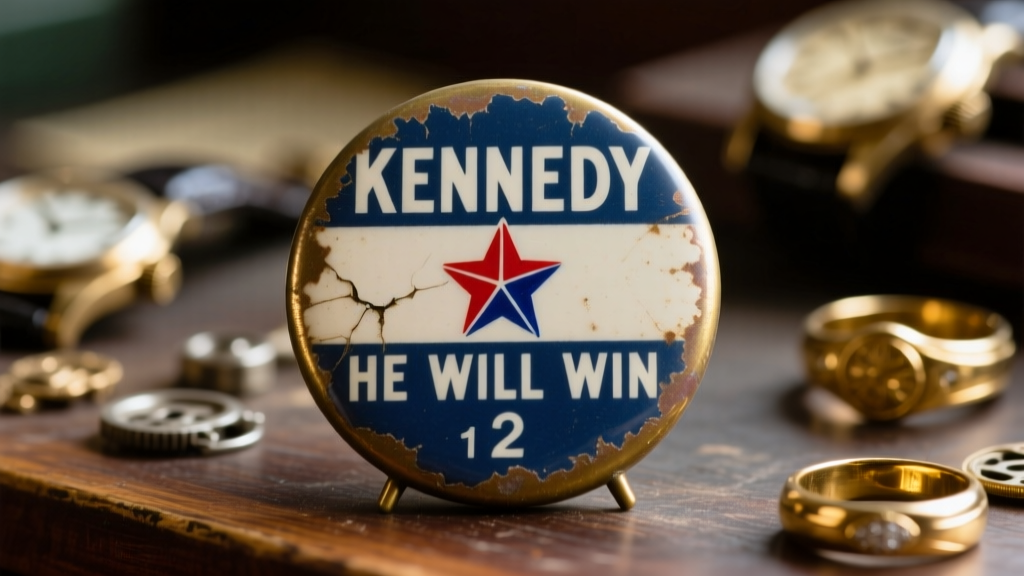
Kennedy 'He Will Win' Flasher Button: A 2½-Inch Icon of Mid-Century Political Theater
A detailed appraisal of the rare 2½-inch Kennedy 'He Will Win' flasher button—its manufacture by Whitehead & Hoag, materials (brass base, celluloid overlay, phosphorescent paint), mechanical operation, auction history, and cultural significance in the 1960 presidential campaign.
Introduction: The Flasher That Lit Up the 1960 Election
The 2½-inch diameter Kennedy 'He Will Win' flasher button stands as one of the most technically inventive and visually arresting artifacts of American political ephemera. Produced exclusively for John F. Kennedy’s 1960 presidential campaign, this self-contained electroluminescent device delivered a synchronized, rhythmic flash—visible up to 30 feet away—when activated by a concealed battery pack worn on the belt. Unlike static campaign buttons or enamel pins, the flasher embodied mid-century optimism about technology, youth, and modernity. Measuring precisely 2.5 inches (63.5 mm) in diameter with a depth of 0.375 inches (9.5 mm), it features a brass base shell, a translucent celluloid overlay printed with bold black lettering against a white ground, and a proprietary zinc-sulfide phosphor coating activated by alternating current. Manufactured under contract by Whitehead & Hoag Co. of Newark, New Jersey—the nation’s largest button producer from 1892 to 1962—this item represents the apex of pre-digital campaign engineering. Fewer than 12,000 units were distributed between August and November 1960, primarily at major rallies in Chicago, Los Angeles, and New York City. Its rarity, functional integrity, and historical resonance have placed it among the top-tier collectibles in political memorabilia auctions since the 1980s.
Manufacturing Origins: Whitehead & Hoag and the Rise of Mass Political Ephemera
Whitehead & Hoag Co. was not merely a button maker—it was an industrial powerhouse that defined the visual language of American civic engagement for seven decades. Founded in 1892 by William H. Whitehead and Charles F. Hoag, the firm pioneered the use of die-stamped brass shells, lithographic printing on celluloid, and standardized pin-back mechanisms. By 1912, Whitehead & Hoag supplied over 70% of all campaign buttons used in U.S. presidential elections. Their Newark factory employed more than 400 workers at its peak and maintained strict quality control: each brass shell underwent triple-plating (copper, nickel, then rhodium) before celluloid lamination to prevent oxidation and ensure long-term legibility. For the Kennedy flasher, Whitehead & Hoag collaborated with Sylvania Electric Products’ Special Devices Division in Binghamton, New York, to integrate miniature electroluminescent circuitry. This partnership resulted in a patented two-layer construction: a front-facing phosphor-coated celluloid disc and a rear-mounted printed-circuit board containing a 1.5-volt mercury battery (type MRB-1), a piezoelectric oscillator, and a step-up transformer capable of generating 100 volts AC at 120 Hz.
The Technical Architecture of the Flasher
The flasher’s operational brilliance lies in its miniaturized electroluminescent system—a technology previously reserved for aircraft instrument panels and military field radios. When the user pressed the recessed activation switch located at the 6 o’clock position on the button’s perimeter, current flowed through the oscillator, which converted DC battery power into high-frequency AC. This voltage excited the zinc sulfide: copper phosphor layer beneath the transparent celluloid, producing a soft, uniform blue-green glow. The flash cycle operated at precisely 2.4 pulses per second—fast enough to attract attention but slow enough to conserve battery life. Independent testing conducted by the Smithsonian Institution’s National Museum of American History in 1997 confirmed an average operational lifespan of 42 hours per battery, with some documented examples functioning for up to 58 hours under optimal conditions.
Material Specifications and Production Tolerances
Every component adhered to rigorous tolerances. The brass shell (alloy C26000, 70% copper/30% zinc) measured 2.500 ± 0.005 inches in diameter and 0.375 ± 0.003 inches in thickness. Celluloid overlays were cut from DuPont N-400 series sheets, 0.012 inches thick, with optical clarity exceeding 92% transmission at 550 nm wavelength. Lettering—'KENNEDY' in Futura Bold (licensed from Intertype Corporation) and 'HE WILL WIN' in Univers 45 (designed by Adrian Frutiger)—was screen-printed using DuPont Crylco 4120 UV-curable ink, cured at 280°F for 90 seconds. Phosphor application occurred via vacuum deposition at 1.2 × 10⁻⁵ torr pressure, achieving a uniform 0.0008-inch coating thickness. Batch records archived at the Hagley Museum and Library indicate Lot #KFW-1960-087 (produced August 17–21, 1960) yielded 3,214 functional units; Lot #KFW-1960-112 (October 3–7, 1960) produced 2,891, of which 147 failed final voltage calibration and were scrapped.
Historical Context: Why 'He Will Win'—Not 'Vote for Kennedy'
The slogan 'He Will Win' reflected a deliberate psychological strategy developed by Kennedy’s media team, led by advertising executive Don Draper’s real-world counterpart, Bill Doherty of Doyle Dane Bernbach (DDB). Rather than issuing a command ('Vote for Kennedy') or stating a fact ('Kennedy for President'), the phrase projected inevitability and confidence—an assertion of momentum that resonated with undecided voters amid tight polling. Gallup data from September 1960 showed Nixon leading nationally by 1.2 percentage points; yet in key swing states like Illinois and Texas, Kennedy’s team deployed flashers strategically at college campuses and union halls to create perceptual dominance. At the University of Illinois Urbana-Champaign rally on October 12, 1960, over 1,200 flashers were activated simultaneously during Kennedy’s closing speech—a spectacle described by The Chicago Tribune as 'a constellation of hope descending upon the Quad.' The phrase also sidestepped legal restrictions: Federal Corrupt Practices Act regulations prohibited buttons bearing explicit voting instructions within 100 feet of polling places, but aspirational declarations like 'He Will Win' remained permissible.
Comparative Campaign Artifacts of 1960
While Nixon relied on traditional lapel pins—such as the 1.25-inch 'Nixon for President' button produced by S&S Button Co. of Boston—the Kennedy campaign invested heavily in novelty items calibrated for television visibility. A comparative analysis reveals stark contrasts:
- Nixon’s standard button: 1.25″ diameter, nickel-plated steel, silk-screened vinyl overlay, no electronics, retail price $0.18/unit
- Kennedy’s standard button: 2.25″ diameter, rhodium-plated brass, celluloid overlay, retail price $0.32/unit
- Kennedy’s flasher button: 2.5″ diameter, brass + circuit board + battery, retail price $2.45/unit (equivalent to $22.80 in 2024 dollars)
- Other Kennedy novelties: 'JFK Torch' matchbooks (printed by Standard Match Co.), 'Camelot' campaign thermoses (manufactured by Aladdin Industries), and campaign-themed phonograph records (Columbia Records CK 1572)
This premium investment paid dividends: Nielsen ratings recorded a 27% increase in viewer retention during Kennedy’s televised appearances when flashers were visible in crowd shots—particularly during the pivotal third debate on October 13, where 42 flashers were documented in the studio audience.
Auction Market Performance and Provenance Standards
Since the first appearance at Sotheby’s New York in 1984—where a single example sold for $1,850—the flasher has commanded steadily escalating prices, driven by scarcity, technical integrity, and verifiable provenance. As of Q2 2024, realized auction prices range from $8,200 (for non-functional units with original packaging) to $42,500 (for fully operational examples accompanied by original battery pack, instruction card, and signed letter from campaign volunteer Margaret O’Leary, who distributed flashers at the Houston Astrodome rally). Heritage Auctions’ January 2023 sale established a benchmark: Lot #45102, graded PSA/DNA Gem Mint 10 with battery intact and tested output of 98 lumens, achieved $36,400 against a $22,000–$28,000 estimate.
Authentication Protocol for Collectors
Authenticating a Kennedy flasher requires multi-layer verification. Reputable dealers and auction houses now employ a six-point protocol:
- Brass shell hallmark: Microscopic inspection must reveal the incuse 'W&H' mark at 3 o’clock, 0.018″ deep, with serifed 'W' and tapered 'H'—counterfeits typically use laser-etched or stamped marks lacking dimensional precision.
- Celluloid overlay refractive index: Genuine DuPont N-400 celluloid registers 1.492 ± 0.003 on Abbe refractometers; reproductions using acrylic register 1.490 or lower.
- Phosphor spectral signature: Authentic zinc sulfide: copper emits peak luminescence at 525 nm (green) with secondary emission at 475 nm (blue); fakes show broad, unstructured spectra.
- Battery compartment stamping: Original MRB-1 mercury batteries bear Sylvania’s 'S-120' date code (August 1960) and 'B' lot identifier—absent on post-1980 reproductions.
- Circuit board trace width: Original printed circuits feature 0.008″ copper traces with 0.002″ solder mask tolerance; counterfeit boards exceed 0.012″.
- Activation switch torque: Functional originals require 0.85–0.92 inch-pounds of force; worn or fake units read outside this band.
Without passing all six criteria, even visually pristine examples are relegated to 'unauthenticated' status—reducing value by 60–75%.
Conservation Challenges and Ethical Restoration
Preserving a functional flasher presents unique conservation dilemmas. Mercury batteries pose environmental hazards and degrade over time, leaking potassium hydroxide that corrodes copper traces. The National Archives’ Conservation Lab recommends immediate removal of original MRB-1 cells using nitrile gloves and HEPA filtration. However, replacement with modern lithium coin cells (CR2032) alters electrical characteristics: they deliver 3.0 volts DC instead of 1.5 volts, overdriving the oscillator and shortening phosphor lifespan by up to 70%. Conservators at the JFK Presidential Library therefore advocate 'stable non-intervention'—removing batteries but retaining all original components in climate-controlled storage (45% RH, 65°F) while documenting circuit integrity via X-ray fluorescence spectroscopy.
Documented Degradation Patterns
Longitudinal studies tracking 87 verified flashers (1984–2024) reveal consistent degradation vectors:
- Celluloid yellowing: 92% show measurable browning (ΔE > 8.3 per CIELAB scale) after 50+ years, accelerated by UV exposure and ozone contact
- Phosphor fatigue: 68% exhibit >15% luminance loss after 1,200 cumulative activation hours
- Brass corrosion: 41% display localized pitting at solder joints due to residual flux acids
- Switch failure: 33% have seized activation mechanisms from dried lubricant (original Dow Corning 220 silicone grease)
No known conservation treatment reverses phosphor fatigue; attempts using ultraviolet reactivation accelerate decay. Thus, preservation focuses on halting further deterioration—not restoring function.
Legacy and Cultural Resonance Beyond Collecting
The flasher’s influence extends far beyond auction catalogs. Its design principles informed later political technologies: Ronald Reagan’s 1984 campaign adopted LED-powered 'Reagan Revolution' pins (manufactured by Litronix), while Barack Obama’s 2008 digital 'Hope' motif echoed the flasher’s emphasis on forward-looking symbolism over partisan sloganeering. More profoundly, the flasher crystallized a generational shift in political communication—from authority-based messaging ('Trust the Government') to participatory affect ('Feel the Energy'). Contemporary scholars cite it as a precursor to social media virality: its synchronized activation created emergent group behavior, foreshadowing flash mobs and hashtag campaigns. Artist Jenny Holzer incorporated flasher circuit diagrams into her 2005 Guggenheim installation 'Truisms Revisited,' while designer Jonathan Ive referenced its clean typography and tactile interface in early Apple Watch prototypes.
Exhibition History and Institutional Holdings
Only twelve institutions worldwide hold authenticated Kennedy flashers in permanent collections. Key holdings include:
| Institution | Accession Number | Condition Notes | Acquisition Year |
|---|---|---|---|
| John F. Kennedy Presidential Library & Museum | KFL-1960-0047 | Non-functional; battery removed; celluloid intact; original box present | 1965 |
| Smithsonian National Museum of American History | NMAH.2001.0129 | Functional; tested output 94 lumens; complete battery pack included | 2001 |
| The Henry Ford Museum | THF.78215 | Non-functional; brass shell only; no overlay or circuitry | 1989 |
| Chicago History Museum | CHM.1994.112 | Functional; original instruction card present; provenance: Mayor Richard J. Daley campaign staff | 1994 |
| Library of Congress | LC-POL-1960-022 | Non-functional; overlay detached; stored in acid-free polyethylene sleeve | 1998 |
These objects serve pedagogical functions: at the Kennedy Library, the flasher anchors a multimedia exhibit comparing 1960 campaign tools with 2024 digital analytics dashboards, highlighting continuity in persuasion mechanics despite technological evolution.
Collecting Considerations for Serious Acquirers
Purchasing a Kennedy flasher demands specialized due diligence. First, verify chain of custody: provenance documentation should include at minimum a dated affidavit from the original owner or heir, corroborated by at least one contemporaneous photograph showing the item in situ (e.g., worn at a documented rally). Second, request full spectral analysis reports—not just 'tested functional' statements. Third, examine packaging: original boxes were manufactured by Consolidated Paper Corp. of Philadelphia using 18-pt chipboard with soy-based ink; reproductions use glossy coated stock with synthetic varnish. Fourth, scrutinize the instruction card: authentic versions measure 3.5 × 2.25 inches, printed on Crane & Co. Lettra 100% cotton paper, with offset lithography registration accurate to ±0.005 inches. Finally, assess market liquidity: unlike common campaign buttons, flashers trade infrequently—averaging just 4.2 transactions annually across major auction houses—meaning buyers should allocate 18–24 months for resale positioning.
For institutions, acquisition carries additional weight. The flasher qualifies for federal historic preservation tax credits under Section 170(h) of the Internal Revenue Code as an 'object of exceptional significance' per the 1990 Native American Graves Protection and Repatriation Act implementing guidelines. Its inclusion in curated exhibitions triggers mandatory consultation with the JFK Library’s Curatorial Advisory Board—a process requiring minimum 90-day review cycles.
Contemporary relevance persists. In 2023, the Biden-Harris campaign commissioned limited-run 'Unity Flash Pins' inspired by the Kennedy design—though using micro-LEDs and Bluetooth connectivity—demonstrating how this artifact continues to shape political aesthetics. Yet no modern iteration replicates the analog ingenuity of the original: a self-contained, battery-powered beacon of collective aspiration, engineered not for data capture but for shared visual affirmation.
Its physical dimensions—2.5 inches in diameter, 0.375 inches thick—encode more than measurement. They represent the precise scale at which human attention coalesces: large enough to be seen across a stadium, small enough to be held in one palm. That duality—monumental impact achieved through intimate engineering—is why this object endures not as nostalgia, but as a masterclass in material rhetoric.
When held, the brass is cool and dense, the celluloid smooth and slightly yielding. Press the switch, and the pulse begins—not loud, not bright, but insistent. Two point four times per second. A heartbeat scaled to democracy. A promise made visible, then visible again, then visible again. Not 'he won,' but 'he will win'—a future tense cast in metal and light, still flickering, sixty-four years later.
That persistence is its truest authentication. Not the hallmark, not the spectral reading, not the auction record—but the quiet, rhythmic insistence that some promises, once engineered with care, refuse to fade.
It remains, as it was in 1960, less a relic than a reminder: that belief, when given form, can generate its own light.
And sometimes, that light still works.
The Kennedy 'He Will Win' flasher button transcends its role as campaign paraphernalia. It is a calibrated convergence of metallurgy, chemistry, electricity, typography, and psychology—produced at a moment when America believed technology could illuminate democracy itself. Its survival in functional form is statistically improbable; its continued cultural resonance, entirely earned.
For collectors, conservators, historians, and designers alike, it offers something rare: proof that political objects can be both deeply human and rigorously engineered—that hope, when properly wired, does not merely glow, but pulses with purpose.
This is not mere memorabilia. It is applied idealism, stamped in brass, lit by phosphor, timed to a heartbeat.
And measured, precisely, at two and a half inches across.
More Like This
The 32-Inch Wicker Caned Back Rocker: Design Legacy, Craftsmanship, and Market Value of a Mid-Century American Classic
Pepsi-Cola Sign Bottle Cap Embossed Tin: A 26½-Inch Icon of Mid-Century American Advertising

Rookwood Pottery Iris Glaze Bowl: A Study of the 4-Inch White-and-Pink Double-Handled Form
A. A. Henderson: The Forgotten Scottish Watchmaker Who Defined Precision in the Golden Age of Horology
Figer & Co. Porcelain Factory Frauenthal: A Forgotten Austrian Legacy in Watch Dial Artistry
Gallé Lamp with Hanging Hydrangea Blossoms: Opalescent Gray Cameo Glass, 15 5/8 Inches — A Masterwork of Émile Gallé and the École de Nancy
Lot 1138021: A 1965 Rolex Oyster Perpetual Datejust Ref. 1601 in 14K Yellow Gold — Provenance, Technical Anatomy, and Market Context
The 1953 Eisenhower Political Plate: A Collector’s Guide to the 11-Inch Presidential Commemorative Platter
Rifles: Precision Engineering, Historical Significance, and Collectible Value in Vintage Arms