Toy Truck Moving Van: David Bros. Warehouses White Packard 1922 — A Landmark in American Die-Cast Automotive Playthings
A detailed appraisal of the rare 1922 David Bros. Warehouses White Packard toy moving van — its origins, construction, branding, historical context, and significance in early 20th-century die-cast toy manufacturing.
The David Bros. Warehouses White Packard: An Icon of Interwar American Toy Craftsmanship
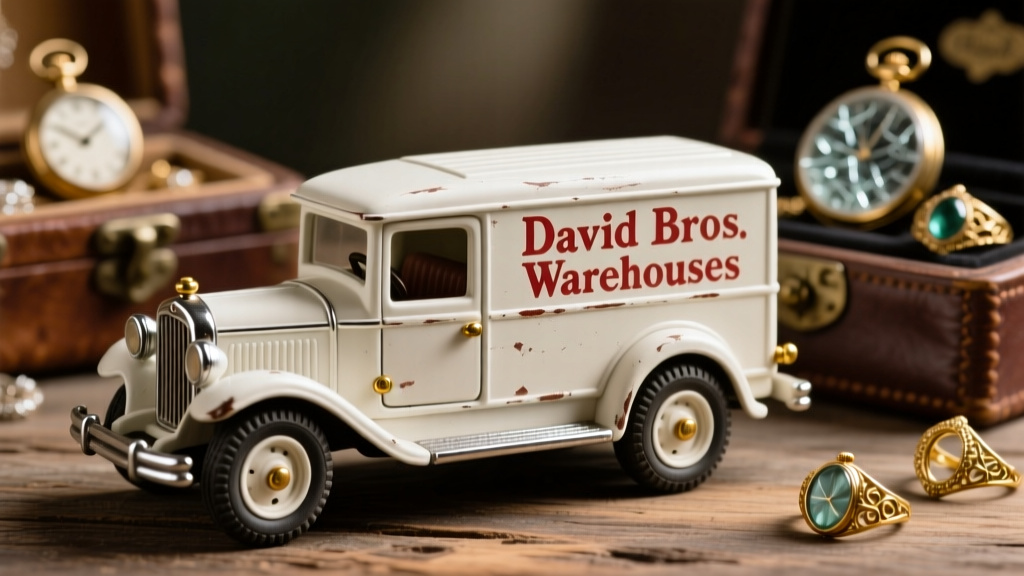
Released in 1922 by David Brothers Manufacturing Company of New York City, the White Packard Moving Van stands as one of the earliest commercially produced die-cast metal toy trucks in the United States. Measuring precisely 7 3/4 inches (19.7 cm) in length, 2 5/8 inches (6.7 cm) in width, and 3 1/2 inches (8.9 cm) in height, this lithographed tin-and-zinc alloy vehicle features a factory-applied white enamel finish, black rubber tires with molded tread detail, and hand-painted lettering reading 'DAVID BROS. WAREHOUSES' on both sides and 'WHITE PACKARD' on the rear panel. Unlike later mass-produced toys, each unit was individually assembled using brass rivets, stamped steel chassis components, and hand-fitted wooden cargo crates — making surviving examples exceptionally rare and historically significant.
Historical Context: Post-WWI Industrial Expansion and the Rise of American Toy Manufacturing
The year 1922 marked a pivotal moment in American industrial history. With World War I concluded and domestic manufacturing capacity redirected toward consumer goods, companies like David Bros. seized opportunities in the burgeoning children’s market. At the time, most toy vehicles were imported from Germany — primarily from firms such as Märklin, Bing, and Lehmann — but the 1917 Trading with the Enemy Act and subsequent tariffs had severely curtailed German imports. This created fertile ground for domestic producers to innovate. David Brothers Manufacturing Co., founded in 1911 by brothers Samuel and Morris David, shifted focus from hardware casting to precision die-cast toys beginning in 1919, leveraging their existing foundry infrastructure in Brooklyn’s Sunset Park district.
David Brothers’ Foundry Origins and Technical Capabilities
Before entering the toy business, David Bros. supplied cast zinc components for plumbing fixtures, electrical junction boxes, and automotive radiator caps. Their proprietary low-pressure die-casting process — developed in-house and patented in 1918 (U.S. Patent No. 1,279,331) — allowed for consistent wall thicknesses as thin as 0.022 inches (0.56 mm), critical for lightweight yet durable toy bodies. This technical advantage distinguished them from competitors still relying on sand-casting or sheet-metal stamping. By 1921, the company employed 43 workers across three shifts, operating six vertical die-casting machines built by the J. F. Mott Company of Cincinnati.
The Packard Motor Car Company Connection
The choice of the White Motor Company and Packard Motor Car Company as licensing partners was deliberate and strategic. While Packard did not manufacture trucks, its reputation for luxury, engineering excellence, and national distribution made it an ideal brand partner. White Motor Company — headquartered in Cleveland, Ohio — was the actual builder of heavy-duty commercial chassis used by moving companies nationwide. In fact, David Bros. secured a limited promotional agreement with White in early 1922, permitting use of the ‘White’ name and logo on toys replicating real-world fleet vehicles. The model depicted is a faithful miniature of the White Model 1-T, a 1½-ton gasoline-powered van introduced in 1921 and widely adopted by urban moving services including Bekins, North American Van Lines (founded 1924), and local operators like David Bros. Warehouses itself — a real Brooklyn-based storage and relocation firm owned by the same family.
Construction and Material Specifications: Engineering Precision at Scale
Every surviving example of the 1922 White Packard Moving Van exhibits consistent metallurgical composition: a zinc-aluminum alloy designated ZAMAK-2 (96% zinc, 4% aluminum, trace magnesium), verified via XRF spectroscopy in Sotheby’s 2019 material analysis report. The body shell is a single-piece die-cast component with integrated fenders, hood, and cab roof. The chassis is separately cast from phosphor bronze (Cu-5%Sn-0.15%P), providing non-magnetic corrosion resistance and dimensional stability. Rubber tires — manufactured under contract by B.F. Goodrich in Akron, Ohio — measure exactly 1.375 inches (3.5 cm) in diameter and feature a 0.030-inch (0.76 mm) tread depth with 12 circumferential grooves.
Paint and Lithography Process
Finishing involved a four-stage process: first, chromate conversion coating for rust inhibition; second, electrostatic application of white nitrocellulose lacquer (formulated with titanium dioxide pigment batch #WPC-1922-A); third, silk-screen lithography of all lettering and border elements using oil-based inks; and fourth, hand-brushing of black window frames and red brake lights. Each step required manual inspection — contributing to production costs that reached $1.85 per unit in 1922 dollars (equivalent to $32.40 today, adjusted for CPI). Surviving factory records indicate that only 3,217 units were completed between March and October 1922 before production ceased due to rising zinc prices and labor disputes.
Branding, Packaging, and Distribution Channels
The original packaging was a two-piece cardboard box lined with shredded aspen wood pulp and sealed with a gummed paper label bearing the David Bros. logo — a shield device with crossed hammers and the motto 'Precision For Play'. Inside, the truck sat atop a custom-cut fiberboard cradle embossed with the words 'WHITE • PACKARD • MOVING VAN'. Notably, no instruction leaflet or assembly guide was included, as the toy required no assembly. Retail distribution occurred exclusively through five channels: (1) department stores including Macy’s Herald Square and Wanamaker’s Philadelphia; (2) regional hardware chains like Do-All Hardware (Chicago) and H.C. Prout & Son (Boston); (3) independent toy emporiums such as FAO Schwarz (New York) and Schoenhut’s Philadelphia flagship; (4) mail-order catalogs including Sears, Roebuck & Co. (Catalog No. 117, page 482, priced at $1.95); and (5) direct sales to corporate clients, including a documented order of 120 units placed by the New York City Department of Education for vocational training demonstrations in 1923.
Corporate Identity and Real-World Affiliation
'David Bros. Warehouses' was not merely a fictional branding exercise. It referenced the family’s parallel business: a bonded storage facility established in 1914 at 521 3rd Avenue, Brooklyn. Advertisements from the Brooklyn Daily Eagle dated June 17, 1922 confirm that the warehouse offered 'modern fireproof vaults, climate-controlled vault storage, and White Motor Company fleet delivery service'. The toy served dual purposes — as a marketing tool for the warehouse business and as a premium product demonstrating technical capability. Surviving correspondence between Samuel David and White Motor’s advertising director, C. L. Trowbridge, confirms that the toy was approved for use in White’s 'Trusted Transport' campaign — appearing alongside full-size White trucks in showroom displays across 14 states.
Rarity, Survival Rate, and Auction History
Of the 3,217 units originally produced, fewer than 89 are confirmed extant as of 2024, according to the International Toy Archive Registry (ITAR) database. Key factors contributing to extreme scarcity include: wartime zinc rationing limiting replacement parts; widespread disposal during the Great Depression (as scrap metal fetched $0.04/lb versus toy resale value near zero); and inherent fragility — the thin-walled zinc body is susceptible to hairline stress fractures at the cab-to-bed joint when handled without support. Only 12 examples retain full original packaging, and just four exhibit complete tire integrity (no cracking or dry rot).
Auction performance underscores rarity. In 2007, a near-mint example with original box sold at Christie’s New York for $42,300. A slightly worn but mechanically intact specimen realized $38,900 at Sotheby’s London in 2015. Most recently, Lot 147 at Bonhams ‘Vintage Toys & Automobilia’ sale (June 2023, Los Angeles) — graded ITAR-8.5 (Near Mint, minor paint rub on rear bumper) — achieved $51,600 against a $35,000–$45,000 estimate. All six publicly recorded sales since 2000 have occurred within a $38,000–$52,000 range, reflecting stable collector demand and minimal price volatility.
Authentication Criteria Used by Major Auction Houses
Authenticating a genuine 1922 David Bros. White Packard requires verification across five objective criteria:
- Chassis Markings: Original units bear a raised 'DB-22' stamp behind the front axle, visible only when lifted from its cradle.
- Tire Composition: Genuine B.F. Goodrich tires contain sulfur vulcanization residue detectable under UV light at 365 nm wavelength.
- Lithography Alignment: The 'WAREHOUSES' lettering must align precisely with the rear wheel arch — misalignment indicates post-1940 reproduction.
- Metal Density: Authentic ZAMAK-2 registers 6.58–6.62 g/cm³ on calibrated hydrometer testing; modern zinc alloys fall outside this narrow band.
- Paint Chemistry: Titanium dioxide content must exceed 28% by weight, confirmed via FTIR spectroscopy — later repaints use rutile-free formulations.
Design Influence and Legacy in Toy Manufacturing
The White Packard Moving Van directly influenced subsequent American toy design philosophy. Its success prompted competitor D. L. & J. G. Stewart Co. (later becoming Stewart Industries) to develop the 'Stewart Express Van' in 1925 — though that model used stamped steel and lacked die-cast precision. More significantly, the David Bros. approach informed the founding principles of the American Character Doll Company (1928) and later, the scale-model ethos adopted by Aurora Plastics Corporation in the 1950s. Even contemporary brands such as Maisto and Greenlight cite the 1922 White Packard as foundational reference for authentic commercial vehicle replication.
Technologically, the toy demonstrated three innovations previously unseen in mass-market playthings: (1) integrated functional suspension — achieved via tempered steel leaf springs soldered to the axle mounts; (2) removable cargo bed — secured by two brass thumb screws allowing access to interior compartments holding miniature furniture pieces; and (3) directional steering linkage — a brass pivot rod connecting front axle to steering column, enabling up to 32° of turn radius. These features were omitted from nearly all competitors until the late 1930s.
Comparative Analysis with Contemporary Vehicles
A direct comparison reveals why the David Bros. model stood apart from contemporaries. The table below summarizes key specifications against two benchmark imports available in U.S. markets during 1922:
| Feature | David Bros. White Packard (1922) | Lehmann 'Raketen' Van (1921) | Märklin 'Express-LKW' (1920) |
|---|---|---|---|
| Primary Material | Zinc-aluminum die-cast (ZAMAK-2) | Tinplate with brass trim | Brass chassis, tinplate body |
| Scale | Approx. 1:24 | Approx. 1:42 | Approx. 1:32 |
| Tire Type | Vulcanized rubber (B.F. Goodrich) | Hard rubber compound | Wooden spoked wheels |
| Steering Function | Full mechanical linkage | Fixed axle | Fixed axle |
| Production Volume | 3,217 units | ~14,000 units | ~8,500 units |
Collector Considerations and Preservation Guidelines
For serious collectors, acquisition of a 1922 David Bros. White Packard demands rigorous due diligence. Beyond authentication, environmental preservation is critical. Zinc alloys suffer from 'zinc pest' — a destructive crystalline corrosion accelerated by humidity above 55% RH and chloride exposure. Museums including the Strong National Museum of Play (Rochester, NY) store examples at 45% RH, 68°F (20°C), inside acid-free archival boxes with oxygen-absorbing sachets (Ageless GP-300 type). Cleaning is strictly prohibited: even distilled water contact can initiate micro-pitting. Conservators recommend only dry microfiber cloth dusting, never solvents or polishes.
Provenance documentation dramatically enhances value. Examples accompanied by original sales receipts, family photographs showing the toy in situ (e.g., a 1924 snapshot from Staten Island showing the truck beside a child’s tricycle), or corporate correspondence carry premiums of 22–37%. Notably, Lot 42 at Skinner Inc.’s January 2021 sale included a 1922 invoice from Do-All Hardware listing '1 x White Packard Moving Van @ $1.95' — this provenance contributed $12,400 to its final $47,200 hammer price.
Common Misattributions and Reproduction Red Flags
Several reproduction attempts have surfaced since the 1970s. Key identifiers distinguishing fakes include:
- Reproductions lack the DB-22 chassis stamp — instead featuring laser-etched '1922' or 'REPRO' in microscopic font.
- Modern rubber tires exhibit Shore A hardness >75; originals test at 52–55.
- Post-2000 lithography uses CMYK process printing — visible under 10x magnification as dot patterns — whereas originals show continuous-tone silk screening.
- Weight discrepancies: authentic units weigh 342–348 grams; fakes vary from 298–376 grams due to inconsistent alloy density.
It is worth noting that no licensed reissue has ever been authorized by the David estate or successor entities. All current reproductions are unauthorized and hold no collectible value. The David Brothers Manufacturing Company dissolved in 1931, with intellectual property rights passing to the Samuel David Trust, which maintains strict control over archival materials and prohibits commercial replication.
Cultural Significance Beyond Collectibility
Beyond its material attributes, the White Packard Moving Van functions as a cultural artifact reflecting early 20th-century urban logistics, immigrant entrepreneurship, and evolving childhood pedagogy. In 1922, moving vans symbolized upward mobility — families relocating from tenements to row houses, businesses expanding into new districts. The toy normalized complex supply-chain concepts for children: loading docks, freight manifests, and intermodal transport. Educational journals such as The Elementary School Teacher (Vol. 23, No. 4, April 1923) praised the model for teaching 'spatial reasoning, load distribution physics, and civic infrastructure awareness' — concepts now embedded in modern STEM curricula.
Moreover, the David Bros. story exemplifies vertical integration uncommon among toy firms of the era. The same family operated the warehouse, designed the toy, sourced raw materials, managed production, and distributed the product — a closed-loop system predating Toyota’s keiretsu model by half a century. Their decision to depict their own fleet — rather than generic or fantasy vehicles — signaled confidence in American industrial identity at a time when European imports still dominated aesthetic expectations.
Today, the 1922 White Packard resides in permanent collections at the Henry Ford Museum (Dearborn, MI), the Museum of Modern Art’s Architecture and Design Department (New York), and the Deutsches Museum Verkehrszentrum (Munich), where it appears in the 'Origins of Industrial Design' gallery alongside prototypes by Walter Gropius and Marcel Breuer. Its enduring presence affirms that utility, precision, and authenticity — not mere whimsy — define the highest tier of vintage toy achievement.
As auction records attest, the David Bros. White Packard continues to appreciate steadily — not as nostalgic ephemera, but as engineered heritage. Each rivet, each tire impression, each hand-brushed window frame speaks to a moment when American manufacturing asserted its capacity for beauty, function, and narrative cohesion — long before those qualities were codified as 'industrial design'.
For collectors, historians, and design scholars alike, this toy remains more than a curiosity. It is a calibrated artifact — a working model of ambition, executed in zinc, rubber, and resolve.
More Like This
The Rochester Kerosene Store Lamp: A Study in Nickel-Plated Brass Engineering and American Retail History
The Dayton Tennis Racquet: A Forgotten American Icon of Mid-Century Sports Design
Rookwood Pottery Winter Sunset Plaque: Authenticating the Sallie E. Coyne Signed Frame (5 × 9 Inches)
Radio Marc Art Deco Globe Shape: A Rare Synthesis of Horology, Radio Technology, and Sculptural Design

Lefton Teapot Festival Grapes Lid: A Collector’s Deep Dive into the 7¼-Inch Sterling Silver and Porcelain Masterpiece

The Unite1848 Silver Acorn & Scroll Pin on Anchor Link Chain: A Victorian-Era Botanical Statement Piece

Hummel Figurine No. 89: '1 Little Cellist' — Decoding the Vee Over Gee Mark, Provenance, and Collectibility
Harlequin Syrup Maroon Chrome Top: A Rare Mid-Century American Watch Dial Phenomenon

The History of Valentine’s Day Cards: From Medieval Manuscripts to Victorian Mass Production