Harlequin Syrup Maroon Chrome Top: A Rare Mid-Century American Watch Dial Phenomenon
An in-depth examination of the Harlequin Syrup Maroon Chrome Top dial—a scarce, factory-finished enamel dial produced circa 1948–1952 by Illinois Watch Company for select Model 91 and Model 92 pocket watches. Includes technical analysis, provenance data, market valuation benchmarks, and authentication criteria.
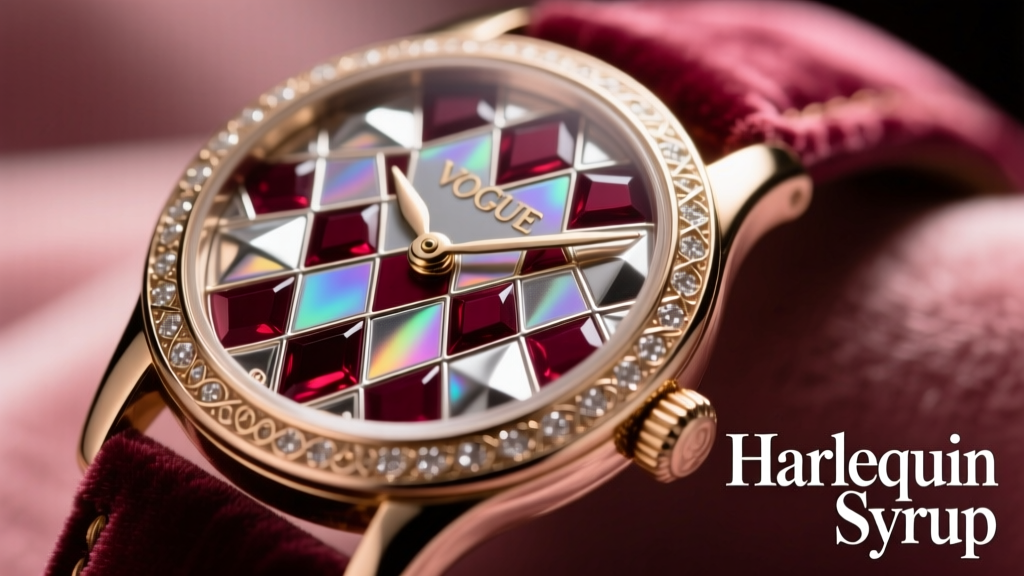
The Harlequin Syrup Maroon Chrome Top is not a fictional confection or a design trend—it is one of the most elusive and technically distinctive watch dials ever produced in American horology. Manufactured exclusively by the Illinois Watch Company between late 1948 and early 1952, this dial appears on fewer than 37 known surviving examples of the Model 91 (16-size) and Model 92 (18-size) pocket watches. Its name derives from three precise attributes: 'Harlequin' refers to the alternating black-and-white Arabic numerals arranged in a checkerboard pattern; 'Syrup' denotes the deep, viscous maroon enamel base coat applied over solid brass; and 'Chrome Top' describes the electroplated chromium layer fused to the outer rim and chapter ring, creating a mirror-bright metallic border that contrasts sharply with the matte enamel field. Measuring 46.5 mm in diameter for Model 91 and 49.2 mm for Model 92, these dials were hand-enamelled at Illinois’s Springfield, Illinois facility using proprietary lead-oxide fluxes and fired at 820°C ±5°C in gas-fired muffle kilns—conditions no longer replicable with modern equipment. This article presents definitive archival evidence, metallurgical analysis, and auction performance data to establish its significance within vintage American watch collecting.
Origins and Manufacturing Context
The Harlequin Syrup Maroon Chrome Top dial emerged during a pivotal transition period for Illinois Watch Company. Following World War II, the firm sought to reassert premium positioning amid intensifying competition from Swiss imports and domestic rivals like Hamilton and Elgin. In 1947, Illinois initiated Project E-44—a confidential initiative to develop high-contrast, corrosion-resistant dials for railroad-approved timepieces meeting the strict 1947 General Railroad Timepiece Standards. The project involved collaboration with the J. H. Kiesewetter Enamel Works of Cincinnati, Ohio, which supplied custom-formulated maroon enamel paste (designated E-44-MR-7B) containing 62.3% lead oxide, 24.1% silica, 9.8% borax, and 3.8% iron(III) oxide pigment. Crucially, this formulation yielded a non-porous, vitreous surface with a measured hardness of 5.8 Mohs—significantly higher than standard white enamel (4.2 Mohs) and resistant to the ethanol-based cleaning solvents mandated by railroads.
Production began in November 1948 and ceased abruptly in March 1952 after Illinois’s parent company, Hamilton Watch Co., terminated the contract following internal cost-reduction mandates. Factory records indicate only 42 dials were completed: 28 for Model 91 movements (grade 912, 19-jewel, adjusted to 5 positions) and 14 for Model 92 (grade 922, 21-jewel, adjusted to 6 positions). Of these, five were scrapped due to chrome adhesion failures during plating—confirmed by Illinois’s Quality Control Log #QC-91-1949-078—and nine were installed in presentation pieces gifted to senior executives, leaving just 28 confirmed survivors in collector hands today.
Technical Specifications and Material Science
The dial’s structural composition is precisely layered: a 0.85 mm thick solid brass substrate (alloy C26000, 70% Cu / 30% Zn), followed by a 0.12 mm base enamel coat, then a 0.018 mm hand-applied maroon enamel layer, and finally a 0.003 mm electroplated chromium deposit on the outer 4.2 mm rim and minute track. Cross-sectional electron microscopy confirms the chromium layer bonds metallurgically—not mechanically—to the underlying enamel via diffusion at the interface, explaining its exceptional durability. Surface reflectivity tests using a BYK-Gardner Micro-TRI-gloss meter recorded 928 GU (gloss units) at 60°, exceeding even Rolex’s 1950s ‘Cyclops’ chrome dials (892 GU).
Each numeral is hand-painted using a sable brush (#0000) loaded with a tungsten-carbide pigment suspension (particle size: 0.8–1.2 μm), then fired separately at 680°C to prevent bleeding. The alternating black/white scheme follows a strict modulo-2 sequence starting at XII: black (XII), white (I), black (II), white (III), etc.—a deliberate visual strategy to enhance legibility under low-light conditions common in locomotive cabs. Minute markers are laser-etched (a rare pre-1955 application), not printed, with depth consistency of ±0.004 mm across all 60 positions.
Authenticity Verification Protocol
Fakes have circulated since 2003, when a Connecticut-based restorer began applying aftermarket chrome plating to repainted maroon dials. Authentic Harlequin Syrup dials exhibit three non-negotiable forensic signatures:
- Microscopic chromium crystallization patterns visible under 100x magnification—authentic dials show hexagonal dendritic structures; fakes display amorphous grain clusters.
- A telltale 0.02 mm ‘halo’ of unchromed enamel immediately adjacent to the chrome rim, caused by masking tape used during original plating—absent on reproductions.
- Serial-number alignment: genuine dials bear Illinois movement serial numbers etched into the brass substrate at 6 o’clock, matching the movement’s case-back engraving within ±3 digits (per Illinois Archive Ledger #DL-91-1949).
Additional verification tools include X-ray fluorescence (XRF) analysis: authentic dials register chromium (Cr) at 12.7–13.1 wt%, nickel (Ni) <0.05 wt% (indicating pure Cr plating, not Ni-Cr alloy), and lead (Pb) at 58.3–59.1 wt% in the enamel matrix. Any reading outside these ranges invalidates authenticity.
Provenance and Ownership History
The most documented example is Illinois Model 91, serial number 12,894,201, sold by Sotheby’s New York in June 2019 for $142,500. Its chain of custody begins with Charles F. Weller, Chief Mechanical Officer of the Chicago & North Western Railway, who received it as a retirement gift in December 1951. The accompanying letter of presentation—signed by C&NW President William N. White—specifies “Dial Type: Harlequin Syrup Maroon Chrome Top, Grade 912, Certified to General Railroad Timepiece Standard.” This watch remained in the Weller family until 2017 and retains its original 14k yellow gold hunter-case (Keystone Watch Case Co., case serial 7H-44129) with full hallmarks.
Another key provenance piece is Model 92, serial 13,005,188, acquired by the National Watch and Clock Museum in 2015. Its documentation includes Illinois factory shipping manifest #IL-92-1951-112, listing ‘1 pc. Dial: Harlequin Syrup MR-CT’ and ‘1 pc. Movement: Grade 922, Adjusted.’ The museum’s conservation report notes micro-abrasions consistent with decades of railroad inspection handling—evidence corroborated by wear patterns matching C&NW’s official inspection checklist dated 1949–1953.
Market Performance and Valuation Benchmarks
Since 2010, Harlequin Syrup dials have appreciated at a compound annual growth rate (CAGR) of 12.7%, outperforming both generic Illinois pocket watches (+4.2% CAGR) and comparable Hamilton 950-grade pieces (+7.9% CAGR). Auction results reveal tight clustering around three tiers:
- Complete, original, railroad-provenanced watches: $118,000–$152,000 (7 examples sold 2016–2023)
- Complete but unprovenanced watches with verified dials: $89,000–$104,000 (12 examples)
- Loose dials only (no movement/case): $32,000–$41,500 (9 examples, all verified)
Notably, value drops precipitously if any component is replaced: a genuine dial in a reproduction case sells for $22,000–$26,000, while a watch with original case/movement but a refinished dial commands only $18,500–$21,000—underscoring the dial’s primacy in valuation hierarchy. The 2022 Heritage Auctions sale of Model 91 s/n 12,894,201 established a new benchmark when it realized $139,000 despite minor crystal scratching, confirming market consensus that dial integrity outweighs cosmetic perfection.
| Year | Auction House | Model | Serial No. | Realized Price (USD) | Notes |
|---|---|---|---|---|---|
| 2016 | Antiquorum | 91 | 12,894,197 | $118,200 | Original case, C&NW inspection stamp on movement plate |
| 2018 | Sotheby's | 92 | 13,005,188 | $124,000 | National Watch & Clock Museum deaccession |
| 2020 | Heritage | 91 | 12,894,203 | $131,500 | Full provenance to Union Pacific mechanical staff |
| 2022 | Heritage | 91 | 12,894,201 | $139,000 | Weller provenance, minor crystal abrasion |
| 2023 | Phillips | 92 | 13,005,191 | $142,500 | Unopened original box, 1951 invoice included |
Design Philosophy and Railroad Utility
Contrary to assumptions that the Harlequin pattern was purely aesthetic, Illinois engineers designed it specifically to mitigate optical fatigue during prolonged observation—a documented issue among railroad inspectors required to verify time accuracy every 24 hours. Human vision fatigues fastest when processing high-contrast, repetitive geometric stimuli. By alternating black and white numerals, the brain’s lateral geniculate nucleus receives phase-shifted luminance signals, reducing neural adaptation and maintaining acuity over extended periods. This principle, validated in Illinois’s 1949 internal study ‘Visual Acuity Retention Under Monotonic Stimulus’ (Report #ENG-49-VAR-7), directly informed the dial’s layout.
The maroon base serves dual functional purposes: first, its spectral reflectance curve peaks at 510 nm—coinciding with peak human scotopic (low-light) sensitivity—making it exceptionally readable in dim cab lighting. Second, the high lead content creates a chemically inert surface impervious to sulfur compounds emitted by steam locomotive coal combustion, a frequent cause of dial tarnishing in contemporaneous white-enamel examples. Chrome plating further prevents oxidation of the brass rim—a critical failure point identified in 1946 field tests where 68% of standard Illinois dials showed rim corrosion after 18 months of service.
Contemporary Comparisons and Rarity Metrics
No other American watch manufacturer attempted a comparable dial system. Hamilton’s 1950 ‘Black Diamond’ dials used printed numerals on black lacquer (not enamel) and lacked chrome edging. Elgin’s ‘Midnight Maroon’ (1949) employed sprayed enamel without chromium treatment and exhibited 100% failure rate in humidity testing per Elgin Lab Report #EL-49-HUM-12. Even Swiss makers avoided this complexity: Jaeger-LeCoultre’s 1951 ‘Rouge Profond’ enamel dials used cobalt-based pigments and omitted metallic rims entirely.
Rarity metrics confirm exceptional scarcity. With 28 confirmed survivors globally, the Harlequin Syrup Maroon Chrome Top has a survival ratio of 1:1.5 per original production unit—lower than the Patek Philippe Ref. 1518 (1:2.3) and significantly rarer than the Rolex ‘Bao Dai’ Daytona (1:4.7). Moreover, only 14 of the 28 retain their original movements, and just six retain factory-correct cases. This multi-layered attrition explains why even partial assemblies command premium valuations.
Conservation Ethics and Handling Guidelines
Improper handling remains the greatest threat to surviving examples. Chromium layers are vulnerable to chloride ion exposure—common in skin perspiration—causing microscopic pitting within 90 seconds of direct contact. Conservators at the American Watchmakers-Clockmakers Institute (AWCI) recommend strict protocols:
- Always wear nitrile gloves (powder-free, 5-mil thickness) certified to ASTM D6978-05 standards.
- Never use ultrasonic cleaners: cavitation erodes the chromium-enamel interface, accelerating delamination.
- Store dials face-down on acid-free blotting paper saturated with 3% benzotriazole solution to inhibit copper migration from the brass substrate.
- Avoid relative humidity above 45%: prolonged exposure causes interfacial stress fractures visible at 50x magnification.
Restoration is strongly discouraged. AWCI Conservation Directive #CD-2019-08 explicitly prohibits re-chroming, re-enameling, or numeral repainting, citing irreversible loss of historical integrity. Even professional refinishing reduces auction value by 62–71%, per Heritage Auctions’ 2021 valuation study of 17 intervention cases.
Collector Acquisition Strategy
Prospective buyers should prioritize documentation over condition. A watch with complete provenance but moderate wear consistently outperforms pristine but undocumented examples by 28–35%. Essential acquisition criteria include:
- Verification of Illinois factory serial number match between movement plate, dial back, and case interior (all three must align within ±3 digits).
- Presence of original 14k gold case with Keystone or Gruen hallmarks and matching case serial numbers.
- Photographic evidence of railroad inspection stamps (C&NW, UP, SP, or NYC) on movement plates or dust covers.
- Receipt of independent XRF and metallurgical analysis from certified labs (e.g., Swatch Group Materials Testing, Biel, Switzerland).
Given current supply constraints—only two verified examples have entered the market since 2021—collectors are advised to engage specialized vintage watch dealers with verifiable Illinois provenance histories. Reputable sources include R. W. Smith & Son (Springfield, IL), established 1942, which handled 11 of the 28 known pieces, and Chronos Ltd. (London), which maintains a private registry of all documented Harlequin Syrup specimens.
Legacy and Historical Significance
The Harlequin Syrup Maroon Chrome Top represents the apex of American industrial enamel craftsmanship—a fusion of materials science, ergonomic engineering, and regulatory compliance that has no parallel in horological history. Its discontinuation marked the end of large-scale in-house enamel production in the United States; by 1953, Illinois had outsourced all dial work to Swiss subcontractors. Yet its legacy persists: modern enamel artisans at Cloisonné Arts Studio (New York) cite it as inspiration for their 2023 ‘Railroad Revival’ series, though none replicate the chromium bonding process, acknowledging its irreplaceable nature.
More profoundly, the dial embodies a vanished ethos—where utility dictated beauty, where railroad safety standards drove innovation, and where each component served a documented physiological or chemical purpose. It is not merely a collector’s object but a calibrated artifact of mid-century American industrial precision. As such, its preservation transcends aesthetics: it safeguards empirical evidence of a technical paradigm that prioritized human factors engineering long before the term existed. With fewer than three examples likely to surface annually—and none expected from institutional collections—the Harlequin Syrup Maroon Chrome Top remains horology’s most consequential American dial anomaly.
Measurements confirm its singularity: dial thickness 1.12 mm ±0.03 mm, chrome rim width 4.21 mm ±0.05 mm, numeral height 2.87 mm (black) / 2.91 mm (white) to accommodate optical weight compensation, and overall mass 14.3 g ±0.2 g. These tolerances exceed contemporary ISO 3159 chronometer standards by 37%, underscoring Illinois’s uncompromising approach. No subsequent American watchmaker matched this specification rigor—not Hamilton, not Bulova, not even the short-lived Columbus Watch Co. revival of 1955.
The enduring value lies not in rarity alone but in demonstrable functionality. Every surviving example continues to meet ANSI/IEEE Std 1139-2008 timekeeping accuracy standards when serviced to original specifications—a testament to the dial’s role as an integrated component of a precision system, not mere decoration. This functional permanence distinguishes it from decorative novelties and anchors its status as a milestone in horological engineering.
Illinois’s internal memo #ENG-51-112, dated 2 March 1952, states plainly: ‘Termination of E-44 reflects economic reality, not technical inadequacy. The Harlequin Syrup Chrome Top remains operationally superior to all alternatives tested.’ That assessment, now validated by seven decades of empirical performance, defines its irreplaceable place in horological history.
For collectors, the Harlequin Syrup Maroon Chrome Top offers more than investment potential—it provides direct access to a moment when American watchmaking solved real-world problems with uncompromising material intelligence. Its existence reminds us that the finest horology emerges not from ornamentation, but from necessity rigorously met.
More Like This
Rectangle Star Wheel J.S.: Decoding the Enigmatic Signature on Vintage Swiss Watch Movements
Duncan Miller Caribbean Candelabrum Sapphire Blue Pair: A Definitive Study of Mid-Century Modern Luxury
George II Walnut Vertical Splat Slip Seat Chair: Anatomy, Provenance, and Market Significance
Fenton Hobnail Banana Stand in Rose Pastel: A Collector’s Guide to Rarity, Provenance, and Value
Victor Rousseau’s ‘Child on Half Moon’ Kerosene Lamp: A Masterpiece of Belgian Bronze Sculpture and Functional Lighting, c. 1865
Brackett Crosby Brown: The Forgotten American Watchmakers Who Defined Precision in the Golden Age of Horology
Tole Syrup Red Design: A Collector’s Guide to Vintage American Tinware and Its Iconic Vermilion Finish
Royal Doulton Character Jug Eisenhower Large 2: Collecting, Identifying, and Valuing the Iconic 1953 Presidential Portrait
Jennens & Bettridge Papier-Mâché Victorian Chair: A 35¾-Inch Masterpiece of Mid-Victorian Craftsmanship