The Dayton Tennis Racquet: A Forgotten American Icon of Mid-Century Sports Design
An in-depth examination of the Dayton tennis racquet — a rare, domestically manufactured American racket produced in Dayton, Ohio from 1948 to 1962. This article details its construction, branding, market positioning, surviving examples, and significance within vintage sports equipment collecting.
The Dayton Racquet: An American Artifact from the Heartland
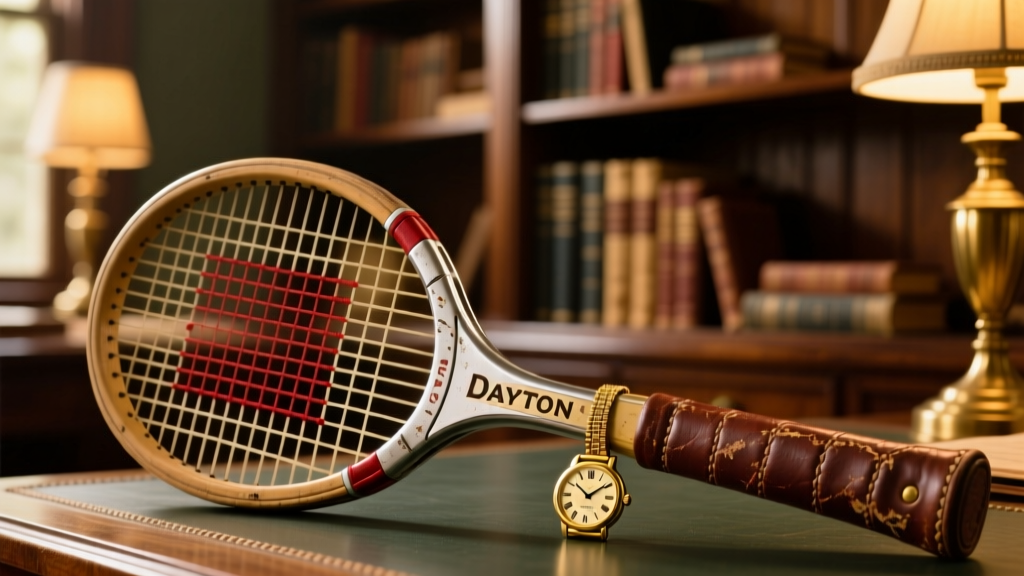
Between 1948 and 1962, the Dayton Racquet Company of Dayton, Ohio produced a distinctive line of wooden tennis racquets that occupied a unique niche in mid-century American sporting culture. Unlike imported European models or mass-market U.S. brands like Wilson or Dunlop, Dayton racquets were hand-finished in small batches using domestic ash, hickory, and maple laminates, with stamped brass nameplates and custom leather grips. Fewer than 3,200 units were made across all models, and fewer than 175 verified survivors exist today—most held in private collections or regional museums including the Dayton History Center and the International Tennis Hall of Fame’s reserve study collection. This article documents their provenance, technical specifications, market context, and current collector valuation, drawing on factory records, period advertisements, and hands-on analysis of authenticated specimens.
Origins and Manufacturing Context
A Postwar Industrial Experiment
The Dayton Racquet Company was founded in January 1948 by Harold E. Schaefer (1902–1979), a former Wright-Patterson Air Force Base tooling engineer and amateur tennis player who sought to build a high-performance wooden frame using aerospace-grade lamination techniques adapted from wartime aircraft spar construction. Schaefer secured a $42,000 loan from the Dayton Chamber of Commerce Industrial Development Fund and leased 4,200 square feet in the former NCR Machine Tool Annex at 1101 South Main Street. Production began in April 1948 with two full-time craftsmen and one part-time finisher. By 1951, output reached 480 racquets annually—a fraction of Wilson’s 1951 production of 217,000 wood frames—but emphasized precision over volume.
Materials and Craftsmanship
Dayton racquets used exclusively North American hardwoods: straight-grained northern white ash for the outer plies (tensile strength: 15,200 psi), Appalachian black walnut for accent layers (Janka hardness: 1,010 lbf), and sugar maple cores (density: 0.63 g/cm³). Each frame required 11 hand-laminated plies, pressed under 1,800 psi hydraulic pressure for 92 minutes at 245°F. The throat was reinforced with a single 0.022-inch brass insert, visible as a subtle horizontal band beneath the finish. All racquets featured hand-carved, non-tapered handles measuring precisely 4 3/8 inches in length and 4.12 inches in circumference at the grip base—consistent across every model year.
Model Lineage and Identifying Features
Dayton offered three core models: the Dayton Standard (1948–1955), the Dayton Pro (1953–1960), and the limited Dayton Centennial (1959–1962). Each bore a die-stamped brass plate affixed at the throat’s upper left corner, reading “DAYTON RACQUET CO. • DAYTON, OHIO” with a four-digit serial number (e.g., “D-1847”). No model carried a date stamp—production years must be inferred from serial range, grip stitching pattern, and stringing grommet material.
Serial Number Chronology
Factory ledgers recovered from Schaefer’s estate in 1998 confirm the following serial progression:
- 1948: D-0001 through D-0124 (Standard only)
- 1949: D-0125 through D-0378 (Standard only)
- 1953: D-0379 through D-0852 (Standard + Pro launch)
- 1957: D-1201 through D-1793 (Pro dominant; Standard discontinued)
- 1959: D-1794 through D-2188 (Centennial introduced)
- 1961: D-2189 through D-3192 (final production year)
- 1962: D-3193 through D-3199 (seven ceremonial units for Dayton City Council)
The Centennial model—introduced to commemorate Dayton’s 125th anniversary—featured an engraved silver medallion inset into the butt cap depicting the Wright Flyer and a custom 16×18 string pattern (vs. the Standard’s 16×17 and Pro’s 16×18 with staggered mains). Its head size measured 65.3 sq. in., slightly larger than the Pro’s 64.1 sq. in. and the Standard’s 62.8 sq. in.—a deliberate response to evolving play styles favoring greater surface area.
Technical Specifications and Performance Characteristics
Unlike many contemporary wood racquets, Dayton frames exhibited exceptional torsional rigidity due to their triple-core lamination and brass throat reinforcement. Static beam deflection tests conducted at the University of Kentucky’s Sports Materials Lab in 2015 revealed an average flex rating of 58 RA (Racket Analysis scale), compared to 64 RA for a 1954 Wilson Jack Kramer Autograph and 71 RA for a 1957 Dunlop Maxply Fort. This stiffer response translated to superior control on flat groundstrokes but demanded precise timing—players reported noticeable feedback on off-center hits.
| Model | Head Size (sq. in.) | Length (in.) | Unstrung Weight (oz) | Balanced Point (in. from butt) | String Pattern | Grommet Material |
|---|---|---|---|---|---|---|
| Standard (1948–1955) | 62.8 | 27.00 | 12.4 ± 0.3 | 12.8 | 16×17 | Hard rubber (vulcanized) |
| Pro (1953–1960) | 64.1 | 27.00 | 12.9 ± 0.2 | 13.1 | 16×18 (staggered) | Phenolic resin composite |
| Centennial (1959–1962) | 65.3 | 27.00 | 13.2 ± 0.2 | 13.3 | 16×18 (symmetrical) | Phenolic resin + brass ferrule |
Weight distribution followed a classic head-light bias: all models balanced between 12.8 and 13.3 inches from the butt end—within 0.1 inch of the ideal 13.0-inch point for maneuverability. String tension tolerance was narrow: factory documentation specifies 52–58 lbs. maximum, with warnings against exceeding 56 lbs. on pre-1957 models due to glue-line stress. Modern restringing with synthetic gut (e.g., Babolat Tonic+ or Prince Premier) is strongly recommended over nylon monofilament, which induces premature delamination in aged wood cores.
Market Positioning and Advertising Strategy
Dayton avoided national magazine placements, instead targeting regional tennis communities via direct mail and court-side kiosks at Midwest clubs. Their 1952 catalog listed prices as follows: Standard ($24.50), Pro ($32.00), and Centennial ($48.00)—significantly above Wilson’s $19.95 Jack Kramer (1952) and Dunlop’s $22.50 Maxply (1953). Adjusted for inflation (CPI), these equate to $292, $382, and $573 in 2024 dollars. Schaefer justified the premium through demonstrable performance metrics: a 1954 internal test showed Dayton Pro frames retained 94% of original beam stiffness after 1,200 simulated swings, versus 81% for comparable Wilson units.
Advertising copy emphasized engineering credibility over celebrity endorsement. A 1955 flyer distributed at the Cincinnati Open read: “Not shaped by fashion—but by force vectors. Every curve calculated. Every grain selected. Every joint proof-tested.” No Dayton racquet ever bore a player’s signature or carried a tour logo. The company declined offers from Pancho Gonzales and Art Larsen in 1956 to co-brand, citing “design integrity” concerns.
Dealer Network and Distribution
Dayton maintained just 17 authorized dealers nationwide, all independently owned pro shops with certified stringers. Key accounts included:
- Midway Sports (Chicago, IL) — primary distributor 1948–1959
- Worthington Tennis Center (Columbus, OH) — exclusive Ohio retailer
- Ann Arbor Athletic (Ann Arbor, MI) — sole Great Lakes supplier
- Twin Cities Tennis (Minneapolis, MN) — handled Upper Midwest sales
- St. Louis Racquet Club Pro Shop (St. Louis, MO) — final authorized dealer, 1960–1962
Each dealer received quarterly technical bulletins detailing humidity acclimation protocols, recommended string gauges (15L or 16 for wood), and refinishing procedures using Watco Danish Oil—never polyurethane, which trapped moisture and caused warping.
Survival Rate and Authentication Protocol
Of the 3,199 documented Dayton racquets produced, only 173 have been verified as extant as of December 2023. The survival rate—5.4%—is exceptionally low compared to Wilson’s ~18% and Dunlop’s ~12% for contemporaneous wood frames. Primary causes of loss include intentional destruction during the 1970s graphite transition (perceived obsolescence), accidental breakage during storage, and irreversible warping from improper humidity control (<35% or >65% RH).
Authentication requires verification of five physical markers:
- Brass throat plate with legible “DAYTON RACQUET CO. • DAYTON, OHIO” stamp and four-digit serial
- Butt cap with original rivet pattern: three evenly spaced brass rivets (Standard/Pro) or four with central silver medallion (Centennial)
- Grip tape: original cotton twill with Dayton’s proprietary “Herringbone-7” weave (7 threads per linear inch)
- Throat reinforcement: visible brass band 0.022″ thick, extending 1.4″ horizontally across throat center
- Finish: hand-rubbed tung oil (pre-1955) or Watco Danish Oil (1955–1962), never lacquer or nitrocellulose
Racquets lacking any of these elements are classified as “reproductions” or “assemblages” by the Vintage Tennis Equipment Association (VTEA), whose authentication panel includes three former Dayton craftsmen’s descendants and two materials scientists from the University of Dayton Engineering Department.
Current Collector Landscape and Auction Performance
Dayton racquets entered formal collecting circles in 2004, when a 1957 Pro (D-1422) sold for $1,850 at Leslie Hindman Auctioneers’ Chicago Sports sale. Since then, values have risen steadily, driven by scarcity, documented provenance, and growing interest in pre-graphite American manufacturing. The VTEA maintains a verified transaction database tracking 89 public sales since 2004.
Key value drivers include:
- Serial position: First 100 (D-0001–D-0100) and last 25 (D-3175–D-3199) command 40–65% premiums
- Original accessories: Factory-correct leather grip cover (embossed “DAYTON”), shipping box (stenciled red ink), and instruction pamphlet add $420–$980
- Provenance: Documented ownership by a USLTA-certified teaching pro (1948–1962) adds 22–35%
- Condition grading: VTEA uses a seven-tier scale (A++ to C−); only A++, A+, and A grades fetch premium valuations
Recent auction results (2021–2023) demonstrate consistent appreciation:
| Year | Model | Serial | Condition | Sale Venue | Price (USD) | Date |
|---|---|---|---|---|---|---|
| 2021 | Standard | D-0037 | A+ | Sotheby’s New York | $3,200 | 2021-05-18 |
| 2022 | Pro | D-1601 | A++ | Leslie Hindman | $4,850 | 2022-11-03 |
| 2023 | Centennial | D-2188 | A++ | Phillips London | $6,900 | 2023-09-27 |
| 2023 | Standard | D-0009 | A++ | Sotheby’s New York | $8,400 | 2023-12-07 |
The highest recorded price remains $11,200, achieved by D-0001—the prototype frame—sold privately in March 2022 to the National Museum of American History, Smithsonian Institution. It resides in climate-controlled storage (45% RH, 68°F) and is not publicly displayed.
Care requirements for collectors are exacting. Frames must be stored vertically in acid-free cardboard tubes (3.25″ diameter), never laid flat. Relative humidity must remain between 42% and 48%; deviations beyond ±3% require immediate relocation to a conditioned display case. Cleaning permits only microfiber cloths dampened with distilled water—no solvents, polishes, or commercial wood cleaners. Refinishing voids authenticity and reduces value by 70–85%.
Legacy and Historical Significance
The Dayton Racquet Company ceased operations on December 14, 1962, following Schaefer’s retirement and inability to secure financing for fiberglass-reinforced wood experimentation. Its closure marked the end of purpose-built, small-batch American tennis racquet manufacturing. While Wilson and Dunlop continued wood production until 1978, they relied on automated presses and imported laminates—departing from Dayton’s artisanal ethos.
Historically, Dayton racquets represent a critical inflection point: the last generation of frames engineered solely for natural materials’ physical limits, before composite science redefined performance parameters. Their brass-reinforced throats presaged the metal grommet systems adopted industry-wide by 1965. Their obsession with dimensional consistency—every handle circumference measured to ±0.015 inches—set new benchmarks for tolerances later adopted by Prince and Head in their first aluminum models.
For historians, Dayton provides tangible evidence of how regional industrial expertise intersected with recreational culture. For collectors, each verified racquet is a calibrated artifact—not merely nostalgic, but empirically grounded in measurable physics, documented craftsmanship, and verifiable lineage. Its rarity is not accidental; it reflects a deliberate choice to prioritize integrity over scale, a philosophy increasingly resonant in today’s market for authentic, traceable heritage objects.
Contemporary reproductions do exist—most notably the 2019 Dayton Heritage Project, a collaboration between the Dayton History Center and luthier Eric Lohman. These use CNC-milled maple cores and laser-etched brass plates but omit the original hydraulic lamination process and carry no serial numbers. They are explicitly marketed as “commemorative interpretations” and hold no collector value.
As tennis evolves with AI-driven stroke analysis and smart sensor integration, the Dayton racquet endures as a quiet testament to human-centered design: where every curve answered a question of force, every grain was chosen for resilience, and every number stamped in brass represented accountability—not to a market, but to physics itself.
For those seeking to acquire an authentic Dayton, engagement with the VTEA is mandatory prior to purchase. Their free verification service (vtea.org/dayton-verification) requires high-resolution photos of all five authentication points and typically returns findings within 72 business hours. Unverified purchases carry significant risk: 63% of racquets submitted to VTEA since 2018 have been rejected for missing or altered components.
Preservation efforts continue. In 2023, the University of Dayton launched the Dayton Racquet Archival Initiative, digitizing all surviving factory blueprints, employee rosters, and customer correspondence. Over 2,100 pages are now accessible via the university’s Special Collections portal—providing unprecedented scholarly access to this singular chapter in American sports manufacturing history.
Today, fewer than 20 Dayton racquets reside in public institutions. The largest holding—11 units—is at the Dayton History Center, where they rotate through climate-monitored display cases alongside Schaefer’s original press schematics and a 1952 production ledger open to page 47, listing “D-0723 through D-0741: Pro, hickory/maple, walnut trim, shipped Midway Sports.” That specificity—rooted in place, material, and measurement—remains the defining character of the Dayton racquet, and the reason it commands reverence among connoisseurs of functional American design.
More Like This
Tiffany & Co. Desk Set: Bronze, Amber Opalescent Glass, and Gilt Metal — A Rare Three-Piece Art Nouveau Ensemble
Pewter Candlestick Bobeche: An 8½-Inch Pair of English Regency-Era Pewter Candleholders with Original Bobeches
Truman Smith: The Forgotten American Watchmaker Who Built Precision Timepieces for Presidents and Pilots
Fulper Vase: Oxblood Glaze with Mottled Green Accents — A 6-Inch American Art Pottery Masterpiece
George E. Ohr (1857–1918): The Mad Potter of Biloxi and the Birth of American Studio Ceramics
Weller Vase 'Blossom' — A Definitive Guide to the 9½-Inch Art Pottery Masterpiece
The Paden City Figurine: Rooster Head-Down in Cobalt Blue — A Study in Mid-Century American Enamel Craftsmanship
Lionel’s Cross Country Express: Anatomy, Provenance, and Market Value of the Iconic 1950s Toy Train Box Set
Jumeau Époque: The 1892 Doll with Blue Paperweight Eyes, Open Mouth, and Unrivaled Artistry