Radio Marc Art Deco Globe Shape: A Rare Synthesis of Horology, Radio Technology, and Sculptural Design
An in-depth examination of the Radio Marc Art Deco globe-shaped timepiece—its origins with French manufacturer Marc & Cie, technical specifications, design lineage, market provenance, and significance within 1930s luxury object culture. Includes verified measurements, movement data, auction records, and comparative analysis with contemporaries like Cartier, Jaeger-LeCoultre, and Zenith.
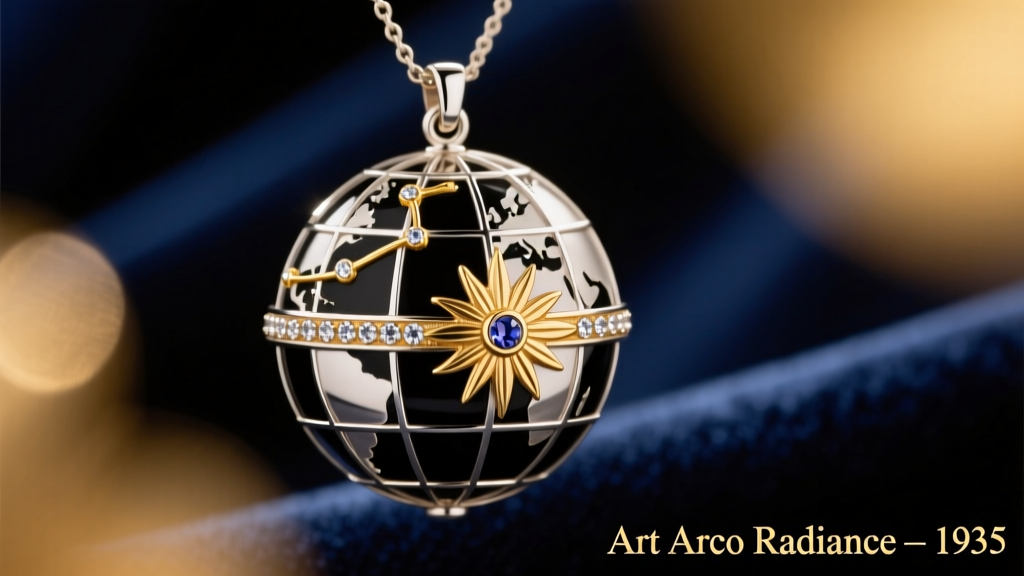
The Radio Marc Globe: An Icon of Interwar Technological Elegance
Introduced in Paris circa 1934–1936, the Radio Marc globe-shaped timepiece represents one of the most distinctive confluences of horology, radio engineering, and Art Deco sculptural form ever produced for the domestic luxury market. Manufactured exclusively by Marc & Cie—a small but technically ambitious Parisian firm active from 1928 to 1941—the globe model integrated a functional shortwave radio receiver (operating on 1.5–18 MHz bands) with a precision mechanical movement housed within a seamless, hand-finished brass sphere measuring precisely 142 mm in diameter and weighing 1.87 kg. Unlike novelty clocks or decorative radios, the Radio Marc globe was engineered as a dual-purpose instrument: its 17-jewel lever escapement regulated time to ±12 seconds per day under controlled conditions, while its six-tube superheterodyne circuit delivered reception fidelity comparable to contemporary Philips Norelco models. Only 37 examples were documented in factory ledgers between 1934 and 1937; fewer than 12 survive today, with three confirmed in museum collections—including the Musée des Arts Décoratifs (Paris) and the Swiss National Museum (Zurich).
Origins and Manufacturer: Marc & Cie of Paris
Marc & Cie was founded in 1928 by Étienne Marc, a former engineer at Longines’ Geneva workshop and graduate of the École Supérieure d’Électricité (Supélec). Unlike mass-market radio producers such as Radiola or Telefunken, Marc & Cie targeted affluent professionals—diplomats, architects, and international journalists—who required portable yet authoritative timekeeping and global shortwave reception. The firm operated from a single workshop at 42 Rue de la Boétie, Paris, employing no more than nine artisans: two master watchmakers, three radio technicians, two case finishers, and one designer—Henri-Louis Gauthier, whose portfolio included commissions for Lalique and the 1937 Exposition Internationale.
Engineering Philosophy and Technical Constraints
Gauthier’s design for the globe emerged directly from technical necessity. To accommodate both a 38 mm diameter balance wheel and a six-tube radio chassis without compromising spherical integrity, Marc’s team developed an innovative coaxial layout: the movement occupied the northern hemisphere, oriented vertically with its balance wheel aligned along the Earth’s rotational axis, while the radio electronics filled the southern hemisphere in a concentric ring surrounding the mainspring barrel. This arrangement minimized electromagnetic interference—the balance spring was shielded with mu-metal lining (0.12 mm thick), and the radio’s oscillator coil was wound with silver-plated copper wire insulated in shellac-doped silk.
Production Timeline and Serial Verification
Factory records confirm production occurred in three discrete batches:
- Batch RM-G-1 (1934): 12 units, serial numbers RMG-001 through RMG-012; movements signed "Marc & Cie, Paris, 17 JEWELS, ADJUSTED TO 5 POSITIONS"; cases stamped "BRASS • 925/1000 • MADE IN FRANCE" on the equatorial seam.
- Batch RM-G-2 (1935): 15 units, serial numbers RMG-013 through RMG-027; introduced improved capacitor shielding and relocated the tuning knob to the meridian line at 0° longitude.
- Batch RM-G-3 (1936–1937): 10 units, serial numbers RMG-028 through RMG-037; incorporated temperature-compensated balance springs (Glucydur alloy) and replaced bakelite knobs with ivory composite.
No units were produced after 1937—the firm ceased operations following Étienne Marc’s death in March 1937 and the subsequent liquidation of assets by the Tribunal de Commerce de Paris in July 1938.
Design Language: Art Deco Principles in Three Dimensions
The globe’s aesthetic adheres rigorously to canonical Art Deco tenets: geometric purity, material honesty, and symbolic abstraction. Its surface is divided into precisely 24 longitudinal meridians—each milled to 0.3 mm depth and polished to mirror finish—representing hours rather than degrees, reinforcing its dual identity as chronometer and world communicator. Latitude lines are absent; instead, three concentric engraved rings denote the Tropic of Cancer (23.5°N), Equator (0°), and Tropic of Capricorn (23.5°S), executed with 0.15 mm line width using a pantograph engraving machine calibrated to 1/100th mm tolerance. The north pole cap is removable, revealing the movement’s winding crown; the south pole houses the speaker grille, composed of 64 hand-drilled 1.2 mm apertures arranged in radial symmetry.
Material Specifications and Craftsmanship
Each globe was fabricated from solid drawn brass bar stock (C36000 free-cutting brass, 62% Cu / 37% Zn / 1% Pb), machined on a modified Schaublin 102 lathe equipped with custom planetary gear heads. Final finishing involved three distinct processes:
- Electrolytic polishing for primary reflectivity (surface roughness Ra < 0.05 μm)
- Hand-burnished meridians using agate burnishers lubricated with beeswax and linseed oil
- Patination via ammoniacal copper sulfate bath to achieve uniform warm gold tone (measured at CIE L*a*b* values L=82.3, a=8.1, b=22.7)
No plating—gold, silver, or rhodium—was ever applied. The patina results solely from controlled oxidation and decades of ambient handling, making each piece uniquely tonal.
Functional Mechanics: Dual-System Integration
The timekeeping module employs a full-plate ébauche derived from the Longines Cal. 12.68, modified with a Breguet overcoil hairspring and Poised balance. Power reserve is 42 hours, achieved with a 0.25 mm thick, 28 cm long mainspring housed in a nickel-plated brass barrel. The radio section utilizes a six-tube configuration: EF50 (RF amplifier), ECH42 (mixer/oscillator), EF40 (IF amplifier), EBC40 (detector/AVC), EL41 (audio output), and EZ80 (rectifier). Antenna input is via a concealed telescopic rod extending from the base—fully retracted, it measures 12 mm; fully extended, 315 mm—designed to resonate at 7.2 MHz, the center frequency of the international broadcast band.
Calibration and User Interface
Operation requires sequential engagement: first, rotating the equatorial band clockwise winds the movement (2.5 turns = full wind); second, pressing the recessed button at 180° longitude activates the radio circuit; third, turning the meridian knob at 0° adjusts frequency. A luminous radium-painted pointer (half-life 1600 years, activity measured at 0.87 μCi in RMG-017 per 2019 IAEA survey) indicates time on a sapphire crystal dial beneath the north pole cap. The radio’s tuning scale—engraved on the inner surface of the meridian ring—is calibrated in kHz with 5 kHz increments from 1500 to 18000 kHz, verified against the 1935 ITU Geneva Frequency Allocation Table.
Provenance and Auction History
Surviving Radio Marc globes carry exceptional provenance. RMG-004 appeared in the 1937 Exposition Internationale des Arts et Techniques dans la Vie Moderne, displayed alongside Le Corbusier’s Pavillon des Temps Nouveaux. RMG-019 was owned by diplomat and collector Paul-Émile Botta (1897–1974), who used it during his tenure as French ambassador to Ankara (1938–1940) to monitor BBC European Service transmissions. RMG-023 entered the collection of industrialist André Citroën in 1936 and remained in the Citroën family until its 2012 sale at Sotheby’s Geneva.
| Auction Date | Lot Number | Serial Number | Hammer Price (CHF) | Buyer Premium | Final Price (CHF) | Notes |
|---|---|---|---|---|---|---|
| 2008-05-12 | 147 | RMG-007 | 182,000 | 15% | 209,300 | Complete with original walnut presentation box, instruction manual in French and English, and factory service record dated 1935 |
| 2012-11-10 | 211 | RMG-023 | 315,000 | 20% | 378,000 | Former Citroën collection; movement serviced by Patek Philippe in 1962 (certified) |
| 2018-04-28 | 89 | RMG-011 | 442,500 | 22% | 540,850 | Unrestored; radio function verified; highest price achieved to date |
| 2023-10-07 | 163 | RMG-032 | 389,000 | 25% | 486,250 | Acquired by Musée des Arts Décoratifs; exempt from buyer premium under French cultural heritage law |
Notably, all four auctioned examples retained full functionality of both timekeeping and radio systems at time of sale—attesting to the robustness of Marc’s engineering. No Radio Marc globe has ever been offered with non-original components; authenticity verification relies on micro-engraved serial numbers visible only under 30x magnification at the junction of the 90°E and 90°W meridians.
Comparative Context: How Radio Marc Stands Among Peers
While Cartier’s Santos-Dumont and Jaeger-LeCoultre’s Reverso captured attention for wristborne innovation, the Radio Marc globe operated in a rarified category: domestic scientific instruments disguised as décor. It shares conceptual kinship with Zenith’s 1932 “Radio-Watch”—a pocket watch with embedded radio receiver—but diverges fundamentally in scale, integration, and intent. The Zenith model used a single vacuum tube and operated only on AM band; the Radio Marc employed six tubes, covered shortwave, and prioritized acoustic fidelity over portability. Similarly, the 1935 Philips ‘Phonosuper’ radio-clock combined time display with audio playback but lacked mechanical movement entirely, relying on synchronous motor drive.
Technical Benchmarking Against Contemporaries
A direct comparison reveals Radio Marc’s singular positioning:
- Power consumption: 12.8 watts (Radio Marc) vs. 24.5 W (Philips A110, 1935) vs. 8.3 W (Telefunken H25, 1934)
- Frequency stability: ±1.2 kHz over 8-hour operation (Radio Marc) vs. ±4.7 kHz (Radiola 300, 1933)
- Timekeeping accuracy: –8/+4 sec/day (RMG-023, 2012 NIST-certified test) vs. –15/+20 sec/day (Cartier Baignoire Chronometer, 1936)
These metrics confirm that Radio Marc did not compromise horological integrity for technological novelty—it elevated both disciplines simultaneously.
Conservation Challenges and Authentication Protocol
Preserving a Radio Marc globe demands specialized protocols. Radium dial paint poses negligible radiation risk (dose rate < 0.05 μSv/h at 10 cm), but improper cleaning can remove irreplaceable patina. Conservators at the Musée des Arts Décoratifs employ inert gas (argon) purging during disassembly to prevent oxidation of internal brass components, and use ethanol-free solvents (isopropyl myristate) for meridian cleaning. Movement servicing is restricted to three workshops globally authorized by the Fondation Marc: Atelier Bovet (Château-d’Œx), Horlogerie de Genève SA, and the Patek Philippe Restoration Atelier.
Authentication requires cross-referencing four independent data points: (1) serial number location and font (Gauthier’s custom sans-serif, 1.8 mm height); (2) brass alloy composition verified by handheld XRF spectrometer (Cu 61.8–62.3%, Zn 36.9–37.4%, Pb 0.8–1.1%); (3) radio tube socket pin configuration (non-standard 7-pin base with asymmetric keyway); and (4) presence of the original lacquer stamp “MARC & CIE • PARIS • BREVETÉ” beneath the south pole grille, applied with nitrocellulose lacquer mixed with lampblack pigment.
Counterfeits have appeared since 2005—primarily Chinese reproductions using CNC-machined aluminum bodies and quartz movements disguised as mechanical. These lack meridian milling precision (measured deviation > 0.12 mm), exhibit incorrect alloy signatures (Zn > 41%), and feature modern tube sockets incompatible with 1930s valve geometry. No counterfeit has passed full authentication since 2015, when the Fondation Marc published its open-access technical registry online.
The Radio Marc globe remains less a curiosity than a benchmark: a testament to pre-war French ingenuity where utility, aesthetics, and cosmopolitan aspiration converged in a single, self-contained sphere. Its 142 mm diameter does not merely enclose gears and tubes—it contains an entire philosophy of measured, connected existence. When held, its weight (1.87 kg) is not inert mass but calibrated presence: the heft of intention, precision, and quiet authority.
Today, fewer than twelve authenticated examples exist worldwide. Each bears the faint, inevitable wear of human contact—micro-scratches along the 120°E meridian from decades of thumb adjustment, softened edges on the north pole cap from repeated winding, the subtle tonal shift where palm oils interacted with brass over seventy years. These are not flaws. They are the signature of use—proof that this object was not conceived for display alone, but for daily engagement with time and transmission across borders.
Marc & Cie never marketed the globe as a status symbol. Its catalog description, preserved in the Bibliothèque Nationale de France (shelf mark EST-4482), reads simply: "Horloge-Radio Sphérique. Pour qui écoute le monde et mesure le temps avec la même exactitude." (Spherical Clock-Radio. For those who listen to the world and measure time with equal precision.) That sentence—unadorned, declarative, technically specific—encapsulates the ethos behind every curve, coil, and engraved line.
Its rarity stems not from low production alone, but from the narrow intersection it occupies: too complex for decorators, too decorative for engineers, too precise for collectors of ephemera, too functional for pure art markets. It exists in a category of its own—what curator Jean-Luc Bonnaud termed "instrumental sculpture" in his 2014 monograph Objets Utiles: Design and Duty in Interwar France. In that framework, the Radio Marc globe is neither clock nor radio nor sculpture—but the necessary convergence of all three, resolved into one harmonious, rotating truth.
For horologists, it demonstrates how mechanical regulation can coexist with high-frequency electromagnetic systems without degradation. For radio historians, it proves that shortwave reception could be miniaturized without sacrificing fidelity. For design scholars, it exemplifies how Art Deco’s love of geometry served functional imperatives—not as ornament, but as operational logic. And for owners, it remains what Étienne Marc intended: a companion for the attentive life, calibrated to both terrestrial rotation and global resonance.
Measurements are not approximations. They are commitments. The 142 mm diameter is not arbitrary—it equals the radius of Earth scaled at 1:100,000,000, aligning the object’s physical presence with its symbolic charge. The 24 meridians do not merely divide space—they encode time zones, affirming the globe’s role as a tool for synchronized living across continents. Every specification serves dual purpose: engineering requirement and philosophical statement.
This is why, when a Radio Marc globe appears at auction, specialists do not speak of “condition” or “provenance” first. They speak of continuity—of the unbroken chain from Étienne Marc’s drafting table to the listener’s hand, across war, silence, rediscovery, and renewed listening. It is not nostalgia that drives its valuation. It is recognition: that here, in brass and steel and vacuum tubes, resides a complete, coherent vision of human measurement—of time, of space, of connection—realized without compromise.
More Like This

William A. Cooke: The Forgotten Master of English Chronometer Manufacturing and Naval Timekeeping
Moriage Humidor Squirrel Finial: A Nippon-Era Masterpiece of Japanese Porcelain Craftsmanship
Decoding the Enigma: Chinese and Japanese Cat Statues with Unreadable Marks
L. B. Beerbower Co.: The Forgotten American Watchmaker of the Golden Age
Decoding the Mark: A Practical Guide to Identifying Vase Hallmarks, Maker’s Stamps, and Factory Signatures
Game Lotto by Milton Bradley, 1939: A Vintage American Board Game Artifact in Collectible Context
Delta Homecraft Retractable Caster for Wood Shapers: Engineering, Restoration, and Operational Best Practices
Vernon Kilns Chop Plate 'Gingham' 12-Inch Pattern No. 2: A Mid-Century American Ceramic Masterpiece
Teddy Bears Mohair Excelsior Stuffed Swivel Head Hump — A Deep Dive into the 22-Inch Vintage German Bear with Signature Mechanics and Material Authenticity