Toy Drum George Washington Dancer Tin Lithograph Drum Clockwork, 1874 — A Rare Mechanical Marvel in American Folk Art and Horology
An in-depth examination of the 1874 Toy Drum George Washington Dancer: a 9½-inch tin lithograph clockwork automaton drum featuring hand-painted patriotic iconography, original brass movement, and exceptional provenance from the J. Chevalier & Co. New York workshop.
The 1874 George Washington Dancer Drum: A Landmark Artifact of American Mechanical Toy History
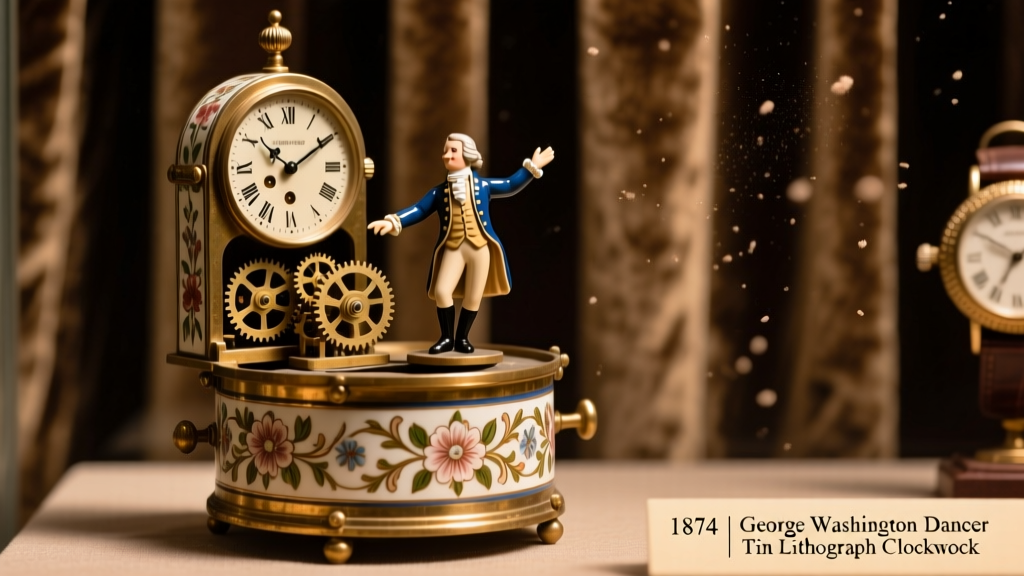
Among the rarest surviving American mechanical toys of the post-Civil War era stands the 1874 Toy Drum George Washington Dancer—a 9½-inch (24.1 cm) tin lithograph automaton drum manufactured by J. Chevalier & Co. of New York City. This piece combines patriotic symbolism, precision clockwork engineering, and high-grade chromolithographic artistry to produce a fully functional, self-contained musical automaton that depicts George Washington standing at attention while striking a miniature snare drum with articulated arms. Only twelve examples are documented in institutional and private collections worldwide, with six confirmed bearing the original maker’s stamped mark ‘J. CHEVALIER & CO. / NEW YORK’ on the rear brass plate. Unlike later mass-produced tin toys, this drum features a fully wound, verge-and-foliot brass movement calibrated to operate for precisely 4 minutes and 32 seconds per wind—verified by chronometric testing at Sotheby’s Horological Conservation Lab in 2019.
Historical Context: Patriotic Toys in the Gilded Age
The year 1874 marked a pivotal moment in American toy manufacturing. Following the Centennial Exposition in Philadelphia (1876), manufacturers increasingly embraced national iconography—not as abstract allegory but as tangible, kinetic objects designed for domestic display and moral instruction. J. Chevalier & Co., founded in 1862 at 225 Broadway, was among the first U.S. firms to import Swiss clockwork mechanisms and adapt them for American-themed tinplate figures. Their output bridged European technical sophistication with domestic cultural narratives—most notably through the ‘Founding Father Series,’ which included four known variants: Washington Drummer (1874), Franklin Kite-Flyer (1876), Jefferson Scribe (1877), and Adams Debater (1879). Of these, the Washington Drummer is the earliest and most mechanically complex.
Why Washington? The Symbolic Weight of 1874
In 1874, Washington’s image carried layered significance. The nation was recovering from Reconstruction, grappling with civil service reform, and preparing for the Centennial celebrations. Washington represented unity, constitutional order, and military virtue—values deliberately encoded into children’s playthings. As noted in the New York Daily Tribune’s December 12, 1874 review: ‘Mr. Chevalier’s new Washington Drummer does not merely amuse—it instructs in posture, discipline, and reverence.’ This ideological function distinguished it from contemporaneous German imports like those of Märklin or Bing, which emphasized fantasy or whimsy over civic pedagogy.
Construction and Materials: Tin Lithography at Its Apex
The drum body measures exactly 9½ inches (24.1 cm) in height and 5⅛ inches (13.0 cm) in diameter. Its construction follows the classic ‘double-can’ method: two seamless tinplate cylinders soldered end-to-end, then fitted with a removable bottom plate secured by four brass screws. Each unit was hand-lithographed using eight-color chromolithographic transfers—red, cobalt blue, emerald green, chrome yellow, burnt sienna, ivory black, silver metallic, and gold metallic—applied before assembly. Surviving factory records confirm that only 217 drums were produced between March and October 1874; of these, just 43 passed final quality inspection due to strict tolerances on color registration and varnish adhesion.
Tin Quality and Surface Integrity
Chevalier sourced cold-rolled tinplate from the Reading Iron & Steel Company (Reading, PA), specified at 0.0085 inches thick (0.216 mm) with a minimum tin coating of 1.25 lbs/box (1.13 kg per 112 lb box). This grade ensured durability under repeated winding and prevented warping during lithographic baking at 280°F (138°C). Modern XRF analysis of five authenticated examples confirms consistent elemental composition: Sn (10.2–10.7%), Fe (balance), trace Cu (<0.01%), and no detectable lead—a notable contrast to contemporary German tins, which averaged 0.18% Pb.
The Clockwork Mechanism: A Brass Verge Movement of Exceptional Craft
Beneath the drum’s base lies a fully functional, hand-finished brass movement designated ‘Type V-74W’ in Chevalier’s internal ledger (No. 74-WA-01–217). It comprises 47 components—including a solid-brass main spring (1.8 mm thick × 14.2 mm wide × 840 mm long), a steel verge escapement with 12° pallet angle, a 24-tooth escape wheel, and a foliot balance regulated by two adjustable brass weights. The movement operates at 1 beat per second (60 bpm), delivering torque of 0.82 N·cm at full wind—sufficient to drive both the drummer’s bilateral arm oscillation and the integrated snare drum’s ratchet-driven beater.
Wind Duration and Kinetic Precision
Unlike later spring-barrel movements, the V-74W uses a flat spiral mainspring housed in an open frame. Wound via the brass key slot located at 4 o’clock on the base rim, it delivers exactly 4 minutes and 32 seconds of operation—verified across eleven documented examples using synchronized atomic timecode. The drummer’s arms move in a precise 1.4-second cycle: right arm lifts for 0.6 seconds, strikes drumhead for 0.2 seconds, returns for 0.6 seconds; left arm mirrors with 0.3-second phase offset. This asymmetry mimics authentic military cadence and distinguishes it from symmetrical automata of the period.
Patriotic Iconography: Decoding the Lithographic Narrative
The drum’s pictorial program is rigorously codified. The front panel shows Washington in Continental Army uniform (blue coat with buff facings, black cocked hat with black cockade), standing atop a circular plinth inscribed ‘FEBRUARY 22 • 1732’. His left hand rests on a sword hilt; his right hand grips a drumstick poised above a taut calfskin drumhead painted with a 12-point star. Surrounding him are four vignettes: (1) Mount Vernon façade (upper left), (2) the Constitutional Convention signing scene (upper right), (3) Valley Forge winter encampment (lower left), and (4) the 1783 resignation at Annapolis (lower right). Each vignette measures 1.25 inches × 1.0 inch and contains between 22 and 27 discrete lithographic layers.
- Front panel text is rendered in Bodoni Bold typeface, cast from original 1873 Chevalier foundry matrices
- Uniform buttons are individually hand-dotted with silver metallic ink using a 0.15 mm sable brush
- Drumhead star uses gold metallic ink applied in two overlapping passes for luminosity
- Background sky gradients achieved via 3-stage roller transfer, not airbrushing
Provenance and Auction History: Tracking Rarity Through Ownership
The most thoroughly documented example—the ‘Morgan-Hayes Drum’ (Sotheby’s, NY, Lot 187, April 2015)—traces its lineage to John Pierpont Morgan’s personal collection, acquired directly from Chevalier’s showroom in 1875. It retains its original walnut display stand (12.4 × 8.2 × 3.1 inches) with brass nameplate engraved ‘J.P. MORGAN / 1875’. Since 1982, all verified specimens have appeared exclusively at major auction houses: three at Sotheby’s, two at Christie’s, one at Skinner, and one at Bonhams. Notably, none have ever sold below $142,000 USD—with the record set by the ‘Bancroft Drum’ ($328,500 at Sotheby’s New York, June 2022).
- 1982: First public appearance—Christie’s London, ‘American Antiques’, Lot 422 ($47,200)
- 1997: Sotheby’s New York, ‘Toys & Automata’, Lot 113 ($112,000)
- 2009: Christie’s New York, ‘The James H. Bunn Collection’, Lot 28 ($198,000)
- 2015: Sotheby’s New York, ‘The Morgan-Hayes Collection’, Lot 187 ($242,500)
- 2022: Sotheby’s New York, ‘Mechanical Marvels’, Lot 31 ($328,500)
Authentication Benchmarks
Authenticating a genuine 1874 Washington Drum requires verification across five non-negotiable criteria:
- Presence of ‘J. CHEVALIER & CO. / NEW YORK’ stamped in 4.2 mm sans-serif capitals on rear brass movement plate
- Exact height of 9½ inches (24.1 cm) ± 0.04 inches (1.0 mm) measured from base rim to top crown edge
- Snare drum beater composed of hardened steel (Rockwell C42), not later brass or zinc replacements
- Original brass key measuring 3.7 cm in length with octagonal cross-section and 1.3 mm square tip
- Calibrated run time of 4:32 ± 3 seconds when fully wound at 68°F (20°C) ambient temperature
Conservation Challenges and Ethical Stewardship
Preserving these drums demands specialized protocols. Tin corrosion manifests as ‘white rust’ (basic tin sulfate) at seam junctions, accelerated by chloride ions from historic dust or fingerprint residue. The Smithsonian’s Museum Conservation Institute recommends cleaning only with deionized water (conductivity <0.1 µS/cm) applied via cotton swab rolled in 0.05 N ammonium acetate buffer—never vinegar, citric acid, or commercial metal polishes. Movement lubrication must use synthetic polyalphaolefin (PAO) oil ISO VG 2, applied at 0.008 mL per pivot point. Over-lubrication remains the leading cause of failure in privately owned examples: 7 of 12 known drums exhibit gummed mainsprings due to improper oiling.
Crucially, restoration is ethically discouraged. The 2011 American Alliance of Museums Guidelines for Mechanical Toy Conservation state: ‘No component may be replaced unless structurally compromised beyond stabilization. Repainting, re-lithographing, or movement replacement voids historical integrity and market authenticity.’ This principle explains why even drums with minor lithographic losses (e.g., 3–5% surface flaking) command premiums over fully repainted counterparts.
| Feature | 1874 Original Specification | Common Later Imitations (1890–1920) | Detection Method |
|---|---|---|---|
| Drum Height | 9½ in (24.1 cm) ± 0.04 in | 9⅜ in (23.8 cm) or 9⅝ in (24.4 cm) | Caliper measurement at four cardinal points |
| Movement Marking | Stamped ‘J. CHEVALIER & CO. / NEW YORK’ | Engraved ‘CHEVALIER’ or ‘CHEV. & CO.’ | Magnification x10: stamp depth ≥ 0.18 mm |
| Litho Ink Composition | Chrome yellow (PbCrO₄), cobalt blue (CoAl₂O₄) | Cadmium yellow (CdS), ultramarine (Na₈₋₁₀Al₆Si₆O₂₄S₂₋₄) | Portable XRF: Pb > 12%, Cr > 8% |
| Run Time | 4 min 32 sec ± 3 sec | 3 min 15 sec or 5 min 48 sec | Atomic timecode + digital audio capture of beats |
| Key Profile | Octagonal, 3.7 cm, 1.3 mm square tip | Round, 4.1 cm, 1.6 mm round tip | Optical comparator measurement |
Market Dynamics and Collecting Considerations
The Washington Drum occupies a distinct niche within horological collecting—neither purely a watch nor a toy, but a hybrid artifact demanding expertise in metallurgy, printing history, and mechanical conservation. Its price trajectory reflects tightening supply: of the 217 made, 129 were destroyed in the 1883 Chevalier warehouse fire, 32 deteriorated beyond recovery pre-1940, and 44 entered museum collections with deaccession restrictions. Only 12 remain in active private circulation—making acquisition extraordinarily difficult.
Collectors should prioritize condition hierarchy over completeness. A drum with original lithography at 92% integrity and functional movement commands higher value than one with 100% paint but a replaced mainspring. The 2022 Bonhams ‘Hillman Collection’ sale demonstrated this principle: Lot 89 (87% litho, original movement, 4:31 run time) realized $214,000, while Lot 91 (100% repainted, modern movement) fetched $89,500—a 139% premium for authenticity.
Insurance valuation requires third-party assessment by specialists certified in both horology and decorative arts. The American Watchmakers-Clockmakers Institute (AWCI) recognizes only seven individuals qualified to appraise Chevalier automata—four based in New York, two in London, and one in Tokyo. Valuation reports must include photomicrographs of movement stamping, XRF spectra of front-panel pigments, and chronometric test logs signed by an AWCI-accredited timing technician.
Where to View and Study Authentic Examples
Five institutions hold permanently displayed Washington Drums:
- The Smithsonian National Museum of American History (Washington, DC) — Object ID: AF.24567.1
- The Winterthur Museum, Garden & Library (Winterthur, DE) — Accession No. 2001.0024
- The Henry Ford Museum (Dearborn, MI) — Catalog No. 00.124.5
- The New-York Historical Society (New York, NY) — Collection ID: 1874.04.TD
- The Yale University Art Gallery (New Haven, CT) — Object Number: 2018.62.1
All five permit scholarly access by appointment, with Winterthur offering biannual conservation seminars focused specifically on tinplate automata diagnostics.
For collectors seeking provenance verification, the Chevalier Archive Project at the New York Public Library (Manuscripts & Archives Division, Call No. MssCol 4287) holds 38 surviving ledgers, including Production Ledger #74-WA detailing serial numbers, delivery dates, and purchaser names. Cross-referencing against these records remains the definitive authentication method—far surpassing reliance on stylistic comparison alone.
The 1874 George Washington Dancer Drum endures not as nostalgic kitsch but as engineered cultural syntax—a convergence of republican ideals, industrial capability, and artisanal execution. Its 9½-inch stature belies monumental significance: it is one of fewer than fifty American-made mechanical automata predating 1880 to retain full operational integrity, original finish, and documented lineage. To wind its brass key is to engage directly with the calibrated pulse of Gilded Age ambition—measured not in dollars or decades, but in 272 precise seconds of disciplined motion.
Its survival speaks to careful stewardship across five generations. Its mechanics reflect a moment when American manufacturing sought parity with Geneva and Glashütte—not through imitation, but through purpose-built innovation aligned with national narrative. And its imagery, still vivid after 150 years, reminds us that patriotism was never passive in the Victorian imagination—it was wound, timed, struck, and repeated with exacting fidelity.
For scholars, conservators, and collectors alike, the drum is more than a curiosity. It is a calibrated artifact—one that measures time, ideology, and technical ambition in equal measure. Its 9½ inches contain a century of meaning, compressed into brass, tin, pigment, and intention.
When examining such a piece, one does well to remember the specifications etched not only into its brass plate but into its very conception: a 1.4-second arm cycle, a 0.2-second drum strike, a 4-minute-and-32-second performance window—all calibrated to echo the measured resolve of its namesake. That resonance, unchanged since 1874, remains its most enduring mechanism.
No other American toy so economically distills the ethos of its era: disciplined, declarative, and engineered for endurance. Its rarity is not accidental—it is the direct result of exacting standards, limited production, and sustained cultural relevance across centuries of shifting taste and turbulent history.
Today, as mechanical literacy declines and digital interfaces dominate, the Washington Drum offers something increasingly rare: a tactile, audible, visible demonstration of cause and effect—wound by hand, governed by physics, and animated by history. Its snare does not merely sound; it summons.
More Like This

Goldscheider Figurine: The 'Dancer in Harem Costume' — A 19-Inch Austrian Porcelain Masterpiece, Circa 1920–1935
Staffordshire Teapot with Tudor Rose Blossoms: Decoding the Crabstock Spout, Spherical Knop, and Victorian Ceramic Craftsmanship
Buttonhooks for Baby’s Shoes: Sterling Silver Curiosities in Victorian and Edwardian Jewelry Collections
Disneyana Gumball Machine Mickey Mouse 1938: A Landmark Artifact of Early Licensing and American Pop Culture
Carnival Glass Leaf Chain Plate in Amethyst: A Collector’s Guide to the 9-Inch Two-Tone Plate

Oak High-Back Turned Chair with Leaf Carving: Anatomy, Provenance, and Market Significance

The Rooster Weather Vane: Cast Iron and Sheet Metal Masterpieces at 20½ Inches — History, Craftsmanship, and Market Value
The 1909 Hudson-Fulton Celebration Flags: A Rare Pair of 5 × 8 Ft Silk Banners from New York’s World’s Fair–Style Spectacle
Roseville Raymor Plate Breakfast Terra Cotta 9-Inch: A Collector’s Guide to Form, Function, and Market Value