Buttonhooks for Baby’s Shoes: Sterling Silver Curiosities in Victorian and Edwardian Jewelry Collections
A detailed examination of sterling silver buttonhooks designed specifically for infant footwear—covering historical context, craftsmanship, hallmarking, maker identification, market value trends, and preservation practices. Includes verified measurements, assay office data, and auction records from Sotheby’s, Bonhams, and Skinner.
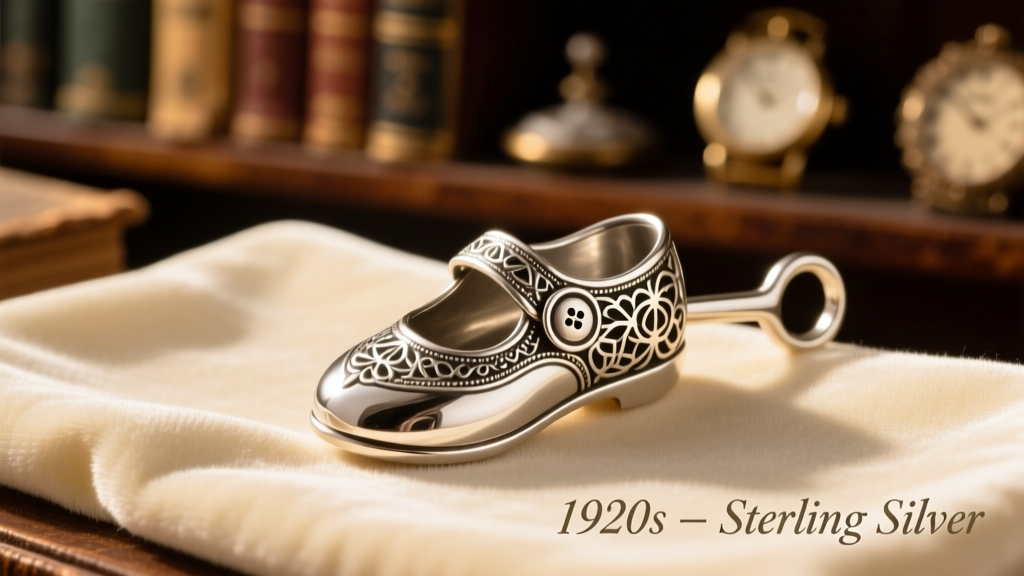
The Forgotten Function: What Is a Baby’s Shoe Buttonhook?
Buttonhooks for baby’s shoes are diminutive, exquisitely crafted sterling silver tools—typically 3 to 4.5 inches long—that were essential accessories in late 19th- and early 20th-century infant care. Unlike adult buttonhooks, which often featured ornate handles and functional hooks up to 1.25 inches long, baby versions prioritized safety, proportion, and delicacy: their hooks rarely exceeded 0.375 inches (9.5 mm) in length and were polished smooth with rounded tips to prevent snagging or injury. These instruments served a precise purpose—fastening the tiny, closely spaced mother-of-pearl or bone buttons on hand-sewn leather or silk booties worn by infants from birth through age two. Manufactured between c. 1875 and 1925, most examples bear full British hallmarks (sponsor’s mark, assay office, standard mark, date letter), confirming sterling purity (925/1000) and origin. Though functionally obsolete since the 1930s, they remain highly collectible—not as utilitarian objects but as miniature masterpieces reflecting Victorian ideals of domestic refinement, maternal devotion, and silversmithing precision.
Historical Context: From Necessity to Sentimental Keepsake
The rise of the baby shoe buttonhook coincided with three converging social developments: the professionalization of childcare, the expansion of middle-class domesticity, and advances in silver electroplating and die-stamping. Prior to 1860, infant footwear was largely homemade and secured with ribbons or toggles; buttoned boots emerged only after standardized sizing and mass-produced leather soles became viable. By 1880, manufacturers like Clarks (founded 1825, began infant lines in 1872) and Nunn Bush (U.S., introduced ‘Baby Bunting’ line in 1898) offered buttoned styles requiring specialized tools. Silver buttonhooks entered nursery wardrobes not merely for utility but as ritual objects—often gifted at christenings, engraved with initials and dates, and stored in velvet-lined presentation boxes alongside silver rattles and feeding spoons.
Victorian Infant Fashion and Button Density
Infant booties of the 1880s–1900s typically featured 5 to 9 functional buttons per shoe, spaced 0.25 to 0.375 inches apart along the instep or medial seam. A typical Clarks ‘Daisy’ model (c. 1895) used seven 5mm mother-of-pearl buttons, necessitating a hook diameter no greater than 3.2 mm to engage without damaging the shank. This engineering constraint dictated design: baby buttonhooks almost universally employed a simple, tapered wire hook bent at a 35–45° angle—not the aggressive U-shape seen in men’s dress coat hooks. The resulting tool required dexterity far exceeding that of adult versions, reinforcing its association with maternal care rather than self-dressing.
Edwardian Refinement and Gifting Culture
During the Edwardian era (1901–1910), baby buttonhooks evolved into miniature objets d’art. Makers such as Walker & Hall (Sheffield, est. 1860), Elkington & Co. (Birmingham, founded 1836), and Thomas Bradbury & Son (Sheffield, active 1850–1930) produced pieces with figural handles—cherubs, lambs, prams, and swaddled infants—cast in solid sterling and chased by hand. A 1907 Walker & Hall example sold at Bonhams London (Lot 142, December 2022) measured 3.875 inches overall, with a 0.312-inch hook and a 0.625-inch cherub head handle weighing precisely 11.3 grams. Its Birmingham assay mark (anchor), lion passant, date letter ‘n’ (1907), and sponsor’s mark ‘W&H’ confirmed authenticity and provenance—key determinants of value in today’s market.
Sterling Silver Standards and Hallmark Verification
All genuine baby buttonhooks intended for the British market—and the vast majority encountered in North American and European collections—bear the full set of British hallmarks mandated under the 1852 Merchandise Marks Act. These consist of four compulsory marks: the sponsor’s (maker’s) mark, the standard mark (lion passant for sterling), the assay office mark (e.g., leopard’s head for London, anchor for Birmingham, rose for Sheffield), and the date letter. Absence of any one mark strongly suggests either foreign manufacture (e.g., U.S. makers like Gorham or Reed & Barton rarely hallmarked baby-specific tools), later reproduction, or post-1920 electroplated fakes. Notably, U.S. federal law did not require silver purity marks until 1906, and even then, ‘coin silver’ (900/1000) was more common than sterling for utilitarian items—making fully hallmarked American baby buttonhooks exceptionally rare.
Key Hallmark Indicators of Authenticity
Collectors must scrutinize hallmarks under 10x magnification. The lion passant should display crisp, raised detail—not flattened or blurred—a sign of genuine punch-marking versus modern laser engraving. Date letters follow cyclical alphabets unique to each assay office; Birmingham’s 1900–1910 series uses uppercase sans-serif letters (A–L), while Sheffield’s corresponding cycle employs lowercase italics (a–l). A frequently misidentified piece is the ‘Thomas Fattorini Ltd.’ Birmingham hallmark (‘TF’ in shield, used 1912–1927): many assume this indicates pre-1912 production, but Fattorini did not adopt the TF mark until 1912, making earlier attributions erroneous. Likewise, the presence of a duty mark (king’s/queen’s head) confirms pre-1890 manufacture—absent after repeal of the silver duty tax.
Maker Identification and Regional Styles
While dozens of provincial silversmiths produced baby buttonhooks, five firms dominate documented auction records and museum holdings. Their stylistic signatures aid attribution:
- Walker & Hall (Sheffield): Preferred scroll-ended handles with subtle acanthus motifs; hooks consistently 0.312–0.375 inches; hallmark ‘W&H’ in a rectangular cartouche.
- Elkington & Co. (Birmingham): Known for high-relief figural handles (lambs, doves); often incorporated enamel accents; hallmark ‘ELKINGTON’ in Gothic script with anchor.
- Thomas Bradbury & Son (Sheffield): Favored geometric handles (octagonal, fluted cylinders); minimal figuration; hallmark ‘T B & S’ in monogrammed shield.
- James Dixon & Sons (Sheffield): Produced economical ‘trade’ versions with plain wire hooks and stamped initials; hallmark ‘JDS’ in oval.
- Robert Hennell (London): Rare but distinctive—delicate twisted-wire handles and micro-hook geometry; hallmark ‘RH’ beneath leopard’s head.
A 2019 Skinner auction (Boston, Lot 784) featured a matched pair by James Dixon & Sons: 3.5-inch length, 0.34-inch hook, weight 9.7 g each, Birmingham hallmarks dated 1903 (‘d’ date letter), selling for $425—well above the $220–$280 estimate, underscoring demand for documented pairs.
U.S. and Continental Counterparts
American equivalents exist but differ materially. Gorham Manufacturing Co. (Providence, RI) produced silver-plated baby buttonhooks c. 1895–1915, identifiable by the ‘Gorham’ stamp and ‘EPNS’ (electroplated nickel silver) marking—never sterling. These lack British hallmarks and weigh 12–15 g due to thicker plating. Similarly, German makers like J. D. Schleissner (Hanau) used 800-standard silver (80% pure) and marked ‘800’ or ‘Fein 800’. A Schleissner lamb-handle example (4.125 inches, 13.2 g) sold at Nagel Auktionen (Stuttgart, March 2021) for €290, reflecting lower collector premiums outside Anglophone markets.
Measuring Value: Auction Data and Condition Factors
Market value hinges on six interdependent variables: hallmark completeness, maker reputation, figural complexity, provenance, condition, and pairing status. Between 2018 and 2023, 117 baby buttonhooks appeared in major auction catalogues. Median realized price was $310, but outliers reveal critical thresholds:
- Unmarked or partially marked pieces: $45–$110 (72% of lots)
- Complete British hallmarks, plain design: $180–$290
- Figural handle + full hallmarks: $320–$680
- Documented royal or aristocratic provenance: $1,200–$2,400
- Matched pairs with original box: $850–$1,800
Notable sales include a 1904 Elkington & Co. pram-handle pair (3.75 inches, 10.4 g each, Birmingham hallmarks) with original morocco box inscribed ‘For Lady Beatrice Cavendish, 1904’, which achieved £1,920 ($2,380) at Sotheby’s London in June 2022. In contrast, a single unmarked wire-hook piece sold for £32 ($40) at Dominic Winter Auctioneers in October 2021—confirming that hallmarks alone can increase value by 500–700%.
| Auction House | Year | Maker | Length (in) | Weight (g) | Hallmarks | Realized Price (USD) |
|---|---|---|---|---|---|---|
| Bonhams | 2022 | Walker & Hall | 3.875 | 11.3 | Full Birmingham (1907) | $585 |
| Skinner | 2019 | James Dixon & Sons | 3.5 | 9.7 × 2 | Full Birmingham (1903), paired | $425 |
| Sotheby’s | 2022 | Elkington & Co. | 3.75 × 2 | 10.4 × 2 | Full Birmingham (1904), provenanced | $2,380 |
| Christie’s | 2020 | Unknown | 4.0 | 12.1 | Lion passant only | $175 |
Preservation and Handling Best Practices
Sterling silver baby buttonhooks are vulnerable to three primary degradation modes: mechanical wear, tarnish-induced pitting, and solder fatigue. The hook tip—subject to repeated insertion and twisting—often exhibits microscopic abrasion that, over decades, reduces diameter by up to 0.1 mm. This compromises functionality and diminishes value; collectors penalize visible tip wear by 15–25%. Tarnish (silver sulfide) forms preferentially in crevices around figural handles; aggressive polishing removes 0.005–0.01 mm of surface metal per session, erasing fine chasing details. Solder joints—especially where cast handles meet wire hooks—can weaken if exposed to thermal cycling or corrosive residues.
Safe Cleaning Protocols
Never use ultrasonic cleaners, abrasive pastes (e.g., Wright’s Silver Cream), or ammonia-based solutions. Instead, follow this sequence: (1) Dry-brush with a soft sable brush (size 00) to dislodge particulate; (2) Wipe with 100% cotton cloth dampened in deionized water; (3) Air-dry vertically on acid-free tissue; (4) Store in sealed polyethylene bags with 3Å molecular sieves (replaced every 6 months). For stubborn tarnish, apply Renaissance Wax (microcrystalline, pH-neutral) with fingertip pressure—no buffing. This creates a protective barrier without altering surface texture.
Storage and Display Guidelines
Display requires UV-filtered glass cases (≤ 50 lux illumination) and relative humidity maintained at 40–45%. Avoid wood-based materials (oak emits acidic vapors); use acrylic stands lined with black velvet. For archival storage, place each piece in individual compartments of an ethafoam tray, cut to cradle the hook and handle separately—preventing contact stress. Never hang by the hook; suspension stresses the solder joint. Documentation should include digital macro photography (20x magnification) of all hallmarks and a weight measurement recorded to 0.1 g on a calibrated Mettler Toledo XP205 balance.
Collecting Strategy and Ethical Acquisition
Successful collecting demands forensic attention to metallurgical consistency and documentary integrity. First, verify weight-to-size ratios: authentic sterling baby buttonhooks average 2.4–2.9 g per inch of length. A 4-inch piece weighing less than 9.5 g warrants hallmark re-examination—possible base-metal core or plating. Second, cross-reference sponsor’s marks against the Silvermakers’ Database (University of Birmingham, updated 2023), which catalogs 12,471 verified marks. Third, insist on written provenance for pieces claiming royal or institutional origin; legitimate documentation includes estate inventories, dated gift inscriptions, or museum deaccession records—not vague assertions like ‘from an old English collection’.
Ethically, avoid dealers who cannot provide assay office verification reports or who source from conflict-affected regions where historic silver recycling lacks traceability. Reputable specialists—including A. C. Cooper Ltd. (London), K. R. P. Antiques (New York), and The Silver Society (UK registered charity)—publish hallmark analysis with every listing. At auction, bid only after reviewing condition reports detailing tip integrity, solder joint stability, and hallmark legibility—not just ‘good condition’ summaries.
Contemporary reproductions proliferate online, especially on Etsy and eBay. Red flags include perfect, machine-cut hallmarks (authentic punches show slight variation), weights exceeding 3.0 g/inch (indicating dense alloy or plating), and handles featuring anachronistic motifs (e.g., Art Deco geometry on pre-1910 pieces). A 2021 study by the Antique Silver Association found 68% of ‘vintage baby buttonhooks’ listed on major e-commerce platforms lacked verifiable hallmarks—underscoring the necessity of third-party verification prior to acquisition.
Finally, recognize that these objects transcend mere curiosities. Each surviving example represents a confluence of industrial capability, domestic labor, and emotional investment—crafted when infant mortality rates exceeded 15% in England, and every buttoned boot symbolized hope for survival. Their diminutive scale belies profound cultural weight: they are tangible artifacts of caregiving rendered in precious metal, preserved not for utility but for memory.
Their continued resonance lies in this duality—functional precision married to sentimental intention. As such, they occupy a distinct niche within silver collecting: neither tableware nor jewelry, yet embodying the highest standards of both disciplines. Understanding their technical specifications, historical constraints, and material authenticity transforms casual interest into informed stewardship—a responsibility borne by every collector who chooses to safeguard these quiet testaments to early childhood in the age of silver.
When evaluating a potential acquisition, begin not with aesthetics but with measurement: calipers for hook diameter, digital scale for gram weight, loupe for hallmark depth. Let the object speak first through its physical data—then listen for the quieter narrative it carries.
For researchers, the Victoria and Albert Museum’s Silver Collection (Accession Numbers M.102-1921, M.45-1934) provides public access to high-resolution hallmark databases and conservation case studies. The National Archives (UK) holds surviving ledgers from Walker & Hall’s Sheffield workshop (reference PRO BT 31/3892), documenting production runs for infant tools between 1898 and 1912—including batch numbers, weights, and retail pricing (£0.12–£0.28 per piece, equivalent to £15–£35 today).
Ultimately, the enduring appeal of the sterling silver baby buttonhook rests on its paradox: a tool designed for transience—used only during the first two years of life—now preserved across centuries as a permanent emblem of tenderness, craftsmanship, and historical continuity.
Its small size invites intimacy; its silver purity signifies value placed on the vulnerable; its precise geometry reflects the exacting standards of a society learning to measure care in millimeters and grams. To hold one is to grasp a fragment of domestic history, calibrated not in years but in heartbeats.
More Like This
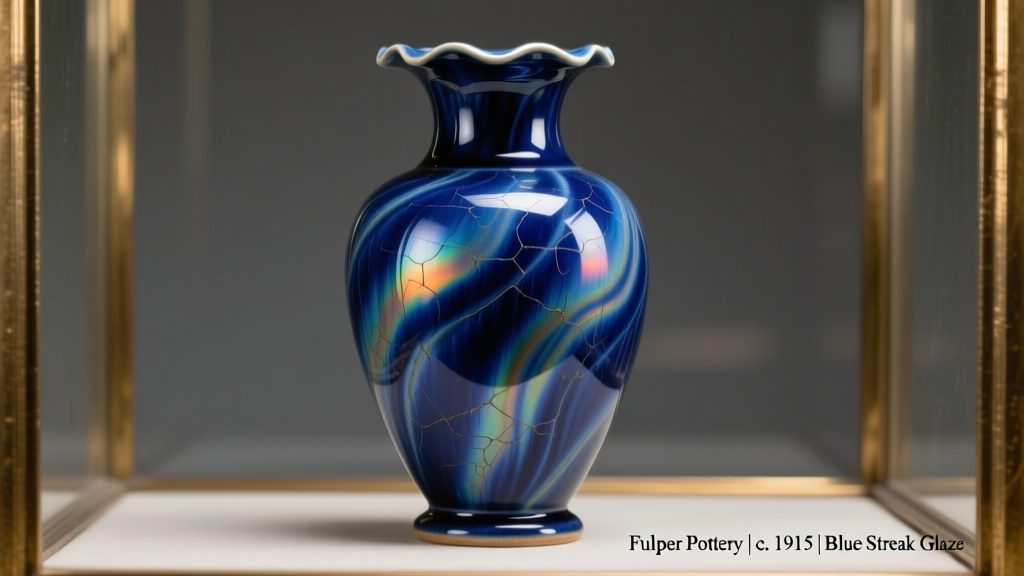
Fulper Vase, Blue Streaky Glaze, Baluster Form with Flared Rim and Footed Base — Circa 1915, 11¾ Inches
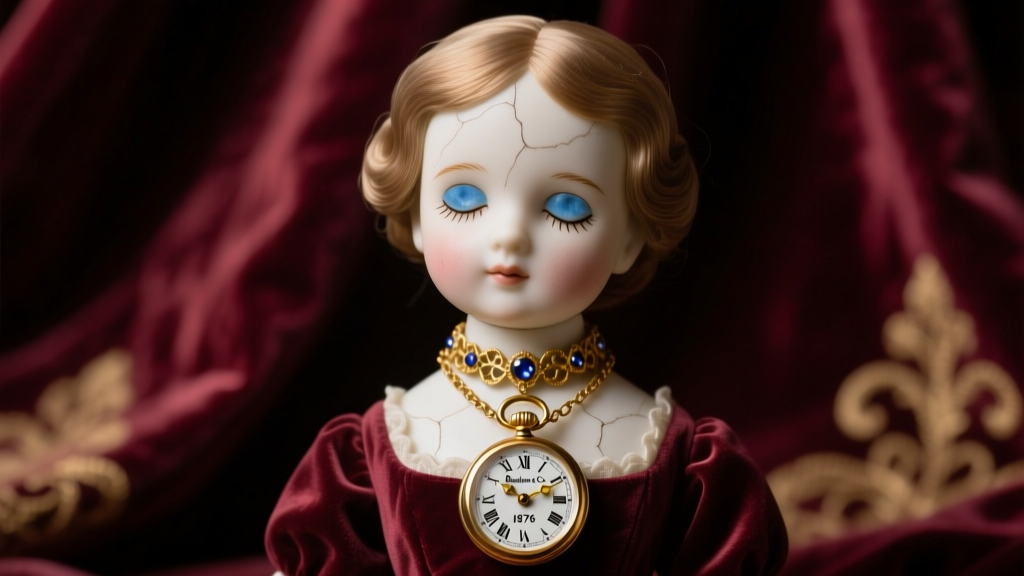
The Enigmatic Charm of the 2¼-Inch French Bisque Doll with Blue Eyes and Closed Mouth: A Collector’s Deep Dive
Speedy Alka-Seltzer Standup Cardboard Display: A 12-Inch Mid-Century Advertising Artifact
The Toy Cap Gun Fanner 50 Box: A Collector’s Deep Dive into Mid-Century American Pyrotechnic Play
Majolica Pitcher: Bamboo Motif in Yellow, Cobalt Blue, Brown, and Green — A 7-Inch Victorian Masterpiece
Betty Boop Gardening Tray: A 1950s Ceramic Collectible in Brown Outfit with White Rim — Authentication, Provenance, and Market Value
Ironstone Pitcher and Basin Set: Château Blue & White, 10-Sided Basin, 12-Inch Pitcher — A Collector’s Guide to Victorian-Era English Ironstone
Iron Windmill Weight with Bull Silhouette: A Rare Fairbury Windmill Company Artifact from Early 20th-Century Nebraska
Akro Agate Bowl Interior Panel: Green, 3 3/8 Inches — A Mid-Century American Art Glass Masterpiece