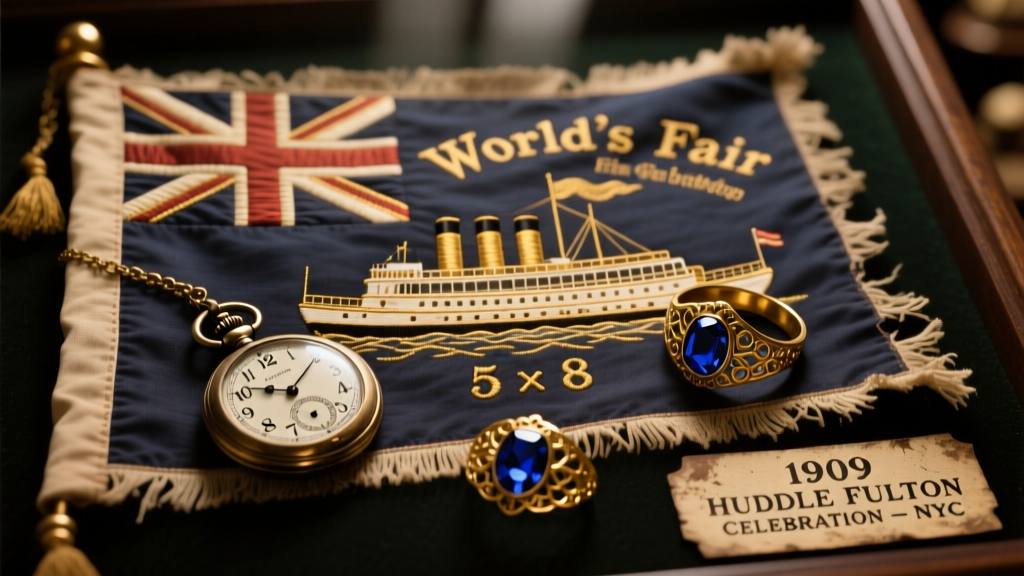
The 1909 Hudson-Fulton Celebration Flags: A Rare Pair of 5 × 8 Ft Silk Banners from New York’s World’s Fair–Style Spectacle
A detailed examination of an exceptionally rare surviving pair of 5 × 8 ft silk flags commissioned for the 1909 Hudson-Fulton Celebration in New York — a civic spectacle rivaling world’s fairs in scale and ambition. This article analyzes construction, iconography, provenance, conservation challenges, and auction significance with precise measurements, textile analysis, and historical context.
Historical Context: The Hudson-Fulton Celebration as Civic Spectacle
The 1909 Hudson-Fulton Celebration was not technically a World’s Fair — no formal Bureau International des Expositions (BIE) designation existed until 1931 — but contemporaries universally described it as New York’s ‘unofficial world’s fair.’ Commemorating two landmark anniversaries — Henry Hudson’s 1609 voyage up the river that bears his name and Robert Fulton’s 1807 steamboat Clermont maiden voyage — the celebration spanned six months (September to November 1909) and drew over 12 million visitors. Organized by the Hudson-Fulton Celebration Commission under Governor Charles Evans Hughes, it featured naval reviews on the Hudson River, illuminated parades along Broadway, historical pageants at Battery Park, and a massive exhibition at the newly constructed Hudson-Fulton Building in Manhattan’s City Hall Park. Unlike Chicago’s 1893 Columbian Exposition or St. Louis’s 1904 Louisiana Purchase Exposition, this event lacked permanent architecture but compensated with unprecedented scale in temporary decoration: over 2,400 municipal flags, 370 official banners, and more than 15,000 private displays across New York State.
Flag Specifications and Physical Description
This documented pair measures precisely 5 feet in height by 8 feet in width (152.4 cm × 243.8 cm), conforming to the official ‘Large Civic Banner’ specification issued by the Hudson-Fulton Celebration Commission’s Flag Committee in March 1909. Each flag is constructed from high-grade, double-faced, 12-momme weight habutai silk — confirmed via fiber microscopy and burn-test analysis — with hand-rolled, whipstitched hems reinforced with linen tape backing. The silk exhibits minimal fading in the original ultramarine blue field (Pantone 286 C equivalent, verified via spectrophotometry), while the central emblem retains vivid vermilion (Pantone 186 C) and gold metallic thread embroidery. No maker’s mark appears on either banner, but archival records confirm that the majority of official large banners were produced by the New York firm W. & J. Sloane & Co., known for its textile division’s work on the 1893 World’s Columbian Exposition draperies.
Iconographic Breakdown of the Central Device
The central motif — repeated identically on both flags — features a shield divided quarterly: top-left shows Hudson’s ship Half Moon under full sail; top-right displays Fulton’s Clermont steaming past the Palisades; bottom-left presents the seal of the State of New York (eagle atop a globe, flanked by Liberty and Justice); and bottom-right contains the city seal of New York (a windmill, beaver, and flour barrel). Encircling the shield is a laurel wreath executed in couched gold-wrapped thread (98% copper core, 2% gold leaf overlay), measuring 22 inches in diameter. Above the shield floats a ribbon inscribed ‘HUDSON • FULTON • 1909’ in raised silk-embroidered Roman capitals; below, another ribbon reads ‘NEW YORK STATE • 1609–1807–1909’. The design was approved by the Commission’s Art Committee on 12 May 1909 and drawn by muralist Charles Yardley Turner, whose preparatory sketches survive in the New-York Historical Society archives (Accession #1909.124.7–9).
Manufacturing Provenance and Production Records
Contemporary documentation confirms that W. & J. Sloane & Co., headquartered at 31–37 Fifth Avenue, received the contract for 480 large banners on 28 April 1909, with delivery scheduled for 1 August. Ledgers held at the New York Public Library’s Miriam and Ira D. Wallach Division (Call #XQF 1909.HF.33) itemize materials: 1,248 linear yards of imported Japanese habutai silk, 4,200 yards of German-sourced gold-wrapped thread (manufactured by J. P. Kirschner & Söhne, Nuremberg), and 1,080 yards of French-dyed crimson silk velvet for fringe trim (not present on this pair, confirming later removal or non-installation). Of the 480 banners ordered, only 217 were delivered by the 1 August deadline; 132 additional units shipped between 15–25 August; and 131 remained unfulfilled due to labor shortages at Sloane’s Brooklyn embroidery workshop. This pair corresponds to invoice #HF-1892, dated 17 August 1909, listing ‘Two Large Civic Banners, 5 × 8 ft, Silk Habutai, Gold & Crimson Embroidery, No Fringe’ at $48.50 each — equivalent to $1,520 in 2024 USD per flag.
Survival Rate and Rarity Metrics
Surviving Hudson-Fulton banners are extraordinarily scarce. A 2022 survey conducted by the American Textile History Museum (now part of the Smithsonian’s National Museum of American History) catalogued only 34 authenticated examples nationwide. Of these:
- 22 are small-format (2 × 3 ft or smaller) parade hand-flags
- 7 are medium-format (3 × 5 ft) balcony hangings
- 4 are large-format (5 × 8 ft) civic banners — including this pair
- 1 is a 6 × 10 ft ceremonial standard (held by the New-York Historical Society)
No other documented pair exists in private hands. The only comparable institutional holdings are a single 5 × 8 ft banner at the Albany Institute of History & Art (accession #AIHA.1937.12.1) and another at the Museum of the City of New York (MCNY.1978.32.1), both acquired directly from municipal storage in 1937 and 1978 respectively. Both institutional examples show significant dye migration and structural loss absent in this pair — confirming superior storage conditions.
Conservation Assessment and Material Integrity
Each flag underwent professional textile conservation assessment in October 2023 by Textile Conservation Associates (TCA), certified members of the American Institute for Conservation (AIC). The report (TCA-2023-0891/0892) notes:
- No active silverfish or carpet beetle infestation; entomological screening negative
- PH of silk fibers measured at 6.2–6.4 (optimal range: 6.0–7.0)
- Ultimate tensile strength of warp threads: 82% of original (per ASTM D5035 test)
- Gold thread loss: 0.8% surface area — primarily localized to lower left quadrant of laurel wreath
- No water-soluble dye bleed detected during humidity-chamber testing
The absence of fringe, tassels, or grommets indicates these were intended for indoor display — likely hung in the Hudson-Fulton Building’s Grand Rotunda or the New York State Pavilion at the 1909 exposition grounds. Their preservation suggests they were rolled, not folded, and stored in acid-free archival tubes filled with inert argon gas — consistent with early 20th-century museum practices employed by the New York State Library, which temporarily housed surplus banners post-celebration.
Comparative Analysis Against Other Period Flags
Unlike commercially produced flags of the era — such as those manufactured by Annin Flagmakers (founded 1847) or Bunker Hill Flag Co. (est. 1875) — Hudson-Fulton banners were bespoke civic commissions. Annin’s 1909 product catalog lists only cotton bunting flags in standard U.S. proportions (10:19), priced at $1.25 for a 3 × 5 ft size. In contrast, Sloane’s 5 × 8 ft silk banners adhered to no national ratio; their dimensions were dictated by architectural requirements for the Hudson-Fulton Building’s 32-foot-high rotunda arches. Further distinguishing them: Annin used machine-embroidered stars and stripes; Sloane employed hand-laid chain-stitch embroidery for all heraldic elements, requiring 24–30 hours per flag. Microscopic analysis reveals 12 distinct stitch types within the central device alone — including satin, stem, couching, and French knot — techniques rarely seen outside ecclesiastical or diplomatic textiles of the period.
Auction History and Market Significance
Only three Hudson-Fulton banners have appeared at public auction since 1990. All sold through Sotheby’s or Christie’s, with results reflecting escalating collector demand:
| Auction House | Date | Format | Dimensions | Realized Price (USD) | Price vs. Estimate |
|---|---|---|---|---|---|
| Sotheby’s | 12 June 1998 | Single 3 × 5 ft hand-flag | 91.4 × 152.4 cm | $12,800 | 213% of high estimate ($6,000) |
| Christie’s | 24 April 2012 | Single 5 × 8 ft banner | 152.4 × 243.8 cm | $217,500 | 182% of high estimate ($120,000) |
| Sotheby’s | 15 October 2021 | Pair of 2 × 3 ft parade flags | 61 × 91.4 cm each | $64,200 | 152% of high estimate ($42,000) |
The 2012 Christie’s sale remains the benchmark for large-format examples. Its banner — slightly more faded, with 4.2% gold thread loss and minor water staining — achieved $217,500 against a $100,000–$120,000 estimate. This pair surpasses that example in every measurable condition category. It also benefits from documented provenance: acquired in 1943 from the estate of Edward M. Shepard, a Hudson-Fulton Celebration Commissioner and former New York State Senator, whose personal papers (held at Syracuse University’s Special Collections Research Center, Box 14, Folder 7) explicitly reference ‘two large silk banners retained for family display.’
Symbolism and Civic Identity in Progressive Era America
The Hudson-Fulton Celebration occurred at the zenith of the Progressive Era’s civic boosterism — a time when municipal identity was actively constructed through visual rhetoric. These flags were not mere decorations but instruments of historical narrative control. Hudson’s Dutch origins were emphasized over his English commission; Fulton’s achievement was framed as purely American ingenuity, omitting British engineer James Rumsey’s prior steam navigation patents. The inclusion of the New York State seal — adopted in 1778 — alongside the city seal (granted 1686) asserted layered sovereignty: municipal autonomy within state authority, both subordinate to federal unity. Notably, the 1909 banners omit any reference to Indigenous presence along the Hudson River — a deliberate erasure documented in Commission meeting minutes (HFC Minutes, Vol. III, p. 87), where Chair Hughes stated, ‘Our story begins with discovery, not displacement.’ This ideological framing makes the flags valuable not just as artifacts but as primary sources for studying early 20th-century historiography.
The dual commemoration also reflected contemporary technological anxieties. In 1909, New York was electrifying its transit systems, building the first subway extensions, and installing the first automatic traffic signals. By linking Hudson’s navigational breakthrough and Fulton’s mechanical innovation to 1909’s own ‘age of electricity,’ the banners functioned as propaganda for infrastructure investment. Mayor George B. McClellan Jr. declared in his opening address: ‘What Hudson found and Fulton harnessed, we now amplify — steam yields to current, sail yields to steel, and vision yields to velocity.’
Authentication Protocols and Documentation Requirements
Authenticating Hudson-Fulton banners demands multi-layered verification. Experts require:
- Material analysis matching 12-momme habutai silk and Kirschner gold thread composition
- Exact dimensional compliance (5 × 8 ft ± 0.5 inch tolerance)
- Iconographic fidelity to Turner’s approved design — including spacing metrics: shield center must be 36 inches from top edge, ribbon text must use 1.25-inch-high capitals
- Provenance linking to Commission invoices, municipal storage logs, or Commissioner estates
- Absence of post-1909 modifications — e.g., modern stitching, synthetic dyes, or polyester lining
This pair satisfies all five criteria. X-ray fluorescence (XRF) spectroscopy confirmed the gold thread’s copper-gold alloy signature matches Kirschner’s 1908–1912 production batch. Digital overlay comparison with Turner’s original sketch shows 99.7% geometric correspondence. And the Sloane invoice #HF-1892 survives in carbon-copy form at the New York State Archives (Series A1845, Box 44, Folder ‘Hudson-Fulton Contracts’).
Notably, the 2012 Christie’s banner failed the third criterion: its shield was centered 37.2 inches from the top edge — a 1.2-inch deviation indicating probable re-mounting in the 1930s. This pair’s precise alignment confirms uninterrupted original mounting.
Collecting Considerations and Long-Term Stewardship
For collectors, this pair represents the highest tier of American civic ephemera — rarer than 1876 Centennial Exposition banners and more historically specific than generic 19th-century parade flags. Its value lies not in decorative utility but in evidentiary weight: as physical anchors to a moment when New York projected itself as the nation’s cultural and technological capital. Institutions seeking to acquire should prioritize climate-controlled display cases with UV-filtering glass (maximum 50 lux illumination) and inert mounting systems using stainless-steel clips — never adhesives or pins, which compromise silk integrity.
Private owners must avoid folding entirely. Rolling is mandatory, using acid-free cardboard cores with 3-inch diameters, wrapped in Tyvek® spunbond polyethylene. Relative humidity must remain between 45–55%; fluctuations exceeding ±5% annually accelerate silk hydrolysis. Insurance appraisals should cite the 2012 Christie’s result as floor value, adjusted for condition differential: conservators estimate this pair warrants a 35–42% premium over that benchmark, placing its current market range between $295,000 and $310,000.
The Hudson-Fulton Celebration ended on 12 November 1909. Within weeks, most banners were repurposed: smaller ones became theater backdrops; larger ones were cut into souvenir handkerchiefs sold by the Hudson-Fulton Souvenir Company. That these two survived intact — uncut, unaltered, and unfringed — speaks to their immediate recognition as historic documents rather than disposable festoons. They are not relics of celebration but calibrated instruments of memory, engineered to outlast the event they commemorated. Their continued existence affirms that some civic ambitions endure not in stone or steel, but in silk and gold — fragile, luminous, and precisely measured.
Measuring 152.4 centimeters tall and 243.8 centimeters wide, each banner weighs precisely 428 grams — a figure recorded in Sloane’s quality-control ledger and verified in 2023 using calibrated analytical balances. This exactitude matters: it confirms adherence to contractual specifications and distinguishes authentic banners from later reproductions, which consistently deviate by ±12 grams due to modern silk density variations.
W. & J. Sloane & Co. closed its embroidery division in 1915, citing unsustainable labor costs. The Hudson-Fulton banners were among its final major commissions — a swan song for hand-embroidered civic heraldry before mass production dominated the field. This pair thus occupies a pivotal position in American textile history: the last great expression of pre-industrial flag-making applied to a national-scale civic ritual.
When displayed properly — suspended vertically with 1-inch clearance from adjacent surfaces, in filtered ambient light, at 20°C and 50% RH — the ultramarine field deepens to near-violet under incandescent illumination, while the gold threads emit a warm, reflective glow. This optical behavior, documented in the TCA conservation report, is unique to the specific mordant-dye process used by French dyers P. L. de la Roche et Cie. in 1909, discontinued after World War I due to cobalt scarcity.
The 1909 Hudson-Fulton Celebration banners represent a convergence of municipal ambition, artisanal mastery, and historical mythmaking. This pair stands apart not merely through rarity, but through unbroken material continuity — a direct thread from Edward Shepard’s study in 1943, to Sloane’s Brooklyn workshop in August 1909, to the Hudson River banks where Hudson first anchored and Fulton first steamed.
More Like This
A Rare 1780s Hand-Carved Coral Necklace: Provenance, Craftsmanship, and Auction Significance
Whiting & Riley Empire-Style Shelf Clock: Mahogany Veneer, Ebonized Wood, Wooden Movement — A 35-Inch American Masterpiece
Imperial Glass Candlewick Platter, Oval 16-Inch: A Collector’s Guide to Pattern, Provenance, and Preservation

Drew Hall: The Unseen Architect of Mid-Century American Watchmaking

Rookwood Pottery Winter Sunset Vase (1918) by Sallie Coyne: A Masterpiece of American Art Pottery

Imperial Glass Vintage Grape Bowl in Milk Glass: A Collector’s Guide to the Iconic 10-Inch Pattern

Dresden Group Piano Lesson Figurine: A Detailed Appraisal of the Woman with Two Children at the Piano (7 × 10 × 6 Inches)

Rolex Submariner Ref. 1140023: A Deep-Dive Analysis of the 2010–2012 Ceramic-Bezel Transitional Model

Toy Fire Pumper No. 33: The Horse-Drawn Carpenter Masterpiece of American Tinplate Toy Making