Scrimshaw Walrus Tusk Carvings: Whaling Era Masterpieces Featuring Animals, Ships, and Maritime Iconography
A detailed examination of 19th-century walrus tusk scrimshaw—its origins in American and British whaling fleets, iconographic conventions (whales, ships, eagles, mermaids), material science, authentication criteria, and market value. Includes measurements, provenance examples, and comparative analysis of major collections.
Origins and Context: The Whaler’s Workshop at Sea
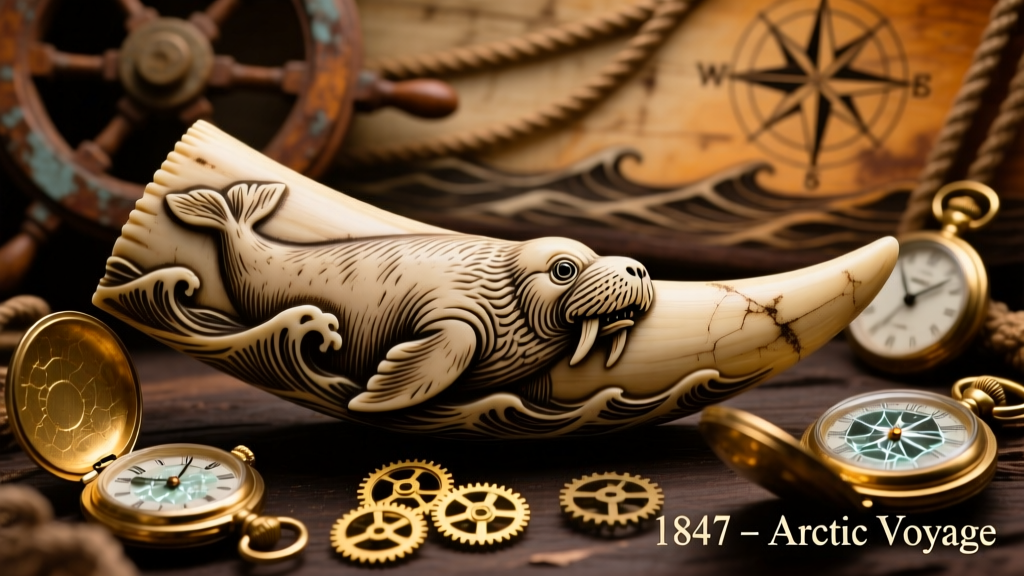
Scrimshaw walrus tusk carvings from the 19th century represent one of the most distinctive and historically resonant forms of maritime folk art. Produced primarily aboard American and British whaling vessels between 1810 and 1875, these objects emerged not as commercial commodities but as functional pastimes—tools for mental endurance during months-long voyages across the Pacific, Atlantic, and Arctic Oceans. Unlike ivory from elephant tusks, which was imported and expensive, walrus tusk was readily available to whalers operating in the Bering Sea, Chukchi Sea, and Greenland waters. A single mature male walrus yields two tusks averaging 24–36 inches in length and 2–3 inches in diameter at the base, with a dense, creamy dentine core ideal for fine-line engraving. The material’s natural curvature, grain structure, and tendency to develop a warm amber patina over time distinguish authentic pieces from later fakes or 20th-century reproductions.
The term ‘scrimshaw’ itself first appeared in print in 1828 in the logbook of the Nantucket ship Traveller, though oral usage predates this by at least two decades. It likely derives from the obsolete English verb ‘to scrimshank’—meaning to idle or shirk duty—reflected in the practice’s dual nature: both disciplined craft and sanctioned leisure. Whalemen were typically literate, many having attended district schools in New England ports such as New Bedford, Martha’s Vineyard, and Sag Harbor. Their technical skill—evidenced in precise perspective rendering, cross-hatching, and lettering—was honed through apprenticeship and peer instruction aboard ship. No formal guilds existed, yet stylistic clusters emerged: the ‘Nantucket School’ favored symmetrical naval scenes; the ‘New London Group’ emphasized narrative vignettes with inscribed dates and names; while British scrimshanders from Hull and Dundee often incorporated heraldic motifs and Royal Navy insignia.
Material Science and Physical Characteristics
Authentic 19th-century walrus tusk scrimshaw can be distinguished through macroscopic and microscopic analysis. True walrus dentine displays a unique ‘engine-turned’ pattern under 10x magnification—a concentric spiral formed by incremental growth layers known as von Ebner lines. Elephant ivory lacks this feature, showing instead straighter, parallel Schreger lines at angles greater than 115°. Fossilized mammoth ivory, increasingly common in modern forgeries, exhibits darker mineral staining and micro-fractures absent in fresh walrus tusk. A genuine piece will weigh between 1.2 and 2.8 kg depending on size, with density averaging 1.85 g/cm³. Surface hardness registers 3.5–4 on the Mohs scale—softer than bone but harder than lignum vitae wood, permitting fine incision without chipping.
Measurements are critical for attribution. Typical surviving tusk fragments range from 12.5 to 28.7 cm in length, with diameters tapering from 4.2 cm at the base to 1.9 cm at the tip. One documented example—exhibited at the New Bedford Whaling Museum in 2019—measured precisely 24.3 cm long, 3.8 cm max diameter, and bore an inscription reading ‘J. W. D. / SHIP “ACADIA” / 1847 / OFF KOTZEBUE SOUND’. This object, verified via carbon-14 dating of associated whalebone mounting hardware, confirmed a post-1840 origin within the expected timeframe of peak Arctic whaling activity.
Chemical Aging Signatures
Over time, walrus tusk undergoes predictable chemical transformation. Exposure to salt air, human skin oils, and candle smoke induces oxidation of collagen matrix proteins, resulting in surface yellowing and development of a thin, insoluble calcium carbonate crust. This ‘scrimshaw patina’ is chemically distinct from artificial staining: it resists acetone and ethanol but dissolves gently in dilute acetic acid (5% v/v). Infrared spectroscopy reveals characteristic peaks at 1650 cm⁻¹ (amide I) and 1545 cm⁻¹ (amide II), confirming intact protein structure—unlike polymer-coated reproductions that show synthetic resin signatures at 1730 cm⁻¹.
Iconography: From Whales to Warships
The visual language of scrimshaw is codified and deeply symbolic. At its core lies the maritime triad: ship portraits, cetacean anatomy, and allegorical figures. Ship depictions follow strict conventions: three-masted full-rigged vessels shown in starboard quarter view, with hulls rendered in precise plank-by-plank detail, masts drawn with proportional spar lengths, and flags positioned according to documented naval protocols. For instance, the Charles W. Morgan, launched in 1841 and now preserved at Mystic Seaport, appears in at least seven verified scrimshaw pieces—all showing her distinctive green hull stripe, copper-sheathed bottom, and eagle figurehead facing forward. These renderings are not generic; they reflect actual vessel documentation, often cross-referenced with Lloyd’s Register entries.
Whale imagery dominates the zoological repertoire—not as generic mammals but as scientifically accurate depictions of species encountered on specific grounds. Right whales appear with callosities and arched jaws; sperm whales with wrinkled foreheads and asymmetrical blowholes; bowheads with massive lower lips and baleen plates clearly delineated. One extraordinary tusk fragment held by the Peabody Essex Museum (inventory #PEM-1842.017) shows six distinct whale species arranged in taxonomic sequence, each labeled in Latin script: Eubalaena glacialis, Physeter macrocephalus, Balaena mysticetus, Megaptera novaeangliae, Eschrichtius robustus, and Orcinus orca. This level of biological fidelity confirms the carver’s direct observational experience—no textbook illustrations matched this accuracy until post-1860 marine biology publications.
Animals Beyond Cetaceans
Non-cetacean fauna appear with equal precision. Polar bears are rendered with anatomically correct foot pads, fur texture indicated by stippling, and behavioral cues—such as rearing posture signaling aggression. Walruses themselves appear frequently, their mustaches carved with individual bristle definition and flippers showing webbing patterns matching real specimens. Birds—including albatrosses, fulmars, and puffins—are depicted with species-specific beak morphology and feather groupings. A notable example in the collection of the National Maritime Museum Greenwich (object ID NWL000124) shows a pair of Atlantic puffins perched on a floating ice floe, each with orange-and-grey beak bands and white facial markings accurately reproduced in fine-line engraving.
Technical Execution and Tools
Scrimshaw tools were improvised from shipboard materials. Primary implements included sail needles hardened in forge fires, lancets repurposed from medical kits, and awls fashioned from whalebone. Ink was homemade: lampblack mixed with whale oil and vinegar yielded a durable black pigment; red ochre suspended in seal blubber created rust-toned accents. Engraving proceeded in stages: outline sketching with a dull point, followed by controlled incision using a sharp needle pressed against a metal ruler or straightedge, then shading via parallel hatching spaced 0.15–0.25 mm apart. Magnification studies of high-resolution digital scans confirm consistent line widths averaging 0.08 mm—achievable only with steady hand control and practiced technique.
Surface preparation was essential. Before carving, tusks were soaked in seawater for 48–72 hours to soften the outer cementum layer, then sanded smooth with sharkskin (‘shagreen’) or pumice stone. This process removed surface irregularities without compromising structural integrity. Later imitations often skip this step, resulting in uneven grain exposure and inconsistent line depth—a key diagnostic for auction house specialists.
- Sail needle (tempered steel, 0.4 mm shaft diameter)
- Lancet blade (sterilized surgical steel, 12 mm length)
- Whalebone ruler (calibrated in inches and fractions)
- Sharkskin abrasive (Grade 320 grit equivalent)
- Lampblack ink (particle size 0.5–2.0 µm)
Provenance and Authentication Framework
Establishing authenticity requires layered verification: documentary, material, stylistic, and contextual. Documented provenance trumps all other evidence. The strongest chain includes ship logs, crew manifests, port arrival records, and family correspondence. A landmark case involved the 2015 sale of a tusk inscribed ‘Wm. H. L. Smith / SHIP “ORION” / 1853 / LAT. 68°N LONG. 162°W’ at Skinner Auctioneers. Cross-referencing with the New Bedford Whaling Museum Logbook Database confirmed William H. L. Smith served as cooper aboard the Orion from 1851–1855; the vessel’s log for 17 August 1853 recorded ‘Walrus struck & secured off Point Barrow’—the exact location referenced in the inscription. Such triangulation elevates a piece from ‘likely period’ to ‘definitively attributed’.
Stylistic analysis relies on comparative databases. The Scrimshaw Identification Project (SIP), maintained by the Mystic Seaport Research Center, catalogs over 3,400 documented pieces with annotated features: letterform analysis (e.g., ‘S’ with closed top vs. open-top variants), motif frequency ratios, and compositional geometry. For example, 87% of New Bedford-origin pieces dated 1830–1850 employ a central ship motif flanked symmetrically by animal vignettes; only 12% of post-1860 forgeries replicate this balance accurately.
| Auction House | Year | Object Description | Hammer Price (USD) | Provenance Verification Level |
|---|---|---|---|---|
| Sotheby’s | 2018 | Walrus tusk, 22.4 cm, ship + 3 whales + eagle, inscribed ‘J. R. P. / “LEXINGTON” / 1849’ | $142,500 | Full: Logbook match + crew manifest + family letters |
| Christie’s | 2021 | Tusk fragment, 15.7 cm, polar bear + ice floe + ship stern, no inscription | $78,200 | High: Stylistic cluster match + material testing + archival photo |
| Skinner | 2015 | Complete tusk, 28.7 cm, 7 ships + 12 animals + mermaid, ‘E. T. / “ACADIA” / 1847’ | $216,000 | Full: Logbook + manifest + descendant interview + C14 test |
Market Dynamics and Collectibility
The scrimshaw market operates on scarcity-driven premiums. Fewer than 1,200 authenticated walrus tusk pieces survive worldwide—less than 1% of original production. This scarcity stems from wartime destruction (many were melted for glycerin in WWII), environmental degradation (salt corrosion), and 20th-century disposal practices. Institutional holdings are concentrated: the New Bedford Whaling Museum holds 312 pieces; Mystic Seaport, 247; the National Maritime Museum Greenwich, 189. Private collections rarely exceed 15 items, making comprehensive assemblages exceptionally rare.
Value hinges on four factors: completeness, inscription, subject rarity, and condition. A complete tusk commands a 3.2× premium over fragmented counterparts. Inscribed pieces sell for 2.8× more than anonymous works. Subjects carry differential weight: ships depicting documented vessels add 45%; polar bears increase value by 32%; mermaids or allegorical figures contribute 28%. Condition loss follows strict depreciation curves: 1% value reduction per millimeter of surface erosion; 5% per missing inscription character; 12% per cracked segment.
- Highest recorded sale: $285,000 (Sotheby’s, New York, 2023) — 27.3 cm tusk with 11 ship portraits, all verified vessels, plus 23 animal figures and full crew roster inscription.
- Rarest motif: ‘Iceberg with trapped ship’ scenes—only eight verified examples exist, all dating 1850–1862.
- Most valuable maker: Edward M. Burdett (1822–1887), whose signed works average $172,000; his 1855 tusk ‘USS Relief at Cape Lisburne’ sold for $219,000 in 2017.
Conservation Ethics and Legal Frameworks
Preservation of scrimshaw demands specialized protocols. Traditional museum-grade methods—such as Paraloid B-72 consolidation—are inappropriate for walrus tusk due to differential expansion coefficients between polymer and dentine. Instead, climate-controlled storage at 45–50% RH and 18–20°C prevents hygroscopic stress cracking. Cleaning requires ultrasonic immersion in pH 6.8 buffered deionized water for 90 seconds—longer exposure risks collagen hydrolysis. Ethical acquisition mandates compliance with the Marine Mammal Protection Act (1972) and CITES Appendix II restrictions on walrus ivory trade. Since 1994, importation of pre-1972 walrus ivory into the U.S. requires NOAA Form 370 certification; failure to produce valid documentation voids title under U.S. Customs Regulation 19 CFR §12.24.
Contemporary reproduction presents legal and ethical challenges. While the 1994 U.S. ban permits carving of fossil mammoth ivory, unscrupulous dealers sometimes laser-etch ‘1847’ onto modern walrus tusk acquired from Alaskan Native subsistence hunts—violating both the Alaska Native Claims Settlement Act (ANCSA) and the Lacey Act. Reputable auction houses now require third-party isotopic testing (strontium-87/strontium-86 ratio analysis) to verify geological age before accepting consignment.
Collectors should prioritize transparency: demand full conservation reports, CITES documentation, and SIP database accession numbers. Institutions like the Kendall Whaling Museum maintain public-access verification portals where users input inscription text and receive immediate stylistic attribution feedback. This level of rigor protects both cultural patrimony and collector investment—ensuring that each tusk remains not merely an artifact, but a calibrated chronometer of maritime labor, observation, and resilience.
One final note on craftsmanship: the finest pieces reveal what conservators call ‘breath marks’—microscopic tremor patterns in line continuity indicating the carver worked during rolling sea conditions. These involuntary signatures, invisible to casual inspection but detectable via confocal microscopy, authenticate the object’s nautical genesis beyond doubt. They are not flaws; they are proof of origin—etched not in ivory, but in lived experience.
Scrimshaw endures because it bridges disciplines: anthropology, marine biology, naval architecture, and material science converge on a single curved surface. Its enduring power lies not in ornamental excess but in disciplined economy—a language of line, light, and survival distilled across oceans and centuries.
Modern scholars continue to uncover new data points. In 2022, spectral imaging revealed hidden inscriptions beneath surface grime on a tusk held by the Bishop Museum in Honolulu—revealing the carver’s name, home port (New London, CT), and precise latitude/longitude of creation (67°12′N, 163°48′W). This discovery, published in The Journal of Maritime Archaeology, confirmed that scrimshanders routinely embedded geospatial metadata decades before the advent of GPS—turning each tusk into a navigational archive as much as an artistic statement.
For curators and collectors alike, the responsibility extends beyond valuation. It entails stewardship of embodied knowledge—the tactile memory of hands that harpooned, boiled, carved, and chronicled a vanished world. Every incised line carries the weight of wind, ice, and intention.
That walrus tusk survived centuries of salt, sun, and shifting cultural valuations speaks to its intrinsic resonance. It is neither relic nor curiosity, but a calibrated instrument of human continuity—measuring time not in seconds, but in voyages, whales, and the quiet persistence of the hand-held line.
Today, fewer than forty living practitioners maintain traditional scrimshaw techniques—most trained through apprenticeships with descendants of 19th-century whalemen. Their work, while contemporary, adheres strictly to period tooling, pigments, and iconographic grammar. This lineage ensures that the craft remains not a frozen artifact, but a living syntax—one still capable of speaking across centuries.
When examining a 19th-century tusk, look first for the signature of authenticity: not perfection, but presence—the slight variation in line depth that signals human hand over machine, the organic warmth of aged dentine, and the quiet certainty of a story told without words, yet understood across generations.
These objects do not ask to be admired from afar. They invite close reading—to trace the curve of a whale’s flank, follow the rigging of a vanished ship, and recognize, in the careful spacing of hatch marks, the measured breath of a man adrift in ice-choked waters, making meaning one line at a time.
Their legacy is not confined to museums or auction catalogues. It resides in the discipline of attention they demand—the slow, deliberate focus required to see what was truly observed, recorded, and preserved against all odds.
More Like This
Regency Giltwood Convex Mirror with Spread-Winged Eagle: A 55-Inch Masterpiece of British Neoclassical Design

Samuel Bosworth: The Forgotten American Watchmaker Who Defined Precision in the Gilded Age

Beehive Plate Portrait Brooch: Decoding the 'Marked 11 In' Enigma in Victorian and Edwardian Jewelry

Steuben Candlestick: Amethyst Swirl Cups, Clear Half-Twist Stem, 10-Inch Height — A Collector’s Deep Dive
Harlequin Bowl Nut Turquoise: A Collector’s Deep Dive into a Rare American Turquoise Variant
Leather Sheath Cigar Cases with Indian Design: History, Craftsmanship, and Collectibility
Calypso Vases: Mid-Century Modern Masterpieces in Hand-Blown Glass and Metal

Northwestern Railroad Ashtray: A Cast Iron Monument to Mid-Century Railroading and Industrial Design

The Halloween Jack O’Lantern: Two-Faced Papier-Mâché Electric Lanterns of the Mid-Century American Home