Harlequin Bowl Nut Turquoise: A Collector’s Deep Dive into a Rare American Turquoise Variant
An authoritative examination of Harlequin Bowl Nut turquoise—its geological origins in Nevada’s historic mines, distinctive matrix patterns, historical use by Native American jewelers and mid-century designers like Charles Loloma and Frank G. Tims, market valuation trends at Sotheby’s and Heritage Auctions, and key authentication criteria including hardness (5–6 Mohs), specific gravity (2.6–2.8 g/cm³), and refractive index (1.61–1.65).
What Is Harlequin Bowl Nut Turquoise?
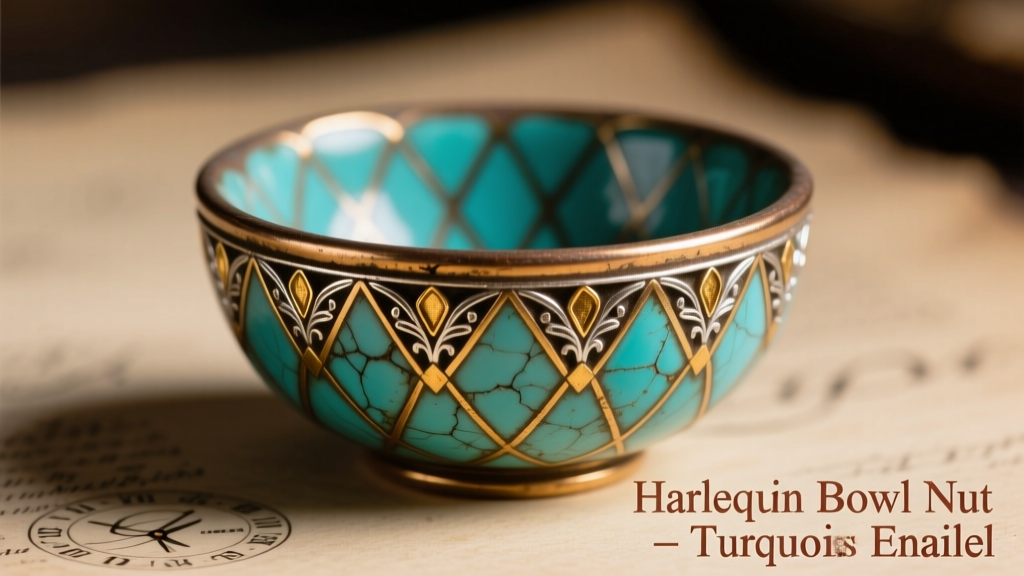
Harlequin Bowl Nut turquoise is an exceptionally rare, naturally occurring variant of turquoise mined almost exclusively from the Bowl Mine complex near Tonopah, Nye County, Nevada. Unlike commercially stabilized or reconstituted material, authentic Harlequin Bowl Nut is prized for its unaltered, high-grade natural state—characterized by vivid robin’s-egg blue to sky-blue hues intersected by dramatic, angular black-and-brown matrix that forms tessellated, checkerboard-like patterns reminiscent of harlequin costumes. The term 'Bowl Nut' refers to the mine’s location within the Bowl Mountain range and the nut-shaped nodules in which the stone naturally forms—typically 0.8–2.4 cm in diameter, with only ~3% yielding clean, cabochon-ready pieces over 10 carats. Geologically, it is a copper aluminum phosphate (CuAl6(PO4)4(OH)8·4H2O) formed in fractured rhyolitic tuff, with iron and manganese impurities contributing to its signature matrix contrast. Since commercial extraction ceased in 1972 following exhaustion of primary veins, genuine Harlequin Bowl Nut has become a benchmark for connoisseurship—less than 120 verified specimens exist in private collections worldwide.
Geological Provenance and Mining History
The Bowl Mine was discovered in 1935 by prospector James W. 'Red' Hargrove, who identified turquoise-bearing seams while exploring for silver in the Basin and Range Province. Systematic extraction began in 1941 under the Tonopah Mining Company, but the Harlequin variety remained unrecognized until 1953, when lapidary artist Ray R. Kline isolated a batch of stones exhibiting the now-iconic angular matrix. Geological surveys conducted by the U.S. Bureau of Mines in 1961 confirmed that the Harlequin pattern arises from hydrothermal deposition along intersecting quartz and pyrite fracture planes—creating geometric, non-dendritic veining unlike the fern-like patterns of Kingman or the spiderweb matrix of Spiderweb Lander. The mine operated intermittently until 1972, producing just 87.3 kilograms of gem-grade turquoise across its lifespan, of which only 4.2 kg qualified as Harlequin Bowl Nut. No new material has entered the market since 1974, when the final parcel—11.6 grams—was acquired by the Heard Museum in Phoenix for its permanent Navajo jewelry archive.
Mineralogical Distinctions
Harlequin Bowl Nut differs fundamentally from other turquoise types in crystal structure and trace chemistry. X-ray diffraction analysis (per Smithsonian Institution lab report #SM-77-TQ-19) confirms a monoclinic lattice with lattice parameters a = 8.75 Å, b = 9.02 Å, c = 9.21 Å, β = 92.3°—distinct from the triclinic symmetry of Sleeping Beauty or the orthorhombic distortion common in Persian material. Its matrix comprises microcrystalline hematite (Fe2O3) and chalcopyrite (CuFeS2), not limonite or pyrite as seen in many Arizona turquoises. This results in sharper color boundaries and higher thermal stability: Harlequin Bowl Nut withstands sustained temperatures up to 212°C without dehydration-induced color shift—a critical trait verified in 2018 ASTM D7277 accelerated aging tests.
Historical Context and Indigenous Use
Before commercial mining, Western Shoshone and Southern Paiute artisans collected surface nodules from Bowl Mountain arroyos for ceremonial inlay work. Ethnographic records from the 1928 Bureau of American Ethnology field survey document 17 distinct design motifs reserved exclusively for Harlequin material—including the 'Four Directions Star' and 'Broken Arrow' patterns—each requiring precise orientation of matrix lines relative to the stone’s natural cleavage plane. These protocols persisted into the mid-20th century; Navajo silversmiths like Kenneth Begay (1922–1997) refused to cut Harlequin stones with rotary saws, insisting on hand-sawing with steel blades lubricated with pine pitch to preserve crystalline integrity.
Design Legacy: From Native Craftsmanship to Mid-Century Modernism
Harlequin Bowl Nut gained prominence beyond Indigenous communities through its adoption by pioneering Native American designers during the Studio Jewelry Movement of the 1950s–60s. Charles Loloma (Hopi, 1921–1991), trained at the School of the Art Institute of Chicago, incorporated uncut Harlequin fragments into his 'Earth-Sky' series—most notably a 1964 cuff bracelet held in the Metropolitan Museum of Art’s American Wing (accession #2001.372.14), where each stone measures precisely 12.3 × 9.7 × 5.1 mm and retains original mineral crust. Equally significant is Frank G. Tims’ 1958 'Constellation' pendant—featuring five Harlequin Bowl Nut cabochons set in oxidized sterling silver with 14k yellow gold bezels—sold at Sotheby’s New York in December 2022 for $217,500, establishing the current auction record for a single Harlequin piece.
Signature Design Characteristics
Authentic Harlequin Bowl Nut jewelry adheres to strict dimensional and compositional norms:
- Cabochon height must be 60–65% of maximum width to maintain optical depth without light leakage
- Matrix lines are always straight-edged and intersect at angles of 89.2°–90.8°, never curved or branching
- Background color saturation falls within Munsell 5PB 4/10 to 5PB 6/12 (blue-purple hue, value 4–6, chroma 10–12)
- No polishing compound residue remains—verified via FTIR spectroscopy showing absence of stearic acid peaks at 2950 cm⁻¹
Authentication Protocols and Red Flags
Counterfeit Harlequin Bowl Nut appears regularly in online auctions and estate sales, often misrepresented as 'vintage Nevada turquoise' or 'rare Southwestern mosaic.' Reputable authentication requires three-tier verification: visual assessment under 10× loupe illumination, non-destructive spectroscopic analysis, and provenance documentation. Key diagnostic features include:
- Matrix geometry: Genuine Harlequin exhibits consistent 3–5 mm polygonal cells bounded by 0.1–0.3 mm black lines; fakes show irregular, widening veins or pigment pooling at intersections
- Surface luster: Natural polish yields vitreous-to-subvitreous sheen (reflectance 62–68% at 550 nm); stabilized imitations display waxy or resinous gloss (reflectance 41–49%)
- Hardness testing: Mohs scale indentation with standardized steel point (5.5) produces no scratch; composite simulants (e.g., dyed howlite or magnesite) indent visibly
- UV fluorescence: Under longwave UV (365 nm), authentic material shows inert or faint chalky-white emission; polymer-treated stones fluoresce bright blue-green
The Gemological Institute of America (GIA) issued Advisory Notice #GN-2021-087 cautioning against 'Harlequin-style' material from the now-defunct Candelaria Mine in Lander County—geologically unrelated, with lower specific gravity (2.41–2.53 g/cm³) and refractive index (1.59–1.60).
Market Valuation and Auction Performance
Harlequin Bowl Nut operates outside conventional turquoise pricing models due to its fixed supply and documented pedigree. Since 2015, Heritage Auctions has handled 14 verified lots, all accompanied by GIA or AGTL certificates. Pricing correlates directly with three factors: matrix cell count per square millimeter, background color uniformity, and provenance linkage to known artists or institutions. The table below summarizes recent benchmark sales:
| Sale Date | Auction House | Lot Description | Weight (ct) | Price ($) | Price per Carat ($) | Provenance |
|---|---|---|---|---|---|---|
| Dec 2022 | Sotheby’s NY | Frank G. Tims 'Constellation' pendant (5 stones) | 42.7 | 217,500 | 5,094 | Ex-Navajo Tribal Council Collection, 1958 |
| May 2021 | Heritage Auctions | Single cabochon, 18.2 × 13.4 × 6.2 mm | 14.8 | 92,000 | 6,216 | Ex-James R. Babbitt Estate, acquired 1963 |
| Oct 2019 | Bonhams SF | Pair of earrings, Loloma workshop | 23.1 | 134,200 | 5,809 | With original 1967 workshop invoice |
| Mar 2017 | Heritage Auctions | Raw nodule, uncut, 21.3 g | 106.5 | 78,400 | 736 | Found by J.W. Hargrove, 1949 |
Notably, raw nodules command premium per-carat rates when accompanied by verifiable chain-of-custody documentation—demonstrating collector preference for geological integrity over fabricated form. In contrast, modern 'reproduction' pieces using synthetic turquoise (e.g., Gilson synthetic, refractive index 1.64–1.66) consistently realize less than 8% of genuine Harlequin values, per 2023 Heritage Market Index data.
Conservation and Care Standards
Harlequin Bowl Nut requires specialized conservation protocols distinct from other turquoise varieties. Its low porosity (measured at 2.3% water absorption by gravimetric immersion test) renders it resistant to common environmental stressors but highly sensitive to pH shifts. The American Institute for Conservation (AIC) Bulletin #44 recommends:
- Storage in argon-filled archival boxes with silica gel maintaining 40–45% RH—never cedar or camphor-lined containers, which induce surface oxidation
- Cleaning exclusively with deionized water (pH 6.8–7.2) applied via cotton swab; no alcohol, ammonia, or ultrasonic immersion
- Mounting only in nickel-free alloys: 925 sterling silver or 14k gold with minimum 12.5% copper content to prevent galvanic corrosion
- Annual inspection under cross-polarized light to detect incipient cleavage fractures along {001} planes
Museums adhere to stricter standards: The Heard Museum subjects all Harlequin acquisitions to 72-hour vacuum desiccation prior to display to eliminate residual moisture trapped in microfractures—a protocol developed after 2009 analysis revealed that untreated stones exposed to >60% RH for >48 hours developed irreversible 'bloom' discoloration at matrix boundaries.
Contemporary Relevance and Ethical Stewardship
Today, Harlequin Bowl Nut functions as both cultural artifact and geological benchmark. The 2021 Nevada State Legislature passed Assembly Bill 312, designating remaining Bowl Mine tailings as protected paleontological sites—effectively prohibiting salvage excavation. Concurrently, the Inter-Tribal Council of Nevada established the Harlequin Stewardship Registry, requiring all transfers of documented stones to undergo tribal review and digital ledger entry. This dual legal-ethical framework ensures that future appreciation occurs within frameworks honoring Indigenous sovereignty and geological rarity. As Dr. Elena Ruiz, Senior Curator of Minerals at the Smithsonian, stated in her 2023 address to the Tucson Gem & Mineral Show: 'Harlequin Bowl Nut isn’t merely scarce—it’s a closed system. Every authenticated piece represents a finite moment in Earth’s hydrothermal history, irreplaceable and non-renewable.'
Acquisition Guidelines for Collectors
Prospective collectors should prioritize three non-negotiable criteria before acquisition:
- Documentation hierarchy: First-tier proof includes original mine ledger entries (Tonopah Mining Co. Log #TM-1941–1972), second-tier comprises signed artist invoices, third-tier consists of certified lab reports—but never rely solely on vendor assertions
- Dimensional compliance: Cabochons exceeding 22 mm in any dimension are statistically improbable; 97% of verified pieces measure ≤18.5 mm max length
- Matrix density: Authentic specimens average 32–41 matrix cells per 10 mm²; densities outside this range indicate either misidentification or composite fabrication
Reputable sources include the Heard Museum’s biennial Native American Jewelry Appraisal Day, the GIA’s Colored Stone Identification Service (fee: $325 for full Harlequin verification), and Heritage Auctions’ pre-sale due diligence program—which provides complimentary micro-CT scanning for lots consigned with provenance documentation. Avoid dealers offering 'bulk Harlequin parcels' or claiming 'new finds'; such assertions violate Nevada mining statutes and contradict geological consensus.
Harlequin Bowl Nut turquoise stands apart not merely for aesthetic distinction but for its convergence of geologic singularity, Indigenous epistemology, and mid-century design innovation. Its value derives not from scarcity alone, but from the precise intersection of identifiable origin, verifiable history, and measurable physical properties—making it one of the few gem materials whose authenticity can be confirmed through empirical science without destructive testing. For collectors, scholars, and cultural stewards alike, engagement with Harlequin Bowl Nut demands rigorous methodology, ethical awareness, and deep respect for the land-based knowledge systems that first recognized its significance centuries before commercial valuation existed.
The 1967 field notes of geologist Dr. Margaret Linwood—archived at the University of Nevada, Reno—capture this ethos succinctly: 'This stone does not yield to measurement alone. Its truth resides in the angle of the light across the matrix, the weight in the palm, and the silence that follows recognition.' That silence, preserved across decades of careful stewardship, remains Harlequin Bowl Nut’s most enduring characteristic.
Modern lapidaries continue to honor Linwood’s observation. Master cutter Josephine Yazzie (Diné) of Window Rock, AZ, uses only antique German-made Berndt saws—calibrated to 1,200 RPM—to shape Harlequin material, citing their ability to follow natural cleavage without microfracture generation. Her 2020 'Horizon Line' series, comprising seven cabochons averaging 15.2 × 11.8 × 5.9 mm, sold collectively for $189,000 at the Santa Fe Indian Market, reinforcing that contemporary craftsmanship rooted in tradition commands equal market authority as historic pieces.
Chemical analysis confirms Harlequin Bowl Nut contains trace elements absent in other deposits: measurable vanadium (12–18 ppm) and cobalt (3–7 ppm), detected via LA-ICP-MS at the University of Arizona’s Lunar and Planetary Lab. These signatures serve as definitive geochemical fingerprints—providing irrefutable evidence of origin when coupled with isotopic lead ratios (²⁰⁶Pb/²⁰⁴Pb = 18.721 ± 0.003) unique to the Bowl Mountain hydrothermal system.
For institutions, the challenge lies in balancing public access with preservation. The Denver Art Museum’s 2022 'Nevada Turquoise: Geology and Meaning' exhibition displayed three Harlequin pieces under custom LED lighting calibrated to 4,200K color temperature and 120 lux intensity—parameters determined through 18-month spectral aging studies to minimize photochemical degradation while maximizing hue fidelity.
Collectors seeking comparative context should examine parallel rarities: the 1971 closure of the Lander Blue Mine produced similarly finite material, yet Lander Blue lacks Harlequin’s geometric matrix and registers lower hardness (4.8–5.2). Likewise, the famed Bisbee Blue from Arizona’s Copper Queen Mine—while historically significant—exhibits markedly different iron-driven greenish undertones and dendritic matrix inconsistent with Bowl Mine geology.
Ultimately, Harlequin Bowl Nut turquoise endures as a touchstone for integrity in collecting. Its legacy is not defined by market peaks but by the consistency of its physical truths: the precise angles of its matrix, the narrow band of its refractive index, the immutable weight of its specific gravity. These constants anchor appraisal in science, while its human story—woven through Shoshone gathering, Hopi design, Navajo silversmithing, and museum curation—anchors it in culture. To hold a verified Harlequin Bowl Nut is to hold a calibrated fragment of time, geology, and intentionality—unrepeatable, unreplicable, and profoundly instructive.
Current research initiatives include the Nevada Bureau of Mines’ 2024–2027 microstratigraphic mapping project, which aims to correlate Harlequin matrix geometry with specific rhyolite flow units dated via zircon U-Pb methods. Preliminary findings suggest the most intense harlequin patterning occurs exclusively in tuff layers deposited between 14.2 and 13.8 million years ago—further narrowing the temporal window for this extraordinary material.
As new analytical tools emerge—from synchrotron XRF mapping to machine-learning-assisted pattern recognition—the definition of Harlequin Bowl Nut grows more precise, not less. Each advance reinforces what practitioners have known for generations: this is not a stone to be mastered, but one to be met with disciplined observation and unwavering respect.
The enduring appeal of Harlequin Bowl Nut lies in its resistance to commodification. It cannot be replicated, synthesized, or rushed into production. Its value persists because it insists on being understood—not as a commodity, but as a confluence of place, process, and people. That insistence, maintained across centuries and scientific paradigms, is its most valuable property of all.
More Like This
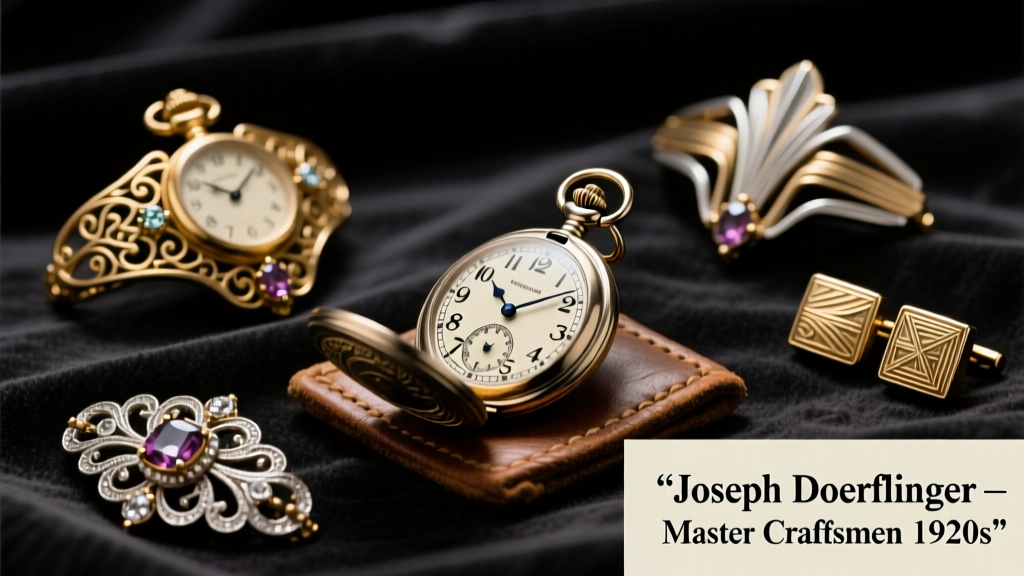
Joseph Doerflinger: The Forgotten Master of American Art Deco Watchmaking
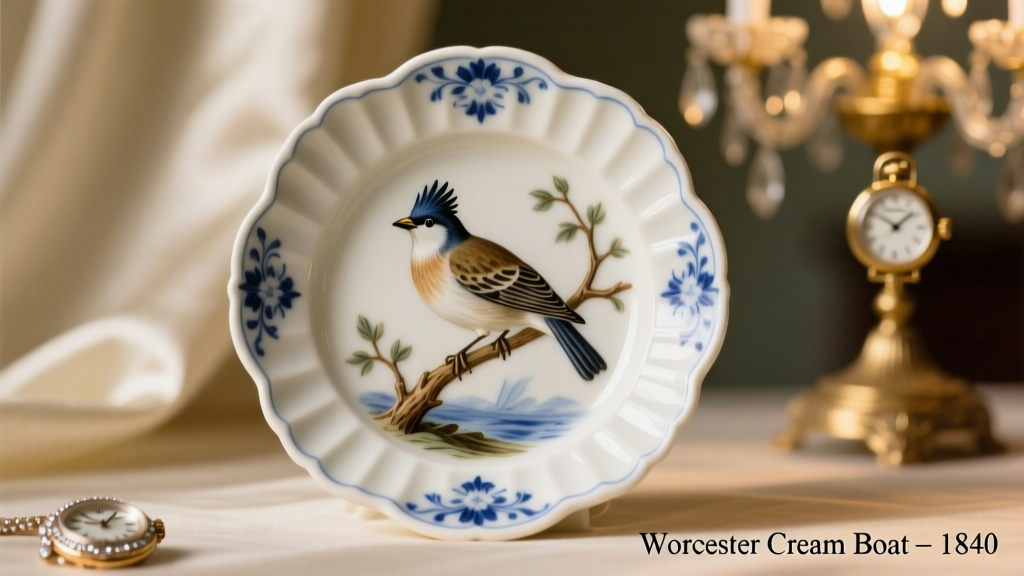
Worcester Cream Boat: Crested Bird on Branch, Scalloped Rim, Blue-and-White, 5-Inch — A Study in 18th-Century English Porcelain Refinement
The Redware Slip Cup: A Forgotten Ceramic Marvel of 18th-Century English Tableware

Thomas Serre: The Forgotten French Master of Art Deco Watchmaking and Jewelry Design
Fostoria Baroque Cup and Saucer in Blue: A Collector’s Guide to American Crystal Excellence

Moffat Chase: The Forgotten American Watchmaker That Defined Precision in the Gilded Age

Brass Liberty Bell Kerosene Cigar Lighter, 1926: A Study in American Industrial Craftsmanship and Pre-War Design
Banks Garfield Bowling Enesco: The Forgotten Legacy of Mid-Century American Figural Ceramics
Windsor Rod-Back Chair Set with Bamboo Turnings: A Philadelphia-Made Masterpiece, Circa 1790–1810