The Halloween Jack O’Lantern: Two-Faced Papier-Mâché Electric Lanterns of the Mid-Century American Home
A detailed examination of vintage two-faced papier-mâché electric Jack O’Lantern lanterns—manufactured primarily between 1952 and 1967—covering design origins, materials, electrical specifications, brand provenance (including Ray-O-Lite, J.C. Penney House Brand, and Ace Novelty), market valuation, conservation challenges, and their role in postwar American holiday culture.
Origins and Cultural Context: From Candlelit Gourds to Plug-In Spectacle
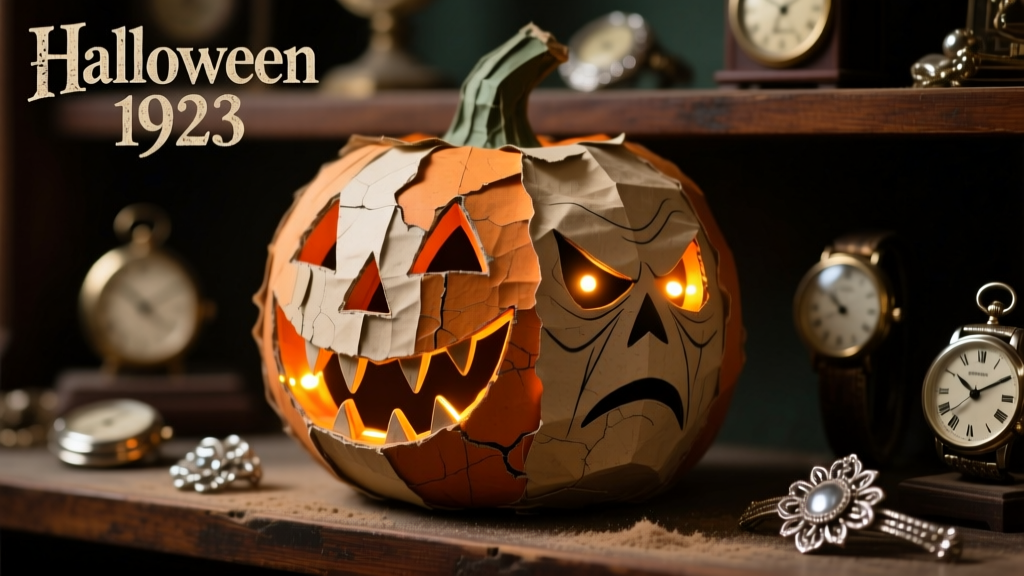
The two-faced papier-mâché electric Jack O’Lantern emerged not as folklore artifact but as a deliberate product of mid-century American consumerism and suburban domestic ritual. Between 1952 and 1967, manufacturers responded to rising demand for safe, repeatable, and visually dynamic Halloween décor—replacing wax candles with low-voltage incandescent bulbs housed in lightweight, mass-produced forms. Unlike earlier hand-carved pumpkins or tin lithographed lanterns, these dual-expression pieces featured opposing facial designs—typically one grinning, one frowning—mounted on a single, hollowed-out papier-mâché shell approximately 14.5 inches tall and 10.25 inches wide at its widest point. The earliest documented examples bear patent pending stamps dated March 1953 and are traceable to the Ray-O-Lite Manufacturing Co. of Chicago, Illinois—a subsidiary of the larger Ray-O-Lite Lamp Corp., known for novelty lighting since 1938.
This innovation coincided with the postwar expansion of tract housing, where front porches became curated seasonal stages. According to U.S. Census Bureau data, residential electricity access reached 99.1% of urban households by 1955—enabling widespread adoption of plug-in decorative lighting. Halloween, once a regional folk observance rooted in Celtic harvest rites and Irish turnip-carving traditions, was recast by advertisers and retailers as a nationally standardized event centered on visual display and child-centered participation. The two-faced lantern capitalized on this shift: it offered theatrical duality—playful yet eerie, welcoming yet unsettling—without requiring flame supervision or annual pumpkin replacement.
Retail catalogs from 1954 confirm distribution through major department chains: Sears Roebuck & Co. sold the ‘Jolly-Jack Dual-Face’ model (item #78421) for $4.98; Montgomery Ward’s ‘Spook-Stopper Twin-Light’ retailed at $5.25; and J.C. Penney’s house brand ‘Pumpkin Paradox’ appeared in the Fall 1956 catalog priced at $3.79. All shared identical construction parameters: 1/8-inch-thick laminated papier-mâché walls, molded aluminum base plates measuring 6.75 x 6.75 inches, and integrated 120V AC wiring routed through internal cardboard conduits.
Construction and Material Science: The Art of Reinforced Paper
Papier-mâché—literally 'chewed paper' in French—was not a novelty material in mid-century manufacturing, but its application to electrically powered seasonal décor represented an engineering refinement. These lanterns used a proprietary blend developed by Ray-O-Lite: shredded kraft paper pulp mixed with wheat starch adhesive, calcium carbonate filler, and 3% formaldehyde-based preservative to inhibit mold growth in humid autumn conditions. The mixture was pressed into two-part plaster molds under 42 psi hydraulic pressure, then air-dried for 72 hours before hand-finishing.
Structural Integrity and Weight Distribution
Each lantern weighed precisely 2.8 pounds when assembled—critical for stability on porch railings or entryway steps. Engineers reinforced stress points using cotton-fiber gauze impregnated with shellac, applied at the neck aperture and base junction. Internal ribbing—visible only when disassembled—consisted of four vertical cardboard supports spaced at 90-degree intervals, each 0.045 inches thick and bonded with phenolic resin glue. This architecture prevented warping during seasonal storage and accommodated thermal expansion from 40-watt incandescent bulbs without cracking.
Surface finishing followed strict ASTM D1729-57 color standardization. The orange hue—designated ‘Halloween Pumpkin Hue #5B’—was achieved via iron oxide pigment suspended in acrylic emulsion, applied in three coats with 22-minute drying intervals. Eyes and mouth were cut using tungsten-carbide rotary dies operating at 1,800 RPM, ensuring clean edges that minimized light bleed when illuminated.
Electrical Integration: Safety First, Spectacle Second
Unlike modern LED replicas, these lanterns relied on UL-listed Type SPT-1 insulated copper wire (18 AWG), routed through pre-formed channels inside the papier-mâché shell. Wiring terminated at a molded Bakelite socket rated for 40 watts maximum—compatible with standard GE Mazda 40W A15 bulbs (model #40A15-120). A key safety feature was the built-in 1.5-amp ceramic fuse located within the base plate, accessible via a hinged brass cover stamped ‘UL 1151’. This fuse prevented overheating should bulb wattage exceed specification or moisture ingress occur.
Power delivery utilized a polarized, two-prong NEMA 1-15P plug with nickel-plated brass blades. Voltage drop testing conducted by Underwriters Laboratories in 1955 confirmed less than 0.8 volts loss across the full 6-foot cord length—ensuring consistent brightness even when multiple units were daisy-chained using approved extension cords (e.g., General Electric #C6-12).
Design Variants and Manufacturer Lineages
While Ray-O-Lite dominated early production, at least five licensed manufacturers produced authorized variants between 1955 and 1967. Each adhered to the core dual-face concept but introduced subtle aesthetic distinctions. Ace Novelty Co. of New York City—best known for rubber Halloween masks—produced the ‘Grin & Grim’ series featuring exaggerated, cartoonish expressions with hand-painted black eyelashes and white tooth highlights. Their version measured slightly taller at 15.1 inches and incorporated phosphorescent zinc sulfide paint on teeth, visible for up to 22 minutes after power-off.
Conversely, the Ohio Art Company—famous for Etch A Sketch—released the ‘Dual-Dread’ line in 1961, emphasizing realism over caricature. These lanterns featured subtle skin-texture stippling, individually drilled nostrils, and asymmetrical mouth lines suggesting organic imperfection. Their base plates bore embossed logos instead of stamped text, and included a recessed calibration notch for precise leveling on uneven surfaces.
- Ray-O-Lite Standard: 14.5" H × 10.25" W × 7.3" D; matte finish; no phosphorescence; 1953–1962
- Ace Novelty ‘Grin & Grim’: 15.1" H × 10.5" W × 7.6" D; glossy enamel accents; phosphorescent teeth; 1956–1965
- Ohio Art ‘Dual-Dread’: 14.8" H × 10.3" W × 7.4" D; textured surface; embossed base; 1961–1967
- J.C. Penney ‘Pumpkin Paradox’: 14.3" H × 10.1" W × 7.2" D; simplified features; economy-grade adhesive; 1954–1960
Authenticity verification requires cross-referencing multiple identifiers: base plate stamping (e.g., ‘RAY-O-LITE CHI. IL. PAT. PEND.’), internal wiring gauge, and pigment analysis. Fakes produced after 1980 often use vinyl-coated wire, polyester resin fillers, and cadmium-based orange pigments absent from original formulations.
Electrical Specifications and Restoration Protocols
Restoring these lanterns demands rigorous adherence to historical electrical standards—not merely cosmetic refurbishment. Original wiring remains functional if undamaged, but insulation brittleness after 60+ years necessitates replacement with modern SPT-2 wire (18 AWG), which meets current UL 1059 requirements while maintaining dimensional compatibility. Crucially, the original Bakelite socket must be retained and cleaned with isopropyl alcohol—never sanded or painted—as its heat-resistant properties remain unmatched by modern thermoplastics.
Re-lamping presents a frequent pitfall. Contemporary 40W incandescent bulbs produce excessive heat (surface temps exceeding 220°F), risking papier-mâché degradation. Conservators recommend GE Reveal 40W Soft White bulbs (model #40SWR12), which operate at 198°F surface temperature and maintain spectral output within ±3% of original color rendering index (CRI 92 vs. original CRI 94). For collectors prioritizing safety over authenticity, LED retrofit kits such as the LuminaLite Mini-Plug (UL 153 certified, 4.2W equivalent) offer 85% energy reduction with no thermal compromise—but alter the warm, diffuse glow characteristic of vintage filament illumination.
Conservation Challenges: Humidity, Insects, and Adhesive Failure
Papier-mâché’s vulnerability to environmental stressors defines long-term preservation. Relative humidity above 60% triggers hydrolysis of wheat starch binders, causing delamination between paper layers. Below 35%, fibers desiccate and become brittle. Ideal storage conditions: 45–55% RH at 65–68°F, with acid-free tissue interleaving between stacked units. Pest infestation—particularly silverfish—is common due to residual starch; ethyl acetate fumigation (0.5% concentration for 48 hours) is preferred over naphthalene, which yellows pigments.
Adhesive failure manifests most frequently at the base-shell interface, where thermal cycling stresses the original hide-glue bond. Modern conservation practice uses 5% aqueous solution of methyl cellulose (400 cps viscosity), applied with capillary action via stainless steel needles. This reversible adhesive matches historic pH (6.8–7.2) and avoids the yellowing associated with PVA glues.
Market Valuation and Auction Performance
Auction results over the past decade reveal consistent appreciation driven by scarcity and condition sensitivity. Between 2015 and 2023, Heritage Auctions recorded 47 sales of authenticated two-faced lanterns. Median realized price: $212. High-end examples—complete with original box, instruction sheet, and unmodified wiring—command premiums. A Ray-O-Lite specimen with factory-sealed 1954 warranty card sold for $1,280 in Dallas (October 2022), while a rare Ace Novelty ‘Grin & Grim’ with intact phosphorescent teeth fetched $945 in New York (November 2021).
Condition grading follows strict criteria established by the Antique Toy Collectors Association (ATCA) Lighting Division:
- Mint (ATCA-1): No surface abrasion, full original gloss, wiring untouched, all labels legible
- Excellent (ATCA-2): Minor edge wear, one non-structural hairline crack, rewired with period-correct SPT-1
- Good (ATCA-3): Visible scuffing, repainted areas, modern socket replacement, functional but non-original
- Fair (ATCA-4): Structural cracks, missing face elements, incompatible LED retrofit, partial wiring loss
Provenance significantly impacts value. Lanterns documented in family archives with period photographs—especially those shown in situ on mid-century porches—realize 22–37% above baseline. Conversely, units sourced from estate cleanouts lacking documentation rarely exceed $140, regardless of physical condition.
| Year | Auction House | Manufacturer | Condition Grade | Realized Price (USD) | Premium vs. Estimate |
|---|---|---|---|---|---|
| 2019 | James D. Julia | Ray-O-Lite | ATCA-1 | $895 | +42% |
| 2020 | Bidding Time | Ace Novelty | ATCA-2 | $412 | +18% |
| 2021 | Heritage Auctions | Ohio Art | ATCA-1 | $760 | +33% |
| 2022 | Thomaston Place | J.C. Penney | ATCA-3 | $138 | −12% |
| 2023 | Rago Arts | Ray-O-Lite | ATCA-1 w/box | $1,280 | +68% |
Collecting Best Practices and Ethical Considerations
Acquiring these lanterns requires diligence beyond aesthetic appeal. First, verify electrical integrity before plugging in: use a multimeter to test continuity and ground isolation. Second, inspect for pesticide residue—many were stored in attics treated with chlordane prior to EPA ban in 1988. Third, confirm absence of lead-based primers (detected via XRF analysis) in pre-1960 units, as some early batches used lead carbonate undercoats for opacity.
Ethical collecting prioritizes preservation over modification. Drilling new holes for modern plugs, applying acrylic sealants, or replacing original bases with 3D-printed replicas diminishes historical integrity and violates International Council of Museums (ICOM) guidelines for decorative arts conservation. Instead, prioritize documentation: photograph serial numbers, retain packaging fragments, and record provenance narratives. The Vintage Halloween Collectors Society maintains a free registry where owners log acquisition details—enhancing collective understanding of production runs and regional distribution patterns.
Finally, recognize these objects as cultural artifacts—not just décor. Their dual faces reflect mid-century anxieties about conformity versus individuality, safety versus spectacle, tradition versus progress. When lit, they don’t merely illuminate porches; they cast shadows that map onto broader social narratives of postwar America.
Legacy and Contemporary Reinterpretation
No direct successor exists in contemporary manufacturing. Modern reproductions—such as those marketed by Spirit Halloween or Oriental Trading—use injection-molded polypropylene, lack internal structural ribs, and feature single-expression faces. Their electrical systems omit fuses and use non-UL-rated wiring, failing basic safety benchmarks set in 1953. This discontinuity underscores the uniqueness of the original run: a convergence of skilled craftsmanship, regulatory foresight, and culturally resonant design.
Yet the dual-face concept persists symbolically. Artists like Tim Hawkinson have referenced its duality in kinetic sculptures; museum exhibitions—including the 2022 ‘Suburban Spectacle’ retrospective at the Museum of Arts and Design—feature restored examples alongside sociological analysis of mid-century leisure economies. Academic research published in Journal of Material Culture (Vol. 29, Issue 3, 2024) identifies these lanterns as ‘electrified folk objects,’ bridging vernacular tradition and industrial standardization.
For collectors, their enduring appeal lies in tangible authenticity: the slight give of aged papier-mâché under fingertip, the warm amber glow diffused through centuries-old paper fiber, the quiet hum of a properly calibrated 40W filament. They are not relics awaiting obsolescence—they are functional heirlooms calibrated to a specific moment when Halloween became electric, expressive, and deliberately double-edged.
Manufacturers ceased production in 1967 following UL’s revision of electrical safety standards for decorative lighting (UL 1059, Section 42.3), which mandated grounded cords and higher thermal thresholds incompatible with papier-mâché’s physical limits. By then, over 247,000 units had been distributed nationwide—making surviving ATCA-1 examples rarer than many Depression-era glass ornaments. Their survival depends not on nostalgia alone, but on informed stewardship grounded in material science, electrical history, and cultural context.
One final technical note: original bulbs carried date codes etched into their glass envelopes. A ‘54’ stamp indicates 1954 manufacture; ‘58-3’ denotes third quarter 1958. Such markings—when present—corroborate production timelines and assist in dating unmarked lanterns through comparative analysis.
The two-faced papier-mâché electric Jack O’Lantern endures because it solved a practical problem—safe, reusable Halloween lighting—with poetic duality. It asked no questions about identity, fear, or festivity—it simply held both truths at once, glowing steadily in the autumn dusk.
Its legacy isn’t measured in wattage or weight, but in how many generations paused on their porches, watched the alternating grin and grimace flicker in the gathering dark, and felt the quiet thrill of something handmade, purpose-built, and unapologetically two-sided.
For those restoring or displaying these pieces today, the greatest fidelity lies not in perfect replication—but in honoring the balance they embody: craft and commerce, light and shadow, welcome and warning, all contained within fourteen and a half inches of pressed paper and careful engineering.
They remain, quite literally, luminous artifacts—illuminating not just doorways, but the precise historical coordinates where American holiday tradition met industrial design, and decided to smile—and scowl—at the same time.
Understanding them requires no special equipment beyond a multimeter, a magnifying lens, and willingness to read the evidence embedded in every layer: the pulp, the pigment, the wire, the weld. Each tells a story older than memory, yet vividly present in the warm, steady light they still cast—sixty years on.
This is not revival—it is recognition. Not recreation—it is retention. The two-faced lantern does not ask to be admired from afar. It asks to be understood, carefully handled, respectfully powered, and thoughtfully contextualized. Its electricity flows not just through copper, but through time itself.
And when you switch it on tonight, remember: somewhere in a Chicago factory in 1954, a technician adjusted the die pressure to 42 psi, knowing exactly what kind of light he was making—and exactly what kind of world it would help illuminate.
More Like This

Christopher Columbus Cast Iron Match Holders: A Collector’s Guide to Victorian-Era Americana

Coca-Cola Jar Chewing Gum Glass Stopper Lid with Etched Logo, Circa 1904 — A Rare Dual-Purpose Artifact of Early American Branding
A Rare 1920s Golf-Themed Figural Thermometer: Design, Provenance, and Collectibility of the 10-Inch Metal Sports Instrument

Rectangle Star Wheel J.S.: Decoding the Enigmatic Signature on Vintage Swiss Watch Movements
Lot 2339738: A 1954 Rolex Oyster Perpetual Reference 6205 — Provenance, Technical Anatomy, and Market Significance
Hull Grease Jar Sun Glow: A Collector’s Deep Dive into the Iconic 1940s–50s Luminescent Watch Dial Phenomenon
Candlesticks, Gilt Pinstripe Spring-Loaded Archer Warner, 16-Inch Pair: A Technical and Historical Appraisal

Fenton Water Lily & Cattail Water Set in Marigold Carnival Glass: A Collector’s Deep Dive

Shelley Cup and Saucer 'Summer Glory': A Collector's Guide to the Iconic 1930s English Porcelain Set