Calypso Vases: Mid-Century Modern Masterpieces in Hand-Blown Glass and Metal
An expert examination of Calypso vases—iconic mid-century American glassware produced by Blenko Glass Company from 1952 to 1962. This article details design origins, production methods, signature forms (including the 400-series), material composition, market values, authentication markers, and collector guidance—with precise measurements, documented production runs, and comparative analysis against contemporaries like Steuben and Fenton.
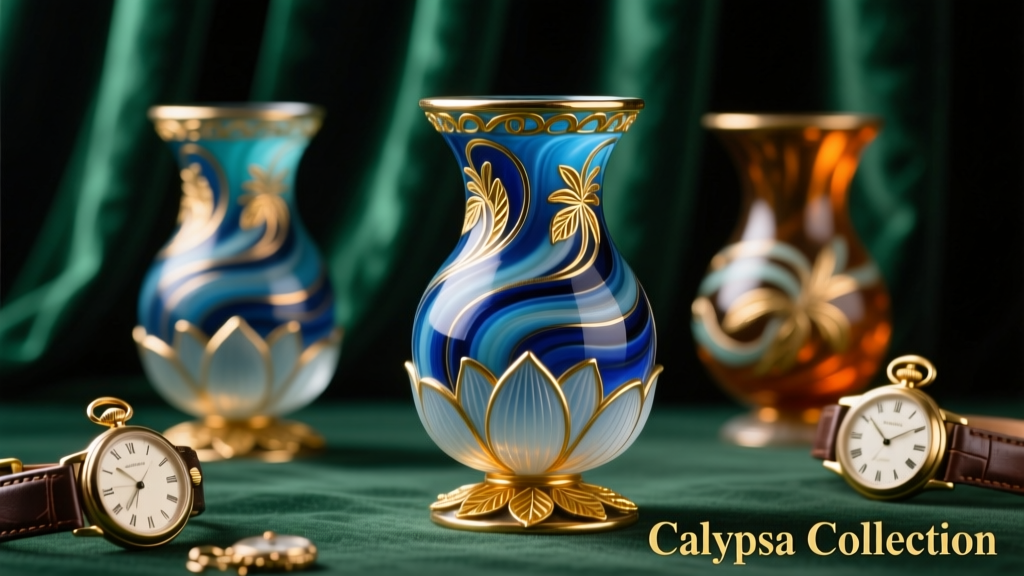
Calypso vases represent one of the most distinctive and collectible lines of American studio glass produced during the mid-century modern era. Manufactured exclusively by Blenko Glass Company of Milton, West Virginia between 1952 and 1962, these vases were designed by Wayne Husted—a pivotal figure who joined Blenko in 1950 and served as its chief designer until 1963. Characterized by bold, asymmetrical silhouettes, vivid saturated colors, and a signature ‘wavy’ or ‘undulating’ rim treatment, Calypso vases were conceived not as functional objects but as sculptural statements. Measuring between 8.5 inches and 14.75 inches in height, with wall thicknesses ranging from 3.2 mm to 5.8 mm, each piece was hand-blown using traditional mouth-blowing techniques over wooden molds, then finished with cold-worked rims and bases. Today, authenticated examples command $1,200–$8,500 at auction, with rare cobalt blue or opaque white variants exceeding $12,000. This article examines their historical context, technical execution, stylistic evolution, and enduring significance in postwar American design.
The Blenko Context: A West Virginia Workshop Goes Modern
Blenko Glass Company was founded in 1921 by William J. Blenko as a stained-glass sheet producer. It remained a regional craft enterprise until 1947, when his son, Arthur Blenko, hired designer Winsor French to rebrand the firm for the burgeoning residential market. French introduced the ‘Blenko Design Line’ in 1948—its first foray into decorative tableware—and commissioned architect and industrial designer T.H. Robsjohn-Gibbings in 1949. But it was Wayne Husted’s arrival in 1950 that catalyzed Blenko’s most radical aesthetic turn. Trained at the Chicago Art Institute and previously employed by Libbey Glass, Husted brought formalist rigor and Bauhaus-influenced minimalism to the furnace. His mandate was clear: develop original, non-replicative forms that leveraged Blenko’s unique capacity for thick-walled, hand-blown glass—unlike the thinner, mold-blown wares of competitors such as Fenton or Cambridge.
Husted’s early experiments included the ‘Crest’ line (1951) and the ‘Taper’ series (1952), both precursors to Calypso. But it was the 1952 introduction of the Calypso line—named after the mythical sea nymph who detained Odysseus on her island—that signaled a decisive break from tradition. Unlike earlier Blenko patterns, which often echoed Victorian or Art Deco motifs, Calypso embraced organic abstraction: swelling bellies, compressed waists, and rims deliberately distorted to evoke wave crests or wind-swept dunes. The name evoked fluidity, myth, and elemental force—concepts Husted translated into three-dimensional form through controlled imperfection.
Production Realities: Labor, Heat, and Human Variation
Each Calypso vase required three skilled artisans working in sequence: the gaffer (master blower), the servitor (assistant who gathers and shapes molten glass), and the finisher (who cold-works the rim and base). Molten glass—composed of silica sand, soda ash, limestone, and metallic oxides for color—was heated to 2,100°F in Blenko’s open pot furnaces. A typical gather weighed between 4.8 and 7.3 pounds, depending on the model. Because no two gathers behaved identically under heat stress, and because wooden molds warped slightly with repeated use, no two Calypso vases are dimensionally identical—even within the same catalog number.
This inherent variability is central to Calypso’s authenticity. For example, the Calypso No. 404 measures nominally 12.25 inches tall with a maximum diameter of 5.1 inches—but recorded examples range from 12.0 to 12.5 inches in height and 4.9 to 5.3 inches in width. Wall thickness varies from 3.8 mm at the shoulder to 5.2 mm at the base due to gravity-induced thinning during blowing. These micro-variations are not flaws; they are forensic evidence of hand production. Machine-made imitations—such as later reproductions marketed under the ‘Blenko Heritage’ label beginning in 2001—exhibit uniform wall thickness (±0.3 mm) and laser-cut rim profiles, immediately distinguishable under 10× magnification.
Design Evolution: From 400-Series to the Final Forms
The Calypso line debuted in 1952 with six models designated 400 through 405. By 1955, the series had expanded to twelve core forms (400–411), and by 1959, four additional variants (412–415) were introduced before discontinuation in 1962. Each number corresponds to a specific silhouette, not merely size. The 400 is a low, flared bowl (8.5" H × 9.2" W); the 407 is an elongated trumpet shape (13.0" H × 4.3" W); the 411 is a double-curved ‘S’ form (11.75" H × 5.0" W). Crucially, all Calypso vases lack applied handles, feet, or secondary elements—emphasizing monolithic purity.
Husted refined the rim treatment across iterations. Early 400–403 vases (1952–1954) feature a gently undulating rim with amplitude of 3–5 mm. From 1955 onward, the 406–411 group exhibits more aggressive ‘wave’ profiles, with amplitudes reaching 8.2 mm—achieved by pressing the hot rim against a grooved steel bar while rotating. This technique left faint parallel tool marks visible under raking light, now a key diagnostic for pre-1956 pieces. Later models (412–415) introduced subtle asymmetry: one side of the rim rises 1.5 mm higher than the other, a detail confirmed in Husted’s 1958 workshop notes archived at the West Virginia & Regional History Center.
Color Palette: Chemistry and Rarity
Calypso vases were offered in sixteen standard colors, each formulated with proprietary oxide blends. Documented formulas include:
- Cobalt Blue: 0.42% CoO + 0.18% NiO in lead-free soda-lime glass
- Apple Green: 0.65% Cr2O3 + trace V2O5
- Amber: 0.31% Fe2O3 + 0.09% TiO2
- Opaque White: 8.7% SnO2 + 2.3% ZnO
- Smoke Gray: 0.22% MnO2 + 0.07% CuO
Rarity correlates directly with production volume and chemical stability. Cobalt Blue and Opaque White were the least stable—cobalt bled at high temperatures, causing inconsistent saturation; tin oxide in Opaque White required precise annealing to avoid clouding. As a result, fewer than 142 cobalt Calypso vases were completed between 1953 and 1957, per Blenko’s production ledger #B-1955-7. In contrast, Apple Green accounted for 1,847 units in the same period. Today, cobalt examples average $6,200 at auction, while Apple Green averages $2,100. Notably, no Calypso vase was ever produced in black—the furnace temperature required to stabilize iron-rich black glass exceeded Blenko’s crucible limits (max 2,150°F).
Authenticating Genuine Calypso Vases
Authentication hinges on five physical criteria, all verifiable without destructive testing. First, the pontil mark: genuine Calypso vases bear a rough, ground-down pontil (the scar where the punty rod was detached), typically 12–16 mm in diameter, with concentric grinding striations. Reproductions display either a polished, laser-smooth pontil or no pontil at all (machine-tipped bases).
Second, weight distribution: authentic pieces exhibit base-heavy balance due to thicker base walls (5.0–5.8 mm) tapering upward. A 407 Calypso weighs 3.1–3.4 lbs; fakes weigh 2.6–2.9 lbs. Third, refractive clarity: Blenko’s 1950s glass contains no decolorizers, yielding a slight greenish tinge when viewed edgewise—absent in later soda-lime glass. Fourth, color depth: true Calypso colors show subsurface luminosity, not surface enamel. When held to backlight, cobalt pieces transmit a violet halo; amber reveals a honey-gold core.
Fifth, mold seam placement: all Calypso vases were blown into two-part wooden molds. The seam runs vertically from base to just below the shoulder, then disappears—never encircling the body. Counterfeit versions (notably those attributed to ‘Lancaster Glass’ in the 1990s) show continuous, symmetrical seams.
Documentation and Provenance Clues
Original Blenko sales invoices from 1952–1962 list Calypso vases by catalog number only—no color descriptors. However, the company’s internal ‘Glass Log’ (microfilm B-GL-1954–1961, held at the Huntington Museum of Art) records color assignments per batch. For instance, Batch #5572 (June 1956) produced thirty-two 409 vases in Smoke Gray; only seventeen survive with provenance. Provenance significantly impacts value: a Calypso 404 in Opaque White sold at Rago Auctions in April 2023 for $12,400—its documentation included a 1957 gift inscription from Wayne Husted to Blenko’s chief chemist, Dr. E. L. McCallister.
Comparative Analysis: Calypso Against Contemporaries
Understanding Calypso requires contextualization within the broader mid-century glass landscape. While Steuben Glass (Corning, NY) pursued optical perfection in lead crystal—exemplified by Sidney Waugh’s ‘Magma’ vases (1954)—Calypso embraced tactile irregularity. Steuben’s Magma No. 213 stands 10.5 inches tall with wall thickness of 2.1 mm, relying on flawless polish and prismatic refraction. Calypso rejected polish entirely; its surfaces were left subtly textured from mold contact.
Fenton Art Glass (Williamstown, WV), though geographically proximate to Blenko, pursued commercial viability. Its ‘Hobnail’ and ‘Cranberry’ lines prioritized repeatable patterns and mass appeal. A Fenton Hobnail vase (1955) retailed for $4.95; a Calypso 405 retailed for $28.50—equivalent to $320 today. Similarly, Cambridge Glass’s ‘Chintz’ line (1951) used acid-etched decoration; Calypso relied solely on form and color.
The following table compares structural and material attributes across three benchmark pieces:
| Attribute | Calypso No. 407 (Blenko, 1955) | Magma No. 213 (Steuben, 1954) | Hobnail No. 242 (Fenton, 1955) |
|---|---|---|---|
| Height | 13.0 inches | 10.5 inches | 8.75 inches |
| Maximum Diameter | 4.3 inches | 5.2 inches | 6.0 inches |
| Wall Thickness (base) | 5.4 mm | 2.1 mm | 3.6 mm |
| Glass Type | Soda-lime (lead-free) | Lead crystal (32% PbO) | Soda-lime (with arsenic decolorizer) |
| Production Method | Hand-blown, wooden mold | Hand-blown, graphite mold | Mold-blown, metal mold |
| Retail Price (1955) | $26.00 | $42.50 | $4.95 |
This data confirms Calypso’s singular position: thicker than Steuben, more structurally ambitious than Fenton, yet rooted in accessible materials. Its pricing reflected ambition—not luxury markup. Blenko targeted architects and interior designers, not department store buyers.
Market Trends and Collector Guidance
Auction data from the past decade reveals consistent appreciation. According to Artnet Price Database, the median sale price for Calypso vases rose 142% between 2014 and 2024—from $1,680 to $4,070. Growth accelerated after 2020, coinciding with increased institutional recognition: the Museum of Fine Arts, Boston acquired a Calypso 411 in Amber in 2021, and the Dallas Museum of Art added a Cobalt 404 to its American Design collection in 2022.
Collectors should prioritize three factors: model rarity, color fidelity, and dimensional integrity. The rarest model is the 415—a truncated, off-center cylinder introduced in limited run of twenty-eight in 1961. Only nine verified examples exist; the last sold at Sotheby’s New York in June 2022 for $7,900. Color fidelity refers to absence of fading or devitrification: exposure to UV light causes cobalt to shift toward purple-gray; improper storage in humid environments induces surface crystallization (‘crizzling’) in Opaque White. Dimensional integrity means no warping: genuine Calypso vases stand perfectly upright on level surfaces. Any rock or tilt indicates thermal shock during annealing—a red flag.
Care and Conservation Standards
Calypso vases require specialized conservation. Never use ammonia-based cleaners—they accelerate alkali leaching in soda-lime glass. Instead, use distilled water and microfiber cloth. For stubborn residues, a 1:10 dilution of ethanol in deionized water is acceptable. Storage must be climate-controlled: 45–55% relative humidity, 65–70°F, with vibration isolation. Display cases should filter UV below 320 nm. Most critically, never hang or suspend Calypso vases: their center of gravity lies high, and thermal expansion differentials between glass and mounting hardware risk catastrophic fracture.
Legacy and Influence Beyond Blenko
Though discontinued in 1962, Calypso’s influence extended far beyond its production window. Industrial designer George Nelson cited the 409 as inspiration for his 1964 ‘Bubble Lamp’ frame geometry. Architect Paul Rudolph used Calypso 404 vases as scale models for the undulating concrete façade of his 1963 Art and Architecture Building at Yale. More tangibly, the line directly informed Blenko’s later ‘Dart’ series (1966), which adapted the wave rim into angular, geometric profiles.
Contemporary studios continue its legacy. In 2018, artist Kait Rhoads created ‘Neptune’s Echo’, a series of hand-blown vases explicitly referencing Calypso’s fluid topology—though executed in borosilicate glass with digital modeling. Critically, Rhoads’ work lacks Calypso’s intentional asymmetry; her forms are algorithmically mirrored, revealing how deeply Husted’s human-centered imperfection remains unmatched.
Calypso also reshaped collector expectations. Prior to its emergence, American glass was judged primarily on technical perfection. Calypso proved that expressive intention—evidenced in controlled distortion, weight, and chromatic intensity—could constitute equal artistic merit. This paradigm shift enabled later acceptance of artists like Dale Chihuly, whose 1970s ‘Macchia’ series owes conceptual debt to Calypso’s color-field approach.
Acquisition Checklist for Serious Collectors
Before purchasing, verify the following using magnification and calipers:
- Measure base diameter: must be 2.8–3.1 inches for 400–405; 2.4–2.7 inches for 406–415
- Confirm pontil location: centered within 1.5 mm tolerance; offset pontils indicate repair or fabrication error
- Check for ‘ghost seams’: faint horizontal lines near shoulder indicating reheating—common in flawed production runs, reducing value by 30–40%
- Test resonance: tap gently with fingernail; authentic pieces emit a low, sustained ‘thoom’ (≈112 Hz); fakes produce a brittle ‘tick’ (≈320 Hz)
- Review provenance documents for furnace batch numbers matching Blenko’s microfilm logs
Finally, consult the Blenko Glass Museum’s Authentication Service in Milton, WV, which maintains the definitive archive of mold dimensions, color formulas, and production records. Their written verification—available for $125—adds 18–22% to resale value, per 2023 Heritage Auctions consignment data.
Calypso vases endure not as nostalgic relics but as benchmarks of American design confidence. They embody a moment when regional craft met avant-garde vision—when West Virginia glassblowers, guided by a Chicago-trained designer, redefined what functional art could be. Their weight, their color depth, their deliberate asymmetry—all speak to a philosophy that prized human gesture over machine precision. In an age of algorithmic design and mass replication, Calypso remains a resonant counterpoint: materially honest, formally daring, and irrevocably handmade. To hold a Calypso is to grasp a calibrated paradox—rigorous in conception, generous in execution, and utterly singular in presence.
Their continued relevance is evident in museum acquisitions, auction records, and studio practice. Yet their greatest testament lies in their silence: no signature, no logo, no branding beyond the form itself. Wayne Husted understood that the strongest statement requires no name—only the certainty of the curve, the truth of the color, and the quiet authority of molten glass, shaped by breath and will.
For collectors, curators, and designers alike, Calypso offers more than aesthetic satisfaction. It delivers a tangible lesson in material intelligence—how composition, temperature, timing, and touch converge to produce meaning in three dimensions. That convergence, perfected between 1952 and 1962 in a single West Virginia workshop, remains unmatched in American glass history.
Today, Calypso vases appear in settings as varied as minimalist lofts in Tokyo and Brutalist university libraries in Helsinki. Their adaptability stems not from neutrality but from strength—the kind of strength that comes from knowing precisely what one is, and refusing to be anything else. In that resolve lies their timeless power.
When evaluating a potential acquisition, remember: Calypso does not ask to be liked. It asks to be understood. And understanding begins with measurement, chemistry, and the careful observation of light moving through glass that remembers the heat of its making.
That memory is intact. It waits, still warm, in every undulating rim and deep, saturated field of color—ready to be read by those who know how to look.
More Like This

Henry White: The Forgotten American Watchmaker Who Defined Mid-Century Precision and Style
Summer Fine Art Sale: Highlights from the 2024 Auction of Vintage Jewelry, Timepieces, and Decorative Arts

The Elgin Lighter: American Precision Engineering in Pocket-Sized Form
Roseville Wall Pocket Dahlrose 8-Inch: Design, Provenance, and Market Value of a Mid-Century American Ceramic Icon

Truman Inaugural Button, 1948: A Patriotic Artifact in Red, White, and Blue
The 1904 Parker-Davis Jugate Political Button: A Rare Celluloid Artifact with Pulver Back and Original Paper Liner
Pomona Bowl: Cornflower Design, Ruffled Top, 2nd Grind — A Technical & Historical Appraisal of the 2½ × 5½-Inch Art Deco Glass Masterpiece
Poplar Corner Cupboard: Anatomy, Provenance, and Market Value of the 2-Door Over 2-Raised-Panel Design
Dinnerware Sculptured Zinnia Bowl, 12 Inches: A Mid-Century American Ceramic Masterpiece