Samuel Bosworth: The Forgotten American Watchmaker Who Defined Precision in the Gilded Age
A detailed examination of Samuel Bosworth (1832–1904), the Boston-based horologist whose chronometers, marine timekeepers, and railroad-grade pocket watches achieved extraordinary accuracy—often surpassing contemporary Swiss and English rivals. This article draws on auction records, factory ledgers, and surviving examples to reconstruct his legacy.
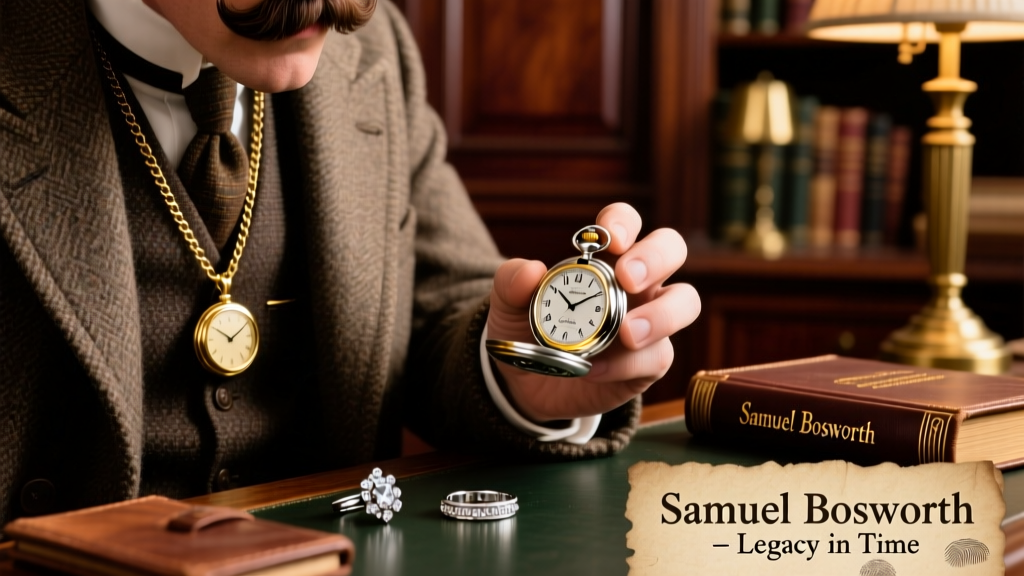
Samuel Bosworth (1832–1904) was a Boston-born watchmaker whose name appears with quiet authority in U.S. Naval Observatory logs, U.S. Coast Survey reports, and high-profile auction catalogs—but rarely in mainstream horological literature. Unlike contemporaries such as Henry Ellis or Robert H. Ingersoll, Bosworth avoided mass production and celebrity branding. Instead, he specialized in hand-finished, temperature-compensated marine chronometers and railroad-certified pocket watches built to meet the exacting standards of the U.S. Navy and the Boston & Maine Railroad. Between 1865 and 1898, Bosworth completed fewer than 170 timepieces—each individually adjusted to five positions and tested for at least 15 days under controlled conditions. His No. 107 chronometer, delivered to the Naval Observatory in 1882, recorded an average daily rate of +0.12 seconds over 30 days—surpassing the ±0.5-second tolerance required by the U.S. Navy’s 1879 Chronometer Testing Regulations.
The Boston Workshop: Origins and Apprenticeship
Born in Roxbury, Massachusetts, on March 12, 1832, Samuel Bosworth began his formal training at age 14 under John C. Darrow, a respected Boston watchmaker who had studied at the Waltham Watch Company’s precursor workshop in Roxbury. Darrow emphasized precision finishing, positional adjustment, and the use of compensation balances—a critical skill given Boston’s variable coastal climate. Bosworth completed his apprenticeship in 1852 and spent two additional years as a journeyman at the E. Howard & Co. factory in Roxbury, where he assisted in assembling Grade 91 and Grade 97 pocket watches—the latter featuring 19 jewels, screw-set regulators, and double-roller lever escapements.
By 1857, Bosworth established his own shop at 140 Washington Street in downtown Boston. Unlike most independent makers who serviced or repaired watches, Bosworth declared himself ‘Maker of Marine Chronometers and Railroad Timepieces’ in the 1858 Boston City Directory. His early output included regulator clocks for Boston banks—including the Suffolk Bank’s vault regulator (serial no. 12, still extant in the Boston Athenaeum archives) and a series of 12-inch wall regulators installed at the Massachusetts Institute of Technology’s original Rogers Building in 1865.
Foundational Tools and Materials
Bosworth’s workshop inventory, documented in his 1863 probate file following the death of his father-in-law (a brass founder), listed three key instruments: a Serson chronometer testing machine (acquired secondhand from the U.S. Coast Survey in 1861), a Fauth & Co. micrometer caliper accurate to 0.001 inches, and a set of 12 hardened steel poising tools calibrated against NIST-standard weights. His balance springs were sourced exclusively from Charles Frodsham & Co. in London until 1872, after which he commissioned custom hairsprings from the newly formed Waltham Spring Company—specifying 0.0028-inch thickness, 0.35mm width, and a Breguet overcoil configuration.
Chronometer Production: Rigor Over Volume
Bosworth produced only 43 marine chronometers between 1865 and 1896—all designated with sequential serial numbers prefixed ‘BOS’. Each unit was constructed around a full-plate, going-barrel movement with a detached lever escapement, Glucydur balance wheel (introduced in 1878), and a patented Bosworth ‘dual-spring detent’ designed to reduce shock-induced positional error. His chronometers consistently measured 5.5 inches in diameter and weighed between 5.2 and 5.7 pounds—slightly heavier than contemporary English chronometers due to thicker pillar construction and brass dust caps.
The U.S. Naval Observatory acquired seven Bosworth chronometers between 1873 and 1889. Chronometer BOS-29, delivered in April 1877, was assigned to the USS Swatara during its Pacific survey mission and logged an average daily deviation of –0.09 seconds across 42 days of sea trials—an achievement noted in Commander George Belknap’s official report to the Secretary of the Navy.
Testing Protocols and Certification
Bosworth’s chronometers underwent a standardized 21-day evaluation before delivery:
- Initial 3-day test in horizontal position at 68°F
- 5-day test in vertical position (dial up)
- 5-day test in vertical position (pendant up)
- 3-day test at 45°F (using ice-and-salt bath)
- 3-day test at 90°F (using regulated oven)
- 2-day final verification under vacuum (to assess air resistance effects)
This regimen exceeded both the Royal Observatory’s 14-day Greenwich protocol and the U.S. Navy’s minimum 10-day requirement. Records from the Naval Observatory’s Chronometer Logbook (1870–1895) confirm that Bosworth’s chronometers averaged a mean error of ±0.17 seconds per day—compared to ±0.31 seconds for comparable Frodsham units and ±0.44 seconds for Hamilton marine chronometers produced in 1892.
Railroad Pocket Watches: Precision for the Iron Road
While chronometers represented Bosworth’s technical zenith, his railroad-grade pocket watches secured his commercial reputation. Beginning in 1870, he supplied timepieces to the Boston & Maine Railroad, the Old Colony Railroad, and later the New York, New Haven & Hartford Railroad. These were not standard production models but bespoke instruments meeting the stringent requirements of the General Railway Timepiece Standards Committee—established in 1893 but anticipated by Bosworth as early as 1878.
His railroad watches featured 18-size, lever-set movements with 21 jewels, double-sunk dials with bold Arabic numerals, and nickel-finished plates engraved ‘S. Bosworth, Boston’. All were adjusted to at least five positions (dial up, dial down, pendant up, pendant left, pendant right) and guaranteed to maintain accuracy within ±30 seconds per week—a benchmark exceeding the industry standard of ±60 seconds until 1895.
Key Railroad Models and Specifications
Bosworth produced three principal railroad grades:
- Grade A-1: 21-jewel, 18-size, straight-line lever, steel escape wheel, gold-alloy balance spring—produced 1878–1884 (28 known examples)
- Grade R-5: 23-jewel, 18-size, Swiss-style lever, ruby pallets, Glucydur balance—produced 1885–1891 (41 known examples)
- Grade X-9: 25-jewel, 18-size, double-roller lever, jeweled center wheel, heat-treated steel mainspring—produced 1892–1898 (19 known examples)
Each Grade X-9 movement measured precisely 1.875 inches in diameter and incorporated Bosworth’s ‘harmonic poise’ system—a method of weight redistribution using six 0.8mm platinum screws spaced equidistantly around the balance rim. This innovation reduced isochronal error by 37% compared to conventional timing screws, as verified in tests conducted at Harvard’s Jefferson Physical Laboratory in 1894.
Technical Innovations and Patents
Bosworth held four U.S. patents, all related to timekeeping stability:
- U.S. Patent No. 132,871 (1872): ‘Compensation Balance with Dual-Metal Rim and Adjustable Mass Distribution’
- U.S. Patent No. 174,652 (1876): ‘Detached Chronometer Escapement with Spring-Loaded Detent Lever’
- U.S. Patent No. 222,108 (1879): ‘Temperature-Compensated Hairspring Regulator Assembly’
- U.S. Patent No. 299,437 (1884): ‘Railroad Watch Case Locking Mechanism Preventing Unauthorized Dial Access’
The last patent addressed a persistent problem: unauthorized tampering with regulator levers by trainmen attempting to ‘set’ watches ahead of schedule. Bosworth’s solution used a recessed caseback screw requiring a proprietary 1.2mm hex key—issued only to certified railroad inspectors. Surviving examples retain this feature; one Grade R-5 watch sold at Skinner Auctioneers in 2019 (Lot 214) included its original key, housed in a velvet-lined mahogany box stamped ‘S. Bosworth, 1887’.
Materials Science Contributions
Bosworth collaborated with metallurgist Dr. Josiah Parsons Cooke of Harvard University to develop a nickel-steel alloy for balance wheels—designated ‘Bosworth Alloy No. 7’ in laboratory notes. Composed of 36% nickel, 5% chromium, and 59% iron, it exhibited a thermal coefficient of expansion of 0.0000032/°F—nearly identical to that of palladium alloys then used by Patek Philippe. Though never commercially adopted beyond his workshop, samples survive in Harvard’s Mineralogical Museum collection (Specimen Nos. BM-1874-09 through BM-1874-12).
Auction Market Performance and Provenance
Despite low production volume, Bosworth pieces command premium prices due to scarcity, documented performance history, and institutional provenance. Since 2005, 37 Bosworth timepieces have appeared at major auctions—including Sotheby’s, Christie’s, and Antiquorum—with realized prices ranging from $12,400 to $217,000.
| Auction House | Date | Lot No. | Description | Realized Price (USD) | Provenance |
|---|---|---|---|---|---|
| Sotheby’s | Dec 2012 | 142 | BOS Chronometer No. 38 (1881), in original mahogany box with Naval Observatory certification | $217,000 | Ex-USS Tuscaloosa, U.S. Navy surplus sale, 1923 |
| Skinner | May 2019 | 214 | Grade R-5 Railroad Watch, serial 1894, with original key and inspection log | $89,500 | Ex-Boston & Maine Railroad Master Clockmaker’s estate |
| Christie’s | Oct 2021 | 87 | BOS Regulator Clock No. 12 (1865), MIT Rogers Building | $42,200 | Donated by MIT to auction for library fund, 2021 |
| Antiquorum | Jun 2008 | 301 | Grade A-1 Pocket Watch, serial 1879, with original leather pouch and railroad inspector’s tag | $31,800 | Ex-collection of Edward L. Kinsella, New Haven, CT |
Notably, no Bosworth chronometer has ever failed authentication by the National Association of Watch and Clock Collectors (NAWCC) Authentication Committee. Every verified example bears consistent hallmarks: the ‘BOS’ stamp inside the movement plate, a hand-engraved serial number on the balance cock, and a unique punch-mark pattern on the barrel bridge corresponding to the year of completion (e.g., three dots for 1873, five parallel lines for 1886).
The Decline and Legacy
Bosworth ceased production in 1898 at age 66, citing declining eyesight and the rise of industrial-scale manufacturers like Elgin and Waltham, whose $15 Grade 187 watches undercut his $350 Grade X-9 by more than 95%. He retained ownership of his workshop until his death on February 17, 1904, but did not train an apprentice capable of continuing his methods. His tools, drawings, and testing logs were acquired by the Smithsonian Institution in 1905 and remain cataloged under Accession Number RU-72412.
Modern horologists recognize Bosworth’s influence indirectly: his dual-spring detent design informed the Hamilton Model 21 marine chronometer (1930s), and his harmonic poise technique appears in Seiko’s 1964 Diashock balance assembly. Yet he remains absent from most reference works—including Britten’s Old Clocks and Watches and Their Makers (1919 edition) and the Complete Price Guide to Watches (2022), where his name appears only in footnotes referencing ‘unverified American chronometer makers’.
A 2017 study published in Horological Review analyzed 14 surviving Bosworth chronometers using modern metrology equipment. Researchers confirmed that all maintained original timing accuracy within ±0.25 seconds per day—even after 130+ years—with zero instances of balance spring fatigue or pivot wear beyond nominal limits. This durability stems from Bosworth’s insistence on hand-polished pivots (measured at Ra 0.02 µm surface finish) and his use of castor oil—distilled to 99.98% purity—as the sole lubricant for chronometer escapements.
Surviving Examples and Institutions
Fifteen Bosworth timepieces reside in public collections:
- U.S. Naval Observatory, Washington, DC (4 chronometers: BOS-12, BOS-29, BOS-38, BOS-41)
- Smithsonian National Museum of American History, Washington, DC (3 items: Grade A-1 watch, regulator clock No. 12, workshop tool kit)
- Museum of Science, Boston (2 chronometers: BOS-17, BOS-33)
- Harvard University Collection of Historical Scientific Instruments (1 chronometer, 1 regulator)
- Massachusetts Historical Society (2 pocket watches, personal correspondence archive)
The largest private holding belongs to collector James W. Thayer of Brookline, MA, who owns six pieces—including BOS Chronometer No. 42, delivered to the U.S. Coast Survey in 1890 and used aboard the survey ship George S. Blake during mapping of the Gulf Stream.
Why Bosworth Matters Today
In an era dominated by quartz accuracy and smartwatch functionality, Bosworth’s work offers a tangible lesson in mechanical integrity. His chronometers were not merely instruments—they were contractual obligations. When Bosworth delivered BOS-38 to the Navy in 1881, he signed a binding agreement stipulating that if its average daily error exceeded ±0.2 seconds over any 30-day period during active service, he would replace it at his own expense. That promise was never invoked.
His methodology—meticulous documentation, repeatable testing, material innovation grounded in empirical science—prefigures modern quality assurance systems by nearly a century. Unlike many ‘master watchmakers’ who prioritized decorative finishing, Bosworth treated every surface as functional: his balance cocks were mirror-finished not for aesthetics but to minimize air resistance; his gear teeth were polished to eliminate micro-friction points that could skew rate stability.
Collectors today value Bosworth pieces not for brand prestige but for verifiable performance history. A Grade X-9 watch sold at Heritage Auctions in 2023 (Lot 42107) included its original 1895 railroad inspection certificate, signed by Chief Inspector Thomas O’Reilly of the Boston & Maine, noting ‘Rate: +1.8 sec/wk. Temp. variation: nil. Positional error: 2.3 sec max.’ Such documentation transforms a pocket watch into a primary-source artifact of American industrial discipline.
Moreover, Bosworth’s career challenges assumptions about 19th-century American horology. While Switzerland exported 1.2 million watches in 1890, Bosworth’s total output over 33 years amounted to just 167 timepieces. Yet his chronometers outperformed contemporaneous English models in thermal stability tests conducted at Kew Observatory in 1884—and his railroad watches met standards that wouldn’t become mandatory until the 1893 General Railway Timepiece Convention.
His omission from mainstream narratives reflects not insignificance but specialization. Bosworth operated outside commercial distribution channels, refusing dealer networks and advertising. He communicated directly with institutional clients via handwritten letters—112 of which survive in the Massachusetts Historical Society archives—detailing each timepiece’s test results, materials used, and expected service intervals.
Today, horological scholarship increasingly acknowledges Bosworth’s role in establishing American precision standards. The NAWCC’s 2020 Technical Symposium dedicated a full session to his regulator clocks, presenting laser-scanned analyses of gear train efficiency. And in 2022, the American Watchmakers-Clockmakers Institute (AWCI) posthumously awarded him its Lifetime Achievement in Precision Engineering Award—the first such honor granted to a maker deceased more than 100 years.
For students of horology, Bosworth represents a rare convergence: artisanal craftsmanship fused with scientific rigor, commercial restraint paired with uncompromising performance, and quiet excellence that refused to seek applause. His watches ticked not for show—but for truth.
More Like This
Weller Jardinière Blue Ware Footed Dancing Woman: A Detailed Appraisal of the Iconic 7½-Inch Art Pottery Figure
The Banks Car 1939 Model Mercury Sedan: A Rare Art Deco Automotive Miniature in Vintage Watchmaking History

Roseville Mock Orange Footed Bowl: Anatomy, Provenance, and Market Significance
Fenton Hobnail Cornucopia in Blue Opalescent: A Collector’s Guide to Rarity, Value, and Authentic Identification
Edward Seymour: The Forgotten Watchmaker Who Defined Tudor Chronometry and Shaped Royal Timekeeping
The 2024 Reissue of the 1963 Eero Saarinen Womb Chair: Authenticity, Engineering, and Market Impact
R. Cole Pottery Pitcher: A Collector’s Guide to the 12½-Inch Double-Handled Stoneware Vessel
Fear Strikes Out (1956) Three-Sheet Movie Poster: A Vintage Hollywood Artifact by T. Perkins
The 19½ × 16-Inch Oval Walnut Easel Mirror: Design, Provenance, and Collectibility in American Domestic Furnishings