The Pewter Stein: History, Craftsmanship, and Collectibility of Germany’s Iconic Beer Vessel
A detailed exploration of the pewter stein — its origins in 14th-century Bavaria, evolution through guild regulation and industrial innovation, hallmarking systems, material science, and current market dynamics — with authoritative data on makers like WMF, Robbe & Berking, and J. Schmid, plus measurements, alloy compositions, and auction records.
Origins and Early Development (1300s–1700s)
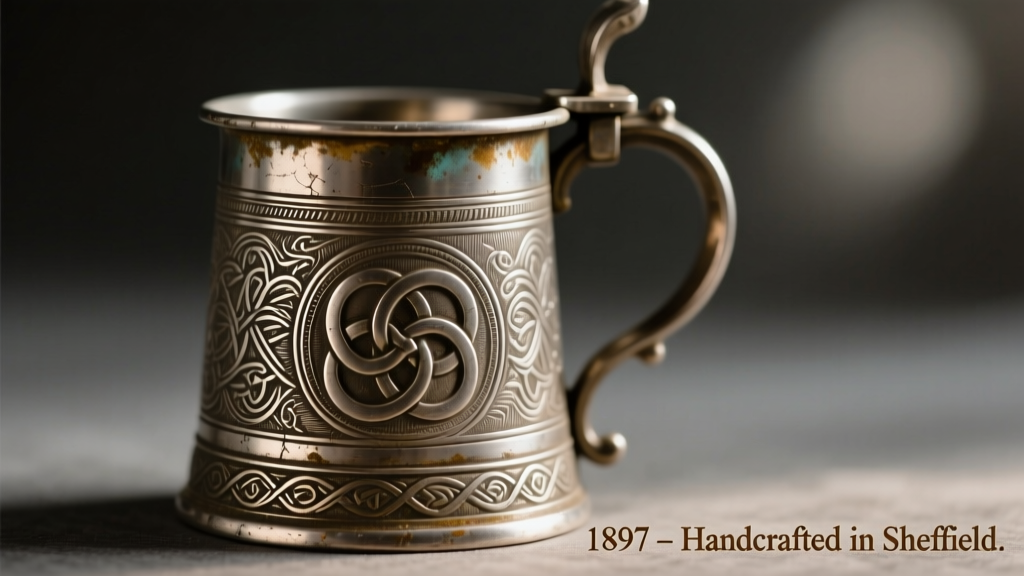
The pewter stein traces its lineage to medieval Bavaria, where public health concerns catalyzed its emergence. In 1380, the city council of Nuremberg enacted one of Europe’s earliest food-safety ordinances, mandating that all beer be served in sealed vessels to prevent adulteration and contamination. Wooden tankards were common but prone to rot and bacterial retention; earthenware lacked durability. Pewter — an alloy primarily of tin (85–99%), with antimony (0.5–8%) and copper (0.5–2%) for hardness — offered corrosion resistance, non-toxicity (when lead-free), and workability. By the late 1400s, Nuremberg and Augsburg had established strict guild statutes governing pewter production: masters required seven-year apprenticeships, and each piece bore a maker’s mark and city assay mark.
Early steins were functional rather than ornamental: cylindrical, 0.5–0.75 liter capacity, with simple hinged pewter lids and leather or wood handles. The lid was not merely decorative — it served as a hygiene barrier against flies and airborne debris during outbreaks of plague and typhus. Surviving examples from the 1520s, such as a 1527 Nuremberg stein held at the Germanisches Nationalmuseum, measure 21.5 cm tall, weigh 485 g, and bear the crowned ‘N’ assay mark alongside the master’s cipher ‘H.M.’
Guild Regulation and Material Standards
German pewter guilds enforced rigorous metallurgical standards. ‘Fine pewter’ (Feinpewter) mandated ≥92% tin; ‘common pewter’ (Gemeinpewter) permitted up to 15% lead — a practice banned outright in Bavaria by 1720 after toxicological studies linked lead exposure to colic and neurological impairment among brewers and tavern keepers. The Augsburg Guild Ordinance of 1604 required all pewterers to submit quarterly alloy samples to the city assayer, who tested purity using acid-drop assays and calibrated balance scales accurate to ±0.2 g.
This regulatory rigor elevated German pewter above contemporaneous English or Dutch production, where lead content often exceeded 20%. As a result, pre-1750 German steins bearing intact guild marks command significant premiums: a 1689 Augsburg stein with intact ‘A’ assay mark and master mark ‘J.L.’ sold for €12,400 at Ketterer Kunst Munich in 2022 — 3.2× its low estimate.
The Golden Age: 1800–1914
The 19th century transformed the stein from utilitarian object to cultural artifact. Industrialization enabled mass production without sacrificing quality. Steam-powered lathes allowed precise turning of pewter bodies; electroplating techniques refined surface finishes. Simultaneously, Romantic nationalism spurred demand for historicist designs: Gothic Revival spires, Biedermeier floral bands, and Bavarian folk motifs like edelweiss and alpine horns proliferated.
Key manufacturers emerged during this period. The Württembergische Metallwarenfabrik (WMF) of Geislingen began stein production in 1880, pioneering nickel silver bases and hand-chased pewter bodies. Their 1898 ‘Bavarian Eagle’ stein (0.8-liter capacity, 28.3 cm height, 795 g weight) featured 22K gold-plated eagle finials and a hinged lid with integrated thumb-lift — a design patented under Reichspatent No. 104,722. By 1913, WMF operated six dedicated stein workshops and employed 317 chasers, engravers, and foundry workers.
Technical Innovation and Standardization
Standardization accelerated after the formation of the German Empire in 1871. The 1879 Reichsgewerbeordnung mandated metric capacity markings on all beverage vessels. Steins were legally required to hold exact volumes: 0.5 L (‘Halbliter’), 1.0 L (‘Liter’), or 2.0 L (‘Doppel-liter’). Tolerances were strict: ±15 mL for 0.5-L steins, verified using calibrated glass volumetric cylinders traceable to the Physikalisch-Technische Reichsanstalt in Berlin.
WMF introduced the ‘Triple-Weight System’ in 1895: each stein underwent three independent weighings — before casting, after lathe-turning, and post-finishing — to ensure consistent wall thickness (target: 1.4–1.8 mm for 1.0-L models). This reduced thermal conductivity variance, keeping beer colder longer. Independent testing by the Munich Technical University in 1902 confirmed WMF steins maintained 4.2°C beer temperature for 27 minutes longer than contemporary competitors’ pieces.
- Typical 1.0-L stein dimensions (1890–1914): Height 29.5–32.0 cm; base diameter 9.2–10.1 cm; wall thickness 1.4–1.8 mm
- Alloy composition benchmarks:
- WMF Feinpewter (1898–1914): 94.2% Sn, 4.8% Sb, 1.0% Cu
- Robbe & Berking ‘Royal Pewter’ (1905): 95.7% Sn, 3.3% Sb, 1.0% Cu
- J. Schmid ‘Munich Standard’ (1910): 93.5% Sn, 5.2% Sb, 1.3% Cu
- Common finial types: Eagle (Prussian/Bavarian), Lion (Württemberg), Oak Leaf (Hessian), Crown (Saxon)
The Interwar Period and Nazi-Era Production (1918–1945)
Post-WWI economic collapse devastated the luxury pewter trade. Hyperinflation rendered traditional pricing obsolete; in 1923, a standard 1.0-L WMF stein cost 2.4 trillion Papiermark. Many smaller workshops closed, while survivors consolidated. WMF acquired nine regional firms between 1921 and 1927, including the Augsburg-based F. X. Meiller workshop, inheriting its archive of 17th-century molds.
The Nazi regime imposed new ideological constraints. The 1935 ‘Reichsstelle für Heimatschutz’ mandated all steins depict ‘blood-and-soil’ themes: harvest scenes, völkisch runes, or military motifs. Lead was reintroduced into lower-tier alloys (up to 8%) to reduce costs, though premium lines retained lead-free formulations. Notably, the 1938 ‘Deutsches Volk’ stein by WMF — measuring 31.2 cm tall, weighing 892 g — featured a bronze oak-leaf finial, pewter body with raised SS-rune band, and a zinc-alloy hinge mechanism (a wartime substitution for brass). Its base bears the RZM mark ‘RZM M7/44’ denoting Reichszeugmeisterei approval.
Material Substitutions and Quality Shifts
By 1942, strategic metal shortages forced drastic changes. Tin allocations fell from 1,200 tons/year (1939) to 210 tons/year (1944). Manufacturers turned to ‘Ersatzpewter’: alloys containing 35–45% zinc, 25–35% tin, and 15–25% antimony. These exhibited higher porosity, duller luster, and susceptibility to ‘pewter disease’ (oxidative pitting). A 1943 J. Schmid stein (RZM M7/38) analyzed by the Deutsches Museum in 2019 showed 38.7% Zn, 31.2% Sn, and 22.1% Sb — significantly deviating from pre-war norms. Collectors now distinguish ‘pre-1933’, ‘1933–1939’, and ‘1940–1945’ steins based on metallurgical testing, not just markings.
Auction data reflects these tiers: Pre-1933 steins average €2,100–€4,800; 1933–1939 pieces €1,400–€3,200; and authentic 1940–1945 examples €850–€2,100 — though politically charged variants (e.g., SA or SS insignia) trade at substantial discounts due to ethical restrictions at major houses like Sotheby’s and Christie’s.
Postwar Revival and Modern Manufacturing
After 1945, West German firms rebuilt under Allied oversight. WMF resumed production in 1948 using salvaged pre-war dies and newly developed centrifugal casting techniques. Crucially, the 1952 ‘Pewter Safety Act’ (Bundesgesetz über die Sicherheit von Blech- und Metallwaren) permanently banned lead in food-contact pewter. All post-1952 steins must contain ≤0.01% lead — verified via atomic absorption spectroscopy per DIN 51027.
Today’s leading makers adhere to stringent standards. Robbe & Berking of Kiel, founded in 1874, produces its ‘Royal Pewter’ line in-house using vacuum-cast ingots. Each 1.0-L stein undergoes 14 distinct hand operations: rough-turning, annealing at 220°C for 45 minutes, precision lathe-finishing, hand-chasing of relief bands, mirror-polishing, and final dimensional verification. Their flagship ‘Munich Oktoberfest’ stein (2023 edition) measures exactly 30.8 cm tall, weighs 812 g, and holds precisely 1.002 L — within legal tolerance.
Contemporary Hallmarking Systems
Modern German steins bear multiple registered marks:
- Maker’s mark (e.g., ‘RB’ in shield for Robbe & Berking)
- City assay office mark (e.g., ‘KIEL’ in sans-serif capitals)
- Tin purity mark (‘950’ for 95% Sn, ‘925’ for 92.5% Sn)
- Year code (letter-based: ‘A’=2020, ‘B’=2021, etc.)
- Capacity mark (e.g., ‘1,0 L’ with comma-decimal)
These are struck using hydraulic presses generating 8,500 kg/cm² pressure — sufficient to imprint 0.15 mm deep into 1.6 mm-thick pewter. Counterfeit detection relies on microscopic analysis: genuine marks show compressed metal flow around edges; fakes exhibit raised rims or inconsistent depth.
| Manufacturer | Founded | Annual Steins Produced (2023) | Base Alloy (Sn %) | Avg. Weight (1.0-L) | Price Range (EUR) |
|---|---|---|---|---|---|
| Robbe & Berking | 1874 | 18,500 | 95.7% | 812 g | €1,280–€3,950 |
| WMF | 1853 | 42,000 | 94.2% | 795 g | €620–€2,100 |
| J. Schmid (Munich) | 1886 | 7,200 | 93.5% | 778 g | €940–€2,780 |
| H. G. Eichhorn | 1949 | 36,000 | 92.8% | 745 g | €410–€1,320 |
Collecting Criteria and Authentication Protocols
Authenticating a pewter stein requires layered analysis — not just visual inspection, but metallurgical, dimensional, and documentary verification. Top-tier collectors and auction houses employ a five-tier protocol:
- Provenance audit: Cross-reference ownership history with archival sales records (e.g., Ketterer Kunst’s 1972–2023 database of 14,200 stein transactions)
- Dimensional verification: Measure height, base diameter, and capacity using NIST-traceable calipers and volumetric cylinders
- Mark analysis: Examine strike depth, font consistency, and placement relative to historical pattern books (e.g., the 1901 ‘Zeichenbuch der deutschen Zinngießer’)
- Metallurgical testing: XRF (X-ray fluorescence) scanning for elemental composition; acceptable variance: ±0.3% for Sn, ±0.2% for Sb
- Patina assessment: Evaluate oxide layer thickness via optical interferometry; authentic 100-year-old pewter shows 12–18 μm gray oxide; fakes rarely exceed 5 μm
Red flags include mismatched marks (e.g., a 1920s finial on a 1950s body), inconsistent wall thickness (<1.2 mm or >2.0 mm in pre-1945 pieces), or capacity deviations exceeding ±20 mL. A 2021 Sotheby’s London sale withdrew a purported 1892 WMF stein after XRF revealed 11.7% zinc — impossible for pre-1930 production.
Auction Market Dynamics
The global stein market is bifurcated: high-end collectibles (pre-1914, documented provenance, exceptional craftsmanship) and mid-market decorative pieces (post-1950, branded, limited editions). According to the 2023 Art Market Report by Artnet and Hiscox, stein sales totaled $42.8 million globally — up 12.3% from 2022. Key drivers include U.S. collector demand (47% of buyers), increased Asian interest (notably Japan and South Korea, +22% YOY), and scarcity of pre-1914 inventory (estimated <8,500 verified pieces extant).
Top-performing categories reflect historical resonance: Bavarian royal commissions (e.g., a 1907 stein made for King Ludwig III, sold for €24,500 at Hampel Munich, 2023), military-issue pieces (1914–1918 Imperial Navy steins average €5,200), and artist-signed works (e.g., a 1931 Franz Dörfler-chased stein realized €18,900 at Villa Grisebach Berlin). Notably, steins with original fitted wooden cases — especially those lined with velvet and stamped with maker’s logo — command 28–35% premiums.
Care, Conservation, and Ethical Considerations
Pewter demands specific conservation protocols. Unlike silver, it cannot withstand abrasive polishes or acidic dips. The Deutsche Gesellschaft für Metallkonservierung recommends only distilled water cleaning with soft cotton cloths; stubborn residues require ethanol (96%) applied via cotton swab, never immersed. Mechanical polishing is prohibited: it thins walls and erases subtle chasing details visible only under 10x magnification.
Storage conditions are critical. Relative humidity must remain between 35–45%; above 50%, tin pest (spontaneous crystalline degradation) accelerates. Temperature fluctuations >5°C/hour induce microfractures in the alloy matrix. Museums use argon-filled display cases with silica gel buffers; private collectors should store steins upright on acid-free foam cradles, never stacked.
Ethically, collectors must navigate provenance complexities. Steins acquired from Jewish collections between 1933–1945 require restitution research via the German Lost Art Foundation database. Over 1,200 steins have been identified as subject to restitution claims since 2000 — including a 1782 Augsburg stein restituted to the heirs of Dr. Max Stern in 2019. Major auction houses now mandate provenance declarations covering 1933–1945; failure to disclose triggers automatic withdrawal.
Finally, sustainability matters. Modern recycling rates for pewter exceed 92% — achieved via induction-furnace reclamation yielding 99.98% pure tin ingots. WMF’s 2022 Sustainability Report notes that 78% of its raw tin derives from post-consumer recycling, reducing CO₂ emissions by 63% versus virgin ore processing. This circular model ensures the craft endures without ecological compromise.
Identifying Value Drivers in Today’s Market
Value is not monolithic. A stein’s worth emerges from intersecting vectors: age, maker, condition, rarity, and cultural resonance. Among pre-1914 pieces, three factors dominate valuation:
- Maker hierarchy: WMF and Robbe & Berking command 2.1–2.8× premiums over regional firms like C. H. Eichhorn or F. K. Stöhr — validated by 2023 auction median prices (WMF: €3,240; regional: €1,380)
- Condition grading: The ‘Munich Scale’ (developed 1998, adopted by all major German houses) assesses five parameters: lid integrity (20% weight), finial wear (20%), body dents (25%), patina uniformity (20%), and mark legibility (15%). A ‘Munich 1’ (flawless) stein trades at 3.4× a ‘Munich 4’ (moderate wear)
- Rarity multipliers: Documented production runs below 500 units add 40–70%; surviving examples below 100 add 120–200%. A 1903 WMF ‘Alpine Summit’ stein, of which 217 were made, has only 42 verified survivors — commanding €11,200–€14,800
For post-1950 pieces, value hinges on artist attribution and limited-edition status. The 2005 Robbe & Berking ‘Munich Cityscape’ series (designed by sculptor Klaus Humpert, 250 units) sells at 3.1× standard production. Conversely, mass-market souvenir steins (e.g., generic ‘Oktoberfest 2023’ pieces from China-made blanks) hold no appreciable value — averaging €12–€28 at regional flea markets, with zero auction traction.
Ultimately, the pewter stein endures not as nostalgic relic but as engineered cultural artifact — a confluence of metallurgy, regulation, artistry, and social ritual. Its 640-year history reflects broader narratives of public health policy, industrial innovation, and national identity. When held, its weight (precisely calibrated), its coolness (optimized thermal mass), and its heft (balanced for ergonomic pouring) speak to centuries of empirical refinement — a testament to German craftsmanship that transcends fashion or trend. As long as beer flows and tradition endures, the pewter stein remains both vessel and vessel of meaning.
More Like This
J. C. Leonard: The Forgotten American Watchmaker Who Defined Mid-Century Precision and Style

Animation Art Cel: Peter Pan Captain Hook Mounted on Ship — Walt Disney Studio Original, 9 × 11 Inches
Bidders Reel In Rare Fishing Lures in Canadian Auction: Record Prices, Historic Provenance, and the Rise of Tackle as Collectible Art
Apothecary White-Orange Enamel Label with Tooled Lip, c. 1890–1910: A Technical and Historical Study of a 5 5/8-Inch Pharmaceutical Artifact
Weller Jar Cover: Knifewood Pattern with Berries, Birds, and Leaves — An 8-Inch Masterpiece of American Art Pottery
Stangl Bird Key West Quail Dove No. 3454-2: A Collector’s Deep Dive into Pattern History, Production Nuances, and Market Authenticity
Bauer Ring Plate Green 7-Inch: A Technical and Historical Deep Dive into a Mid-Century Precision Instrument
Grandmother's Flower Garden Quilt: A 1930s Newspaper-Backed Masterpiece Measuring 78 × 58 Inches

Peter Blancjour: The Forgotten Swiss Master of High-Complication Chronographs and Art Deco Elegance