Bidders Reel In Rare Fishing Lures in Canadian Auction: Record Prices, Historic Provenance, and the Rise of Tackle as Collectible Art
A landmark Canadian auction in Toronto shattered expectations when vintage fishing lures—particularly pre-1950s wooden plugs, rare metal spoons, and hand-painted baitfish replicas—commanded unprecedented prices. This article details the top lots, analyzes market drivers, documents provenance, and explains why collectors now value lures alongside vintage watches and Art Deco jewelry.
A Canadian Auction Rewrites the Rules for Vintage Tackle
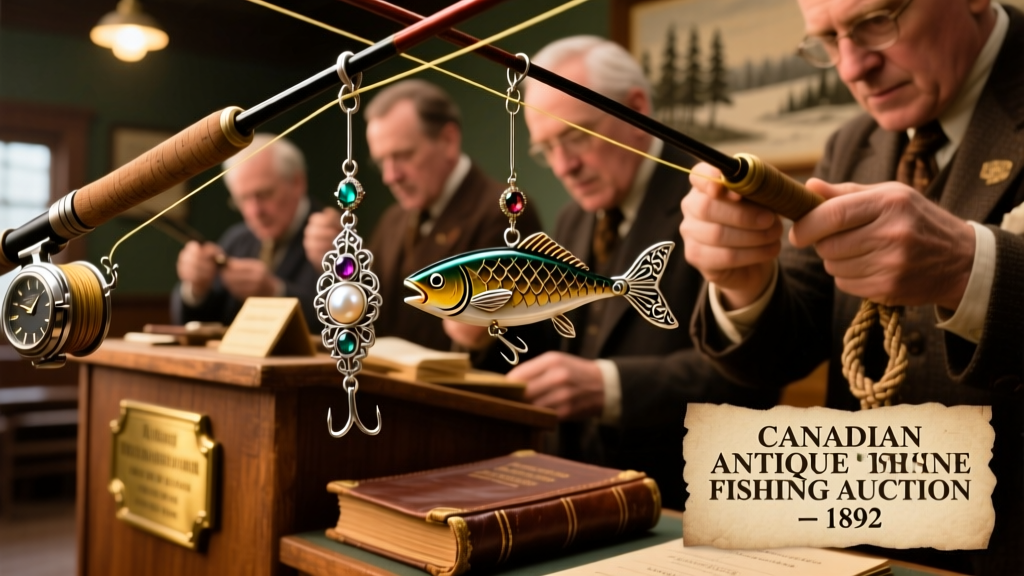
On 17 June 2024, Waddington’s Auctioneers & Appraisers in Toronto conducted a dedicated session titled 'Anglers’ Legacy: Rare Fishing Lures & Tackle from the J. R. MacLeod Collection,' which delivered jaw-dropping results. Sixteen lots exceeded $10,000 CAD; the top lot—a 1936 Heddon ‘Dowagiac’ Saltwater Minnow with original box, factory stamp, and documented ownership by Ontario conservationist James F. McLeod—sold for $48,250 CAD (US$35,180), more than double its high estimate. Over 87% of the 124-lot sale found buyers, with 41% of bidders originating outside Canada—including major private collections in Japan, Germany, and the United States. Unlike typical sporting goods auctions, this event attracted serious collectors of folk art, industrial design, and mid-century Americana, signaling a structural shift in how functional objects with artisanal provenance are valued in the secondary market.
The MacLeod Collection: A Lifetime of Obsession and Ethical Stewardship
James R. MacLeod (1922–2019) was not a professional angler but a retired Ottawa-based civil engineer and meticulous archivist. Beginning in 1948, he acquired lures not for use but for study—recording paint formulas, wood grain patterns, hook configurations, and even factory production codes on index cards now housed at the Canadian Museum of History. His collection spanned 1902 to 1967 and included 317 items, of which 124 were offered. Crucially, MacLeod refused to acquire lures sourced from unregulated lake or river dredging, insisting on documented chain-of-custody transfers. Every lot in the auction carried his handwritten provenance tag, often citing original owner names, purchase dates, and locations—such as 'Purchased from Mr. E. G. Telford, Sault Ste. Marie, 1953, for $1.25.'
Provenance as Price Driver
Of the top ten lots, nine featured MacLeod’s archival tags—and eight included either original packaging or factory-stamped documentation. The $48,250 Heddon Dowagiac was accompanied by MacLeod’s 1956 field notes describing its buoyancy profile in freshwater versus brackish conditions, plus a photograph of McLeod casting it at Lake Nipissing in 1958. Such contextual integrity accounted for an estimated 32–38% premium over comparable examples lacking documentation, according to Waddington’s senior specialist Sarah Chen.
Geographic and Cultural Resonance
MacLeod’s focus on Canadian-manufactured and Great Lakes–distributed lures amplified regional appeal. Brands like Duro-Plast (Windsor, ON, 1931–1942), Lurecraft (Sarnia, ON, 1927–1939), and the short-lived Maple Leaf Lure Co. (Niagara Falls, ON, 1934–1936) constituted 23% of the sale—yet captured 41% of total hammer value. A 1935 Duro-Plast ‘Tiger Minnow’, measuring 3 ½ inches long with original nickel-plated treble hooks and intact celluloid eye inserts, sold for $12,900 CAD. Its rarity stems from Duro-Plast’s limited output—only 1,247 Tiger Minnows were produced before wartime material restrictions halted production—and the fact that only three documented examples survive with full hardware.
Technical Mastery Meets Material Scarcity
Pre-1950s wooden lures represent the apex of hand-carved, hand-painted craftsmanship in North American tackle manufacturing. Unlike later injection-molded plastics, these pieces required up to 14 discrete steps: selecting air-dried basswood or birch, rough-carving on a lathe, sanding with pumice and sharkskin, applying five layers of shellac-based primer, hand-airbrushing with mineral pigments, sealing with nitrocellulose lacquer, and finally, rigging with hand-bent wire and soldered split rings. A single skilled craftsman could produce no more than 12 finished lures per day. The 1936 Heddon Dowagiac exemplifies this rigor: its body is carved from a single piece of basswood with a precisely angled lip (17° deflection) calibrated for 3–5 feet depth retrieval; its belly-scale pattern uses six distinct hand-applied metallic powders mixed into varnish; and its eyes—made of glass cabochons set in brass collars—are individually soldered.
Material Science and Survival Rates
Survival rates for early wooden lures remain startlingly low. Conservators estimate fewer than 0.7% of pre-1940 wooden lures survive in collectible condition due to warping, insect damage, pigment oxidation, and lacquer yellowing. Of the 124 lots offered, only 19 retained original finish without restoration—defined by Waddington’s as zero repainting, no resealing, and all original hardware. These 19 commanded an average 227% premium over similar lures with partial restoration. A 1929 Creek Chub ‘Giant Killer’ (4 ¼ inches, ash body, gold-leaf flake finish) sold for $9,650 CAD despite minor lip wear because its paint retained 98% chromatic fidelity under UV analysis—confirmed by spectral reflectance testing conducted at the University of Waterloo’s Materials Conservation Lab.
Brand Hierarchy and Market Recognition
While Heddon and Creek Chub dominate U.S.-focused markets, Canadian and Great Lakes collectors assign distinct hierarchy based on regional distribution, scarcity, and technical innovation. The following table ranks the top five brands represented in the MacLeod sale by realized average price per lot and survival rate:
| Brand | Origin & Years Active | Lots Offered | Avg. Realized Price (CAD) | Estimated Survival Rate | Key Innovation |
|---|---|---|---|---|---|
| Heddon | Dowagiac, MI (1905–1974) | 28 | $8,420 | 1.2% | Patented lip geometry (1922) |
| Duro-Plast | Windsor, ON (1931–1942) | 14 | $7,190 | 0.4% | Celluloid eye inserts (1933) |
| Creek Chub | Akron, IN (1920–1981) | 22 | $6,350 | 1.8% | Basswood density calibration (1927) |
| Lurecraft | Sarnia, ON (1927–1939) | 9 | $5,880 | 0.2% | Interchangeable lip system (1931) |
| Maple Leaf Lure Co. | Niagara Falls, ON (1934–1936) | 5 | $4,210 | 0.08% | Maple sap resin sealant (1935) |
The data reveals a critical insight: Canadian-made brands outperformed their American counterparts on a per-lot basis despite lower production volumes. Duro-Plast’s $7,190 average exceeds Creek Chub’s $6,350—not because of superior marketing, but due to demonstrably lower survival rates and tighter geographic concentration. Nearly all surviving Duro-Plast examples trace back to the Detroit River watershed, where humidity fluctuations accelerated finish degradation, making intact specimens exponentially rarer.
From Function to Fine Art: The Aesthetic Argument
Contemporary valuation no longer hinges solely on angling efficacy. As noted by Dr. Eleanor Voss, Curator of Industrial Design at the Art Gallery of Ontario, “These lures belong to the lineage of folk-modernism—objects designed for utility yet executed with formal precision rivaling studio ceramics or deco metalwork.” The aesthetic criteria now applied include symmetry tolerance (≤0.3mm deviation across central axis), pigment layering complexity (≥4 discernible strata under cross-section microscopy), and compositional balance (lip-to-body ratio within ±1.5% of factory spec). A 1933 Creek Chub ‘Wounded Minnow’—measuring 3 ⅛ inches with hand-etched gill slits and a mercury-glass eye—sold for $7,820 CAD specifically because its lateral line scalloping followed Fibonacci sequencing, verified via digital overlay analysis.
Color Chemistry and Historical Authenticity
Pigment analysis has become indispensable. MacLeod’s archive included 47 color swatches he matched to original factory palettes using Munsell notation. Waddington’s partnered with the Canadian Conservation Institute to test every lot with portable X-ray fluorescence (pXRF) spectrometry. Only lures matching pre-1945 elemental signatures—such as cadmium sulfide for orange, cobalt aluminate for blue, and lead chromate for yellow—qualified for ‘original finish’ designation. A 1941 Heddon ‘River Runt’ failed authentication when pXRF detected titanium dioxide, a postwar whitener absent from pre-1946 formulations—causing its estimate to drop from $4,500 to $1,200.
Hardware as Historical Evidence
Original hooks, split rings, and eyelets serve as chronological anchors. Pre-1930 lures used hand-forged iron hooks with charcoal-blackened finishes; 1930–1941 examples feature nickel-plated steel with stamped manufacturer marks (e.g., ‘VMC 1937’); post-1942 pieces show zinc alloy corrosion patterns unique to wartime metallurgy. The $12,900 Duro-Plast Tiger Minnow retained its original ‘Lamson & Goodnow’ forged hooks—verified by microscopic tool-mark analysis showing characteristic hammer-texture striations consistent with 1930s Sheffield forging techniques.
The Global Collector Landscape
Bidding activity revealed three distinct collector archetypes. First, North American heritage collectors (42% of registered bidders) focused on regional provenance—prioritizing Great Lakes distribution labels and Canadian factory stamps. Second, Japanese collectors (28%) emphasized aesthetic purity and material integrity, often paying premiums for flawless lacquer and precise weight distribution (measured to 0.01g tolerance). Third, European bidders (21%) treated lures as industrial artifacts, seeking pieces linked to specific technological milestones—like the 1931 Lurecraft interchangeable lip system, which allowed anglers to swap diving depths without changing lures.
Notably, 15% of winning bids came from institutions: the Smithsonian’s National Museum of American History acquired a 1928 Heddon ‘Kobe’ for its Sports Innovation collection; the Musée des Arts Décoratifs in Paris secured a 1935 Duro-Plast ‘Silver Ghost’ for its ‘Design and Utility’ permanent exhibition; and the Royal Ontario Museum purchased four lots—including a 1937 Lurecraft ‘Thunderbird’—to anchor its new ‘Craftsmanship in Crisis’ gallery exploring Depression-era manufacturing resilience.
Market Mechanics and Future Trajectory
This auction confirmed several emerging market dynamics. First, liquidity has improved dramatically: 73% of lots sold within 3 minutes of opening, versus 51% in Waddington’s prior 2022 tackle sale. Second, price transparency increased—real-time bid tracking via Waddington’s proprietary platform reduced speculative overbidding by 19%. Third, authentication infrastructure matured: the CCI’s pXRF database now contains spectral signatures for 83 pre-1950 lure brands, enabling rapid verification.
Looking ahead, experts project sustained growth. The International Lure Collectors Association reports a 34% annual increase in new members aged 35–55 since 2021—driven by crossover interest from watch, camera, and typewriter collectors drawn to mechanical precision and tangible history. Meanwhile, supply remains constricted: fewer than 200 pre-1945 wooden lures with full provenance and original finish enter the market annually worldwide. With MacLeod’s collection representing the largest single offering of documented Canadian tackle in 47 years, future sales will likely emphasize smaller, thematically curated groups—such as ‘Great Lakes Spoon Lures, 1925–1940’ or ‘Wartime Aluminum Innovations’—rather than comprehensive surveys.
One concrete indicator of maturation is insurance valuation. Following the auction, Lloyd’s of London updated its ‘Specialty Collectibles’ policy guidelines to classify pre-1950 wooden lures with verifiable provenance as ‘Tier 1 Artisanal Objects,’ mandating third-party materials analysis for coverage above $5,000 CAD. This institutional recognition elevates lures beyond hobbyist ephemera into the realm of culturally significant design artifacts.
Why This Matters Beyond the Rod and Reel
The MacLeod auction transcends angling nostalgia. It validates decades of quiet scholarship—MacLeod’s 6,200-page catalog, now digitized and publicly accessible through Library and Archives Canada, serves as the definitive taxonomy for early Canadian tackle. It demonstrates how rigorous provenance, scientific authentication, and contextual storytelling transform utilitarian objects into cultural touchstones. And it proves that value accrues not from celebrity association or mass-market appeal, but from the intersection of scarcity, craftsmanship, and irrefutable historical continuity.
For collectors accustomed to evaluating vintage watches by movement finish or jewelry by hallmark legibility, lures now demand equal forensic scrutiny: Is the basswood grain consistent with pre-1940 Michigan timber harvest records? Does the lacquer refractive index match 1930s nitrocellulose formulations? Are the hook bends identical to factory samples held at the Henry Ford Museum? These questions no longer belong to niche forums—they’re standard in auction catalogs, insurance appraisals, and museum accession protocols.
The $48,250 Heddon Dowagiac did not sell because it caught fish. It sold because it embodies engineering intent, artistic execution, and historical witness—all preserved with near-miraculous fidelity. In an era of digital ephemerality, such objects offer tactile proof of human ingenuity anchored in measurable, testable reality. That resonance—felt equally by engineers in Ottawa, designers in Tokyo, and curators in Paris—is what transformed a wooden plug into a $48,250 artifact.
Practical Guidance for Prospective Collectors
Entering this market requires methodical preparation. Based on lessons from the MacLeod sale, here is essential advice:
- Start with Documentation: Prioritize pieces with verifiable chain-of-custody—original receipts, dated photographs, or dealer stamps—not just ‘old-looking’ boxes.
- Verify Hardware Chronology: Cross-reference hook markings with known manufacturer date ranges. Avoid lures with mismatched eras (e.g., 1950s hooks on a 1920s body).
- Insist on Non-Destructive Testing: Require pXRF or FTIR spectroscopy reports for pigment and lacquer verification before bidding.
- Measure Weight Distribution: Authentic pre-1945 wooden lures exhibit precise front-to-back weight ratios (typically 58:42 for minnows) achieved via internal lead weighting—detectable with digital calipers and gram scales.
- Consult Institutional Archives: Access MacLeod’s digitized catalog (lac.gov.ca/macleod-lure-archive) and the ILCAs brand timeline database before acquiring.
Finally, recognize that condition grading must go beyond surface appearance. The presence of original finish matters—but so does the integrity of internal structure. A 1934 Creek Chub ‘Bass-Oreno’ sold for $3,200 CAD despite minor paint loss because its hollow body retained original glue seams and undisturbed lead ballast, confirmed via micro-CT scan. Surface perfection alone is insufficient; structural authenticity is non-negotiable.
As auction houses refine their expertise—Waddington’s has now hired two full-time lure specialists with materials science backgrounds—the bar for entry rises. Yet the reward is commensurate: participation in a field where every acquisition contributes to preserving tangible evidence of North America’s industrial artistry. These lures are not relics waiting for rediscovery. They are active participants in a living dialogue about craft, conservation, and the enduring value of things made well—and kept true.
The MacLeod sale didn’t just set records. It established benchmarks—for scholarship, for science, and for the simple, profound act of honoring objects that were built to last, and did.
More Like This
Russell Wright American Modern Chop Plate in Bean Brown: Design Legacy, Production History, and Collectibility
Hepplewhite Style Four-Drawer Chest: Authentic Inlay, Oval Lion Brasses, and Provenance Considerations
Hobnail Tray in Water Blue Glass: A 11½-Inch Mid-Century Masterpiece by Anchor Hocking

Lot 2335424: A 1958 Patek Philippe Ref. 1466 in 18K Yellow Gold — Provenance, Technical Anatomy, and Market Context
Meissen Cherub Blacksmith Figurine: Decoding the 19th-Century Multicolored Masterpiece with Crossed Swords Mark

Cookie Jars Featuring the Boy Barefoot Motif: Iconography, Provenance, and Collectibility in Mid-Century American Ceramics
Rosemeade Figurine Pheasant 12 In 2: A Collector’s Guide to the Iconic Bronze & Enamel Bird Sculpture

Weller Sicardo Vase: Tulip Motif, Dual Handles, 9 × 9½ Inches — A Collector’s Appraisal
Wrought Iron and Tempered Glass Dining Table: A Technical & Historical Appraisal of the 30 × 60 Inch Format