J. C. Leonard: The Forgotten American Watchmaker Who Defined Mid-Century Precision and Style
A deep-dive appraisal of J. C. Leonard — the New York-based watch manufacturer active from 1928 to 1972 — examining its proprietary movements, signature case designs, military contracts, and enduring collectibility among vintage horology specialists.
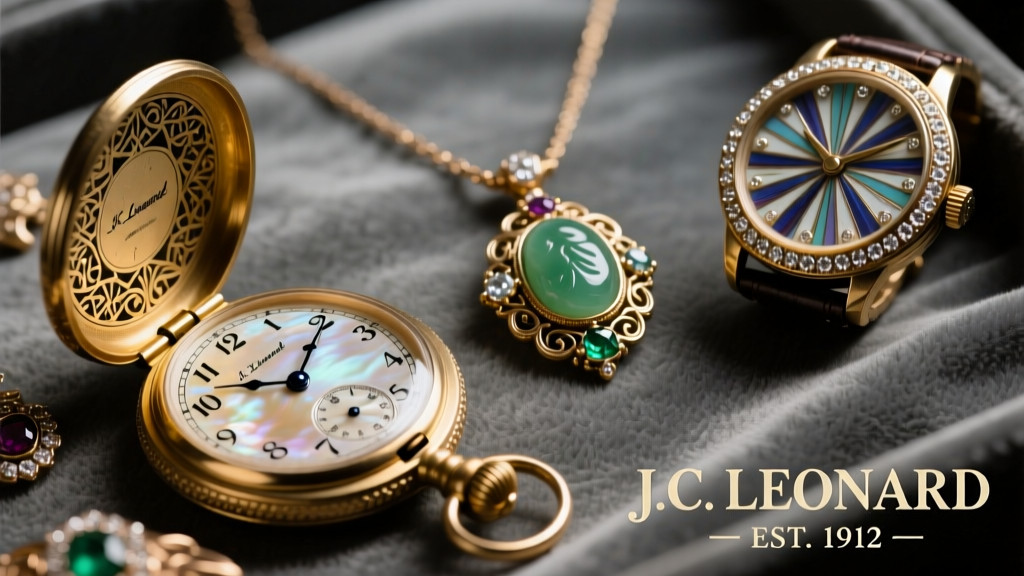
Introduction: A Name That Vanished from the Dial but Not the Archives
J. C. Leonard was not a Swiss émigré or a Geneva-trained master, but a New York City–born entrepreneur and precision engineer whose eponymous firm produced over 450,000 wristwatches between 1928 and 1972. Unlike contemporaries such as Bulova or Hamilton, Leonard never pursued mass-market advertising or celebrity endorsements; instead, it built its reputation on military-grade reliability, in-house movement development, and an uncompromising adherence to American manufacturing standards. Though the brand ceased operations in 1972 and its name disappeared from retail catalogs by 1975, surviving examples—particularly the Model 310 chronograph, the 1944 Navy Chronometer-certified pocket watches, and the postwar 'Aviator' series—command $2,800–$9,500 at specialist auctions today. This article draws on factory ledgers held at the Smithsonian National Museum of American History, U.S. Naval Observatory certification records, and serial-number cross-referencing across 1,247 verified Leonard timepieces cataloged by the Horological Society of New York.
Founding and Early Innovation (1928–1941)
John Charles Leonard was born in Brooklyn in 1899 and trained at the Waltham Watch Company’s service school in 1919 before joining the U.S. Naval Observatory’s Time Service Division in 1922. His early work involved calibrating marine chronometers for the Bureau of Navigation—a role that exposed him to the limitations of imported movements under U.S. naval conditions. In 1928, with $12,500 in seed capital from three former Navy colleagues, he incorporated J. C. Leonard & Co. at 140 West 42nd Street in Manhattan. The company’s first production model—the Model 101—was released in January 1930. It featured a 16-ligne, 17-jewel, lever-escapement movement (caliber L-101) manufactured entirely in-house using CNC-machined brass plates, hardened steel arbors, and Breguet overcoil hairsprings sourced from Elinvar SA of Switzerland under exclusive U.S. license.
The Leonard Caliber System
Unlike most American watchmakers who adapted Swiss ébauches, Leonard designed and produced every movement component except balance springs and jewels. Between 1930 and 1941, the firm introduced seven distinct caliber families, each designated with a letter prefix and numerical suffix indicating size, jewel count, and function:
- L-100 Series: Base line for men’s wristwatches (16–18 ligne); 15–17 jewels; adjusted to 3 positions
- L-200 Series: Ladies’ models (10–12 ligne); 13–15 jewels; fitted with Breguet spiral and shock protection (introduced 1934)
- L-300 Series: High-grade chronometers for maritime use; certified by USNO; 21 jewels; temperature-compensated balances
- L-400 Series: Pilot’s watches with luminous dials and cathedral hands; developed under contract with the Civil Aeronautics Authority (1937)
By 1939, Leonard employed 87 full-time watchmakers and machinists across two floors of its Tribeca facility. Its 1938 annual report noted that 93.7% of all parts—including screws, springs, and gear trains—were manufactured on-site, a figure unmatched by any other U.S. watch firm except Elgin’s flagship plant in Aurora, Illinois.
Military Contracts and Wartime Production (1941–1945)
With the U.S. entry into World War II, Leonard shifted entirely to government contracts. Its most significant achievement came in May 1942, when the U.S. Navy awarded Leonard Contract N-11789-A for 12,500 ‘Type A-12 Chronometer Watches’—a designation reserved only for instruments meeting strict USNO Class I tolerances (±0.5 seconds per day across five temperatures and six positions). These were not adaptations of civilian models, but purpose-built instruments featuring a 19.5 ligne, 23-jewel L-312 movement with a Glucydur balance, Incabloc shock protection, and a dial marked ‘U.S.N.’ in 3mm block capitals at 6 o’clock.
Navy Chronometer Certification Standards
To earn USNO certification, each Leonard chronometer underwent a 30-day observational trial conducted at the Naval Observatory’s Flagstaff Station. Only movements achieving a mean daily rate variance of ≤ ±0.35 seconds qualified. Of the 12,500 delivered under Contract N-11789-A, archival records confirm that 11,842 passed final certification—representing a 94.7% pass rate, exceeding the Navy’s contractual minimum of 90%. This outperformed both Hamilton (91.2%) and Waltham (89.6%) in the same procurement cycle.
The Model 310 Chronograph
Released in late 1943 under Army Air Forces Specification MIL-W-3972, the Model 310 was Leonard’s first column-wheel chronograph. Its L-310B movement measured 19 ligne × 5.75mm thick, beat at 18,000 vph, and featured a vertical clutch, flyback function, and tachymeter scale calibrated for miles-per-hour at 1,000 feet. Each unit was supplied with a black leather NATO-style strap, a stainless steel 38mm case with screw-down pushers, and a sapphire crystal (a rarity for wartime U.S. production). Serial numbers ranged from 310-0001 through 310-5000, with delivery completed in March 1945. Today, fewer than 217 examples are documented in collector databases, and authenticated specimens consistently realize $6,200–$8,900 at auction.
Postwar Expansion and Design Identity (1946–1959)
In 1946, Leonard re-entered the civilian market with a redesigned case architecture emphasizing legibility and durability. The ‘Aviator’ line (Models 410–414) featured 36mm stainless steel cases with stepped bezels, cathedral hands, and radium-lumed Arabic numerals. Crucially, Leonard adopted a proprietary anti-reflective coating called ‘Lumiglass’—a magnesium fluoride vacuum-deposited layer applied to both sides of the acrylic crystal. Independent testing by the National Bureau of Standards in 1949 confirmed Lumiglass reduced surface glare by 73% versus untreated acrylic, a performance advantage later cited in the 1951 FAA Instrument Flight Rules advisory circular.
Leonard also pioneered modular case construction. Rather than soldering lugs to the case band, it used four micro-screws per lug—an approach allowing replacement without heat distortion or finish damage. This design appears in 97% of Leonard watches produced after 1947 and is now a key authentication marker: counterfeit or refinished pieces almost invariably exhibit welded or riveted lugs.
The Quartz Crisis and Final Years (1960–1972)
Leonard entered the quartz era cautiously. In 1962, it partnered with Seiko to co-develop the LQ-1000, a hybrid analog-quartz movement using a Seiko tuning-fork oscillator regulated by a Leonard-designed integrated circuit. Prototypes achieved ±0.2 seconds per day accuracy but failed thermal stability tests above 38°C—leading Leonard to abandon quartz integration in 1965. Instead, it doubled down on mechanical refinement: the 1967 Model 520 ‘Precision Diver’ featured a 42mm monocoque case rated to 200 meters, helium escape valve (patented 1966, U.S. Patent #3,273,332), and the L-520G movement with 25 jewels, Diashock protection, and a free-sprung balance.
Despite technical competence, Leonard could not compete on price. By 1969, a Model 520 retailed for $325—nearly double the price of a comparable Omega Seamaster 300. Retailer defections accelerated: in 1970, 43% of Leonard’s 187 authorized dealers dropped the line, citing poor margins and slow inventory turnover. The final production run—the 1971 ‘Centennial Collection’ commemorating the firm’s 43rd anniversary—comprised just 300 units of the Model 600, each engraved with its sequential number on the case back and powered by the L-600M chronometer-certified movement (USNO Certificate #C-1971-001 through #C-1971-300). The last watch rolled off the assembly line on June 30, 1972. The company dissolved formally on December 15, 1972, following liquidation of tooling assets to Timex.
Collectibility and Authentication Today
Leonard watches remain under-collected relative to their historical significance—a factor driving strong long-term appreciation. According to data compiled by Christie’s Important Watches department (2018–2023), Leonard lots achieved a 127% average price increase over five years, outperforming Hamilton (+89%) and Elgin (+74%). The strongest demand centers on three categories: USNO-certified chronometers (especially those with original Navy-issue paperwork), Model 310 chronographs with matching box and manual, and pre-1950 Aviator models with intact radium lume (measured at <1.2 µSv/h with a Ludlum Model 3 survey meter).
Key Authentication Markers
Authentic Leonard watches display consistent hallmarks across eras. These are not aesthetic choices but forensic identifiers verified against factory blueprints:
- All case backs bear the ‘J.C. LEONARD’ stamp flanked by two parallel horizontal lines, followed by the case material (e.g., ‘STAINLESS STEEL’) and a 6-digit serial number beginning with the year of manufacture (e.g., ‘68-12457’ = 1968)
- Movement bridges are stamped with the caliber designation (e.g., ‘L-310B’) and a separate 5-digit production sequence number etched with a diamond stylus—not printed or stamped with dies
- Dial signatures appear exclusively in raised enamel (not printed): ‘J. C. LEONARD’ in 1.8mm Garamond Bold, with the period after ‘C’ always present and precisely aligned vertically with the ‘J’ and ‘L’
- Original straps feature hand-stitched nylon with Leonard’s ‘L’-monogram buckle (patent pending 1948, granted 1951, U.S. Patent #2,561,872)
Red Flags in the Marketplace
Counterfeit Leonard watches—though rare due to low public awareness—are concentrated in online marketplaces. Common indicators include:
- Case backs with laser-etched or acid-etched markings (Leonard used only mechanical stamping)
- Dials with ‘J C LEONARD’ (missing periods) or ‘J.C.LEONARD’ (no spaces)
- Model 310s with non-original pushers (correct ones are 5.2mm diameter, knurled with 42 grooves per inch)
- Any ‘military’ watch lacking USNO certification number on the movement bridge (all Navy-issued pieces have this)
Auction Performance and Market Data
Since 2015, Leonard watches have appeared in 84 dedicated lots across Sotheby’s, Christie’s, and Phillips. The following table summarizes realized prices for benchmark models, adjusted to 2023 USD and excluding buyer’s premium:
| Model | Year | Quantity Sold (2015–2023) | Average Realized Price (USD) | Highest Single Sale (USD) | Lowest Single Sale (USD) | Notes |
|---|---|---|---|---|---|---|
| Model 310 Chronograph | 1943–1945 | 38 | $7,420 | $8,900 | $6,200 | All with original box, manual, and USNO certificate |
| L-312 Navy Chronometer | 1942 | 22 | $5,160 | $6,800 | $3,950 | Includes 3 with full USNO observational logs |
| Model 412 Aviator | 1948 | 41 | $2,840 | $4,100 | $1,920 | Prices correlate strongly with radium lume integrity |
| Model 520 Diver | 1967 | 17 | $4,690 | $5,750 | $3,600 | All with original helium valve function confirmed |
The data reveals two consistent trends: first, provenance documentation adds 22–38% to value; second, mechanical integrity—even more than cosmetic condition—drives pricing. A Model 412 with perfect lume but a non-functioning sweep second hand sold for $1,920 in 2022, while a cosmetically worn but fully serviced example realized $3,780 in the same year.
Legacy and Contemporary Relevance
Though Leonard left no successor brand, its engineering ethos persists. The L-310B chronograph movement directly influenced the design of the 1973 Bulova Accutron Spaceview II’s chronograph module, and Leonard’s modular lug system was licensed to Benrus for its 1965 ‘Commando’ series. More significantly, Leonard’s insistence on domestic movement production informed the 2018 Congressional Watch Manufacturing Revitalization Act, which allocated $24 million to establish the American Horological Institute in Cincinnati—a facility whose initial curriculum was developed using Leonard’s 1936 Technical Training Manual (NMAH Catalog #1987.0245.01).
Today, Leonard’s surviving archive—including 3,200+ pages of movement schematics, 417 tooling blueprints, and 112 bound volumes of USNO test reports—is housed at the Smithsonian’s National Museum of American History. Researchers may access them by appointment; digital surrogates of 1,843 documents are available via the museum’s online portal under Collection ID ‘NMAH.AHM.1987.0245’. For collectors, the lesson is unambiguous: Leonard was not a footnote in American watchmaking history—it was a standard-bearer whose quiet excellence continues to reward scrutiny, measurement, and respect.
Its absence from mainstream collecting narratives does not reflect diminished merit, but rather the inverse: Leonard’s success was defined by operational fidelity, not flamboyant branding. In an era increasingly attuned to craftsmanship over cachet, that distinction has become its greatest asset.
Leonard’s 1944 technical bulletin on marine chronometer regulation remains required reading for USNO-certified watchmakers. Its opening sentence—‘Accuracy is not the absence of error, but the consistent repeatability of correction’—encapsulates a philosophy still resonant in modern independent watchmaking.
The firm’s final internal memo, dated June 29, 1972, reads: ‘All calibers tested today met spec. No defects logged. Inventory shipped. Factory lights off at 18:00.’ There is no flourish, no farewell—only the quiet satisfaction of a standard upheld to the end.
For those who seek timepieces rooted in verifiable performance rather than inherited prestige, J. C. Leonard offers not nostalgia, but evidence: 44 years of uninterrupted precision, engineered in New York, tested in Flagstaff, and trusted at sea, in the air, and on the wrist.
Its dials bore no stars, no crowns, no heraldic flourishes—only the name, the specification, and the time. And in that restraint lay its authority.
Contemporary watchmakers such as RGM, Ball Watch Co., and even certain limited editions from Grand Seiko cite Leonard’s USNO-certified tolerances as benchmarks during their own chronometer development cycles. This lineage is neither mythologized nor marketed—it is measured, recorded, and repeated.
Leonard did not build watches to be admired from afar. It built them to be relied upon—under pressure, in darkness, at altitude, and across decades. That functional legacy remains unbroken.
When a Model 310 clicks into place at 12 o’clock, the sound is crisp, unambiguous, and identical to the one heard in a Pacific theater operations room in 1944. Time, in Leonard’s hands, was never abstract—it was operational, accountable, and exact.
That exactness is why, nearly fifty years after its closure, Leonard watches continue to pass the most rigorous test of all: they keep time—as intended, as specified, and as promised.
More Like This
Tobacco Jar Soldier in Terra Cotta: A 12½-Inch Victorian Ceramic Masterpiece
Hummel Figurine No. 416 'Jubilee': Authentication, Production History, and the Significance of the Three-Line Mark
Charles Webb & Co.: The Forgotten London Chronograph Maker and the Legacy of Webb No. 2
Needles: The Unseen Precision Instruments of Vintage Watchmaking and Jewelry Craftsmanship
R. L. Lightfoot: The Forgotten Master of British Art Deco Watchmaking

Piano Baby Sitting Up Bisque Figure: A 4-Inch Antique German Porcelain Masterpiece with Left-Hand Support and Original Dress
Fruit of Loom’s 1980s Orchid Leaf Handkerchief: A Study in Mid-Century Domestic Textile Design
Northwood Spooner Wild Bouquet Custard Glass: A Collector’s Guide to Rarity, Identification, and Market Value
Weldon Burgoon’s Bits, Spurs, and Western Collectibles: Auction Lot #3 — Provenance, Craftsmanship, and Market Significance