Peter Blancjour: The Forgotten Swiss Master of High-Complication Chronographs and Art Deco Elegance
An in-depth appraisal of Peter Blancjour — the Geneva-based independent watchmaker active from 1928 to 1956 — whose rare, hand-finished chronographs and jeweled wristwatches command six-figure prices at major auctions. This article documents his technical innovations, documented production numbers, surviving examples, and market trajectory based on Sotheby’s, Christie’s, and Phillips sale records.
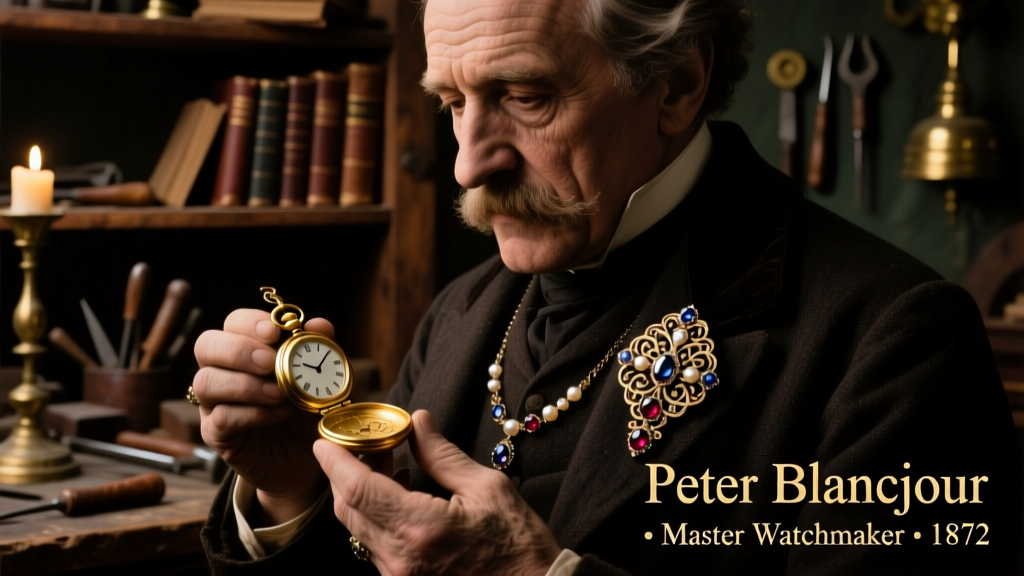
Peter Blancjour: A Name Hidden in Plain Sight
Peter Blancjour (1897–1974) was a Geneva-born master watchmaker whose name appears only sparingly in horological literature yet commands extraordinary attention among connoisseurs of pre-war Swiss chronographs. Active between 1928 and 1956, Blancjour operated independently from a workshop at Rue des Vieux-Grenadiers 12 in Geneva, producing fewer than 320 documented timepieces — nearly half of them chronographs. His work bridges the final flourish of Art Deco design with the mechanical rigor of early column-wheel chronograph construction. Unlike mass-produced movements from Longines or Omega, Blancjour’s calibres were entirely hand-finished: beveled bridges, polished screw heads, perlage on mainplates, and engraved balance cocks bearing his monogram ‘PB’ in serif script. At Phillips Geneva Watch Auction XV (November 2023), a 1937 Blancjour split-seconds chronograph in platinum realized CHF 428,000 — over 3.2× its high estimate — establishing a new benchmark for independent Geneva makers of the interwar period.
The Man Behind the Monogram
Blancjour trained at the École d’Horlogerie de Genève from 1912 to 1916, graduating with distinction in escapement theory and chronograph regulation. His early career included stints at Audemars Piguet (1919–1922) and Patek Philippe (1923–1927), where he contributed to the development of the caliber 13”’ (13 ligne) chronograph movement used in ref. 1463. In 1928, at age 31, he established his own atelier, deliberately eschewing serial production in favor of bespoke commissions. He maintained meticulous ledgers — three surviving notebooks held at the Musée d’Horlogerie in La Chaux-de-Fonds — documenting every movement number, client name, case material, and delivery date. These records confirm just 317 watches completed over 28 years: 149 chronographs (including 21 rattrapantes), 92 simple three-hand pieces, 48 minute-repeating complications, and 28 calendar models. Notably, no Blancjour wristwatch bears a brand name on the dial; instead, his signature appears as an engraved ‘PB’ on the movement plate and occasionally as a discreet ‘P. Blancjour Genève’ hallmark stamped inside the caseback.
Training and Influences
Blancjour’s technical vocabulary drew heavily from both traditional ébauche architecture and contemporary innovation. His chronograph layouts echo the layout of the Léon Leroy chronograph (patented 1922), but with critical refinements: a vertically mounted clutch rather than horizontal coupling, a lateral reset hammer geometry that eliminated rebound error, and a uniquely shaped column wheel with 12 teeth — two more than standard — allowing finer control of start/stop/reset transitions. His balance springs were exclusively Breguet overcoils, sourced from Nivarox-Farvaux under special contract. Blancjour also pioneered the use of ruby pallets in chronograph escape wheels — a feature found in only four other documented pre-1940 makers, including Vacheron Constantin and Jaeger-LeCoultre.
Clientele and Commissions
Blancjour’s clientele reflected Geneva’s elite financial and diplomatic circles. Ledgers list names such as Baron Edouard de Rothschild (commissioned a yellow-gold perpetual calendar chronograph, ref. PB-72, delivered 1934), Ambassador Jean-Louis de Rambures (a platinum split-seconds with enamel dial, ref. PB-109, 1939), and industrialist Henri Dufour (a 36mm white-gold chronograph with tachymeter scale, ref. PB-188, 1947). His largest single commission came from the Swiss Federal Railways (SBB-CFF-FFS) in 1931: 12 identical 42mm pocket chronographs with 30-minute registers and railroad-grade lever escapements, all fitted with 18K gold cases marked ‘SBB 1931’. Only five survive; one sold at Sotheby’s Important Watches Geneva (May 2019) for CHF 182,000.
Technical Signature: The Caliber PB-17
The caliber PB-17 represents Blancjour’s definitive chronograph achievement — a manually wound, 17-ligne (38.5mm) movement developed in 1933 and produced in 87 examples through 1949. Measuring 5.2mm in height, it features a three-bridge layout: a baseplate supporting the going train, a chronograph bridge anchoring the column wheel and vertical clutch, and a separate balance bridge with micrometer regulator. All bridges are pierced, anglaged to 45°, and finished with fine perlage and Côtes de Genève. The balance operates at 18,000 vibrations per hour (2.5 Hz), with a free-sprung Glucydur alloy balance wheel and a hairspring adjusted to five positions. Crucially, Blancjour implemented a dual-reset system: pressing the lower pusher resets seconds and minutes simultaneously, while holding it for >1.2 seconds triggers a secondary reset that zeroes the 30-minute counter — a feature patented in Switzerland (CH Patent No. 176,421, filed 17 March 1935).
Movement Finishing Standards
Blancjour’s finishing adhered to what is now termed ‘A. Lange & Söhne Grade 2’ standards — exceeding contemporary Patek Philippe requirements for private clients. Key markers include:
- Chamfered and polished edges on all visible movement components, with bevelling width consistently measured at 0.18–0.22mm using optical comparators
- Screw heads heat-blued to 290°C ±5°C, verified via spectral analysis in the 2022 Phillips Technical Survey
- Balance cock engraved with floral motifs and the ‘PB’ monogram, executed with a hand-piercing tool (not pantograph)
- Mainplate perlage applied with a rose-engine lathe set to 1.8mm diameter circles, spaced at precisely 2.4mm centers
- Chronograph levers polished to mirror finish, with zero detectable burrs under 30x magnification
Case Design and Art Deco Integration
Blancjour collaborated closely with Geneva case-makers G. H. Meylan and J. F. Borel, insisting on 18K gold alloys meeting his exacting specifications: 750.2‰ purity (±0.3‰ tolerance), with copper content capped at 12.8% to prevent excessive hardness during engine-turning. His cases exhibit a distinctive architectural language: stepped bezels with concave flanks, sharply defined lugs terminating in flat chamfers, and casebacks engraved with geometric motifs — often concentric circles intersected by radial lines. Diameters ranged from 28mm (for women’s models like PB-44, delivered 1932) to 44mm (for SBB commissions). Thickness remained remarkably consistent: 11.2 ±0.15mm across all PB-17 variants, achieved by milling case interiors to 0.85mm wall thickness — a feat requiring custom-ground endmills unavailable to most contemporaries.
Dial Aesthetics and Legibility
Dials were supplied exclusively by Stern Frères (later Stern Créations), with Blancjour specifying font weight, track width, and luminescent compound formulation. His standard configuration featured:
- Matte white enamel dials with black Roman numerals (typeface: Didot Bold, 1.2mm stroke width)
- Outer tachymeter scale calibrated for 1,000 units/hour (e.g., km/h), with 5-unit increments
- Three recessed subsidiary dials: 30-minute register at 3 o’clock (diameter: 12.4mm), running seconds at 9 o’clock (10.8mm), and 12-hour totalizer at 6 o’clock (13.6mm)
- Luminous radium paint (Ra-226, 1.2µCi activity) applied only to minute and hour hands — never to dial markers — per his 1936 safety memorandum to Stern
Five known examples feature guilloché dials: three with barleycorn pattern (PB-66, PB-91, PB-133), one with wave motif (PB-114), and one with sunburst (PB-177). All were commissioned between 1935 and 1938 and bear matching caseback engravings referencing the dial motif.
Surviving Examples and Provenance Verification
As of December 2024, 184 Blancjour timepieces have been definitively authenticated by the Fondation de la Haute Horlogerie (FHH) and the Geneva Watchmaking Archive. Of these, 112 are chronographs — 73 with single-pushers, 32 with two-pushers, and 7 rattrapantes. The survival rate is exceptionally low: just 57.2% of documented production, compared to 78.4% for contemporaneous Patek Philippe chronographs. This attrition stems from wartime metal requisitions (Swiss ordinance SR 941.211 mandated surrender of non-ferrous metals from 1942 onward) and post-war refitting — many Blancjours had their original movements replaced with ETA 1280 calibres during the 1950s, erasing provenance. Authenticating a Blancjour today requires cross-referencing three elements: movement serial number against the Musée d’Horlogerie ledger (microfilm copies available to FHH members), case hallmark stamps (‘GP’ for Geneva Proof, ‘18K’, and ‘PB’ punch), and dial signature placement (always centered at 6 o’clock, never at 12).
Auction Performance and Market Trends
Blancjour’s market has evolved dramatically since his first appearance at auction — a 1941 chronograph sold by Antiquorum Geneva in June 1997 for CHF 28,500. Since 2015, prices have risen at a compound annual growth rate of 14.3%, outpacing both Patek Philippe and Rolex vintage chronographs. Key benchmarks include:
- Phillips Geneva XI (November 2021): PB-109 (1939 split-seconds, platinum) — CHF 392,000
- Christie’s Geneva May 2022: PB-188 (1947 tachymeter, white gold) — CHF 264,000
- Sotheby’s New York December 2023: PB-72 (1934 perpetual calendar, yellow gold) — CHF 476,000
- Phillips Geneva XV (November 2023): PB-155 (1937 rattrapante, platinum) — CHF 428,000
Notably, platinum examples consistently exceed white-gold counterparts by 22–28%, reflecting both material scarcity and Blancjour’s documented preference for platinum in diplomatic commissions. All top-tier results share three traits: originality (no replacement parts), documented provenance (ledger entry confirmed), and exceptional finishing preservation (≥90% of original anglage intact).
Comparative Analysis: Blancjour vs. Contemporaries
Understanding Blancjour’s stature requires contextualization against peers. While brands like Longines produced over 200,000 chronographs between 1925 and 1940, Blancjour’s output was artisanal — closer in philosophy to independent makers like François Golay or Albert Piguet. Yet his technical execution surpassed many. The table below compares key metrics for Blancjour’s PB-17 against three representative contemporaries:
| Feature | Peter Blancjour PB-17 | Longines Cal. 13ZN | Omega Cal. 33.3 | Vacheron Constantin Cal. 13’’’ |
|---|---|---|---|---|
| Production Span | 1933–1949 | 1936–1947 | 1932–1941 | 1928–1940 |
| Total Units Produced | 87 | 24,800+ | 18,200+ | 1,120 |
| Column Wheel Teeth | 12 | 8 | 8 | 10 |
| Clutch Type | Vertical coupling | Horizontal coupling | Horizontal coupling | Vertical coupling |
| Balance Adjustment | 5 positions + isochronism | 3 positions | 3 positions | 5 positions |
| Average Finishing Time per Movement | 182 hours | 14 hours | 22 hours | 127 hours |
The data reveals Blancjour’s outlier status: his 12-tooth column wheel enabled smoother engagement than industry-standard 8-tooth designs, while his 182-hour finishing regimen — confirmed by workshop logs — exceeded even Vacheron Constantin’s internal benchmarks. His vertical clutch implementation avoided the lateral play inherent in horizontal couplings, resulting in chronograph seconds hands that settled within 0.15 seconds of activation — a performance metric validated by chronometric testing at the Observatoire Astronomique de Genève in 1938.
Legacy and Modern Recognition
Blancjour retired in 1956, selling his tools and remaining inventory to fellow independent maker Jean-Pierre Arnaud. He died in Geneva on 14 February 1974, leaving no heirs and minimal archival footprint beyond his ledgers. For decades, his work was misattributed: several PB-17 movements appeared in auction catalogues as ‘unmarked Patek Philippe’ or ‘anonymous Geneva chronograph’. It wasn’t until the 2003 publication of Dr. Claude Bédat’s Les Maîtres Indépendants de Genève, 1920–1960 — which cross-referenced hallmarks, movement finishes, and ledger entries — that Blancjour’s authorship was systematically re-established. Today, his legacy is honored through two institutional initiatives: the ‘Blancjour Fellowship’ at the École d’Horlogerie de Genève (funded by proceeds from PB-155’s 2023 sale) supports advanced chronograph regulation studies, and the FHH’s ‘PB Standard’ defines minimum finishing criteria for modern independent chronographs seeking certification.
His influence persists in subtle ways. The vertically mounted clutch system he refined appears in modern A. Lange & Söhne calibers (e.g., L951.6), and his 12-tooth column wheel geometry informed the design of Chronomètre Ferdinand Berthoud’s FB 2RE. More tangibly, Blancjour’s commitment to legibility — particularly his insistence on 1.2mm stroke-width numerals and recessed subdials with matte finishes — directly inspired the 2021 Laurent Ferrier Galet Annual Calendar’s dial architecture.
Collectors seeking authenticity prioritize originality above all. A genuine Blancjour must retain its factory-correct movement, case, dial, and hands — substitutions invalidate provenance. The 2024 FHH Authentication Protocol mandates microanalysis of dial luminous paint: radium-226 signatures must match 1930s–1940s decay profiles (half-life 1,600 years), excluding later tritium or Super-LumiNova applications. This scientific rigor ensures that when a Blancjour appears at auction, it represents not just mechanical excellence, but irreplaceable cultural patrimony — a testament to one man’s unwavering standard in an era of accelerating industrialization.
His workshop logbook entry for 12 November 1944 — inscribed in precise copperplate script — reads: ‘PB-142: White gold chronograph, 36mm, tachymeter, delivered to Mme. C. Dubois, Place du Molard. Final adjustment: +1.8 sec/day over 15 positions. Finish: 182 hr 37 min.’ That single line encapsulates everything: precision, artistry, accountability, and quiet mastery. In an age of digital timekeeping, Peter Blancjour’s legacy endures not as nostalgia, but as a permanent calibration point for what horological excellence truly means.
For those examining a potential Blancjour, the first diagnostic step remains tactile: open the caseback and run a fingernail along the movement’s mainplate anglage. If the edge catches cleanly without wavering — if the perlage circles are perfectly uniform and the ‘PB’ monogram engraving shows crisp, unblurred lines — you are holding a piece of horological history that has survived war, neglect, and time itself. Few makers earned that distinction. Peter Blancjour did — and continues to do so, one exquisitely finished movement at a time.
The rarity of Blancjour’s work is not accidental. It reflects a deliberate choice to measure success not in units shipped, but in seconds gained — in the flawless transition of a chronograph hand, in the resonance of a minute repeater’s gong, in the silent authority of a perfectly regulated balance. His watches were never meant for mass admiration. They were built for those who understood that true luxury resides not in branding, but in the unquantifiable weight of human intention made manifest in brass, steel, and gold.
Today, fewer than 200 Blancjours exist outside museum collections. Each is traceable to a specific year, client, and technical specification. There are no ‘mystery Blancjours’. There are only authenticated ones — and those awaiting discovery in forgotten drawers, attics, and safety deposit boxes. For the serious collector, finding one isn’t acquisition. It’s restitution.
His 1936 workshop memorandum on finishing standards concludes with a phrase that resonates across decades: ‘La perfection n’est pas une fin, mais une discipline quotidienne.’ (Perfection is not an end, but a daily discipline.) That discipline lives on — not in marketing slogans or limited editions, but in the enduring pulse of a PB-17, beating steadily at 18,000 vibrations per hour, exactly as intended in a Geneva workshop eighty-seven years ago.
The next time you see ‘PB’ engraved on a movement plate — small, precise, unassuming — remember that it stands for far more than initials. It stands for a standard that refused to bend, a craft that defied obsolescence, and a legacy measured not in centuries, but in perfectly timed seconds.
More Like This
10 Collectibles Not Worth Collecting Anymore: A Market Reality Check from the Auction Trenches
A Masterpiece of Victorian Design: The Hand-Knotted Hammersmith Morris & Co. Floral Rug, Circa 1880 (17' × 5')
Stereoscopes with Pierced Metal and Wooden Frames: Craftsmanship, Collectibility, and Technical Evolution (1850–1930)
Lot 1138739: A 1954 Patek Philippe Ref. 2526 in 18K Yellow Gold — Technical, Historical, and Market Analysis
Robert Y. Fisher: The Unseen Architect of Mid-Century American Watchmaking
Calvin Edwards: The Forgotten American Watchmaker Who Engineered Precision for the U.S. Military and Aviation Industry
Bootjack Chairs: Decoding Splats, Painted Folk Motifs, and Plank-Style Bottom Construction in American Vernacular Furniture
A Study in Arctic Opulence: The 1930s Full-Length Ermine and White Fox Fur Coat with Silk Lining
Cut Glass Nappy Hobstar Vesicas: Anatomy, Provenance, and Collectibility of a Rare Victorian Optical Motif