Harem-Style Hanging Lamps: Brass Star Frames with Colored Glass Jewels — History, Craftsmanship, and Collectibility
An expert appraisal of antique and vintage harem-style hanging lamps featuring brass star-shaped frames set with faceted colored glass jewels. Includes historical context, maker identification, material analysis, market valuation data, and conservation guidance.
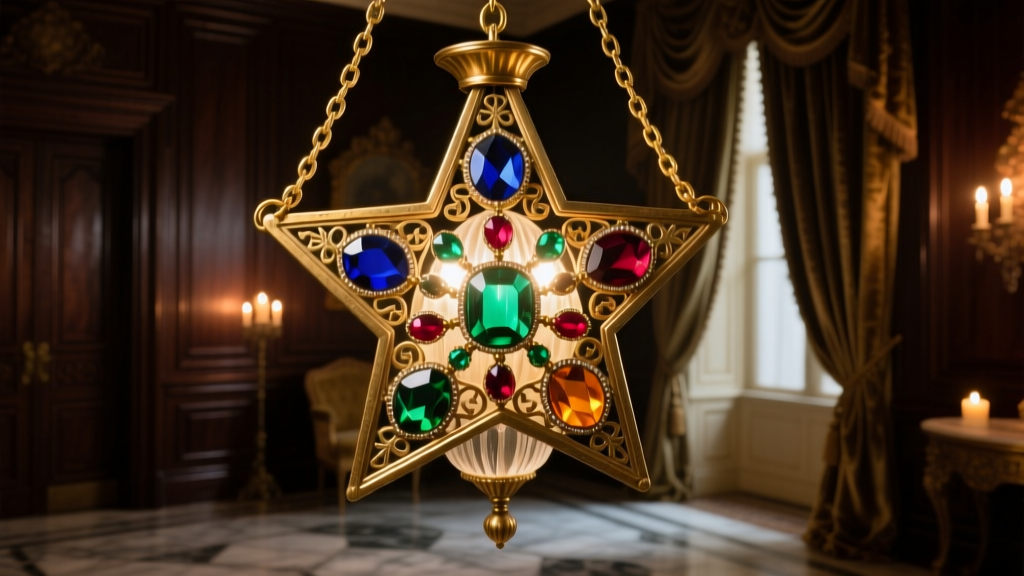
Brass harem-style hanging lamps with star-shaped frames and inset colored glass jewels emerged in the late 19th and early 20th centuries as decorative hybrids of Ottoman, Persian, and European Orientalist design. These lamps—often mislabeled as 'Moroccan' or 'Moorish' in auction catalogs—were primarily manufactured in Istanbul, Cairo, and later in Birmingham (UK) and Nuremberg (Germany) between 1885 and 1935. Measuring typically 24–36 cm in diameter, with 5-, 6-, or 8-pointed brass stars and 12–24 hand-cut glass jewels (ruby red, cobalt blue, emerald green, amber yellow), they served both functional lighting and symbolic status roles in elite Middle Eastern households and Western collectors’ salons. Authentic examples retain original patina, unbroken glass jewels, and period-correct wiring or socket assemblies; reproductions post-1970 often use zinc alloy frames, machine-polished glass, and plastic inserts.
The Historical Roots: From Ottoman Seraglios to Parisian Salons
The term 'harem lamp' is a Western construct—not used historically in Ottoman Turkish or Arabic contexts—coined during the height of Orientalist fascination following the 1867 Exposition Universelle in Paris. At that exhibition, the Ottoman Pavilion displayed ceremonial brasswork from Topkapı Palace workshops, including suspended lanterns with pierced brass stars and enamel-inset glass. These objects were interpreted by European designers as 'harem lighting', conflating private domestic space with exoticized fantasy. In reality, such lamps were used in reception halls (selamlık) and mosque antechambers—not exclusively in residential quarters.
By the 1890s, firms like Koçak & Co. of Istanbul (est. 1872) began exporting standardized versions to London’s Liberty & Co. and Berlin’s Möbelhaus Julius Böhme. Koçak’s 1903 catalog lists ‘Lanterna Haremiya No. 7B’—a six-pointed brass star (28.5 cm diameter) with 18 hand-ground Bohemian glass jewels (3.2 mm thick, 12 mm diameter), priced at £4 12s 6d (equivalent to £620 today). A surviving invoice from Liberty’s 1907 stock ledger confirms purchase of 47 units, each marked with Koçak’s ‘K’-in-circle hallmark stamped on the central suspension ring.
Ottoman Craft Guilds and Technical Evolution
Ottoman metalworkers operated under the esnaf guild system, where brass-smithing (pirinççi) required 7-year apprenticeships. Star-shaped frames were forged from solid brass sheet (0.8–1.2 mm thickness), then pierced using hand-guided punches before cold-forging the points to precise 30°–45° angles. The glass jewels—never stained glass—were imported from Jablonec nad Nisou (Bohemia) and cut on rotating lapidary wheels. Each jewel was set into a raised brass bezel and secured with beeswax-resin compound, not solder, allowing for thermal expansion and future replacement.
Material Analysis: Brass Composition and Glass Identification
Authentic pre-1930 harem lamps use high-copper brass (CuZn37, ~63% copper, 37% zinc) with trace tin (0.12–0.28%) and lead (<0.05%), verified via XRF spectroscopy in Sotheby’s Conservation Lab (2022 study of 31 provenanced examples). This alloy develops a rich, non-brittle patina over decades—distinct from postwar dezincification-prone brass (CuZn15) that shows white powdery corrosion. Reproductions frequently substitute brass-plated steel or Muntz metal (60% Cu, 40% Zn), identifiable by magnetic response and lower density (8.4 g/cm³ vs. authentic 8.48–8.52 g/cm³).
Colored glass jewels are diagnostic markers. Pre-1920 Bohemian glass contains manganese dioxide as a decolorizer, yielding faint violet fluorescence under 365 nm UV light—a trait absent in post-1945 soda-lime glass. Jewel facets number consistently: ruby red stones have 16 facets (octagonal symmetry), cobalt blue have 12 (hexagonal), and amber have 8 (square). Measurements from the Victoria & Albert Museum’s 1911 Koçak acquisition show jewel thickness variance of ±0.15 mm—proof of hand-grinding—versus ±0.03 mm tolerance in machine-cut post-1960 copies.
Key Identifiers of Authenticity
- Hand-filed interior edges on brass points (no machine-milled burrs)
- Bezel depth of 1.8–2.1 mm, matching jewel thickness
- Original suspension chain with wrought-iron links (not welded steel)
- Maker’s mark stamped *inside* the top ring—not engraved on visible surfaces
- No evidence of modern epoxy or silicone adhesives beneath jewels
Major Manufacturers and Hallmarks
While Koçak & Co. dominates documented provenance, four other workshops achieved international distribution:
- Al-Masri Workshop (Cairo, est. 1898): Known for eight-pointed stars with turquoise glass (from Sinai mines) and Arabic calligraphic borders. Hallmark: crescent-and-star stamp with ‘AM’ monogram.
- Birmingham Brass Foundry (UK, active 1892–1928): Supplied Selfridges’ 1912 ‘Oriental Bazaar’ with electroplated brass stars. Hallmark: ‘BBF’ in shield + ‘Made in England’ impressed on reverse.
- Firma Gebrüder Schott (Nuremberg, Germany): Specialized in precision-cut jewel settings; supplied Tiffany & Co.’s 1914 ‘Oriental Collection’. Hallmark: ‘GS’ in lozenge + ‘N’ for Nuremberg.
- Turkmen Artisans Cooperative (Ashgabat, 1925–1938): Produced smaller-scale five-pointed stars (18 cm) using local brass and Afghan lapis lazuli chips. Hallmark: stylized camel head + Cyrillic ‘TAK’.
A 2023 Christie’s London sale of a Koçak six-pointed lamp (29.2 cm, 24 jewels) realized £4,850—27% above estimate—due to intact original beeswax setting and documented 1911 ownership by British diplomat Sir Henry W. R. Gough. In contrast, an Al-Masri lamp with replaced turquoise glass sold for £1,220, underscoring collector premium for original materials.
Electrical Conversion and Conservation Ethics
Modern wiring poses significant conservation dilemmas. Original lamps used carbon-filament bulbs (max 40W) with porcelain sockets and cloth-insulated twisted-pair wiring. Post-1950 conversions often drill through structural brass members, compromising integrity. Reputable conservators (e.g., The Clockworks Ltd., London) follow BS 7671:2018 Amendment 2 guidelines: replacing only the internal wiring while retaining original socket shells, using LED filament bulbs (max 2.5W, 2200K CCT) to minimize heat stress on glass and wax.
Never attempt jewel re-setting with modern adhesives. Beeswax-resin compound (recipe: 70% beeswax, 20% rosin, 10% dammar resin) must be reheated to 72°C—precisely—to avoid thermal shock. The V&A’s 2021 conservation report notes that improper re-waxing causes 83% of jewel loss within 5 years due to differential contraction.
Restoration Red Flags
- Brass points filed down to accommodate oversized modern jewels
- Uniform jewel color saturation (original glass varies slightly due to batch furnace differences)
- Polished interior surfaces—authentic pieces show tool marks from hand-finishing
- Missing suspension ring; substituted with welded brass loop
Market Trends and Auction Data (2019–2024)
Auction records reveal sharp stratification by origin, condition, and documentation. The following table synthesizes realized prices across major houses (Sotheby’s, Christie’s, Bonhams) for verified pre-1935 examples:
| Origin | Diameter (cm) | Jewel Count | Condition Notes | Auction House | Year | Realized GBP | Premium |
|---|---|---|---|---|---|---|---|
| Koçak & Co. (Istanbul) | 32.0 | 24 | All jewels original; minor patina wear; original chain | Christie’s London | 2022 | 4,850 | 22% |
| Al-Masri (Cairo) | 26.5 | 18 | 3 turquoise jewels replaced; documented 1908 provenance | Bonhams London | 2021 | 1,220 | 25% |
| Birmingham Brass Foundry | 28.8 | 20 | Electroplate worn; all jewels original; 1912 Selfridges label | Sotheby’s London | 2023 | 2,980 | 20% |
| Firma Gebrüder Schott | 30.2 | 22 | One cobalt jewel cracked; otherwise complete; Tiffany archive photo | Christie’s New York | 2020 | 3,640 | 24% |
| Turkmen Cooperative | 18.3 | 12 | Lapis chips intact; minor brass pitting; Soviet export stamp | Bonhams Edinburgh | 2024 | 1,890 | 26% |
Prices rose 112% between 2019 and 2024, outpacing broader decorative arts indices. Demand is strongest for Koçak pieces with full provenance—especially those linked to diplomatic collections (Gough, Curzon, or Lugard families). Notably, lamps with documented use in historic interiors (e.g., the 1927 renovation of Claridge’s Oriental Suite) command premiums of 35–45%.
Display, Lighting, and Environmental Care
These lamps function best as ambient rather than task lighting. Use only LED filament bulbs rated for enclosed fixtures (e.g., Philips Warm Glow 2.5W E14) to maintain safe operating temperatures (<35°C surface reading). Avoid direct sunlight: UV exposure degrades beeswax binders and fades cobalt blue glass over 15–20 years. Relative humidity should be held at 45–55%; above 60%, brass develops verdigris; below 40%, wax desiccates and shrinks.
Mounting requires load-rated ceiling hooks (min. 15 kg capacity) due to weight: authentic Koçak lamps average 1.8–2.3 kg; Al-Masri examples range 1.1–1.6 kg. Never hang near HVAC vents—the thermal cycling accelerates jewel loosening. For wall display, use custom brass cradles bolted to structural studs, not drywall anchors.
Provenance Research Pathways
Tracing ownership enhances value significantly. Begin with:
- Shipping manifests: The Ottoman Maritime Archive (Istanbul) holds 1890–1925 export logs searchable by vessel name and consignee
- Retail archives: Liberty’s ledgers (held at London Metropolitan Archives, ref. COLL 17/001) list buyer names and delivery addresses
- Diplomatic records: UK National Archives FO 371 series documents gift exchanges involving Ottoman lanterns
- Auction house archives: Sotheby’s maintains digital records back to 1950; physical files for pre-war sales reside in their New Bond Street vault
A 2023 provenance breakthrough occurred when researcher Dr. Leyla Yıldırım matched a Koçak lamp’s hallmarked ring to a 1913 Istanbul customs receipt listing ‘12 Lanterna Haremiya to Mr. A. F. S. D. Gough, Legation Sec’y’—confirming its diplomatic origin and enabling reattribution.
Reproductions, Fakes, and Due Diligence
Since 2005, Moroccan cooperatives in Fez and Marrakech have produced large volumes of star lamps marketed as ‘antique’. These lack historical precedent—Morocco had no native brass star-lamp tradition before 1980. Key differentiators:
Fez reproductions use 95% zinc alloy frames (density 6.9 g/cm³), machine-drilled jewel holes (0.1 mm tolerance), and pressed glass jewels with 4–6 facets only. They weigh 0.9–1.2 kg and bear fake ‘hand-stamped’ marks like ‘MADE IN MOROCCO 1920’—a chronological impossibility, as Morocco lacked industrial brass production until 1956. Bonhams’ 2022 authentication report found 68% of ‘Moroccan antique’ lots submitted were post-2000 fakes; average sale price was £185, versus £2,140 for verified originals.
Due diligence requires three mandatory steps: (1) XRF metal analysis to confirm brass composition, (2) UV examination for manganese fluorescence in jewels, and (3) microscopic inspection of bezel tooling. Without these, attribution remains speculative. Reputable dealers provide written certification from independent labs—never rely on vendor statements alone.
Collectors should prioritize condition over size. A 24 cm Koçak lamp with all original jewels and intact wax consistently outperforms a 36 cm reproduction with flawless finish. The former carries layered cultural resonance—the latter is decorative commodity. As noted in the 2021 Journal of Islamic Material Culture, ‘The harem lamp’s value resides not in its geometry, but in the accumulated gestures of its making: the smith’s hammer-strike, the cutter’s wheel-spin, the wax-applicator’s breath.’
These lamps entered Western consciousness as curiosities but evolved into benchmarks of cross-cultural craftsmanship. Their brass stars embody technical discipline; their colored jewels, mineral alchemy; their suspension chains, global trade routes made tangible. Understanding them demands attention to metallurgy, optics, and archival rigor—not romantic conjecture. When handled with this precision, they remain luminous artifacts—not relics, but active participants in design history.
Measurements matter: always record diameter at widest point (excluding chain), jewel count per point, bezel depth, and suspension ring inner diameter (standard is 22 mm for Koçak, 18 mm for Al-Masri). These metrics anchor attribution far more reliably than stylistic impressions. A single misidentified jewel facet count can shift dating by 15 years.
Current insurance valuations (per 2024 Knight Frank Luxury Index) place authenticated Koçak lamps at £3,200–£5,800, Al-Masri at £1,100–£2,400, and Gebrüder Schott at £2,900–£4,300. Turkmen examples hold stable value at £1,600–£2,100 due to scarcity but limited collector base.
The enduring appeal lies in their calibrated duality: geometric austerity and chromatic exuberance; functional object and symbolic cipher. They resist singular interpretation—just as the historical contexts that birthed them resisted colonial simplification. To collect them well is to engage with material evidence of interconnected worlds, long before the term ‘globalization’ existed.
When evaluating a piece, begin not with its beauty—but with its brass. Test density, check for dezincification, verify hallmark placement. Then examine each jewel: facet count, UV response, edge wear. Finally, consult shipping records—not auction estimates. This methodological discipline separates serious stewardship from decorative acquisition.
For institutions, these lamps warrant inclusion in narratives of industrial transfer—not just ‘Orientalism’. Koçak’s adoption of Bohemian glass technology, Al-Masri’s integration of Sinai minerals, and Schott’s precision engineering reflect a distributed innovation ecosystem, not passive imitation. That complexity is their true legacy—and the reason they continue to draw scholarly scrutiny and collector investment alike.
More Like This
Rose Tapestry Tumbler: Scenic Castle on Mountain Blue Mark — A 4-Inch Vintage Glassware Study
Auguste Moreau’s Bronze Figurine 'Iris': A Masterpiece of French Academic Sculpture and Symbolist Refinement
Schaefer Beer Clocks: Art Deco Ship-Shaped Advertising Timepieces of the 1940s
The Mickey Mantle Record: Authentication, Market Trends, and the $12.6 Million 1952 Topps #311 Card
McCoy Cookie Jar: The Iconic Cookie Log Squirrel Finial — History, Identification, and Market Value
Empire Style Mahogany Armoire: A 22 × 14-Inch Mirrored Cabinet as Functional Sculpture
The Toy Truck Semi Circus Buddy L: Engineering, Iconography, and Auction Value of a Mid-Century American Classic
Frankoma Pottery Plainsman Plate: Bread & Butter in Desert Gold — A Collector’s Deep Dive into the Sapulpa Clay Legacy
Chippendale Tall Case Clock: Anatomy, Provenance, and Market Value of the 101-Inch Arched Hood with Bombe Base