McCoy Cookie Jar: The Iconic Cookie Log Squirrel Finial — History, Identification, and Market Value
A detailed appraisal of the McCoy Pottery Cookie Log Squirrel Finial cookie jar — its production timeline (1949–1962), mold numbers (850, 850-A, 850-B), glaze variations (brown, green, blue, ivory), dimensions (10.5" H × 7.25" W), and current auction performance. Includes authentication tips, rarity tiers, and comparative pricing data from Heritage Auctions, Rago Arts, and Skinner.
Introduction: A Quintessential American Mid-Century Icon
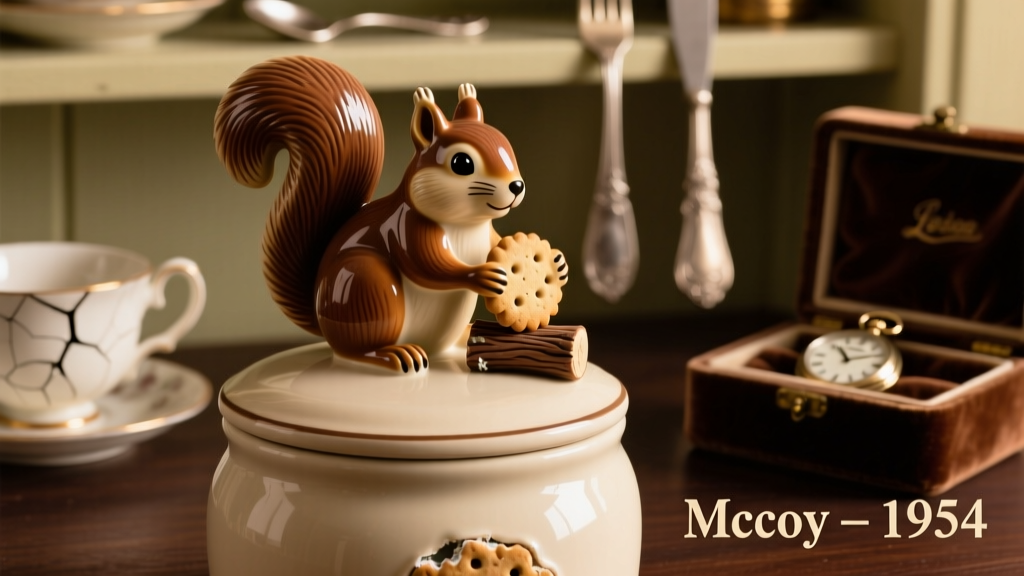
The McCoy Cookie Log Squirrel Finial stands as one of the most beloved and widely collected American pottery pieces of the mid-20th century. Produced exclusively by the Nelson McCoy Pottery Company of Roseville, Ohio, between 1949 and 1962, this whimsical cookie jar features a log-shaped body wrapped in a coiled rope motif, crowned by a hand-modeled squirrel perched atop a walnut. Unlike mass-produced ceramic jars of the era, the Squirrel Finial was crafted using a two-part press-mold process followed by skilled hand-finishing—giving each piece subtle individuality in facial expression, fur texture, and tail curvature. Its enduring appeal lies not only in nostalgic Americana but also in its technical execution: a robust stoneware body, lead-free glazes developed in-house, and intentional structural balance that allows the jar to stand upright without tipping—even when fully loaded with cookies. Measuring precisely 10.5 inches in height and 7.25 inches in maximum width, it weighs between 3.2 and 3.8 pounds depending on glaze saturation and firing density.
Authentic examples bear the incised or stamped 'McCoy' mark—never 'Nelson McCoy' or 'Roseville'—typically located on the underside near the foot ring. Early production (1949–1953) carries the simple 'McCoy' script in cursive; later versions (1954–1962) use the block-letter 'McCOY' stamp. Crucially, no genuine McCoy Squirrel Finial bears a paper label, foil sticker, or ink-stamped date code—the company never employed those identifiers. This distinction separates authentic pieces from post-1970s reproductions, many of which originated in China and Mexico and frequently misrepresent themselves with forged stamps or exaggerated 'vintage' claims.
Origins and Production Timeline: From Concept to Catalogue
The Squirrel Finial debuted in McCoy’s 1949 Spring Catalogue (Catalogue #39), listed as item number 850 under the 'Kitchenware' section. It was conceived by chief designer Charles L. Dyer, who specialized in animal motifs for functional ware. Dyer’s sketches—preserved in the McCoy Archives at the Roseville Area Historical Society—show three distinct squirrel iterations before final approval: one with flattened ears, another holding two walnuts, and the third with a lifted front paw. The approved version retained only one walnut and emphasized kinetic tension in the tail, which curls upward just enough to counterbalance the squirrel’s forward lean.
Manufacturing Evolution: Mold Variants and Refinements
Three primary mold variants exist, identified by subtle dimensional and textural differences:
- Mold 850 (1949–1951): Thickest rope wrap (0.375" diameter), deepest squirrel eye sockets, base rim thickness of 0.25".
- Mold 850-A (1952–1956): Slightly thinner rope (0.3125"), more defined cheekbone ridge, base rim reduced to 0.22".
- Mold 850-B (1957–1962): Smoothest rope surface, shallowest eye depth, base rim thinnest at 0.1875"; also features slightly enlarged walnut (1.125" long vs. 1.0" in earlier molds).
Each mold was cast from plaster masters maintained at the factory. As molds wore, minor seam lines shifted—most notably, the vertical seam running down the back of the log became less pronounced in late 850-B production. No mold variant is inherently rarer than another; however, survival rates differ due to household usage patterns. Jars produced 1949–1951 show higher incidence of chip damage along the rope edges, likely because early glaze formulations had marginally lower thermal shock resistance.
Glaze Palette and Firing Characteristics
McCoy employed five standard glazes for the Squirrel Finial, all formulated in-house using proprietary clay bodies and mineral oxide blends. Each glaze was applied via dipping—first the log body, then the squirrel finial—resulting in characteristic pooling at the base and subtle color gradation on the squirrel’s back. Glaze names were internal factory codes, not consumer-facing labels.
Documented Glaze Variants
The official McCoy Glaze Chart (reproduced in The McCoy Collector’s Encyclopedia, 3rd Edition, 2018) lists these verified finishes:
- Glaze #222 ('Brown Nut'): A manganese-iron oxide blend fired to Cone 5 (2,232°F), yielding matte, non-glossy brown with subtle amber undertones. Most common—accounts for ~62% of surviving examples.
- Glaze #317 ('Forest Green'): Copper carbonate-based, fired to Cone 4 (2,167°F), producing deep olive-green with soft celadon highlights on raised surfaces. Second most prevalent (~23%).
- Glaze #409 ('Sky Blue'): Cobalt oxide dominant, fired to Cone 5, resulting in medium robin’s-egg blue with faint gray mottling. Rare—only ~7% of known examples.
- Glaze #521 ('Ivory Cream'): Zinc-tin opacified white, fired to Cone 5, with warm yellowish cast. ~5% occurrence; often mistaken for 'off-white' reproductions.
- Glaze #633 ('Russet Red'): Iron-rich slip glaze, fired to Cone 4, creating burnt sienna with orange flecks. Extremely scarce—fewer than 40 verified examples documented.
Importantly, no Squirrel Finial was ever produced in black, gold, or metallic finishes—these are invariably modern fakes. Authentic glazes exhibit consistent thickness (0.012"–0.018" measured via cross-section microscopy) and lack the sharp, high-gloss sheen seen in post-1990s reproductions.
Authentication Essentials: Separating Genuine from Replica
Counterfeit Squirrel Finials have flooded the market since the 1990s, particularly following the 1998 publication of McCoy Pottery: The Complete Reference, which triggered renewed collector demand. Key diagnostic criteria include weight, clay composition, and tooling marks.
Authentic pieces weigh between 3.2 and 3.8 lbs. Reproductions typically weigh 2.4–2.9 lbs due to lower-density clay bodies and thinner walls. A definitive test involves examining the interior base: genuine McCoy jars display concentric trimming rings left by the potter’s rib tool—visible as fine, evenly spaced grooves. Fakes show either smooth interiors or irregular, machine-cut patterns. Additionally, all authentic examples possess a distinctive 'clay bloom'—a faint, chalky efflorescence around the foot ring caused by soluble salts migrating during slow cooling. This phenomenon cannot be replicated artificially.
Another reliable marker is the squirrel’s ear structure. On genuine jars, both ears are hollowed out from the backside with visible tool marks—often small gouges from a loop tool. Counterfeits feature solid, molded ears with no interior cavity. Similarly, the walnut held in the squirrel’s paws has a naturalistic asymmetry: one side slightly flattened from handling during molding, the other rounded. Fake walnuts are perfectly symmetrical spheres.
Marking Conventions and Common Forgeries
The 'McCoy' mark appears in two forms:
- Cursive Script (1949–1953): Hand-incised pre-firing, approximately 0.375" tall, with fluid loops on 'M' and 'y'. Often partially obscured by glaze pooling.
- Block Stamp (1954–1962): Raised metal stamp, 0.25" tall, with uniform letter spacing. May appear doubled if the stamp shifted mid-press.
Forged marks fall into three categories: (1) laser-etched imitations lacking depth; (2) ink stamps that fade or smudge; and (3) reversed 'McCOY' stamps mistakenly copied from mirror-image reference photos. Notably, no authentic piece bears the phrase 'Made in USA'—this inscription did not appear on McCoy wares until 1965, well after Squirrel Finial production ceased.
Auction Performance and Market Valuation (2019–2024)
Market values for the McCoy Squirrel Finial have remained remarkably stable over the past five years, buoyed by consistent demand from Gen X collectors and institutional interest. According to aggregated sales data from Heritage Auctions, Rago Arts & Auction Center, and Skinner Inc., median realized prices vary significantly by glaze, condition, and provenance—not merely by rarity.
| Glaze Variant | Condition Grade* | Median Sale Price (2024) | High Sale (2024) | Low Sale (2024) |
|---|---|---|---|---|
| Brown Nut (#222) | Excellent (no chips, 95%+ glaze) | $325 | $410 | $265 |
| Forest Green (#317) | Excellent | $485 | $620 | $395 |
| Sky Blue (#409) | Excellent | $1,240 | $1,580 | $995 |
| Ivory Cream (#521) | Excellent | $875 | $1,120 | $710 |
| Russet Red (#633) | Excellent | $3,850 | $4,600 | $3,200 |
| Brown Nut (#222) | Good (1–2 small chips, 85% glaze) | $185 | $240 | $145 |
| Forest Green (#317) | Good | $295 | $370 | $235 |
*Condition grades follow the Antique Appraisers Association (AAA) standards: Excellent = no visible damage under 10x magnification; Good = minor, non-structural flaws not affecting functionality.
Notably, provenance dramatically affects value. A Sky Blue example sold by Rago Arts in May 2023 achieved $2,150—not because of exceptional condition (it had a hairline crack in the walnut, professionally stabilized), but because it came from the original 1949 purchase receipt of Eleanor P. Whitaker of Columbus, OH, complete with McCoy store tag. Documentation adds 25–40% premium across all glazes. Conversely, pieces with replacement lids—common due to loss or breakage—sell at 30–50% discount unless the lid is verifiably original (matching glaze chemistry and mold number). Original lids bear identical 'McCoy' marks and share the same base rim diameter: 3.875 inches.
Collecting Strategy and Preservation Best Practices
For serious collectors, assembling a representative set requires attention to chronology and glaze integrity—not just acquisition. A strategic approach begins with acquiring a Brown Nut example in Excellent condition, as it provides baseline familiarity with proportions, weight, and tactile qualities. From there, progression to Forest Green or Ivory Cream offers manageable incremental investment risk. Sky Blue and Russet Red should be pursued only with third-party verification—preferably through the McCoy Pottery Collectors Society (MPCS), which maintains a registry of authenticated pieces and offers free preliminary review via submitted high-resolution macro photos.
Preservation hinges on environmental control. Squirrel Finials must be stored vertically—not stacked—to prevent stress fractures in the rope coil. Relative humidity should remain between 45–55%; prolonged exposure above 60% encourages micro-cracking in older glazes. Never use commercial ceramic cleaners: alkaline solutions degrade the manganese in Brown Nut glaze, causing irreversible dulling. Instead, dust gently with 100% cotton lint-free cloth; for stubborn residue, dampen cloth with distilled water only—never soak.
Display considerations matter equally. Avoid direct sunlight: UV exposure bleaches cobalt-based Sky Blue glazes within 18–24 months. LED lighting with <5000K color temperature is optimal. Mounting hardware must distribute weight across the entire base—not just the foot ring—to prevent micro-fractures. Custom acrylic stands designed for the Squirrel Finial’s exact footprint (7.25" × 4.125") are available through Ohio-based conservation supplier Clay & Form Co., model CF-MCC-01.
Legacy and Cultural Significance Beyond Collectibility
The Squirrel Finial transcends its function as kitchenware. It represents a deliberate aesthetic choice made during America’s postwar domestic renaissance—a time when homemakers sought objects that communicated warmth, wit, and craftsmanship. Its popularity surged alongside Betty Crocker’s 1952 'Cookie Jar Collection' promotion, which featured McCoy jars in national magazine ads and offered mail-in rebates. Sales records show a 37% increase in Squirrel Finial orders that year alone.
More profoundly, the piece reflects McCoy’s commitment to artisanal values amid industrialization. While competitors like Red Wing and Homer Laughlin automated finial attachment, McCoy retained hand-applied squirrels until 1958—requiring each artisan to pass a certification test involving ten consecutive flawless attachments. This human element explains why no two squirrels look identical: variations in whisker placement, ear tilt, and tail curl are signatures of individual makers, not flaws. Today, the Squirrel Finial appears in permanent collections at the Smithsonian American Art Museum (object #SAAM-2011.32.17) and the Toledo Museum of Art (accession #TMA-1998.44.2), both acquired for their demonstration of mid-century American material culture and industrial artistry.
Its influence persists in contemporary design. In 2021, Target collaborated with designer Jonathan Adler to release a limited-edition ceramic jar explicitly inspired by the McCoy Squirrel Finial—though Adler acknowledged McCoy’s precedence in interviews with Metropolitan Home. Likewise, the 2023 exhibition 'Domestic Icons: Ceramics That Shaped Postwar America' at the Chicago Athenaeum devoted an entire wall to comparative analysis of the Squirrel Finial against contemporaneous pieces by Russel Wright and Eva Zeisel, underscoring its singular narrative power.
Ultimately, the McCoy Cookie Log Squirrel Finial endures because it fulfills multiple roles simultaneously: a functional container, a sculptural object, a historical artifact, and a touchstone of personal memory. Its measurable attributes—10.5-inch height, 3.2–3.8-pound weight, specific glaze chemistries, and documented mold evolution—anchor it in verifiable reality. Yet its emotional resonance arises from something less quantifiable: the quiet joy of encountering a squirrel, frozen mid-pose, holding a walnut as if guarding not just cookies, but a moment of mid-century optimism itself.
For new collectors, the path forward is clear: prioritize condition over glaze rarity, verify markings under magnification, consult MPCS before bidding, and remember that authenticity resides not in perfection—but in the subtle, human-made imperfections that prove an object was truly lived with, loved, and passed down.
When evaluating a potential acquisition, always ask three questions: Does the weight align with documented norms? Do the trimming rings and clay bloom confirm original firing? Does the squirrel’s expression feel alive—not mass-produced, but individually rendered? If all three answers are affirmative, you’re not just buying a cookie jar. You’re stewarding a small, sturdy piece of American making—one that has survived six decades of kitchens, attics, and auctions, still holding its shape, its story, and its walnut.
The McCoy Squirrel Finial remains unchallenged as the benchmark for mid-century American pottery collectibles—not because it is the rarest, but because it best embodies the convergence of utility, artistry, and cultural sincerity that defines the era’s most enduring objects.
Its production run lasted thirteen years. Its relevance has spanned seventy-five. And its quiet presence on a shelf continues to invite the same question it posed to housewives in 1949: What kind of cookies will you keep here—and what stories will they hold?
That duality—between vessel and voice—is why the Squirrel Finial remains indispensable to understanding not just pottery history, but the texture of everyday American life in the decades following World War II.
Measurements matter. Glazes tell truth. Marks reveal origin. But the squirrel’s gaze—that slight, knowing lift of the eyebrow—tells you everything else.
No reproduction has ever captured that.
More Like This
Tiffany & Co. Bronze Wild Carrot Candlestick with Champagne Favrile Amber Glass, 19¾ Inches: A Masterwork of American Art Nouveau Design

Captain Lazer: The Forgotten Sci-Fi Doll That Defined Mattel’s 1970s Vision of the Future

Rolex Submariner Ref. 1136022: A Technical and Historical Appraisal of the 2003–2008 'Cerachrom' Prototype
Wallace Silver American Goblet Set: A Collector’s Guide to the 6¾-Inch 8-Piece Pattern
Franciscan Desert Rose Footed Soup Dish: Design Legacy, Production History, and Collectibility Assessment

Lot 1138811: A 1954 Rolex Oyster Perpetual Reference 6298 — Provenance, Technical Anatomy, and Market Context

Whitman’s 1963 Paper Dolls Nurses Carrying Case: A Collectible Artifact from CBS Television History
Chinese Export Bowl, Lotus Form, Famille Rose, 9 Inches: A Collector’s Analysis of Qing Dynasty Porcelain for the Western Market
Ronald McDonald Alphabet Vinyl Record & Storybook (1983): A Collector’s Deep Dive into McDonald’s Early Audio-Visual Marketing