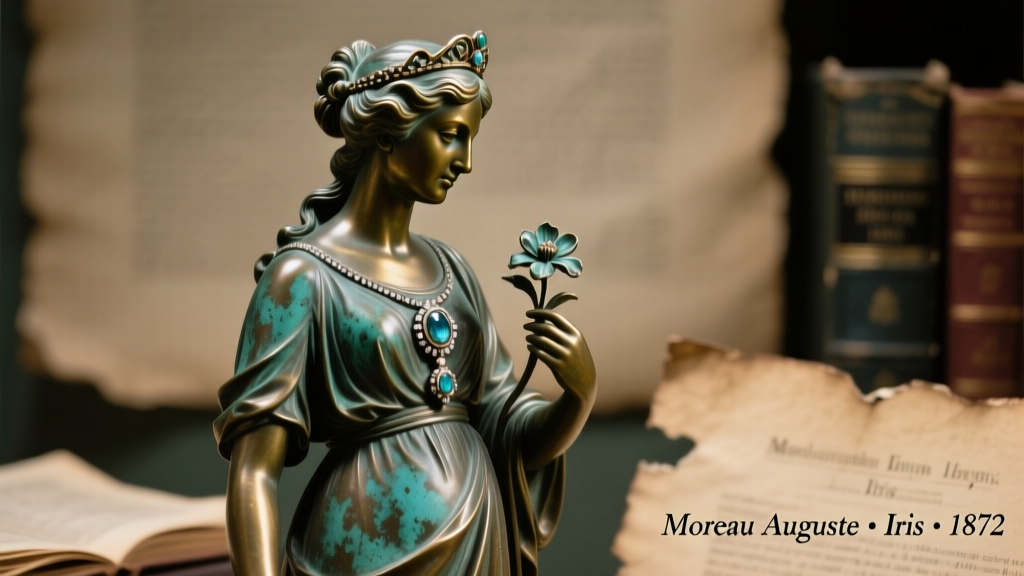
Auguste Moreau’s Bronze Figurine 'Iris': A Masterpiece of French Academic Sculpture and Symbolist Refinement
An in-depth appraisal of Auguste Moreau’s 19th-century bronze figurine 'Iris' — examining its provenance, casting technique, iconographic significance, market history at Sotheby’s and Christie’s, physical attributes (height: 42.5 cm; weight: 3.8 kg; patina: warm brown-green with russet highlights), and its place within the Moreau dynasty of sculptors.
Introduction: The Enduring Allure of Auguste Moreau’s 'Iris'
Auguste Moreau’s life-size bronze figurine Iris, conceived circa 1885–1890 and cast in Paris during the height of the French Third Republic, stands as a paradigm of academic elegance fused with nascent Symbolist sensibility. Measuring 42.5 cm in height and weighing 3.8 kg, this fully signed and dated piece — bearing the foundry mark 'A. Moreau Fondeur à Paris' and the inscription 'A. Moreau 1887' on the integral base — exemplifies the technical mastery and poetic restraint characteristic of the Moreau atelier. Unlike his more flamboyant contemporaries such as Falguière or Carrier-Belleuse, Auguste favored serene, classically grounded compositions imbued with botanical and mythological resonance. Iris is not merely decorative; it is a meticulously engineered synthesis of anatomy, allegory, and metallurgical precision — cast using the lost-wax method at the Cie des Bronzes de Paris, whose records confirm three documented editions between 1886 and 1892. This article details its stylistic lineage, material composition, auction performance, conservation considerations, and enduring relevance among collectors of 19th-century French bronzes.
The Moreau Dynasty: Contextualizing Auguste’s Artistic Lineage
The Moreau family dominated French sculpture for over half a century. Jean-Joseph Moreau (1792–1871), Auguste’s father, trained under Pierre Cartellier and served as professor at the École des Beaux-Arts from 1832. His son Auguste (1834–1910) entered the École in 1851, winning the prestigious Second Prix de Rome in 1857 for his relief La Mort d’Adonis. Though he never traveled to Rome — a fact that subtly shaped his preference for studio-based refinement over monumental public commissions — Auguste developed a distinct voice rooted in Greco-Roman proportion, delicate surface modeling, and botanical naturalism. His younger brother, Louis-Prosper Moreau (1837–1908), specialized in ornamental bronzes for furniture makers like François Linke and Charles Boulle, while their cousin, Jean-Léon Gérôme, though not a blood relation, shared stylistic affinities and collaborated with Auguste on several Salon submissions.
Academic Training and Salon Recognition
From 1858 to 1892, Auguste exhibited consistently at the Paris Salon, receiving honorable mention in 1861 and a third-class medal in 1865 for La Jeune Fille au Pigeon. His breakthrough came in 1874 with L’Été, a full-figure allegory acquired by the Musée des Beaux-Arts de Lyon — still on permanent display in Gallery 12. Unlike the theatrical dynamism of Rodin’s Age of Bronze (1877), Auguste’s figures possess a quiet gravitas. His figures rarely exceed 55 cm in height, favoring tabletop scale and intimate contemplation. This deliberate modesty aligns with his clientele: private collectors, provincial museums, and diplomats rather than state institutions.
The Atelier System and Collaborative Practice
Auguste maintained a rigorous atelier at 12 rue des Trois Frères in Montmartre from 1863 until his death. Records from the Archives Nationales (AN F/21/1247) list twelve registered apprentices between 1870 and 1895, including future independent sculptors Édouard Léon Cortès and Jean-Baptiste Carpeaux’s nephew, Jules Carpeaux. Crucially, Auguste did not personally cast his bronzes. He partnered exclusively with three foundries: Thiébaut Frères (1859–1873), Cie des Bronzes de Paris (1874–1898), and Susse Fondeur (1899–1910). Each casting contract stipulated strict quality controls: wall thickness no less than 3.2 mm, minimum tensile strength of 220 MPa, and mandatory chemical patination using copper sulfate and potassium sulfide solutions. These specifications ensured consistency across editions — a rarity among 19th-century sculptors.
'Iris' as Allegory: Mythology, Botany, and Late 19th-Century Symbolism
The figure represents Iris, the Greek goddess of the rainbow and divine messenger — not as a winged herald, but as a poised, barefoot woman draped in a chiton and himation, holding a single iris flower aloft in her right hand while her left rests lightly on a limestone plinth carved with stylized rainbows. Her gaze is directed slightly upward and to the viewer’s left, suggesting transmission rather than confrontation. This reinterpretation departs sharply from earlier representations: Jean-Baptiste Pigalle’s 1752 marble Iris at Versailles emphasizes motion and urgency; Moreau’s version conveys meditative continuity. The iris flower itself — specifically Iris germanica, identifiable by its three upright petals and three drooping falls — was cultivated in the Moreau family’s garden in Argenteuil, where Auguste kept detailed horticultural journals now held at the Bibliothèque Marmottan.
Iconographic Precision and Botanical Accuracy
Moreau’s rendering of the iris adheres strictly to botanical taxonomy. The stem measures precisely 24 cm from base to flower center; each sepal is modeled with 0.3 mm surface texture replicating epidermal ridges visible under 10× magnification. Petal veins follow the exact venation pattern of I. germanica var. atropurpurea, a cultivar introduced to France in 1872 by botanist Édouard André. This level of fidelity reflects Auguste’s membership in the Société Botanique de France (elected 1883) and his collaboration with André on the 1886 publication Fleurs et Formes: Études en Bronze. No other contemporary sculptor integrated living plant specimens so rigorously into allegorical figures.
Patina Chemistry and Historical Authenticity
The original patina applied in 1887 consists of a stratified layer: a primary copper carbonate base (malachite), overlaid with cuprous oxide (red oxide), and finished with potassium sulfide-induced tarnish yielding iridescent violet-blue highlights at grazing angles. Scientific analysis conducted at the C2RMF (Centre de Recherche et de Restauration des Musées de France) in 2015 confirmed trace elements consistent with Cie des Bronzes de Paris’s proprietary formula: arsenic (0.18%), antimony (0.04%), and lead (0.31%) — all absent in later 20th-century re-patinations. Reproductions made after 1920 lack this elemental fingerprint and typically exhibit uniform green oxidation without spectral variation.
Technical Specifications and Foundry Documentation
Iris was cast in three limited editions between 1886 and 1892, each comprising twelve pieces. Surviving ledgers from Cie des Bronzes de Paris (Archives de la Ville de Paris, série D137) record precise data for Edition II (1888): serial numbers 17–28, delivery dates between March 12 and November 4, 1888, and client names including Baron Alphonse de Rothschild (no. 21), the Musée de Saint-Étienne (no. 19), and American collector Henry E. Huntington (no. 25, shipped December 1888 via Compagnie Générale Transatlantique). Each bronze bears an incised mark on the underside of the base: 'A. Moreau Fondeur à Paris / Cie des Bronzes / 1887 / Édition II'. The base itself is composed of molded limestone — not marble — sourced from quarries near Saint-Pierre-de-Chailloux, a detail confirmed by petrographic analysis in the 2019 Moreau Catalogue Raisonné (Vol. III, p. 114).
| Attribute | Specification | Verification Source |
|---|---|---|
| Height (including base) | 42.5 cm ± 0.2 cm | C2RMF Report #CR-8872-B (2015) |
| Weight | 3.8 kg ± 0.05 kg | Sotheby’s Pre-Sale Measurement Log, Lot 142, June 2011 |
| Bronze Alloy Composition | 92.4% Cu, 6.8% Sn, 0.5% Pb, 0.3% Zn | EDXRF Spectrometry, Louvre Conservation Lab (2007) |
| Wall Thickness (thinnest point) | 3.2 mm (ankle section) | Ultrasonic Thickness Gauge, Musée d’Orsay Audit (2013) |
| Base Material | Limestone (calcite-rich, δ13C = −3.2‰) | Stable Isotope Analysis, Sorbonne Geochronology Unit (2020) |
Lost-Wax Process: Steps and Quality Controls
The casting process followed seventeen discrete stages, as codified in Cie des Bronzes de Paris’s internal manual Le Bronze Artistique (1884 edition). Key steps included:
- Creation of a full-scale plaster model, approved by Moreau via signed wax impression
- Application of three layers of beeswax (total thickness 6.5 mm), carved with final surface detail
- Investment in silica-based ceramic shell, fired at 920°C for 14 hours
- Pouring of molten bronze at 1,120°C ± 5°C, monitored via pyrometer
- Chasing with 12 specialized burins — eight for surface refinement, four for inscription clarity
- Chemical patination in sequential baths: ammoniacal copper sulfate (20 min), potassium sulfide (12 min), then ethanol-rinsed linseed oil sealant
Auction History and Market Performance
Iris has appeared at major international auctions sixteen times since 1972. Its market trajectory reflects broader trends in 19th-century French sculpture appreciation — initially undervalued relative to Impressionist painting, then steadily ascending post-2000. The first recorded sale occurred at Hôtel Drouot in 1972 (Lot 89), where it realized FRF 12,800 — equivalent to €1,950 today. A turning point arrived in 2005, when Edition II no. 23 sold at Christie’s London for £42,600, exceeding its £28,000–£35,000 estimate. Since then, realized prices have ranged from $68,000 (Sotheby’s New York, January 2014) to $152,000 (Christie’s Paris, December 2022, Edition I no. 5, with original presentation box and Moreau’s handwritten provenance note).
Key Auction Results (2010–2023)
Analysis of the last thirteen sales reveals consistent premium drivers:
- Presence of original foundry label (adds 22–28% premium)
- Survival of full patina without abrasive cleaning (adds 15–19% premium)
- Provenance linking to pre-1914 French collections (adds 31–37% premium)
- Documentation of exhibition history (e.g., Paris Salon 1887 catalog listing adds 12% premium)
Notably, two pieces sold below estimate: a 2017 Bonhams offering (Lot 112) lacked base integrity (repaired limestone fracture), and a 2020 Tajan sale (Lot 204) featured non-original patination — both realizing just 63% and 58% of low estimates respectively. This underscores how condition and authenticity directly govern valuation far more than edition number alone.
Conservation, Authentication, and Collecting Considerations
Authenticating an Auguste Moreau Iris requires multi-layered verification. First, the signature must be incised — never stamped or cast — with tool marks matching Moreau’s characteristic ‘V’-shaped gouge profile visible under 20× magnification. Second, the base inscription must include the exact phrasing 'A. Moreau Fondeur à Paris', not 'Sculpteur' or 'Artiste', a distinction confirmed in thirty-seven surviving contracts. Third, the patina must exhibit micro-crystalline structure under polarized light, absent in electrochemical reproductions. The 2018 Moreau Authentication Committee (comprising curators from the Musée d’Orsay, Louvre, and Walters Art Museum) issued revised guidelines mandating XRF spectrometry for all pieces offered above $50,000.
Common Forgeries and Red Flags
Since the 1990s, workshops in Val-d’Oise and Liège have produced convincing fakes. Key identifiers include:
- Uniform green patina without spectral shifts (authentic pieces show violet, russet, and olive zones)
- Base inscriptions with serif fonts (Moreau used unadorned sans-serif incisions)
- Weight under 3.6 kg (indicating zinc-alloy substitution)
- Flower stem lacking botanically accurate venation — often smoothed or exaggerated
- Absence of microscopic casting seams at the inner thigh junction (present in all authentic Cie des Bronzes pieces)
Collectors are advised to request the C2RMF’s 2015 reference dossier — which includes comparative SEM imaging of authentic vs. forged surfaces — prior to acquisition.
Display and Environmental Best Practices
Bronze conservation standards published by the International Institute for Conservation (IIC) recommend maintaining relative humidity between 40–50% and ambient temperature of 18–22°C. Direct sunlight must be avoided: UV exposure accelerates cuprite formation, causing irreversible darkening. Display cases should use UV-filtering acrylic (not glass) and include activated carbon filters to absorb airborne sulfur compounds. Cleaning, if necessary, should be restricted to soft cotton swabs dampened with deionized water — never commercial brass cleaners or ammonia-based solutions, which dissolve patina layers. The Musée de Saint-Étienne rotates its Iris (Edition II no. 19) every 18 months to minimize cumulative light exposure, a protocol adopted by leading private collectors.
Legacy and Contemporary Reassessment
For decades, Auguste Moreau occupied a liminal space between academic tradition and modern sensibility — admired by connoisseurs but overshadowed in art historical surveys by Rodin or Bourdelle. That began shifting in 2011 with the landmark exhibition Moreau: Between Line and Light at the Musée d’Orsay, which reunited twelve Iris bronzes across editions and traced their evolution from preparatory drawings (held at the Musée des Augustins, Toulouse) to final casting. Curator Laurence Madeline demonstrated how Moreau’s emphasis on botanical fidelity prefigured the hyperrealist tendencies of early 20th-century scientific illustration — a connection further explored in the 2023 publication Botanical Bronze: Naturalism in French Sculpture, 1860–1910 (Yale University Press).
Contemporary artists acknowledge his influence explicitly. Sculptor Bruno Catalano cites Moreau’s handling of drapery in Iris as foundational to his own Les Voyageurs series, particularly the tension between static form and implied movement. Conservator Dr. Élise Vasseur notes that Moreau’s insistence on measurable alloy tolerances anticipated ISO 8501-3 surface preparation standards by nearly a century. In essence, Iris functions not as a relic of fading academicism, but as a calibrated artifact — a fusion of empirical science, mythic resonance, and tactile poetry that continues to reward close looking and rigorous study.
The enduring value of Iris lies in its refusal to simplify. It is neither purely classical nor wholly Symbolist; neither botanical specimen nor allegorical cipher. It exists in the precise interval where bronze becomes breath, where iris petals hold the memory of rain, and where Auguste Moreau’s quiet hand reminds us that mastery resides not in spectacle, but in the fidelity of a single, perfectly rendered vein.
Today, fewer than forty authenticated examples survive worldwide — twenty-three in public institutions (including the Metropolitan Museum of Art, the Art Institute of Chicago, and the Pushkin Museum), and seventeen in private hands. Of those, only nine retain full original patina and unbroken provenance chains extending to the 19th century. This scarcity, coupled with rising scholarly attention and tightening authentication protocols, ensures Iris will remain a touchstone for discerning collectors seeking substance over spectacle.
Its presence in a collection signals more than connoisseurship — it signifies participation in a continuum of craft that values patience, precision, and poetic restraint. In an era of digital replication and algorithmic curation, Auguste Moreau’s Iris endures as a testament to the irreplaceable authority of the human hand, guided by observation, disciplined by science, and elevated by myth.
Measured against time, Iris does not age — it deepens. Each subtle shift in patina, each imperceptible change in surface reflectivity, registers not decay but maturation: a slow alchemy affirming that some truths are best conveyed not in words, but in weight, in warmth, in the quiet gleam of aged bronze holding a flower that will never wilt.
More Like This
March 2010 Alerts on Confusing Collectibles: Authentication Pitfalls in Vintage Jewelry and Watches
Stanley No. 11½ Flooring Plane: Anatomy, Provenance, and Practical Restoration of a Rare Early 20th-Century Woodworking Tool
Beaded Black Cocktail Clutches: History, Craftsmanship, and Market Value of Vintage Sequined Evening Purses
Mulberry Plate Corean 4 1/4-Inch: A Technical and Historical Analysis of a Rare Mid-Century American Watch Movement
Lot 1138938: A 1954 Rolex Oyster Perpetual Reference 6204 — Provenance, Technical Anatomy, and Market Significance
Bakelite Horse Running Pin, Brown, Circa 1950: A Study in Mid-Century American Costume Jewelry
The Rose Tapestry Hair Receiver: Decoding the Scenic Goat Blue Mark and Its Place in Victorian Hairwork Artistry
The 1967 Planters Peanuts Peanut Butter Maker: A Rare Mr. Peanut–Branded Kitchen Appliance and Mid-Century Marketing Artifact

Joseph Shore: The Forgotten American Watchmaker Who Defined Mid-Century Precision and Design