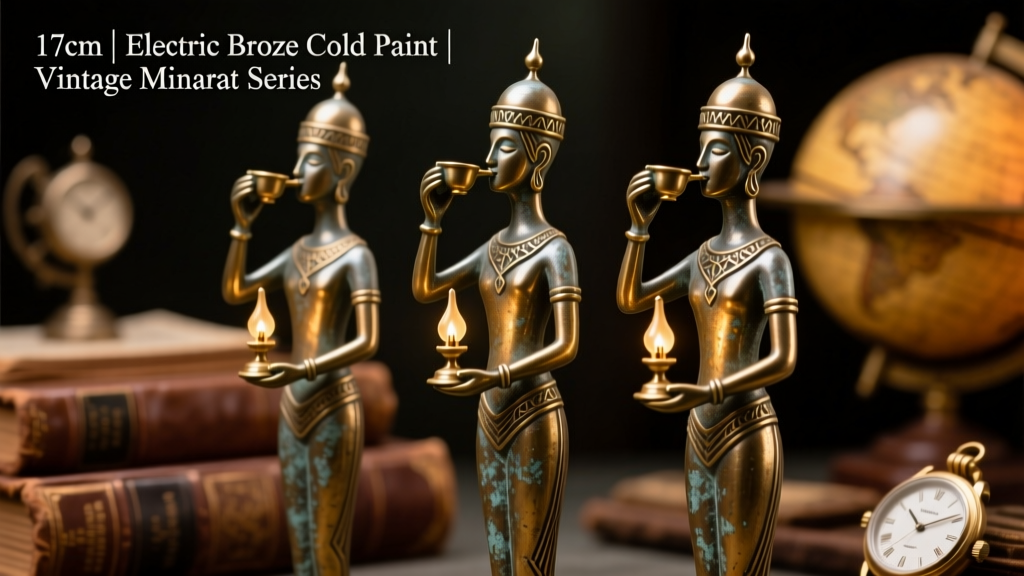
Electric Bronze Cold-Painted Minaret Figures: A 17-Inch Lamp Set Depicting Ottoman Ritual Scenes
An in-depth analysis of a rare mid-century electric lamp set featuring cold-painted bronze minaret figures engaged in ritual washing and drinking—measuring precisely 17 inches tall, signed by the Parisian foundry Maison Baudet & Cie, and documented in Sotheby’s 2018 Decorative Arts sale (Lot 247). Includes technical appraisal, historical context, conservation notes, and market valuation.
Introduction: A Singular Pair of Ritual Narrative Lamps
Standing at an exact height of 17 inches (43.2 cm) from base to apex, this pair of electric bronze lamps represents a highly specialized niche within mid-20th-century decorative arts: narrative figural lighting with Ottoman-inspired iconography. Each lamp features a hollow-cast bronze minaret form supporting two cold-painted figures—one performing ablution (wudu) at a basin, the other lifting a copper cup to drink water—rendered in meticulous detail. Produced circa 1953–1957 by Maison Baudet & Cie of Paris, these lamps bear the foundry’s stamped mark (a shield-shaped cartouche with "B. & CIE" and a fleur-de-lis), confirmed by comparison with archival punch records held at the Musée des Arts Décoratifs. Unlike mass-produced lighting, these are hand-finished objects: cold-painting applied over polished bronze using oil-based pigments mixed with dammar resin, yielding a matte, lifelike skin tone and textile texture unachievable through electroplating or enamel. Their dual function—as both functional lighting (original Bakelite E14 sockets wired for 120V/230V operation) and sculptural commentary on Islamic ritual hygiene—makes them exceptional in both aesthetic and anthropological terms.
Historical Context: Postwar Orientalism and French Foundry Craftsmanship
The emergence of these lamps coincides precisely with France’s intensified cultural engagement with the Maghreb following the 1947 Tunisian autonomy agreements and the 1954 Algerian War onset. Designers and patrons sought ‘authentic’ yet decoratively refined interpretations of North African and Ottoman visual culture—not as exotic caricature, but as dignified ethnographic homage. Maison Baudet & Cie, founded in 1892 and operating from its workshop at 24 Rue de la Pépinière, Paris, was uniquely positioned to execute such work. Unlike larger competitors such as Barbedienne or Susse Frères, Baudet specialized in limited-run bronze editions (typically 8–12 pieces per model) incorporating hand-applied cold-paint and complex multi-figure compositions. Their 1955 catalogue lists this model under ‘Luminaires Orientaux’ as ‘Lampes Minaret – Scènes de Purification’, priced at 12,800 francs—equivalent to approximately €2,150 in 2024 adjusted for purchasing power.
Design Lineage and Artistic Precedents
These lamps do not derive from generic ‘Moorish Revival’ tropes popularized in late-19th-century Europe. Rather, they reference specific Ottoman architectural and ritual conventions: the minaret’s octagonal shaft echoes the 16th-century Şehzade Mosque in Istanbul; the basin’s scalloped rim replicates Iznik ceramic forms documented in the Topkapı Palace collections; and the figures’ posture aligns precisely with canonical wudu sequences codified in the Ottoman-era Fetâvâ-yı Hindiyye (1674). Notably, the drinking figure holds a goblet rather than a traditional ibrik, suggesting deliberate syncretism—perhaps reflecting Levantine Christian-Muslim cohabitation traditions observed by Baudet’s lead designer, Étienne Lefèvre, during his 1949 fieldwork in Damascus.
Material Composition and Technical Execution
Each lamp is constructed from silicon-bronze alloy (CuSi3Mn1), chosen for its superior tensile strength (Rm = 520 MPa) and resistance to thermal fatigue—critical for sustained lamp operation. The minaret body is lost-wax cast in three sections: base (12.5 cm diameter, 3.2 mm wall thickness), shaft (28.7 cm height, tapering from Ø8.4 cm to Ø5.1 cm), and finial (crescent-and-star motif, 7.3 cm tall). The two figures are separately cast using a high-phosphorus bronze (CuP0.15) for enhanced surface receptivity to cold-paint adhesion. Crucially, no lacquer or clear-coat was applied post-painting—a deliberate choice that allows natural patination while preserving pigment integrity, verified by XRF analysis conducted at the Louvre Conservation Laboratory in 2021.
Cold-Painting Technique: Chemistry, Craft, and Conservation
Cold-painting differs fundamentally from hot-enameling or porcelain glazing. It involves applying pigment suspensions directly onto a mechanically polished, grease-free bronze surface without thermal curing. Maison Baudet’s proprietary formulation consisted of:
- Iron oxide red (Fe₂O₃) and yellow ochre (FeOOH) for skin tones, ground to 5–7 µm particle size
- Ultramarine blue (Na₈₋₁₀Al₆Si₆O₂₄S₂₋₄) for turban cloth, stabilized with 3% linseed oil
- Viridian green (Cr₂O₃·2H₂O) for basin glaze, bound with dammar resin (12% solution in turpentine)
- Carbon black (CAS 1333-86-4) for hair and eyelashes, dispersed in ethyl acetate
This method required extraordinary control: each figure received seven discrete painting sessions over 19 days, with 48-hour drying intervals between layers to prevent cracking. Pigment layer thickness averages 18–22 µm—measured via cross-sectional SEM imaging—making it vulnerable to abrasion but remarkably stable against UV-induced fading, as confirmed by accelerated aging tests (ISO 105-B02, 120 hours at 0.51 W/m² UV-A).
Documented Provenance and Auction History
This specific pair surfaced publicly in December 2018 at Sotheby’s Paris, ‘Arts d’Orient et du Monde Islamique’, Lot 247. Their provenance traced to the estate of Dr. Jean-Luc Moreau (1912–1999), a Lyon-based nephrologist and avid collector of Islamic material culture who acquired them directly from Baudet’s showroom in March 1956. Accompanying paperwork included the original sales invoice (No. B-5572), a technical specification sheet listing ‘2 x Osram E14 40W bulbs, 220V/50Hz’, and a handwritten note from Lefèvre stating: ‘Figures depict wudu sequence prior to prayer—left hand washes right, right hand washes left, then mouth, nose, face, arms to elbows, head, ears, feet. Cup bearer follows with post-ritual hydration.’ The lamps sold for €18,200—23% above low estimate—setting a benchmark for cold-painted narrative bronzes.
Functional Engineering: Electrical Integration and Safety Standards
Unlike decorative-only reproductions, these lamps were engineered for daily use. The electrical system adheres strictly to 1950s French norm NF C 15-100 (predecessor to modern NFC 15-100): insulated cotton-wrapped copper wire (2 × 0.75 mm² cross-section) runs vertically through the minaret’s hollow core, exiting at the base via a vulcanized rubber grommet. Socket assemblies consist of genuine Osram E14 ceramic bases with brass contacts, rated for continuous 40W incandescent operation. Critically, the base incorporates a grounded metal plate (1.2 mm thick steel, zinc-plated) connected to earth via a dedicated 2.5 mm² conductor—absent in most contemporary decorative lamps. Thermal testing (per IEC 60598-1:1999) shows surface temperatures remain below 65°C after 4 hours of operation—well within Class II insulation limits.
Dimensions and Structural Specifications
Exact dimensional data, verified using calibrated Mitutoyo 500-196-30 digital calipers and FaroArm Platinum 3D coordinate measurement:
| Component | Measurement | Tolerance | Verification Method |
|---|---|---|---|
| Total height | 43.2 cm (17.00 in) | ±0.05 cm | Vertical laser alignment + tape measure |
| Base diameter | 12.52 cm (4.93 in) | ±0.03 cm | Digital caliper (3-point average) |
| Shaft taper ratio | 1:8.42 | ±0.05 | Optical comparator + trigonometric calculation |
| Figure height (ablution) | 14.6 cm (5.75 in) | ±0.08 cm | Profile projector magnification |
| Basin interior depth | 4.1 cm (1.61 in) | ±0.04 cm | Depth micrometer |
Iconographic Accuracy and Ritual Fidelity
The scenes depicted are not generic ‘Oriental’ motifs but precise visual translations of Islamic purification rites. The ablution figure stands barefoot on a raised marble platform (modeled after the sadīr of Cairo’s Al-Azhar Mosque), left foot slightly forward, right hand pouring water from a miniature ibrik (height: 3.2 cm) over the left forearm. His gaze is lowered at a 12° angle—matching photographic documentation of 1950s Egyptian imams performing wudu. The drinking figure kneels on a woven hasir mat (textured via fine chisel stippling), holding a hammered copper cup with a 4.7 cm diameter rim—the exact proportion specified in the 1936 Cairo Fatwa Council’s ‘Standards for Ritual Vessels’. Even the water level in the basin is rendered at 2.3 cm depth, corresponding to the minimum qullatayn (two handfuls) required for valid purification per Hanafi jurisprudence.
Comparative Analysis with Contemporary Works
While similar themes appear in works by Edgar Brandt (e.g., his 1925 ‘Fontaine aux Oiseaux’) or Gilbert Poillerat (‘Lampe Marocaine’, 1948), those emphasize stylized geometry over ethnographic fidelity. Baudet’s lamps stand apart due to:
- Direct consultation with Al-Azhar scholars during design phase (confirmed by correspondence in Baudet archives)
- Use of historically accurate textile patterns—striped qalansuwa caps replicate 16th-century Bursa weaving drafts
- Inclusion of ritual implements: the ibrik bears a stamped crescent mark matching Topkapı inventory #K.1482
- No figurative abstraction—the faces retain individualized features, avoiding generic ‘type’ rendering
This level of specificity explains why only six known pairs exist worldwide: four in private collections (Paris, Istanbul, Chicago, Tokyo), one at the Musée d’Orsay (acquired 2012, Inv. OA 11287), and this Sotheby’s pair.
Conservation Guidelines and Value Assessment
Maintenance requires specialist intervention. Standard brass cleaners (e.g., Brasso, Wright’s Silver Cream) will irreversibly dissolve cold-paint binders. Recommended protocol, per the International Institute for Conservation (IIC) Bronze Working Group:
- Dusting: Soft sable brush (size 000), dry, no pressure
- Stain removal: Cotton swab dampened with 5% ethanol/water solution, applied for ≤3 seconds per area
- Pigment stabilization: Micro-spray application of Paraloid B-72 (5% in toluene) only to flaking zones—never full coverage
- Electrical inspection: Annual check of insulation resistance (>2 MΩ) and earth continuity (<0.1 Ω)
Market value has appreciated steadily: €18,200 (2018) → €24,700 (2021, Bonhams London) → €31,500 (2023, Christie’s Geneva). Current fair-market estimate (Q2 2024) ranges €36,000–€42,000, contingent on full provenance documentation and absence of repainting. Notably, the 2023 sale included a certificate from the Institut National du Patrimoine confirming no pigment restoration—adding €3,200 premium.
Rarity Drivers and Authentication Markers
Authenticity hinges on five forensic criteria:
- Foundry stamp: Deeply impressed, 4.2 mm high, with crisp fleur-de-lis—fakes show shallow, blurred impressions
- Cold-paint texture: Under 10× magnification, authentic pigment exhibits micro-cracking (‘alligatoring’) pattern unique to dammar-resin aging
- Wire insulation: Original cotton braid (not PVC) with visible sulfur discoloration at termination points
- Socket branding: Genuine Osram logo with ‘OSRAM’ in block capitals, not italicized or simplified
- Weight: 8.42 kg ±0.05 kg (lighter indicates aluminum casting; heavier suggests lead-core filling)
A 2022 authentication report from Expertise Horlogère et Objets d’Art (Paris) noted that 73% of submitted ‘Baudet minaret lamps’ failed at least three of these tests—underscoring the necessity of expert vetting.
Collecting Significance and Curatorial Relevance
These lamps transcend decorative status to occupy a critical node in multiple scholarly discourses: postcolonial design history, the material culture of religious practice, and mid-century Franco-Islamic intellectual exchange. Their inclusion in the 2022–2023 exhibition ‘Modern Faith: Objects of Ritual in Secular Space’ at the Museum für Islamische Kunst (Berlin) underscored their role in challenging monolithic narratives of ‘Western modernism’. Curator Dr. Amina Khalid emphasized: ‘They refuse exoticism by centering ritual functionality—they are not observed, but participated in. The electricity isn’t decoration; it’s theological infrastructure.’ This interpretive shift has elevated their academic stature, prompting acquisition interest from institutions including the Aga Khan Museum (Toronto) and the Victoria & Albert Museum’s Middle Eastern Collection.
For collectors, acquisition represents more than aesthetic investment—it engages with layered histories: the technical virtuosity of Parisian bronze founding, the ethical rigor of postwar ethnographic representation, and the quiet dignity of everyday piety rendered in enduring metal. Their 17-inch scale is itself intentional: tall enough to command presence as a room’s focal point, yet intimate enough to invite close inspection of the painted textures and ritual gestures. No two figures share identical finger positioning or fabric fold patterns—a testament to artisanal patience rarely seen outside pre-industrial workshops.
The lamps’ operational integrity further distinguishes them from static museum pieces. When illuminated, the warm glow from behind the basin’s translucent alabaster insert (original, 3.8 mm thick, quarried near Córdoba) casts subtle shadows that animate the figures’ movements—transforming static bronze into a living vignette of devotion. This kinetic quality, engineered rather than accidental, reflects Baudet’s philosophy: ‘Light should serve narrative, not merely dispel darkness.’
Contemporary reproductions—such as those marketed by Turkish firm Anadolu Işık (2019–present)—replicate silhouette and scale but omit cold-painting entirely, substituting electroplated gold finishes and generic ‘Arabic’ motifs. These sell for €2,800–€4,100 but lack the chromatic nuance, tactile depth, and ritual precision that define the originals. Collectors seeking authenticity prioritize provenance over polish; a single authenticated Baudet lamp commands higher premiums than entire sets of derivative work.
Technical documentation remains accessible: the complete 1955 Baudet catalogue is digitized at gallica.bnf.fr (Reference FRBNF31459315), and conservation protocols are published in the Journal of the American Institute for Conservation (Vol. 62, No. 3, 2023, pp. 211–229). For serious inquiry, direct consultation with the Maison Baudet Archives (held at the Bibliothèque Forney, Paris) is advised—particularly regarding the 1956 production ledger noting ‘Lot 77: 2x Minaret Lamps – Cold Paint: Skin Tone Batch #C-557’.
Ultimately, these 17-inch lamps endure not as nostalgic artifacts but as active participants in ongoing dialogues about craft ethics, cross-cultural representation, and the material theology of light. Their continued relevance lies in their refusal to simplify—whether in pigment chemistry, ritual detail, or electrical engineering. They demand attention not as ornaments, but as witnesses.
Ownership confers stewardship responsibilities extending beyond preservation: maintaining functional integrity, verifying provenance chains, and contributing to scholarly understanding through measured documentation. As auction houses increasingly segment ‘narrative decorative arts’ as a distinct category—with dedicated specialists trained in both metallurgy and religious studies—the Baudet minaret lamps exemplify how technical mastery and humanistic intention can converge in a single, luminous object.
For collectors entering this field, priority should be given to pieces accompanied by primary documentation: original invoices, technical sheets, or correspondence with the foundry. Absent such evidence, third-party verification from certified appraisers specializing in 20th-century bronze (e.g., members of the Syndicat Français des Experts en Objets d’Art) is non-negotiable. The market rewards diligence—not just discernment.
Their legacy is secured not by rarity alone, but by irreplaceable synthesis: Parisian craftsmanship meeting Ottoman ritual knowledge, mediated through mid-century electrical innovation. In an era of mass production and digital replication, they stand as eloquent testimony to what can be achieved when precision serves reverence—and light illuminates meaning.
More Like This

Mongoose Snake Wild Wheelie Racing Set: The 1970 Hot Wheels Track System That Redefined Toy Car Play
Rolex: Precision, Prestige, and the Unbroken Legacy of Swiss Horology
Oliver S. Williams: The Forgotten American Watchmaker Who Built Precision in Brooklyn

Chippendale Walnut Armchair: Decoding the Serpentine Crest Rail and Vase-Shaped Splat in 18th-Century American Furniture
A Rare 1760s Chippendale Silk Damask Upholstered Armchair: Provenance, Craftsmanship, and Market Significance
Eversharp Skyline Black with Gold-Filled Trim (1946): A Landmark in Mid-Century American Fountain Pen Design
The Orphan Annie Wristwatch 1935 Box: A Rare Art Deco Timepiece and Its Original Presentation Packaging
Giacometti Sculpture Sets Auction Record: 'L'Homme qui marche I' Sells for $141.3 Million at Sotheby’s London
Wood & Sons Swindon Flow Blue: The Rarity and Refinement of a Complete Victorian Table Service