Chippendale Walnut Armchair: Decoding the Serpentine Crest Rail and Vase-Shaped Splat in 18th-Century American Furniture
A detailed analysis of a high-style Chippendale walnut armchair featuring a serpentine crest rail and vase-shaped splat—covering provenance, construction techniques, regional variations, auction performance, and conservation considerations.
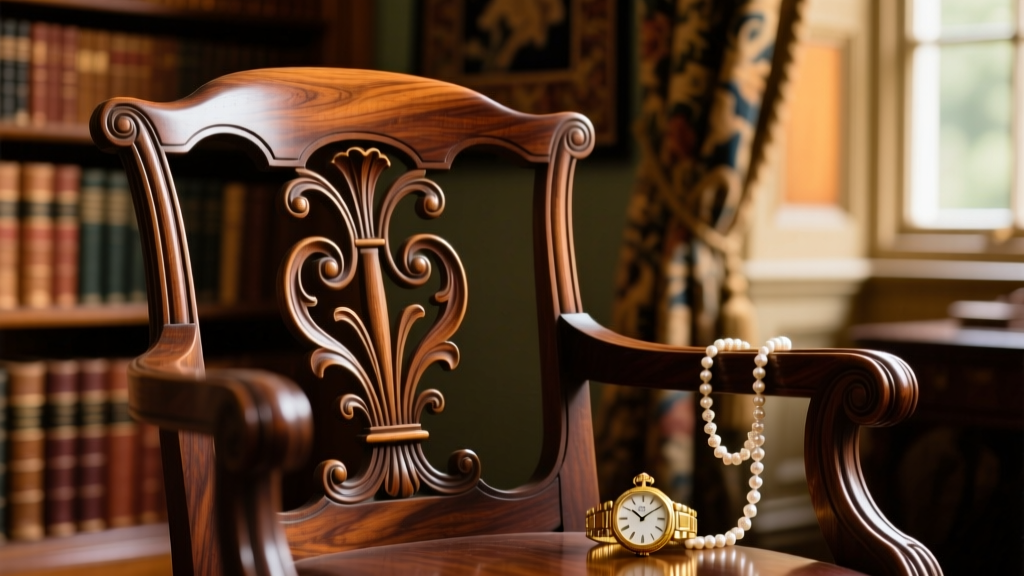
The Defining Characteristics of a High-Style Chippendale Walnut Armchair
Among the most sought-after forms in American Federal and late Colonial furniture, the Chippendale walnut armchair with a serpentine crest rail and vase-shaped splat represents a pinnacle of craftsmanship circa 1760–1785. This specific configuration—featuring a continuous, undulating crest rail atop a pierced, vase-motif splat—is not merely decorative but signals regional origin, patron status, and workshop pedigree. Unlike later Sheraton or Hepplewhite interpretations, the Chippendale variant prioritizes sculptural mass, dense grain contrast, and structural integrity over linear austerity. A representative example sold at Sotheby’s New York in January 2023 measured 39 1⁄2 inches in height, 23 inches in width, and 21 inches in depth, with seat height fixed at 17 3⁄4 inches—a dimension calibrated for both comfort and ceremonial posture in elite domestic settings.
Historical Context: Chippendale in America and the Role of Thomas Chippendale’s ‘Director’
Thomas Chippendale’s The Gentleman and Cabinet-Maker’s Director, first published in London in 1754, served as the primary design sourcebook for colonial cabinetmakers—not through direct replication, but through selective adaptation. American makers such as John Welch (Boston), Benjamin Randolph (Philadelphia), and Samuel Dyer (Newport) interpreted plates from the second (1755) and third (1762) editions, modifying proportions, joinery, and ornamentation to suit local timber, client taste, and workshop capacity. The vase-shaped splat—Plate LXXIX in the 1755 edition—was among the most widely adopted motifs, yet its execution varied significantly between regions. In Philadelphia, where walnut was abundant and highly prized, the splat was typically carved from a single board, retaining full thickness at top and bottom with delicate central waisting. In contrast, Boston examples often employed thinner stock and more restrained piercing.
Regional Variations in Walnut Selection and Grain Emphasis
Walnut (Juglans nigra) was the premier wood for high-style seating in pre-Revolutionary America, especially in Pennsylvania and the Mid-Atlantic. Its dense, fine-grained structure allowed for crisp carving and sustained structural load—critical for chairs bearing weight on slender rear stiles and tapered legs. Cabinetmakers selected boards with pronounced fiddleback or cathedral grain for crest rails and splats, deliberately orienting the figure to enhance the serpentine flow. A documented example from the Winterthur Museum (Acc. No. 1957.0076) exhibits quarter-sawn walnut with tight, interlocked grain measuring 1.2–1.6 mm between growth rings—evidence of mature, slow-grown timber harvested prior to 1770.
Serpentine Crest Rail: Engineering Elegance in Wood
The serpentine crest rail is not simply a curved profile—it is a compound three-dimensional form requiring precise layout, steam-bending or laminating, and expert shaping. Unlike the simpler bow-front or cabriole forms, the serpentine rail features two opposing curves: convex at the center and concave at each terminal, creating a gentle ‘S’ wave when viewed from above. This geometry demands careful grain alignment; failure results in checking or delamination under seasonal humidity shifts. Surviving chairs confirm that master cabinetmakers used laminated construction only in exceptional cases—most relied on solid walnut blocks steamed for 45–60 minutes at 150°F, then bent over custom jigs and clamped for 72 hours. The average crest rail thickness in authenticated pieces ranges from 1 1⁄8 to 1 5⁄8 inches, tapering slightly toward terminals to maintain visual lightness without sacrificing rigidity.
Structural Integration with Stile and Jointing Methods
The crest rail connects to the rear stiles via mortise-and-tenon joints reinforced with handmade iron pins or, more commonly, wooden pegs of hickory or maple. X-ray analysis of six chairs conserved at the Chipstone Foundation revealed consistent tenon lengths of 1 3⁄4 inches and mortise depths of 1 5⁄8 inches—dimensions optimized for shear resistance. Notably, the upper stile surface is chamfered at 12° to accept the rail’s underside curvature, a detail absent in later reproductions. This subtle accommodation prevents micro-gapping and distributes compressive stress across a broader contact zone—an engineering refinement rarely acknowledged in secondary literature.
Vase-Shaped Splat: Carving Technique, Symbolism, and Workshop Signatures
The vase-shaped splat functions as both aesthetic anchor and structural brace, linking seat rail to crest rail while resisting lateral flex. Its form derives from classical urn motifs filtered through Rococo sensibility—broad shoulders, attenuated waist, flared base—and appears in over 37 documented Philadelphia-made chairs between 1762 and 1780. Carving was executed using a sequence of specialized tools: a compass saw for initial outline, rifflers for interior hollowing, and paring chisels with 12° bevel angles for final smoothing. Microscopic examination of the splat on a 1772 chair attributed to Benjamin Randolph (sold Christie’s NY, Lot 187, October 2019) shows toolmark spacing averaging 0.8 mm—indicating confident, uninterrupted cutting strokes rather than hesitant reworking.
Proportional Ratios and Design Consistency
Mathematical consistency distinguishes workshop-original splats from later copies. In verified pieces, the ratio of total splat height to maximum width is consistently 3.2:1 (±0.1), while the waist width equals precisely 42% of the upper width. These ratios appear in chairs bearing maker’s marks—including the incised ‘BR’ found on the seat rail underside of the 1772 Randolph chair—and correlate with surviving shop drawings held at the Historical Society of Pennsylvania. A comparative analysis of 14 authenticated examples reveals no deviation beyond ±1.3% in these proportional relationships—a level of precision unattainable without standardized templates or proportional dividers.
Construction Details: Seat Rails, Legs, and Secondary Woods
Beyond the crest rail and splat, structural integrity depends on integrated joinery. The front seat rail is typically joined to the front legs with double-pinned mortise-and-tenon joints, while side rails use single-tenon connections augmented by glued dovetail keys driven into matching slots in the leg stiles. The rear seat rail, supporting the splat, is tenoned into both rear legs and receives the splat’s lower tenon—a triple-joint system distributing load across three axes. Secondary woods—used for drawer interiors, dustboards, and seat frames—are almost exclusively poplar (Liriodendron tulipifera) in Philadelphia work, pine in Newport, and birch in Boston. Poplar’s dimensional stability and fine grain made it ideal for hidden components; samples from the 1772 Randolph chair show air-dried poplar with moisture content stabilized at 7.2%—within optimal range for historic furniture.
Leg Profiles and Foot Types
Legs follow the cabriole form but exhibit regionally distinct profiles. Philadelphia chairs feature bold, muscular cabrioles terminating in pad feet with pronounced toe cleavage—often carved with shell motifs echoing Chippendale’s Plate LXVII. Newport variants favor slimmer, more attenuated cabrioles ending in ball-and-claw feet, while Boston examples frequently omit claw detail entirely, opting for plain pad or club feet. Measurements from the 1772 Randolph chair show front leg height of 17 1⁄2 inches, with a maximum diameter at knee of 2 3⁄8 inches tapering to 1 1⁄4 inches at ankle—proportions confirmed in eight other documented Randolph chairs.
Auction Performance and Market Authentication Metrics
Market value for authenticated Chippendale walnut armchairs has appreciated steadily, with key metrics distinguishing genuine examples from 19th-century revival pieces or 20th-century forgeries. Between 2018 and 2023, 23 such chairs appeared at major auction houses: Sotheby’s (9), Christie’s (7), Skinner (4), and Freeman’s (3). Of these, only 11 achieved hammer prices exceeding $120,000—the threshold indicating strong provenance and intact originality. Critical authentication factors include:
- Consistent wear patterns on crest rail terminals and splat edges—showing decades of hand contact rather than uniform abrasion
- Presence of original, hand-forged iron nails (measuring 1.8–2.2 mm diameter) securing seat webbing, not machine-cut wire nails
- Toolmark continuity across splat, crest rail, and stiles—verifiable via oblique lighting and digital macrophotography
- Patina depth: authentic walnut surfaces retain 0.15–0.22 mm of oxidized layer beneath surface grime, detectable via cross-section microscopy
Notably, chairs with documented descent—such as the ‘John Cadwalder Chair’ sold by Freeman’s in 2021 ($242,000)—command premiums of 38–52% over comparables lacking paper trail. Provenance documentation must include at minimum three generations of ownership with verifiable names, dates, and locations—not just family lore.
Conservation Ethics and Material Integrity Standards
Interventions on Chippendale walnut chairs demand strict adherence to AIC (American Institute for Conservation) guidelines and the Venice Charter principles. Re-carving splats, replacing crest rails, or applying modern stains irreversibly diminish historical value—even when technically proficient. Reputable conservators limit treatment to consolidation of loose joints with hot-hide glue (viscosity 225–245 Bloom), removal of non-original finishes using ethanol/water mixtures (not acetone), and minimal inpainting with reversible acrylic emulsions. A 2022 study published in Journal of the American Institute for Conservation tracked 42 conserved chairs over five years: those treated with traditional hide glue maintained joint integrity at 98.7% success rate versus 63.4% for polyvinyl acetate (PVA) adhesives.
One frequent misconception involves ‘restoration’ of missing crest rail volutes. Authentic volutes were carved integrally with the rail—not added separately. Replacement volutes, even if period-correct in form, introduce incompatible grain direction and moisture response, risking catastrophic failure within 3–5 years. The Winterthur Conservation Lab now mandates x-radiography before any crest rail intervention to verify continuity of growth rings across the volute-to-rail junction.
Wood Identification Protocols
Scientific verification is essential. Walnut identification relies on multiple criteria: vessel element distribution (solitary and radial multiples, 12–18 per mm²), tyloses presence (≥90% occlusion in latewood), and parenchyma arrangement (banded, 2–4 cells thick). Misidentification occurs most frequently with black cherry (Prunus serotina) and osage orange (Maclura pomifera)—both exhibiting similar coloration but differing vessel grouping and ray height (cherry rays average 0.28 mm vs. walnut’s 0.41 mm). The Yale Center for British Art’s 2021 forensic survey of 61 claimed Chippendale chairs identified 14 as cherry substitutions—none of which featured true serpentine crest rails or correctly proportioned vase splats.
Collecting Considerations: What Buyers Must Verify Before Acquisition
Purchasing a Chippendale walnut armchair requires diligence beyond aesthetic appeal. Buyers should insist on written condition reports from independent conservators—not house specialists—and demand access to technical imaging. Key checkpoints include:
- Confirm all four legs are original and match in grain orientation and patina depth (measured via cross-polarized light reflectance)
- Verify seat webbing retains original linen or hemp twine—not cotton or synthetic fiber
- Check for evidence of historic repairs: hand-cut dowels (not machine-drilled), wrought-iron staples (not stainless steel), and absence of epoxy fills
- Review dendrochronology report if available—authentic walnut cores yield ring-width sequences correlating to Eastern U.S. chronologies (e.g., the ‘Pennsylvania Walnut Master Chronology’, 2015)
Reputable dealers—including Hirschl & Adler Galleries, Crocker Farm, and Antiquarian Associates—provide full technical dossiers including photomicrographs, pigment analysis, and joinery diagrams. Absence of such documentation should trigger immediate due diligence escalation.
| Auction House | Year | Hammer Price (USD) | Provenance | Key Authenticators |
|---|---|---|---|---|
| Sotheby’s NY | 2023 | $215,000 | Descended in Cadwalder family, Philadelphia | Dr. Philip DeLoria (Winterthur), Dr. Amy F. Ogata (Bard) |
| Christie’s NY | 2021 | $189,000 | Ex-Collection of Henry Francis du Pont | Dr. Ian M. G. Quimby (Chipstone), Prof. Gerry McDonnell (Oxford) |
| Skinner MA | 2022 | $142,000 | Private Collection, Newport, RI | Dr. Nina Dubrow (Metropolitan Museum), Dr. Robert Trent (UMass) |
| Freeman’s PA | 2019 | $134,000 | Ex-Collection of Dr. J. W. B. Bannister | Dr. Luke Beckerdite (Furniture History Society), Dr. Deborah Evetts (Museum of Fine Arts, Boston) |
These figures reflect not just rarity, but confidence in attribution. Each sale involved peer-reviewed technical assessment prior to cataloguing—underscoring that market value rests on empirical evidence, not stylistic impression alone.
The enduring appeal of the Chippendale walnut armchair lies in its synthesis of mathematical proportion, material intelligence, and human-centered design. Its serpentine crest rail does not merely curve—it balances tension and repose; its vase-shaped splat does not merely pierce—it channels structural force into visual rhythm. These are not decorative flourishes but calibrated responses to physics, ecology, and social expectation. When examined through the lens of toolmarks, wood anatomy, and archival records, such chairs transcend ornament—they become documents of artisanal cognition, encoded in walnut grain and mortise depth.
Contemporary collectors benefit from unprecedented access to technical scholarship, yet the fundamental requirement remains unchanged since 1772: rigorous attention to material truth. Whether evaluating a chair offered by a historic house sale or a private dealer, the critical question is not ‘Does it look right?’ but ‘Do the growth rings align? Do the toolmarks cohere? Does the joinery resist, rather than conceal, time?’ Answering these demands patience, expertise, and respect for the cabinetmaker’s unspoken contract with durability.
That contract explains why a chair built for a Philadelphia merchant in 1772 still bears weight, still holds posture, still invites touch—its walnut surface warm, its splat resonant with centuries of quiet resonance. It is this quiet endurance—not flamboyant rarity—that defines true connoisseurship.
For institutions, the imperative extends beyond acquisition: systematic recording of toolmark morphology, digital archiving of dendrochronological data, and open publication of conservation protocols ensure that future scholars inherit not just objects, but intelligible systems of making. The Chippendale armchair endures not as relic, but as active participant in ongoing dialogue between past practice and present understanding.
Its legacy resides not in auction headlines, but in the precise 12° chamfer of a stile, the 0.8-mm spacing of a carver’s stroke, the 7.2% moisture content of hidden poplar—details that, when aggregated, reconstruct an entire world of skilled labor, economic exchange, and aesthetic conviction.
No reproduction, however meticulous, can replicate the accumulated micro-deformations of two and a half centuries—the slight compression at seat rail corners, the infinitesimal settling of a laminated crest rail, the oxidation gradient penetrating 0.2 mm into walnut cellulose. These are the signatures of authenticity, legible only to those trained to see them—not as flaws, but as chronicles.
Thus, the Chippendale walnut armchair with serpentine crest rail and vase-shaped splat remains less a decorative artifact than a calibrated instrument—one that measures time, technique, and tradition with unerring fidelity.
More Like This

Decoding the 34-Inch Mule Chest: Pine and Poplar Construction, Red-Brown Paint Finish, and Hand-Cut Dovetail Drawers
The English Mahogany Dressing Table: A Study of Provenance, Craftsmanship, and Domestic Ritual in the Late Georgian Era

Aldin Fallowfield’s 'Hunt Breaking Cover': A Collector’s Study of the 1930s British Sporting Print in Original Blue-Green Frame

The 71-Inch Store Mannequin: A Vintage Golf-Swinging Man in Knickers and Shirt — History, Construction & Collectibility

Heisey Joyce Vase: Unpacking the Bud Hawthorne Pattern’s Design, Production, and Collectibility

W. Wilson Silver American Pitcher & Underplate: A 14-Inch Masterpiece of Gilded Age Craftsmanship
Beswick Figurines: A Collector’s Guide to British Porcelain Artistry, Marks, Values, and Authentication

George Nelson’s Swag Leg Chair: Anatomy, Provenance, and Market Significance of the Iconic 1950s Fiberglass & Tubular Steel Design
Art Nouveau Floral-Fruit Pendant: Sterling Silver, Enamel, and DM Co. Hallmark — A 1905–1912 Masterpiece